Supreme Court on CJP Protest Crackdown: “Whoever Committed Excesses Should Be Taken to Task”
By: News Desk | 28 July 2026
The Supreme Court has sent a strong message on accountability amid allegations of police excesses during the recent student protests, making it clear that the right to maintain public order cannot become a licence for unlawful use of force.
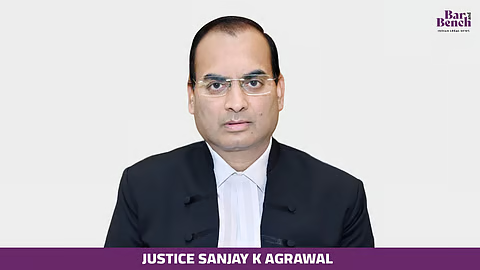
During a hearing on Tuesday, July 28, the bench headed by Chief Justice of India Surya Kant said that “whosoever committed excesses, took law in their hands should be taken to task.” The court also indicated the need for a fair, independent and transparent investigation into allegations surrounding the handling of the protests.
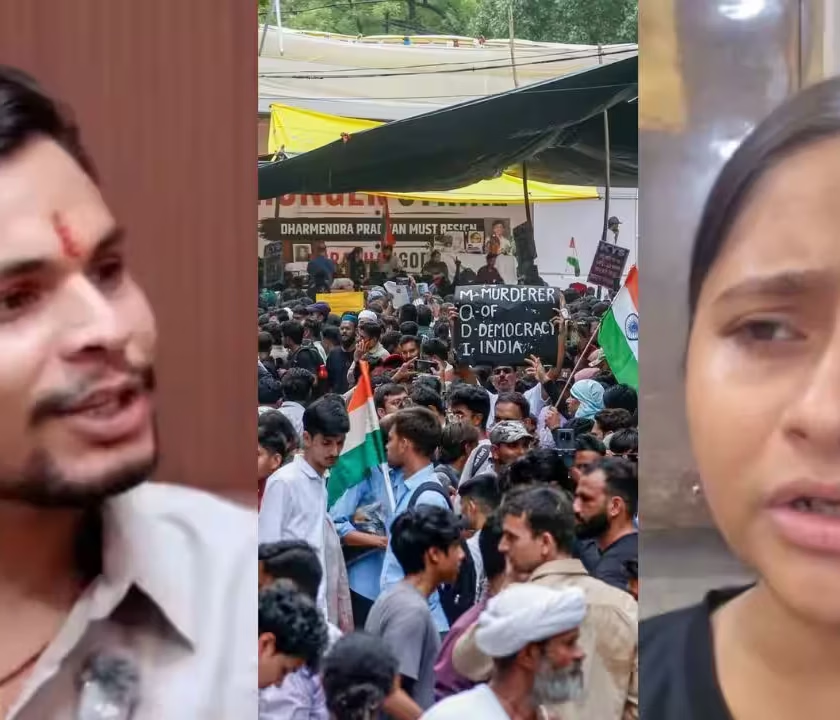
The observations came against the backdrop of clashes during a July 20 march towards Parliament organised by the Cockroach Janta Party (CJP), where protesters were demanding action over alleged examination irregularities and the NEET controversy.
The hearing has put the conduct of security personnel and protesters under simultaneous judicial scrutiny.
While lawyers appearing for the protesters raised allegations of police excesses, the court also took note of claims that around 250 police personnel were attacked during the unrest. The bench said the circumstances surrounding those incidents also needed to be investigated to determine whether the violence was committed by students or by other individuals who may have entered the protest.
The Supreme Court’s approach is therefore broader than a simple indictment of the police response.
Its message is that every alleged violation must be investigated, regardless of who committed it.
Supreme Court Seeks Independent Probe Into Protest Violence
The Supreme Court’s central concern appears to be the credibility of the investigation.
The bench questioned why there should not be an independent probe into allegations of police excesses and indicated that a Special Investigation Team could potentially be constituted to ensure a thorough examination of the events.
The court’s position reflects a basic principle of criminal justice: an investigation must establish facts before responsibility is assigned.
If security personnel used force beyond what was legally permissible, those responsible must be identified and dealt with according to law.
At the same time, if protesters or outsiders attacked police personnel, damaged property or committed other offences, those allegations must also be investigated and prosecuted where evidence supports such action.
That approach is particularly significant in politically charged protests, where competing narratives can quickly emerge.
One side may highlight police action.
Another may point to violence by protesters.
The role of an independent investigation is to move beyond competing claims and establish what actually happened.
The court’s observation that a probe would be meaningless unless responsibility is fixed underlines the importance of accountability at every level.
“Take to Task Whoever”: What the Supreme Court Message Means
The phrase used by the Chief Justice carries a wider constitutional significance.
The Supreme Court was not, based on the available reports, declaring that every allegation against the police had been proved.
Instead, the court was emphasising that any person who crosses the legal line must face the consequences.
That principle applies equally to state authorities and private citizens.
Police officers have legal powers to control unlawful assemblies and maintain public order. But those powers are not unlimited. The use of force must remain within the framework of law and established protocols.
Likewise, the right to peaceful protest does not provide immunity for violence, destruction of property or attacks on public servants.
The balance between these two principles is at the heart of the current case.
A democratic society must protect peaceful dissent while also ensuring public safety.
The Supreme Court’s latest remarks reinforce the idea that neither side can claim absolute immunity.
Protest Rights vs Public Order: Where Does the Law Draw the Line?
India’s constitutional framework recognises the right to peaceful assembly and expression, subject to reasonable restrictions prescribed by law.
That means citizens can protest against government policies, examination irregularities and other public issues.
But the right to protest is not an unrestricted right to use violence.
Similarly, the government’s responsibility to maintain public order does not automatically justify excessive force.
This distinction is particularly important during large demonstrations.
A protest can begin peacefully and later become tense because of crowd movement, police barricades, arrests, misinformation or the actions of a small group of individuals.
In such circumstances, law enforcement agencies are expected to follow established protocols and use the minimum force necessary to restore order.
The Supreme Court’s intervention appears aimed at examining whether those boundaries were respected during the July 20 events.
The court had already indicated that an agitation cannot be used to justify police excesses or indiscriminate force, while simultaneously recognising that violence against police personnel also requires investigation.
The July 20 Parliament March: What Happened?
The latest hearing relates to clashes that occurred during a July 20 march towards Parliament.
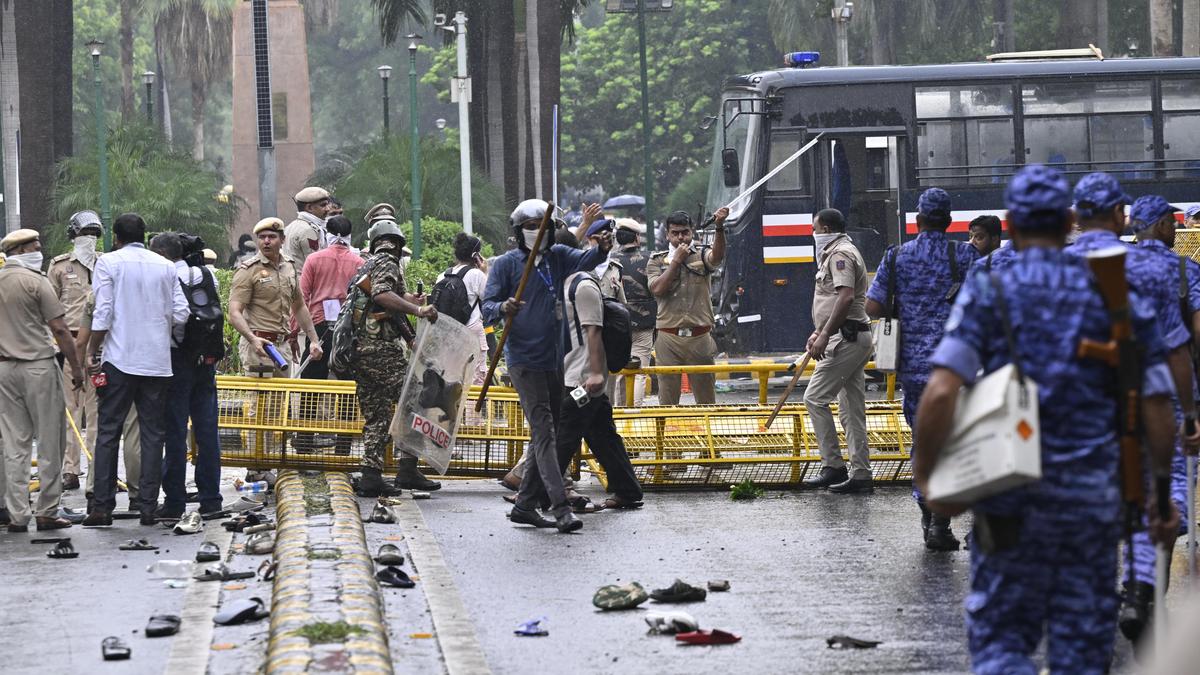
According to reports, security personnel used lathis and tear gas to disperse protesters attempting to move towards Parliament.
The protesters were demanding accountability over alleged irregularities linked to examinations and the NEET controversy and were also seeking political action against Union Education Minister Dharmendra Pradhan.
The events quickly generated competing claims.
Protesters and their supporters alleged excessive use of force by police.
Authorities, meanwhile, pointed to violence against police personnel and the presence of alleged miscreants among the demonstrators.
The Supreme Court has now signalled that these competing claims must be examined through a credible investigation rather than settled through political arguments.
The court’s decision to consider an independent probe is therefore significant because it could provide a neutral mechanism to establish the sequence of events.
Security Forces Under Judicial Scrutiny
The Supreme Court’s intervention places the conduct of law enforcement agencies under renewed scrutiny.
Security forces operate under difficult circumstances during mass protests. They must manage large crowds, protect sensitive installations and prevent violence.
But the responsibility to maintain order comes with legal obligations.
Any allegation of excessive force, unlawful detention or violation of established procedures must be examined seriously.
Accountability is essential not only for protecting citizens but also for maintaining public confidence in the police and security institutions.
If officers are found to have acted unlawfully, disciplinary or criminal proceedings may follow depending on the nature of the violation.
At the same time, an investigation that finds no wrongdoing should also be respected.
The objective of an independent probe is not to establish guilt in advance.
It is to establish facts.
That distinction will be crucial as the case develops.
The Court Also Wants Violence Against Police Investigated
One of the most important aspects of the Supreme Court’s intervention is that it has not focused exclusively on allegations against security personnel.
The bench also asked for an investigation into claims that around 250 police officers were attacked during the protests.
The court reportedly raised the question of whether those attacks were carried out by genuine student protesters or by other individuals who may have joined the demonstration.
This is a significant point.
Large protests often involve thousands of people, and responsibility for individual acts of violence cannot automatically be attributed to every participant.
Equally, allegations of police misconduct cannot be ignored simply because some protesters may have acted violently.
The legal principle is straightforward: individual responsibility must be established through evidence.
That is why the court’s call for a comprehensive investigation could help separate legitimate peaceful protesters from those accused of committing offences and, at the same time, distinguish lawful crowd-control measures from alleged excesses.
Why the Supreme Court’s Intervention Matters
The case carries implications beyond one protest.
India has witnessed several large public movements in recent years, covering issues ranging from education and employment to agriculture, citizenship and government policy.
The handling of these protests has repeatedly raised questions about the limits of state power and the responsibilities of demonstrators.
The Supreme Court’s latest observations reinforce a fundamental democratic principle: public order and civil liberties are not mutually exclusive.
The government has a duty to maintain peace.
Citizens have a right to express dissent.
Law enforcement agencies must operate within the law.
And protesters must also remain within the boundaries prescribed by law.
The challenge is ensuring that these principles work together rather than being treated as competing absolutes.
A Test for Judicial Accountability
The next stage of the case could determine how significant the Supreme Court’s intervention becomes.
If an independent investigation is established, its credibility will depend on several factors:
- Who conducts the investigation?
- How independent is the investigating team?
- Will protesters and police personnel both be examined fairly?
- Will video footage and other digital evidence be collected?
- Will individual responsibility be identified?
- Will disciplinary or criminal action follow where wrongdoing is established?
These questions will matter because a probe without consequences can weaken public confidence.
The Supreme Court’s observation that a probe is meaningless unless responsibility is fixed sends a clear signal that accountability must go beyond paperwork.
At the same time, the process must remain evidence-based.
Punishment cannot be imposed merely because of public pressure or political demands.
Political Fallout Could Grow
The court’s remarks are likely to intensify political debate over the handling of the protests.
Opposition parties may use the observations to argue that the government’s response to dissent has been excessive.
The government, on the other hand, is likely to emphasise the court’s recognition that violence against police personnel must also be investigated.
Both sides may attempt to interpret the hearing through their own political lens.
But the Supreme Court’s broader message is arguably more important than the political battle.
The court has effectively placed the focus on accountability.
If protesters committed offences, the law should act.
If police or security personnel committed excesses, the law should act.
If both sides violated the law, both sides must face the consequences.
That is the principle that gives meaning to the phrase “take to task whoever committed excesses.”
Public Trust Will Depend on What Happens Next
For ordinary citizens, the most important question is no longer what happened in the political speeches surrounding the protest.
It is whether the truth will be established.
Public trust depends on credible investigations.
If allegations of excessive force are proven and no action follows, confidence in institutions can suffer.
If allegations are found to be unsubstantiated but security personnel are nevertheless publicly blamed, the credibility of the justice process can also be damaged.
The same principle applies to protesters.
A peaceful demonstration should never be criminalised merely because it is politically inconvenient.
But peaceful protest cannot be used as a shield for violence or deliberate destruction.
The Supreme Court’s intervention therefore places a responsibility on every stakeholder to allow the investigation to proceed without political interference.
The Larger Constitutional Message
The deeper significance of the Supreme Court’s remarks lies in the principle that the rule of law applies to everyone.
The state cannot be above the law.
Citizens cannot be above the law.
Police officers cannot be above the law.
Protesters cannot be above the law.
The strength of a constitutional democracy is measured by how institutions respond when allegations of wrongdoing emerge.
The court’s call for an independent investigation sends a reminder that accountability is not selective.
The coming days will reveal whether the proposed investigation can establish the facts surrounding the July 20 clashes and whether those found responsible—regardless of their position or affiliation—are held accountable.
For now, the Supreme Court has drawn a clear line.
Peaceful protest must be protected. Violence must be investigated. Excessive force must not be ignored. And anyone who crosses the law must answer for it.
That is the real significance of the court’s message: “Whoever committed excesses should be taken to task.”