NC-BJP Clash in J&K Assembly Over Hari Singh, Sheikh Abdullah Holidays
By: News Desk | 22 September 2026
Srinagar: History returned to the floor of the Jammu and Kashmir Legislative Assembly on Tuesday, and it did not arrive quietly.
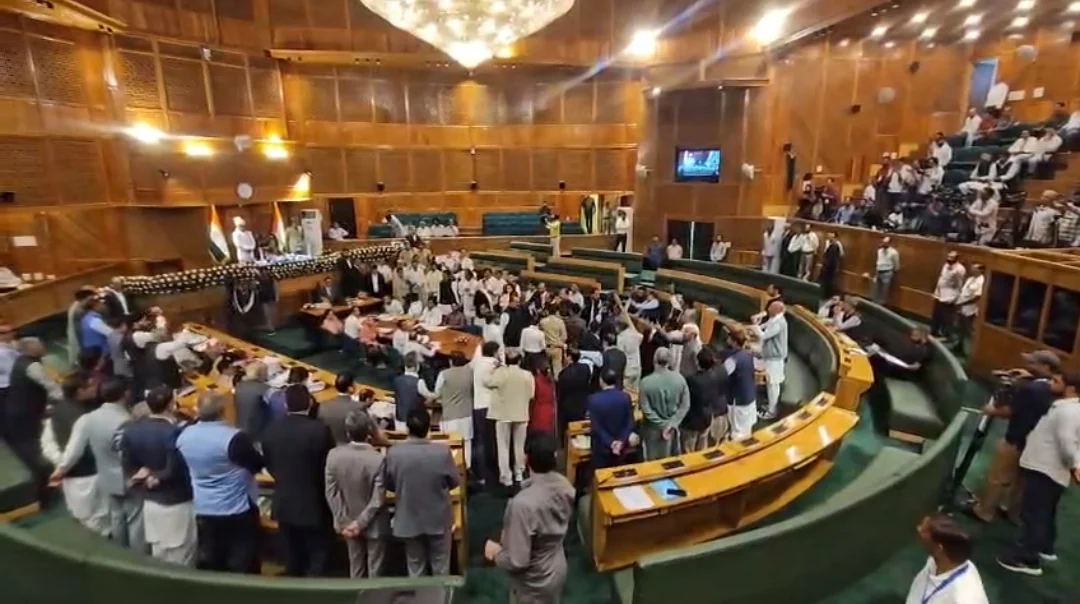
A debate over government holidays marking the anniversaries of two of the most consequential figures in Jammu and Kashmir’s modern history, Maharaja Hari Singh and Sheikh Mohammad Abdullah, triggered noisy scenes, competing slogans and eventually a walkout by BJP legislators.
The immediate dispute began when National Conference MLA Abdul Majeed Larmi demanded restoration of the public holiday associated with Sheikh Mohammad Abdullah. He went further, saying that if the holiday was not restored, the government should consider withdrawing the holiday marking Maharaja Hari Singh’s birth anniversary.
BJP legislators strongly objected.
The confrontation was not merely about a day off from government offices. It exposed a much older disagreement over historical memory in Jammu and Kashmir: which personalities should receive official recognition, which political chapters should be commemorated, and how the region’s competing narratives of monarchy, popular politics and democratic change should be represented by the state.
The fact that the dispute erupted just one day before the September 23 holiday for Maharaja Hari Singh made the confrontation even more politically charged.
The Holiday Dispute That Triggered the Uproar
The second day of the Assembly’s autumn session began with Larmi raising the issue of public holidays.
According to multiple reports, the NC legislator demanded restoration of the holiday marking Sheikh Mohammad Abdullah’s birth anniversary on December 5. He also referred to the former holiday associated with Sheikh Abdullah’s death anniversary and argued that if the government would not restore the Sheikh-related holidays, the holiday for Maharaja Hari Singh should also be reconsidered.
The BJP immediately objected.
Its legislators questioned why the holiday commemorating Hari Singh should be withdrawn and raised slogans in support of the former Maharaja. BJP MLA Devyani Rana said the holiday would not be cancelled.
The exchange quickly became a confrontation between the Treasury and opposition benches.
NC members defended Sheikh Abdullah’s historical role. BJP legislators defended the recognition given to Maharaja Hari Singh.
The Speaker, Abdul Rahim Rather, intervened repeatedly as the House descended into disorder.
Speaker Makes One Point Clear: The Assembly Cannot Simply Declare a Holiday
One important aspect of the confrontation received less attention amid the slogans.
The Speaker clarified that he did not have the authority to grant or withdraw a government holiday. Larmi had expressed a position before the House, but any actual change would have to follow the appropriate governmental procedure.
That distinction matters.
A legislator can raise a demand in the Assembly. The government can consider it. The relevant administrative authority can then amend the official holiday calendar.
But a heated exchange inside the House does not itself change the holiday list.
The 2026 official J&K holiday notification, issued by the General Administration Department, lists September 23, 2026, as the birthday of Maharaja Hari Singh. Sheikh Mohammad Abdullah’s December 5 birthday is not included among the 2026 general holidays.
So, as the dispute unfolded, the legal-administrative position was straightforward: Hari Singh’s birthday remained an official holiday for 2026.
The Assembly debate was about whether that policy should change in the future.
Why September 23 Matters
The timing of the controversy was politically significant.
The Assembly debate took place on September 22, immediately before the scheduled September 23 holiday marking Maharaja Hari Singh’s birth anniversary.
The government holiday was introduced in 2022, making Hari Singh’s birthday an official holiday after it had not previously occupied that position in the post-2019 calendar.
For supporters, the holiday represents recognition of the last Dogra ruler of Jammu and Kashmir and his historical place in the region’s political history.
For critics, the question cannot be separated from the simultaneous removal of holidays associated with Sheikh Abdullah and the July 13 events.
That is why the issue has acquired symbolic importance far beyond the calendar itself.
A holiday is a government decision, but it can also function as an official marker of historical memory.
What Happened to Sheikh Abdullah’s Holiday?
Sheikh Mohammad Abdullah’s birthday had historically been observed as a public holiday on December 5.
That changed after the reorganisation of Jammu and Kashmir.
The administration removed December 5 from the official holiday list in 2020. The same policy change also removed the July 13 holiday, traditionally observed as Martyrs’ Day in memory of those killed outside Srinagar Central Jail in 1931.
The changes were made after the August 2019 constitutional changes and reorganisation of the former state into two Union Territories.
The removal of the holidays was therefore not an isolated calendar exercise. It formed part of a broader administrative reshaping of official commemorations.
Then, in 2022, September 23 was added as a public holiday marking Maharaja Hari Singh’s birthday.
The contrasting decisions are now being revisited politically inside the elected Assembly.
Why Sheikh Abdullah Remains Central to the Debate
Sheikh Mohammad Abdullah occupies an unusually complicated place in Jammu and Kashmir’s history.
He was the founder of the National Conference and one of the most influential political leaders in the region during the transition from Dogra rule to post-1947 politics.
NC legislators in the Assembly invoked that history directly.
MLA Nazir Gurezi described Sheikh Abdullah as a people’s leader while supporting restoration of the holiday. NC chief whip Mubarak Gul also backed the party’s position.
For the National Conference, recognition of Sheikh Abdullah is closely tied to its political history and its interpretation of the region’s democratic movement.
But that interpretation is not universally shared.
The BJP’s political narrative places much greater emphasis on Maharaja Hari Singh and his historical role.
The Assembly confrontation therefore reflects two competing ways of remembering the same period.
Maharaja Hari Singh’s Legacy Is Equally Political
Maharaja Hari Singh was the last ruling Maharaja of the princely state of Jammu and Kashmir.
His reign ended with the political upheaval surrounding 1947, including the accession of Jammu and Kashmir to India.
His legacy has different meanings across the region’s political communities.
For the BJP and many supporters in the Jammu region, recognition of Hari Singh is associated with the Dogra dynasty, Jammu’s historical identity and the Maharaja’s place in the accession of the princely state.
That explains the strength of the BJP’s response when Larmi suggested reconsidering the holiday.
BJP legislators raised slogans supporting Hari Singh, and Devyani Rana publicly rejected any suggestion that his holiday should be removed.
The BJP’s response also reflects a wider political argument that changing official commemorations can affect how Jammu’s historical identity is represented.
PDP Brings July 13 Into the Debate
The dispute did not remain limited to Hari Singh and Sheikh Abdullah.
PDP MLA Waheed Para supported restoration of Sheikh Abdullah’s holiday and also raised the demand for restoration of the July 13 Martyrs’ Day holiday. Other PDP legislators joined the discussion.
July 13 has its own deeply contested historical meaning.
On July 13, 1931, 22 people were killed outside Srinagar Central Jail during protests against Dogra rule. The date subsequently became known as Martyrs’ Day and was observed officially in Jammu and Kashmir for decades.
Its removal from the official holiday calendar in 2020 transformed the date from an official commemoration into a subject of political dispute.
The PDP’s intervention therefore widened the Assembly debate.
The question was no longer simply:
Should Sheikh Abdullah’s birthday be a holiday?
It became:
Which chapters of Jammu and Kashmir’s pre-1947 and post-1947 history should receive official recognition?
The BJP Walkout
The confrontation eventually escalated beyond slogans.
BJP legislators staged a walkout from the House in protest against the remarks and what they regarded as an attempt to question the Hari Singh holiday.
The walkout underlined the depth of disagreement.
For the BJP, the issue was about protecting the official recognition given to Maharaja Hari Singh.
For the NC and PDP members supporting the demand, the issue was about what they viewed as an imbalance created by removing holidays associated with Sheikh Abdullah and the 1931 martyrs while retaining the Hari Singh holiday.
Neither side was debating the administrative importance of a holiday.
They were debating the historical symbolism attached to it.
This Is About Memory as Much as Politics
Governments around the world use official calendars to commemorate people and events.
The choice of dates can reflect political history, cultural identity and public memory.
Jammu and Kashmir is particularly sensitive on this front because its modern political history contains competing narratives that remain politically active.
The Dogra monarchy.
The 1931 uprising.
Sheikh Abdullah’s rise.
The political developments of 1947.
The accession to India.
The subsequent relationship between Jammu and Kashmir and the Union.
The constitutional changes of 2019.
Each of these events is interpreted differently by different political constituencies.
That is why changing a holiday can generate a reaction disproportionate to the administrative importance of closing government offices for one day.
The calendar becomes a symbol.
The 2020 and 2022 Changes Created the Current Fault Line
The sequence of government decisions is important.
2020: The administration removed July 13 Martyrs’ Day and December 5, Sheikh Abdullah’s birthday, from the official holiday list.
2022: September 23, Maharaja Hari Singh’s birthday, was introduced as a public holiday.
2026: The official holiday calendar continues to list September 23 as a holiday, while December 5 remains absent.
The political dispute in the Assembly is essentially about that sequence.
NC and PDP members are asking whether the earlier commemorations should return.
The BJP is defending the present recognition of Hari Singh.
The government’s position will ultimately determine whether the calendar changes again.
Congress Adds Another Layer to the Debate
The political divisions are not perfectly aligned along one simple NC-versus-BJP line.
Congress, which is allied with the National Conference at the government level but remains outside the Council of Ministers, also supported restoration of the Sheikh Abdullah holiday while favouring retention of the Hari Singh holiday, according to reports from the House.
That position illustrates the complexity of the issue.
A party can recognise the historical importance of Maharaja Hari Singh while also arguing that Sheikh Abdullah’s anniversary deserves official recognition.
The debate therefore need not necessarily be framed as one historical figure replacing another.
One possible political question is whether different commemorative dates can coexist.
That, however, is ultimately a matter for the government and its holiday policy, not for slogans on the Assembly floor.
Why the Dispute Matters Beyond the Assembly
The confrontation is significant because it shows how questions of historical memory continue to influence contemporary politics in Jammu and Kashmir.
The region is not debating its history only in universities, archives or textbooks.
Its political parties are debating it through government calendars, Assembly resolutions, public commemorations and official names.
The choice of a holiday tells citizens which people and events the government is prepared to recognise officially.
That makes the issue particularly sensitive in a region where competing political identities have been shaped by very different readings of the past.
For the Omar Abdullah government, the challenge is now twofold.
It must manage the immediate political confrontation while deciding whether it wants to revisit the holiday policy established by previous administrations.
Any change would likely have political consequences.
Keeping the current calendar also has consequences.
What the Assembly Can and Cannot Decide
The Speaker’s intervention provides an important institutional reminder.
The Assembly can debate the issue and legislators can make demands.
But the actual holiday notification is an administrative decision made through the government framework.
The 2026 holiday notification was issued by the General Administration Department, and the September 23 Hari Singh holiday is already formally listed for this year.
Therefore, Tuesday’s confrontation did not cancel or alter the September 23 holiday.
The practical question is what happens to the calendar for future years.
If the government chooses to restore December 5 or another Sheikh Abdullah-related date, it would need to amend the official holiday framework.
If it retains the present arrangement, the political disagreement is likely to continue.
The Larger Political Battle Over J&K’s Historical Narrative
The holiday dispute comes during an already turbulent Assembly session.
The BJP has been attacking the Omar Abdullah government over governance, electricity tariffs, employment and public services.
The ruling coalition and opposition parties have also clashed over restoration of statehood.
Against that backdrop, the historical debate adds another layer to the political contest.
The Assembly is simultaneously debating how Jammu and Kashmir should be governed today and how its history should be officially remembered.
Those questions are separate, but in J&K politics they frequently overlap.
For the National Conference, Sheikh Abdullah remains inseparable from the party’s political history.
For the BJP, Maharaja Hari Singh represents an important part of Jammu and Kashmir’s Dogra-era history and the political transition of 1947.
For the PDP, July 13 carries the memory of those killed during the 1931 agitation.
For Congress, the issue presents another opportunity to support restoration of a historical commemoration without necessarily challenging the existing Hari Singh holiday.
The Assembly’s noisy proceedings have therefore exposed something larger than a dispute over dates.
They have shown that official memory itself remains a contested political space in Jammu and Kashmir.
The Unresolved Question
The most immediate question is no longer whether September 23 will be a holiday.
It will.
The official 2026 calendar is clear on that point.
The unresolved question is whether the government will consider restoring the December 5 holiday for Sheikh Mohammad Abdullah, revive July 13 as an official holiday, or maintain the current calendar.
That decision will have to come through the appropriate government process.
What happened inside the Assembly on September 22 was the political opening of that debate.
And judging by the slogans, walkout and competing appeals to history, it is unlikely to be the last word.