Sonam Wangchuk Fears ‘Encounter’, Demands Amit Shah’s Resignation Over Leh Violence
By: Javid Amin | 24 September 2026
One Year After Four Deaths in Leh, Ladakh Activist Seeks Release of Judicial Inquiry Report and Warns of Growing Distrust
Leh: One year after four people were killed during violence in Leh, climate activist Sonam Wangchuk has intensified his criticism of the Centre, demanding the resignation of Union Home Minister Amit Shah, seeking publication of the judicial inquiry report into the September 24, 2025 violence and saying he fears he could be killed in an alleged “encounter”.
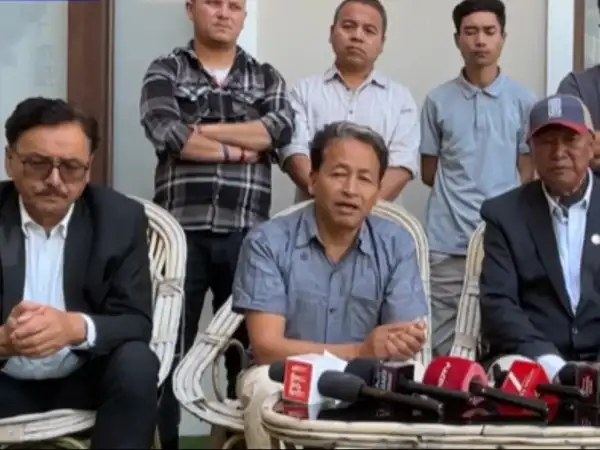
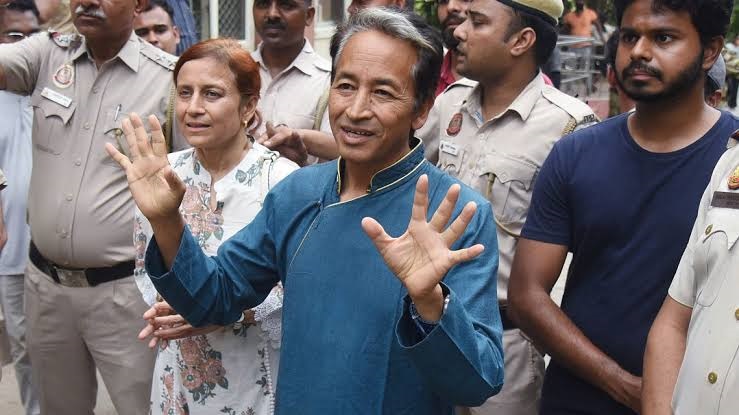
Speaking during commemorations marking the first anniversary of the violence, Wangchuk said he had received warnings about a possible threat to his life because of his criticism of the government.
He said that if such an incident occurred, it should prompt the country to pay greater attention to the situation in Ladakh.
Wangchuk also held Shah politically responsible for the deaths and called for his resignation. His remarks represent his political position and allegations; responsibility for the violence and police action remains a matter examined by the judicial inquiry constituted by the Union government.
The September 2025 violence left four people dead following police action in Leh. The Ministry of Home Affairs subsequently ordered a judicial inquiry headed by former Supreme Court judge Justice B.S. Chauhan to examine the circumstances leading to the law-and-order situation, the police action and the deaths.
The report of that inquiry has not been publicly released, becoming one of the central demands of Wangchuk and sections of the Ladakh movement.
‘They may encounter me’: Wangchuk raises alarm over his safety
At the anniversary gathering, Wangchuk said he had been warned that he could be killed in an “encounter”.
He referred to his earlier detention and said the possibility of another form of coercion or violence could not be ruled out.
The remarks came in the context of his continuing confrontation with authorities over Ladakh’s political demands.
Wangchuk has been one of the most prominent public faces of the movement seeking greater constitutional and political safeguards for the Union Territory, including statehood and protection under the Sixth Schedule of the Constitution.
His comments about an alleged threat to his life have not been established independently as a confirmed threat.
They should therefore be understood as an expression of apprehension by Wangchuk rather than evidence that an attempt on his life is imminent.
Why Wangchuk is demanding Amit Shah’s resignation
The most politically significant part of Wangchuk’s anniversary speech was his demand for the resignation of Union Home Minister Amit Shah.
He argued that political responsibility for the events of September 2025 must be fixed at the highest level and said Shah should step down.
The demand comes against the backdrop of the Centre’s central role in Ladakh’s administration and the fact that the Ministry of Home Affairs ordered the judicial inquiry into the violence.
However, the existence of the inquiry does not itself establish ministerial responsibility for the deaths.
The inquiry was specifically tasked with examining three issues:
- the circumstances leading to the serious law-and-order situation;
- the police action; and
- the resultant deaths of four individuals.
The findings would therefore be important in determining the factual sequence of events and assessing the actions of authorities during the violence.
Until those findings are made public, competing political interpretations remain.
What happened in Leh on September 24, 2025?
The violence occurred during an agitation linked to demands for greater political representation, statehood and constitutional safeguards for Ladakh.
The September 24 protest escalated into a serious law-and-order situation in Leh.
According to the official Ladakh administration record, police action followed the deterioration of the situation and resulted in the deaths of four individuals. The administration subsequently issued a public notice regarding the judicial inquiry.
The government later formally notified a judicial inquiry under Justice B.S. Chauhan, a former Supreme Court judge, describing the objective as an impartial examination of the circumstances surrounding the incident.
The inquiry began proceedings in October 2025.
In November, the commission invited members of the public to submit evidence, including oral, written and electronic material, relating to the incident.
By December 2025, the commission had recorded statements from officials including personnel from the CRPF, Ladakh Police and magistracy, according to the Ladakh administration.
That institutional record is significant because it demonstrates that the inquiry was not merely announced; proceedings were initiated and evidence collection began.
Why the inquiry report has become the central demand
For Wangchuk and supporters of the Ladakh movement, the absence of a publicly available inquiry report has become a symbol of unresolved accountability.
A year after the deaths, they are asking a straightforward question:
What exactly happened inside Leh on September 24, 2025, and who was responsible for the decisions that led to the police firing?
Wangchuk has demanded immediate publication of the report.
He has also warned that, if the judicial inquiry findings are not released, an independent “people’s tribunal” could be established to examine the police action.
That proposal would not replace the statutory judicial inquiry in legal terms. Rather, it would represent an alternative civil-society effort to establish a public account of events.
The demand for transparency has become particularly important because the official inquiry was specifically tasked with examining police action.
Wangchuk alleges use of automatic weapons
Wangchuk has also made serious allegations about the nature of the police firing.
He alleged that security personnel used automatic weapons, including AK-47 rifles, against protesters and claimed that some victims were struck in the chest, back and head.
These are allegations made by Wangchuk and have not been established by the judicial inquiry in any publicly released finding.
That distinction is important.
The fact that four people died in police action is officially documented. The precise circumstances of the firing, the weapons used, the sequence of events, the orders given and the proportionality of the response are among the issues that the inquiry was established to examine.
Until the inquiry report is released, claims about those specific details remain contested.
A year later, the official record still leaves questions open
The official inquiry’s terms of reference offer a roadmap for understanding what remains unresolved.
The commission was asked to examine not only the violence itself but also the police action that followed.
That means several factual questions remain significant:
- What triggered the escalation of the protest?
- What orders were issued to security forces?
- Was there a formal firing order, and by whom?
- What alternatives were available to authorities?
- What weapons and ammunition were used?
- How did individual deaths occur?
- Were standard crowd-control procedures followed?
- Were there failures of administration or policing before the violence?
- Who bears responsibility for any procedural violations?
The public cannot independently answer all of these questions without access to the underlying evidence and the inquiry’s findings.
That is precisely why the report’s release has become such a major political demand.
Wangchuk’s own detention remains part of the story
The anniversary also carries a personal dimension for Wangchuk.
Following the September 2025 unrest, he was detained under the National Security Act on September 26, 2025.
The Union government subsequently revoked his detention with immediate effect on March 14, 2026.
The Ministry of Home Affairs said at the time that Wangchuk had already undergone nearly half of the detention period and that the government wanted to foster an atmosphere of peace, stability and mutual trust to facilitate dialogue with stakeholders in Ladakh.
The government also said it remained committed to addressing the concerns and aspirations of the people of Ladakh through dialogue, including through the High-Powered Committee and other appropriate platforms.
That decision effectively marked a shift from Wangchuk’s detention toward renewed engagement with the broader political dispute.
But the underlying disagreements remained.
The larger Ladakh movement: statehood and constitutional safeguards
The violence cannot be separated from the political demands that preceded it.
Since Ladakh became a Union Territory in 2019, sections of the region’s political and civil-society leadership have sought stronger constitutional safeguards for land, employment, cultural identity and local decision-making.
Two of the most prominent demands have been:
Statehood for Ladakh
and
Inclusion of Ladakh under the Sixth Schedule of the Constitution.
The Sixth Schedule provides special arrangements for administration in specified tribal areas of Assam, Meghalaya, Tripura and Mizoram through autonomous district and regional councils.
For Ladakh’s campaigners, the demand is linked to concerns over the protection of land, culture, employment and local participation in governance.
The Centre, meanwhile, has continued to engage with representatives through institutional mechanisms rather than accepting the movement’s principal demands outright.
The dispute has consequently remained unresolved.
From protest movement to confrontation with the Centre
The events of September 2025 marked a major escalation.
The Ladakh movement had previously relied heavily on peaceful demonstrations, hunger strikes, marches and negotiations.
Wangchuk’s activism had drawn national attention to environmental and political concerns in the high-altitude region.
But the violence in Leh transformed the debate.
Four deaths meant that the dispute was no longer confined to questions of constitutional safeguards and political representation.
It became a question of policing, accountability and the use of force.
That is why the judicial inquiry carries importance beyond the immediate political confrontation.
Its findings could potentially provide the most authoritative public reconstruction of the events of September 24, 2025.
Ladakh marks anniversary amid shutdown and heightened security
The first anniversary was marked by a shutdown across Leh and other parts of Ladakh.
The day was observed by supporters of the movement as a remembrance for those who died.
Wangchuk and other participants also sought renewed attention to the region’s political demands and the unresolved inquiry.
At the same time, security arrangements were increased.
Wangchuk alleged that heavy security deployment and restrictions discouraged people from attending commemorative events.
Ladakh Police rejected those allegations, describing them as false and misleading. Police said security arrangements were standard crowd- and traffic-management measures and that no person had been prevented from attending the authorised prayer meeting.
The police also said organisers had initially projected a much larger gathering, which was a factor in the deployment of barricades and other arrangements. According to the police account reported by Moneycontrol, fewer than 800 people attended the event, despite the venue having a capacity of around 10,000.
This remains another area where the accounts of Wangchuk and the authorities differ.
The political responsibility question
Wangchuk’s demand that Amit Shah resign puts political accountability at the centre of the anniversary debate.
But political responsibility and legal responsibility are not identical concepts.
A political leader can be criticised for decisions, policies or the broader handling of a situation without that criticism automatically establishing personal responsibility for individual acts of violence.
Similarly, the fact that the Union Home Ministry ordered the judicial inquiry does not itself establish culpability for the police action.
The purpose of the inquiry is precisely to establish the circumstances through evidence.
That is why the publication of the findings is likely to remain central to the debate.
Why the inquiry matters beyond Ladakh
The Leh violence has implications beyond the Union Territory.
At its core are questions familiar to democratic systems everywhere:
How should authorities respond when large political protests become disorderly?
What limits should govern the use of force?
How should responsibility be established when civilians die during police action?
How transparent should an investigation into such deaths be?
And perhaps most importantly:
How can public confidence be restored when official and activist accounts of the same event differ sharply?
The judicial inquiry was created to address precisely this gap.
Its findings could establish a common factual record where competing narratives currently dominate.
The road ahead for Ladakh
The anniversary has revived the political movement rather than closing it.
Wangchuk continues to press for constitutional safeguards, greater political representation and accountability over the September 2025 violence.
The Centre has maintained that dialogue remains the route for addressing Ladakh’s concerns. In March 2026, while revoking Wangchuk’s NSA detention, the Home Ministry reiterated its commitment to safeguards for Ladakh and engagement through the High-Powered Committee and other platforms.
The two sides, however, remain divided over the pace and substance of political change.
For Wangchuk and sections of the movement, the issue is now also about justice for those who died.
For the administration, maintaining public order while continuing dialogue remains a central concern.
The unresolved judicial inquiry sits between these competing narratives.
A year later, the central question remains unanswered
September 24, 2025 left four people dead in Leh.
A judicial inquiry was subsequently constituted under a former Supreme Court judge to examine what led to the violence and how the police responded. The commission began its work, collected official evidence and called for public submissions.
One year later, Wangchuk is demanding that its findings be made public.
He has also raised fears about his own safety and called for the resignation of the Union Home Minister.
The authorities, meanwhile, have rejected allegations of intimidation surrounding the anniversary events and continue to point to dialogue as the route for resolving Ladakh’s political concerns.
The political rhetoric is unlikely to settle the dispute.
The judicial inquiry potentially can — provided its findings are released and subjected to public and legal scrutiny.
For Ladakh, that report now carries significance well beyond one anniversary.
It could determine how the September 24 violence is remembered: as a tragic breakdown of law and order, as a failure in the use of police force, or as an event whose full circumstances require a more complex accounting.
For the families of the four people who died, however, the central issue is simpler.
They are still waiting for the official account of how their loved ones were killed.