JKBOSE Textbook Authority Upheld by J&K High Court: What the Landmark Ruling Means for Schools and Students
By: Javid Amin | 24 June 2026
Court reinforces JKBOSE’s role as central academic regulator, directing affiliated schools to follow prescribed curriculum and textbooks
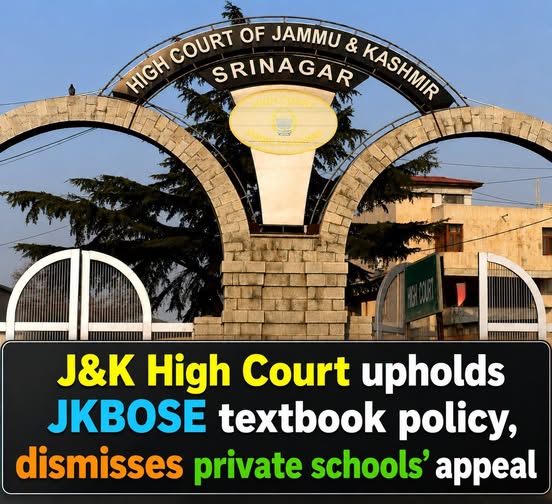
The Jammu and Kashmir High Court has upheld the authority of the Jammu and Kashmir Board of School Education (JKBOSE) to prescribe textbooks and curriculum for schools affiliated with it, strengthening the board’s position as the primary academic regulator in the Union Territory.
The ruling has significant implications for private schools, students, publishers and education policy in Jammu and Kashmir, as it reinforces the idea of a uniform academic framework across affiliated institutions.
The court observed that maintaining consistency in curriculum, teaching material and examination standards is essential to ensure equal learning opportunities for students.
Background of the legal dispute
The case emerged after several private schools challenged notifications issued by JKBOSE that required affiliated institutions to use textbooks prescribed and published by the board.
The schools questioned whether JKBOSE had the legal authority to make the use of its prescribed textbooks mandatory.
The dispute centred around a larger question:
Should affiliated schools have freedom to select their own textbooks, or should a central education authority maintain uniformity across all institutions?
Single Judge ruling: JKBOSE has legal authority
Earlier, on September 8, 2023, a single judge of the Jammu and Kashmir High Court ruled that JKBOSE was legally empowered to prescribe curriculum and textbooks for schools under its affiliation.
The court recognised that the board’s responsibilities extend beyond conducting examinations and include maintaining academic standards.
The judgment emphasised that curriculum regulation helps ensure:
- Uniform learning outcomes
- Standardised examination preparation
- Quality control in education
- Consistency among affiliated schools
High Court appeal decision reinforces JKBOSE powers
The division bench of the High Court upheld the earlier decision, rejecting the challenge against JKBOSE notifications.
The ruling confirms that schools affiliated with JKBOSE must follow the board’s prescribed academic framework, including approved textbooks.
The decision effectively limits the ability of schools to independently adopt alternative textbooks as primary learning material when JKBOSE has issued specific academic guidelines.
Why textbook uniformity matters in education
Education experts often argue that a common curriculum creates a level playing field for students.
A standardised textbook system helps in:
Equal exam preparation
Students across different schools study from the same approved material, reducing differences in learning resources.
Better academic monitoring
Education authorities can assess teaching quality and curriculum implementation more effectively.
Consistent learning standards
A common framework ensures that students are exposed to similar concepts, topics and academic expectations.
For a region with schools operating in diverse geographical and social conditions, maintaining academic consistency remains a major policy challenge.
Impact on private schools
The ruling places greater responsibility on private schools affiliated with JKBOSE.
Schools will now have to ensure compliance with:
- JKBOSE syllabus
- Prescribed textbooks
- Board academic guidelines
Private institutions may still provide additional learning resources or supplementary material, but the primary academic framework must remain aligned with JKBOSE requirements.
Some schools and education stakeholders may view the decision as reducing academic flexibility, especially for institutions that prefer different teaching resources.
Impact on private publishers and textbook market
The judgment may affect private publishers who supply textbooks to schools.
With JKBOSE-approved books becoming mandatory for affiliated institutions, demand for alternative textbook providers could reduce.
However, supporters of the decision argue that education should prioritise academic consistency over commercial competition.
The ruling places greater emphasis on regulatory control and quality assurance within the school education system.
Challenges ahead: Implementation remains key
While the court has clarified the legal position, effective implementation will remain important.
Major challenges include:
Timely availability of textbooks
Students must receive prescribed books before academic sessions begin.
Distribution system
JKBOSE will need efficient mechanisms to ensure books reach schools across urban and remote areas.
Quality and updates
Textbooks must regularly reflect changing educational requirements and modern teaching approaches.
A standardised system can only succeed when learning material is accessible, updated and effectively delivered.
Education governance and accountability in J&K
The ruling highlights a broader issue in education policy — balancing institutional freedom with the need for uniform standards.
While schools often seek flexibility in teaching methods, regulators argue that minimum academic standards are necessary to protect students’ interests.
The High Court’s decision places JKBOSE at the centre of this balance by recognising its responsibility as an academic authority.
What the judgment means for students
For students, the immediate impact is greater uniformity in academic content.
They are likely to benefit from:
- Similar syllabus coverage across schools
- Standardised preparation for board examinations
- Reduced variation in learning material
However, education experts say the quality of textbooks, teacher training and classroom delivery will ultimately determine the success of the policy.
The road ahead for JKBOSE
The judgment strengthens JKBOSE’s role in shaping school education in Jammu and Kashmir.
The board’s next challenge will be ensuring that regulatory authority translates into better educational outcomes.
A strong education system requires more than common textbooks — it needs trained teachers, updated curriculum, digital support and effective implementation.
The High Court ruling provides the framework. The real test will be how effectively that framework improves learning experiences for students across Jammu and Kashmir.