Sunil Sharma Says J&K Government Will Collapse on Its Own, BJP Won’t Topple It
By: Javid Amin | 12 June 2026
LoP Says Omar Abdullah Government Is Losing Direction, But BJP Will Not Engineer Any Fall — A Political Message Ahead of Bigger Battles
A Political Prediction or a Strategic Message?
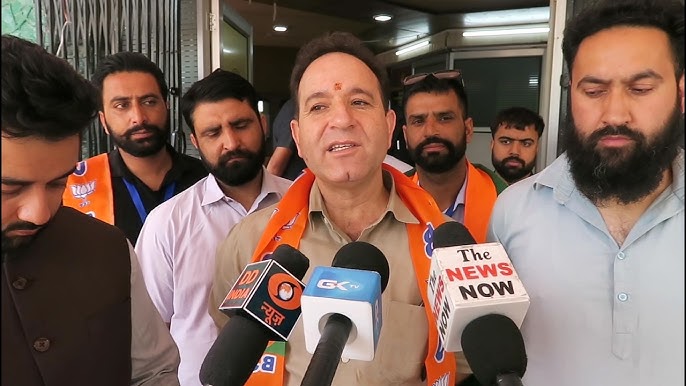
Leader of Opposition Sunil Sharma has delivered a sharp political assessment of the Jammu and Kashmir government, claiming that the current administration will “collapse on its own.”
However, in the same breath, Sharma made one point clear:
The BJP will not attempt to bring down the government.
The statement carries two messages.
One is an aggressive attack on the ruling National Conference-led government, accusing it of internal weakness and poor governance.
The other is a strategic distancing by the BJP from any perception that it is trying to destabilize an elected government.
Sharma’s argument is that the government does not need external pressure because, according to him, its own contradictions and failures will create instability.
What Did Sunil Sharma Claim?
Sharma has accused the ruling dispensation of lacking direction and failing to address issues that directly affect citizens.
His criticism focuses on three broad areas:
Governance Delivery
The LoP alleged that the government is more focused on political appearances and internal consolidation rather than solving public problems.
Public Issues
He highlighted concerns including:
- Unemployment.
- Infrastructure gaps.
- Flood preparedness.
- Administrative efficiency.
Political Stability
He suggested that internal dissatisfaction and governance shortcomings could weaken the government’s foundation.
According to Sharma, the BJP believes the government’s problems are internal rather than something requiring opposition intervention.
Why BJP Is Saying “We Won’t Topple the Government”
In Indian politics, accusations of government destabilization are common whenever an opposition party predicts a collapse.
By stating that BJP will not play any role in bringing down the government, Sharma is attempting to avoid a familiar political charge:
That the opposition is trying to create instability.
The message appears carefully calibrated.
BJP’s Position
“We are not creating the crisis; the government is creating it itself.”
This allows the BJP to position itself as a waiting alternative rather than an active destabilizing force.
If the government faces future challenges, BJP can argue that those difficulties emerged from governance issues rather than political manoeuvring.
The Political Target: Omar Abdullah’s Leadership
Sharma’s remarks directly target Chief Minister Omar Abdullah’s leadership style.
The opposition has increasingly built a narrative around three allegations:
1. Optics Over Outcomes
BJP leaders have repeatedly accused the government of focusing on political symbolism rather than measurable governance achievements.
2. Internal Party Management
The NC’s internal meetings, including the recent Dachigam retreat, have become part of opposition criticism.
BJP leaders have described such exercises as efforts to manage party unity rather than public administration.
3. Governance Expectations
After returning to power, the National Conference faces pressure to demonstrate visible results on issues affecting everyday life.
Opposition parties are attempting to turn public expectations into political criticism.
Is the Government Actually Facing Collapse?
At present, a prediction of collapse does not automatically indicate an immediate political crisis.
Governments can face criticism, internal debates, and public dissatisfaction without being close to losing power.
The stability of any elected government depends on several factors:
- Legislative numbers.
- Internal party unity.
- Coalition arrangements.
- Leadership control.
- Public support.
Political disagreements within a party are not unusual.
The key question is whether those disagreements remain manageable or become a larger challenge.
The Context: A Politically Active J&K
Sharma’s statement comes during a period of heightened political activity in Jammu and Kashmir.
Recent developments include:
- National Conference’s push for statehood restoration.
- PDP’s outreach for collective political action.
- Debates around Article 370.
- Opposition attacks on governance.
- Internal discussions within ruling parties.
The political environment is becoming increasingly competitive.
Every statement is now part of a larger narrative battle.
BJP’s Broader Strategy: Build an Alternative Narrative
The BJP has been working to position itself as an alternative political force in Jammu and Kashmir.
Its strategy focuses on presenting itself as:
- Development-oriented.
- Governance-focused.
- Less dependent on traditional political structures.
Sharma’s remarks fit into this broader approach.
By saying the government will fail due to its own shortcomings, BJP is attempting to create a perception that change is inevitable.
The NC Challenge: Delivery Beyond Politics
For the National Conference government, the response challenge is clear.
Political narratives can be countered most effectively through visible governance outcomes.
The government will likely face continued scrutiny over:
- Employment generation.
- Infrastructure projects.
- Administrative reforms.
- Public services.
- Development delivery.
The opposition argument becomes stronger if citizens feel daily problems remain unresolved.
Public Perception Will Decide the Political Battle
Ultimately, the biggest factor is not opposition rhetoric alone.
It is public experience.
If citizens see:
- Better services.
- Faster decisions.
- Employment opportunities.
- Improved infrastructure.
The government strengthens its position.
If dissatisfaction grows, opposition narratives gain space.
In politics, predictions of collapse often matter less than whether people begin believing them.
Conclusion
Sunil Sharma’s statement that the Jammu and Kashmir government will “collapse on its own” is both an attack on Omar Abdullah’s administration and a carefully positioned BJP strategy.
By refusing to claim any role in bringing down the government, BJP is attempting to portray itself as a patient alternative waiting for political circumstances to change.
The National Conference, meanwhile, faces the challenge of proving that its government is defined by governance outcomes rather than political management.
The coming months will reveal whether Sharma’s prediction becomes a political forecast or remains an opposition attack line.
For now, the battle is not only about numbers in the Assembly.
It is about controlling the public narrative.