Jammu & Kashmir Reacts to Khamenei Assassination: CM Omar Abdullah Appeals for Calm, Schools Closed, Leaders Condemn Strike
By: Javid Amin | 01 March 2026
A Region Holding Its Breath
Jammu & Kashmir and Ladakh remain tense but controlled after reports emerged alleging the assassination of Iran’s Supreme Leader, Ayatollah Ali Khamenei, in a US–Israel strike.
While the emotional response — especially among Shia communities — has been intense, political leadership across party lines has struck a remarkably unified and restrained tone.
The administration has moved swiftly with preventive measures, closing educational institutions and tightening security in sensitive districts.
Chief Minister Omar Abdullah’s Appeal: “Let People Grieve Peacefully”
Chief Minister Omar Abdullah addressed the situation directly, urging calm and responsibility.
His message was clear:
-
Those mourning must be allowed to grieve peacefully.
-
There should be no confrontation.
-
Public order must be maintained.
The Chief Minister emphasized that grief should not turn into unrest. His appeal reflects awareness of the emotional intensity in Shia-majority pockets such as Budgam and Kargil, where religious solidarity with Iran runs deep.
Officials close to the administration indicate that intelligence assessments suggested heightened sentiment but no organized violent mobilization at this stage.
A Rare Political Consensus in J&K
In a significant development, leaders across Jammu & Kashmir’s divided political spectrum issued statements describing the alleged killing as “tragic.”
Among those who reacted:
-
Farooq Abdullah
-
Ghulam Nabi Azad
-
Mehbooba Mufti
-
Altaf Bukhari
-
Sajad Lone
-
M.Y. Tarigami
Despite ideological differences, their messaging converged on three points:
-
The incident is tragic.
-
Escalation must be avoided.
-
Peace and restraint are essential.
This unified tone reflects both political prudence and recognition of the emotional resonance the news carries among segments of the population.
Security & Administrative Measures: Swift and Preventive
Districts Under Tight Vigil
Authorities tightened restrictions in:
-
Srinagar
-
Budgam
-
Anantnag
-
Pulwama
-
Parts of Ladakh
In Srinagar, security presence around Lal Chowk was visibly increased, with police and paramilitary forces deployed to prevent large gatherings.
Schools Closed, Exams Postponed
In a precautionary move:
-
Schools and colleges were shut for two days.
-
Scheduled examinations were postponed.
Officials described the closures as preventive rather than reactive — aimed at ensuring student safety and minimizing crowd formation.
Education authorities stated that fresh exam dates will be announced after reviewing the security situation.
Kargil: Seven Days of Mourning
If Srinagar was cautious, Kargil was visibly emotional.
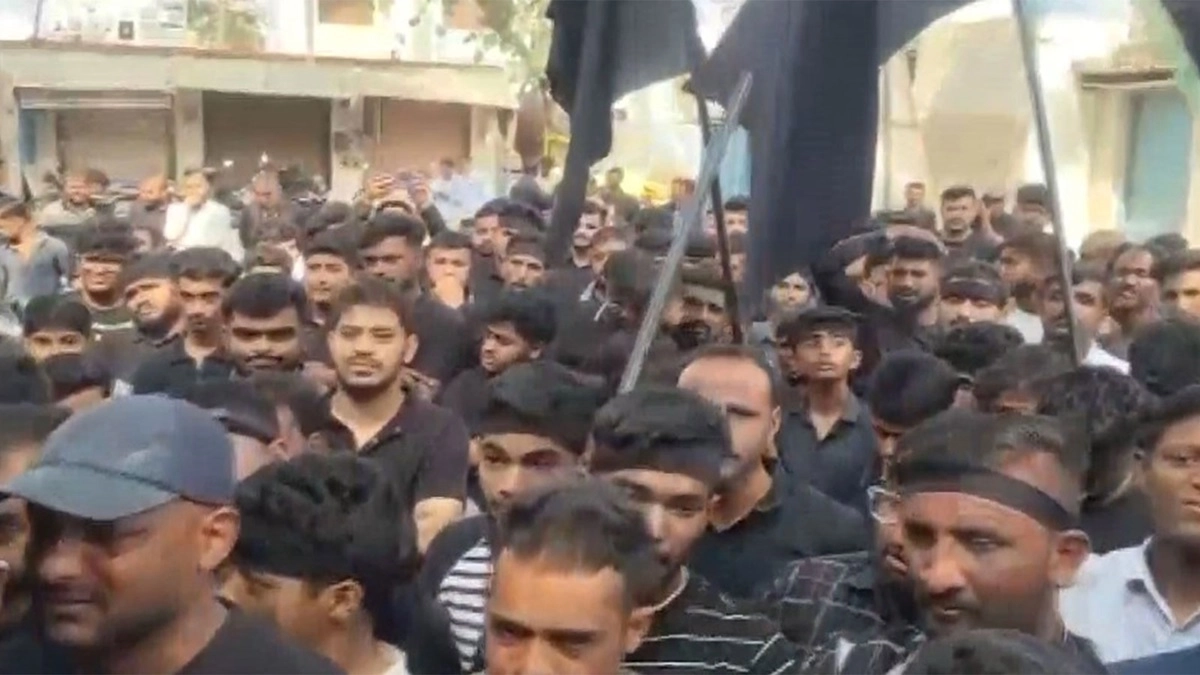
Kargil district in Ladakh, home to a significant Shia population, announced seven days of mourning. Local religious bodies organized:
-
Processions
-
Condolence gatherings
-
Prayer assemblies
Black flags were reported across several neighborhoods, and shops in certain areas remained partially closed in solidarity.
Community leaders emphasized peaceful mourning but warned against provocation.
Emotional Intensity in Shia-Majority Areas
The intensity in Kargil is not unexpected. The district maintains strong religious and cultural ties with Iranian seminaries and clerical institutions.
For many Shia communities, the Supreme Leader of Iran represents not merely political authority but spiritual guidance.
This explains:
-
The depth of grief
-
The scale of mourning declarations
-
The unified reaction from local clerics
Yet, unlike violent protests seen elsewhere in the region, Kargil’s gatherings have remained organized and largely peaceful.
Ladakh Administration’s Calculated Approach
In Ladakh, authorities opted for:
-
Enhanced monitoring
-
Dialogue with community leaders
-
Restrained policing
Rather than imposing sweeping curfews, officials relied on local coordination and appeals for calm.
This softer administrative approach appears aimed at preventing alienation while maintaining order.
Wider Regional Context: Pakistan and Iran
Pakistan: Violence in Karachi
In neighboring Pakistan, protests reportedly turned violent in Karachi, where demonstrators attempted to storm the US Consulate. Casualties were reported amid clashes with security forces.
Prime Minister Shehbaz Sharif condemned the alleged strike, calling it a violation of international norms.
Iran: Forty Days of Mourning
Iran declared 40 days of national mourning. Reports indicate Revolutionary Guard units remain on high alert, with rhetoric signaling potential retaliation.
The global dimension adds to the sensitivity in border regions like J&K and Ladakh, where public sentiment often aligns emotionally with broader Muslim-world developments.
The Ground Situation: Tense but Contained
Security officials describe the current situation as:
-
Emotionally charged
-
Politically sensitive
-
Administratively controlled
There have been:
-
No confirmed large-scale clashes
-
No major casualties reported in J&K
-
No widespread curfew imposition
Preventive deployment and coordinated political messaging appear to have reduced immediate escalation risks.
Why This Matters for J&K
Jammu & Kashmir has historically responded strongly to geopolitical developments involving Muslim-majority nations. Events in Palestine, Iraq, Afghanistan, and Iran have previously triggered protests.
However, the post-2019 security architecture in the region emphasizes:
-
Rapid intelligence-based deployment
-
Controlled protest management
-
Political messaging centered on restraint
The current handling reflects that evolved approach.
Political Sensitivity Ahead
The coming days will be crucial.
Authorities are monitoring:
-
Friday prayers
-
Large religious gatherings
-
Social media mobilization
Any miscalculation could inflame tensions, especially if developments in Iran escalate further.
Comparative Insight: India vs Pakistan
| Factor | India (J&K & Ladakh) | Pakistan (Karachi) |
|---|---|---|
| Government Approach | Preventive restrictions | Confrontational clashes |
| School Closures | Yes (2 days) | Not widespread |
| Casualties | None reported | Reported deaths |
| Political Messaging | Unified call for calm | Strong condemnation |
India’s strategy has focused on containment without confrontation — a contrast to the violence reported across the border.
The Bigger Picture
For Jammu & Kashmir and Ladakh, the episode is not merely about foreign policy.
It is about:
-
Religious identity
-
Emotional solidarity
-
Political stability
-
Administrative credibility
The unified response from leaders like Omar Abdullah and Farooq Abdullah signals recognition of the fragile balance between sentiment and stability.
What Happens Next?
Three scenarios are being closely watched:
-
Stabilization: Mourning concludes peacefully, institutions reopen, no escalation.
-
Localized Protests: Limited demonstrations during prayer gatherings.
-
Regional Escalation: If Iran retaliates significantly, emotional intensity could spike.
For now, the situation remains under watch.
Conclusion: Calm Before Clarity
Jammu & Kashmir and Ladakh stand at a delicate moment.
Grief is real. Emotions are strong. Political reactions are unified. Security is tight.
Yet the region has not tipped into chaos.
Chief Minister Omar Abdullah’s appeal — to allow people to grieve peacefully — may prove to be the defining tone of this moment.
Whether that balance holds depends on both local restraint and global developments in the days ahead.