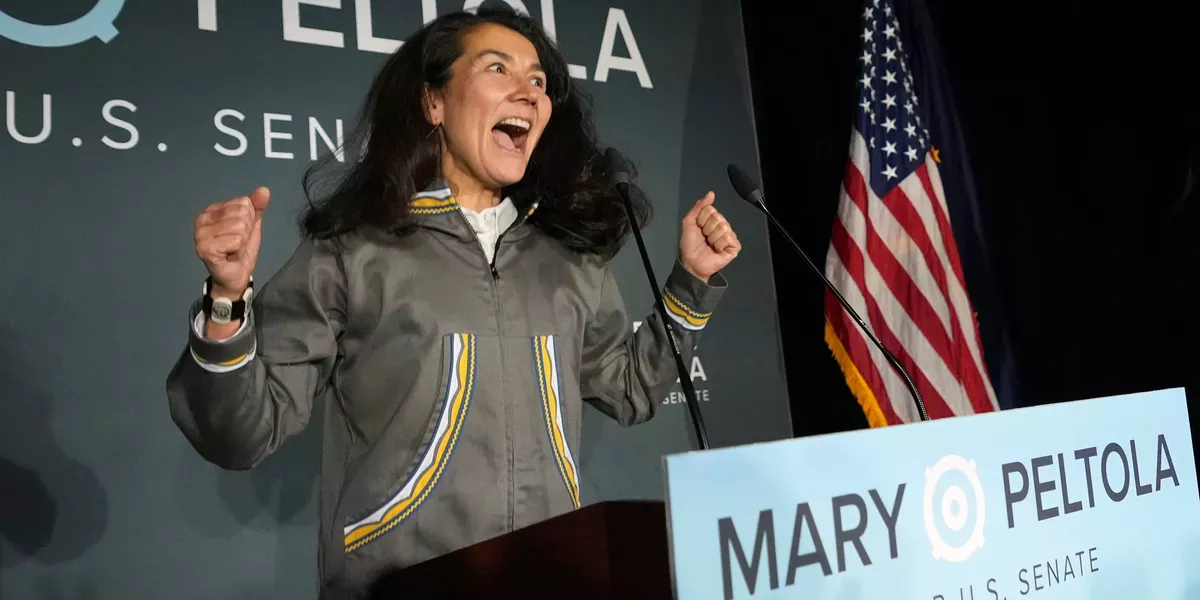
Mary Peltola’s victory in Alaska completes a remarkable Democratic comeback, giving the party its biggest Senate midterm gain since 1958. With control of both chambers of Congress, Democrats are preparing to challenge Donald Trump’s domestic and foreign policies, investigate his administration and push an affordability-focused legislative agenda. But a 56-seat Senate majority does not give them unlimited power.
By: Javid Amin | 18 November 2026
The American political landscape has changed dramatically following the November 3 midterm elections. What initially appeared to be a competitive contest for control of Congress has developed into one of the most significant Democratic victories in modern US political history.
The final Senate result came from Alaska, where former Democratic congresswoman Mary Peltola defeated Republican incumbent Dan Sullivan, delivering the party its ninth Republican-held Senate seat.
The victory completed a remarkable electoral sweep. Democrats will enter the new Congress in January 2027 with a 56-44 Senate majority, while also regaining control of the House of Representatives, ending unified Republican control of Congress during President Donald Trump’s second term.
The outcome is particularly damaging for Republicans because the midterms were supposed to be an opportunity to consolidate their legislative position. Instead, voters have handed Democrats control of the two institutions responsible for passing federal legislation, approving major appointments and holding the executive branch accountable.
But the significance of the result goes beyond the numbers. It raises a larger question about the direction of American politics: have voters rejected Trump’s governing approach, or are they primarily expressing frustration over the economy, the cost of living and the consequences of his foreign policy decisions?
The answer is likely a combination of all three.
Mary Peltola’s Alaska victory completes the Democratic sweep
The final piece of the Senate election fell into place on November 17, when the Associated Press called the Alaska race for Democrat Mary Peltola.
Peltola defeated two-term Republican Senator Dan Sullivan, becoming the first Democrat elected to the US Senate from Alaska since Mark Begich in 2008. She will also become the first Alaska Native to serve in the Senate.
According to Alaska Public Media, Peltola secured approximately 50.1 per cent of the first-choice vote, enough to win without requiring a second round of Alaska’s ranked-choice voting system.
The result was particularly significant because Alaska has traditionally leaned Republican in presidential elections. Donald Trump carried the state comfortably in 2024, and Sullivan had been seeking another term with the backing of the Republican establishment.
Peltola, however, campaigned on issues with direct relevance to Alaskan voters, including the rising cost of living, healthcare expenses, fishing rights and protection of local communities.
Her campaign slogan, “Fish, Family, Freedom”, reflected an effort to present herself as an Alaska-focused candidate rather than simply a representative of the national Democratic Party.
The contest also became controversial because of a second candidate named Dan Sullivan, a retired teacher who appeared on the ballot as Daniel J. Sullivan Jr. Reports alleged that Democratic operatives had helped recruit the candidate to divide Republican votes. Peltola’s campaign denied involvement, and a federal lawsuit seeking to delay certification was dismissed.
The controversy deserves attention, but it does not change the central electoral fact: Peltola received enough first-choice votes to cross the 50 per cent threshold, and the Associated Press declared her the winner.
Her victory gave Democrats their ninth Republican-held Senate pickup of the election.
A historic result not seen since 1958
The scale of the Democratic victory becomes clearer when compared with the 1958 midterm elections.
During the presidency of Republican Dwight D. Eisenhower, Democrats gained 15 Senate seats, marking one of the largest midterm swings in American political history.
The 2026 result is the strongest Democratic midterm Senate gain since that election.
There is, however, an important historical distinction. The 1958 figure of 15 included 13 Republican-held seats and two seats created when Alaska became a state. The current nine-seat figure refers to Republican-held seats flipped by Democrats.
The comparison remains extraordinary.
Before the 2026 elections, Republicans held a 53-47 Senate advantage. Democrats have now reversed that balance and will enter the 120th Congress with 56 seats against 44 Republicans.
The party’s new majority will be its largest Senate advantage in 16 years.
The Associated Press also reported that Democrats gained 42 House seats as of November 18, strengthening their control of the lower chamber.
This is not simply a change in party leadership. It represents a substantial shift in the balance of power in Washington.
Why Republicans suffered such a heavy defeat
Midterm elections traditionally present difficulties for the party occupying the White House. Voters often use them to express dissatisfaction with the president, particularly when economic conditions, public services or national security become contentious.
But the 2026 outcome appears to reflect more than the usual midterm backlash.
The cost-of-living issue
Economic pressure was a major theme of the Democratic campaign.
Healthcare, housing, food, fuel and everyday expenses have become politically sensitive issues across the United States. Democrats argued that the administration’s economic policies were not delivering sufficient relief to ordinary households.
Peltola’s campaign in Alaska demonstrated how effectively affordability could be used in a state where remote communities often face exceptionally high grocery and fuel costs.
The Democratic message was not confined to Alaska. Candidates in several traditionally Republican states also focused on household expenses and the affordability of healthcare.
The Iran war and rising energy costs
The eight-month US-Iran conflict also became a political liability for the Trump administration.
The Associated Press reported that Trump acknowledged the war and the resulting increase in gasoline prices had hurt Republican candidates. Vice President JD Vance also blamed the conflict for contributing to the party’s electoral losses.
This is particularly important because foreign policy is often judged by voters through its domestic consequences.
Military operations may be justified by national security arguments, but prolonged conflict, higher energy prices and uncertainty over international trade can create economic pressure at home.
The Iran conflict therefore became part of a wider debate about the costs of Trump’s foreign policy.
Concerns about democratic institutions
Democrats also campaigned on protecting democratic institutions, congressional oversight and the constitutional balance of power.
Their argument was that Congress must act as an independent check on the presidency rather than simply approve decisions made by the White House.
This message resonated with voters concerned about executive authority, political accountability and the independence of federal institutions.
It would be simplistic to attribute the entire result to one issue. The outcome reflects a combination of economic dissatisfaction, opposition to the administration’s policies, candidate-specific campaigns and the traditional tendency of voters to punish the president’s party in midterms.
Democrats regain control of the House as well
The Senate result is only half the story.
Democrats have also reclaimed the House of Representatives, gaining approximately 42 seats and ending Republican control of the chamber.
This gives the party control over both houses of Congress for the first time during Trump’s second term.
The House majority carries particular importance because it controls the chamber’s legislative agenda, committee leadership and investigative priorities.
Hakeem Jeffries is positioned to become Speaker of the House when the new Congress convenes in January. If elected, he would become the first Black politician to hold the position.
The Democratic leadership has already indicated that its priorities will include healthcare affordability, the cost of living, tariffs, federal spending and oversight of the Trump administration.
The party also plans to examine the administration’s implementation of major domestic policies, including legislation that affected Medicaid and other federal programmes.
This could lead to an increasingly confrontational relationship between Congress and the White House.
What changes should Americans expect from January 2027?
The Democratic victory will have consequences across several areas of American government.
However, it is important to distinguish between what Democrats can do with congressional control and what requires presidential approval or broader bipartisan support.
1. Greater scrutiny of Trump’s administration
One of the earliest changes is likely to be a sharp increase in congressional investigations.
Democrats will control House committees with authority to hold hearings, demand documents and summon government officials for testimony.
Possible areas of scrutiny include:
-
The administration’s handling of the Iran war.
-
Military spending and the cost of overseas operations.
-
Federal immigration enforcement.
-
Tariff decisions and their economic consequences.
-
Government contracts and the use of federal funds.
-
Allegations of conflicts of interest or misconduct.
-
The implementation of major domestic legislation.
Congressional investigations do not automatically establish wrongdoing. Their importance lies in the ability to obtain information, question officials and make government decisions subject to public examination.
The Senate will also gain control over its committees and confirmation process, giving Democrats greater influence over federal appointments.
2. Healthcare and Medicaid could become major battlegrounds
Healthcare is likely to be among the biggest legislative priorities.
Democrats have indicated that they want to restore expanded Affordable Care Act premium subsidies and reverse substantial Medicaid reductions included in Trump’s major domestic policy legislation.
They are also likely to push for lower prescription drug costs and stronger protections for people who depend on federal health programmes.
The challenge will be getting legislation through both chambers and securing Trump’s signature.
Even with control of Congress, Democrats cannot simply reverse every Republican policy. They will need sufficient votes, and any legislation opposed by the president could face a veto.
3. Tariffs and trade policy will face stronger scrutiny
Trump’s tariff policies are another likely target.
Democrats have criticised the economic consequences of tariffs, arguing that import duties can increase costs for businesses and consumers.
A Democratic-controlled Congress could hold hearings, demand greater transparency over the economic impact of tariffs and attempt to limit the administration’s authority through legislation.
However, the president retains significant statutory powers over trade policy. Congressional intervention would therefore require carefully drafted legislation and potentially bipartisan support.
4. Immigration policy will become more contentious
Immigration is likely to remain one of the most divisive issues in Washington.
Republicans have supported stricter border controls, increased deportations and stronger enforcement powers. Democrats have generally argued for a combination of border security, legal immigration pathways and protections for certain migrant groups.
With control of Congress, Democrats could challenge funding decisions, scrutinise detention practices and seek changes to immigration enforcement.
But they will face resistance from the White House and Republicans, particularly over border security and deportation policy.
5. Climate, energy and environmental regulation
Democrats are expected to press for stronger investment in renewable energy, climate resilience and environmental protection.
Their party platform supports cleaner energy production, reduced pollution and federal investment in climate-related infrastructure.
Republicans, by contrast, have generally favoured expanding domestic oil and gas production, reducing regulatory restrictions and prioritising energy independence through conventional and emerging energy sources.
A Democratic Congress could attempt to restore or expand clean-energy incentives, although the final outcome will depend on budget negotiations and presidential approval.
6. Federal appointments and judicial nominations
The Senate has a particularly important constitutional role in confirming federal judges, ambassadors and senior executive officials.
With 56 seats, Democrats will control the Senate’s confirmation agenda and can slow or reject nominees.
This could have long-term consequences for the federal judiciary and government agencies.
However, judicial appointments require presidential nominations. Trump will continue to nominate candidates, and the Senate will decide whether to confirm them.
The Democratic majority will therefore have considerable influence, but it cannot independently choose the president’s nominees.
7. Foreign policy will face tougher congressional oversight
The change in congressional control could also affect US foreign policy.
Democrats are likely to demand greater scrutiny of the Iran conflict, military spending, relations with Israel, support for Ukraine and the administration’s wider approach to China.
Congress has important powers over defence appropriations, arms sales and certain foreign policy decisions.
But the president remains commander-in-chief and retains substantial authority over military operations and diplomatic negotiations.
Democrats can increase political and financial pressure on the administration, but they cannot automatically dictate every foreign policy decision.
Why a 56-seat Senate majority does not mean Democrats can pass everything
The election has given Democrats a powerful position, but the American legislative system places limits on what a congressional majority can achieve.
The most important obstacle is the Senate filibuster.
Under current Senate rules, most major legislation can be delayed through extended debate. Ending debate on most legislative questions normally requires 60 votes.
Democrats will have 56 seats, meaning they remain four votes short of that threshold.
They may therefore need Republican support to pass many major bills.
There are exceptions. Certain budget-related legislation can proceed through the reconciliation process, which limits debate and can allow passage with a simple majority, provided the measure meets strict procedural and budgetary requirements.
The president also retains the power to veto legislation.
Overriding a presidential veto requires a two-thirds majority in both chambers. Democrats do not have enough votes to achieve that on their own.
This means the new Congress will be capable of blocking, investigating and reshaping political debates, but it will not automatically be able to implement its entire programme.
The Senate’s procedural rules are explained in the official US Senate guide to powers and procedures and the Congressional Research Service’s report on the legislative process.
Could Democrats impeach Trump?
The possibility of impeachment is likely to become part of the political debate.
Control of the House gives Democrats the power to initiate impeachment proceedings if they believe there are constitutional grounds to do so.
The House can approve articles of impeachment by a simple majority. The Senate then conducts a trial, and conviction requires a two-thirds vote of senators present.
With 56 seats, Democrats would fall well short of the votes required to convict Trump without substantial Republican support.
Impeachment is therefore constitutionally possible, but removal from office is a much higher threshold.
The more immediate consequence of the Democratic victory is likely to be increased investigations, hearings and demands for accountability rather than an automatic move towards removing the president.
Democrats and Republicans: What do the two parties stand for?
The US political system is dominated by two major parties, but they represent different political traditions, economic priorities and approaches to government.
Democratic Party
Democrats generally support a more active federal government in healthcare, social welfare, infrastructure, environmental protection and economic regulation. They tend to favour stronger labour protections, expanded access to healthcare, reproductive rights, LGBTQ+ protections, climate action and more progressive taxation.
Their economic argument is that government should help reduce inequality and make essential services more affordable.
Republican Party
Republicans generally favour lower taxes, less federal regulation, stronger border enforcement, expanded domestic energy production, a strong military and greater emphasis on individual responsibility and market-based solutions.
The party’s current Trump-aligned wing places particular emphasis on immigration restrictions, tariffs, national sovereignty, conservative judicial appointments and the “America First” approach to foreign policy.
These are broad political tendencies, not fixed positions held by every elected member. Both parties contain moderates and more ideological factions.
The Democratic Party also has disagreements between progressives, who want ambitious reforms such as universal healthcare and higher taxes on wealth, and moderates, who prefer incremental changes and bipartisan agreements.
Republicans face their own divisions between traditional conservatives, fiscal hawks, national-security conservatives and Trump’s populist MAGA movement.
Their official policy documents offer a clearer picture of the differences: Democratic Party platform and Republican Party platform.
What does this mean for the rest of Trump’s presidency?
The biggest consequence may be the emergence of divided government.
Trump will remain president, but he will no longer have a Republican-controlled Congress to support his legislative programme.
Democrats will control committee chairmanships, legislative scheduling and much of the congressional oversight process.
That creates three likely developments.
First, more political confrontation. Congressional hearings, investigations and disputes over federal spending are likely to become more frequent.
Second, a tougher legislative environment. Major Republican proposals will face greater resistance, while Democratic bills will encounter the president’s veto threat and the Senate’s procedural barriers.
Third, more negotiations over budgets and government funding. Congress must approve federal spending legislation and address fiscal deadlines. These issues could become sources of confrontation, particularly if the two parties cannot agree on healthcare, immigration or defence priorities.
The Democratic leadership has already discussed a 100-day agenda focused on reducing costs, restoring healthcare support and investigating the administration.
But the party faces its own test: whether it can convert electoral success into practical results.
A sweeping election victory creates expectations. If Democrats spend the next two years focusing entirely on investigations and political confrontation without delivering improvements on household costs, they may struggle to maintain public support.
The Republicans, meanwhile, will have to decide whether to defend Trump’s approach more aggressively or distance themselves from the policies voters have rejected.
Source: Reuters analysis of divisions within the Democratic Party after its midterm victory.
The international implications: What changes for India, Europe and the Middle East?
The election will be closely watched outside the United States because congressional control influences the country’s budget, foreign assistance, arms transfers, sanctions and diplomatic oversight.
For India, the immediate question is whether the new Congress will seek a different approach to trade, tariffs, technology cooperation and relations with China.
A Democratic majority could demand greater scrutiny of Trump’s tariff decisions and the wider economic consequences of trade restrictions. However, it would be premature to assume that Democrats will automatically reverse every policy directed at India or other Asian economies.
On the Middle East, Democrats are likely to intensify congressional scrutiny of the Iran war, US support for Israel and the cost of American military operations.
That does not mean the party will adopt a uniformly softer approach towards Iran. Democrats have traditionally included both diplomatic engagement advocates and lawmakers who favour strong pressure on Tehran.
On Ukraine and European security, the new Congress could reopen debates over military assistance, defence spending and the future of US commitments to NATO.
The broader message is that Trump’s foreign policy will face more questions in Washington, even though the president retains considerable authority over diplomacy and military decisions.
Conclusion: A warning to Republicans, an opportunity for Democrats
The 2026 midterms have delivered a major political setback to Donald Trump and the Republican Party.
Nine Senate pickups, a 56-44 majority and control of the House give Democrats an opportunity to reshape the political debate during the remaining two years of Trump’s presidency.
But the election is not a transfer of executive power. Trump remains in the White House, retains his veto authority and continues to exercise substantial control over foreign policy and federal administration.
Democrats must now demonstrate that their victory was about more than opposition to the president. They need to show that they can address healthcare costs, economic pressure, employment, immigration and public confidence in government.
Republicans face an equally important challenge. They must explain why a party controlling the presidency and Congress before the midterms lost so much ground, particularly in states where Trump had performed strongly.
The most important lesson may be that American voters are willing to change the balance of power even in the middle of a presidential term.
For Trump, the next two years are likely to be more difficult. For Democrats, they offer a chance to prove that they can govern, not simply oppose.
The real test of this historic election will begin when the new Congress takes office in January 2027.