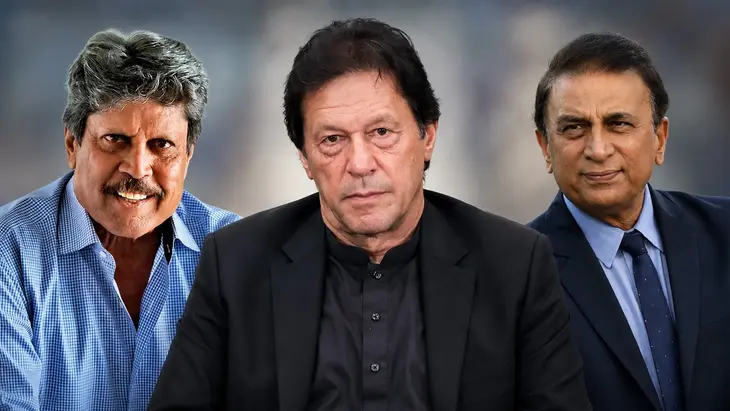
Imran Khan Health Row: 21 Cricket Captains, Including Gavaskar & Kapil, Appeal to Shehbaz Sharif
By: Javid Amin | 23 Aug 2026
From Cricket Rivals to a Common Appeal: 21 Captains Ask Pakistan to Protect Imran Khan’s Health
For decades, some of cricket’s fiercest rivalries were played out between men who rarely agreed on anything.
Sunil Gavaskar and Imran Khan. Kapil Dev and Imran Khan. Greg Chappell and Imran Khan. Allan Border and Imran Khan.
They competed against each other in an era when Test cricket was as much about endurance and personality as it was about technique.
Now, those old cricketing rivalries have given way to something very different: a collective appeal over the welfare of one of the game’s most famous former captains.
On August 23, 21 former international cricket captains from nine cricketing nations wrote to Pakistan Prime Minister Shehbaz Sharif, asking his government to ensure that jailed former Prime Minister and 1992 World Cup-winning captain Imran Khan receives the medical assessment and treatment ordered by Pakistan’s Supreme Court.
Among the signatories are Indian legends Sunil Gavaskar, Kapil Dev and Dilip Vengsarkar, along with Greg Chappell, Ian Chappell, Allan Border, Clive Lloyd, Adam Gilchrist, Steve Waugh, Michael Atherton, Nasser Hussain, David Gower, Andrew Strauss and John Wright.
The appeal is significant not simply because of the names attached to it.
It comes at a critical moment in the dispute over Imran Khan’s health, access to independent doctors and the implementation of a Supreme Court order.
And it is the second such collective intervention this year.
Why the 21 Captains Have Spoken Out Again
The latest letter follows an extraordinary sequence of events.
On August 18, Pakistan’s Supreme Court ordered that Khan be transferred from Adiala Jail to Shifa International Hospital in Islamabad for medical examination and treatment. The court also directed the formation of a medical board that would include Khan’s personal physician, Dr Faisal Sultan, and his sister, Dr Uzma Khan.
The court’s order followed concerns about Khan’s health, including fluctuating blood pressure and an eye problem.
But according to Khan’s family, legal team and the former captains’ letter, what followed did not amount to the independent medical assessment envisioned by the court.
Khan was taken to hospital but returned to Adiala Jail within hours after being examined by a government-appointed medical team that declared him fit, according to reporting on the episode.
That is the central issue behind the captains’ renewed appeal.
They are not asking Pakistan’s government to release Khan.
They are not seeking to intervene in his criminal cases.
They are asking for something narrower:
That the court-ordered medical process actually be completed.
What the Former Captains Are Demanding
The 21 former captains have made three principal requests.
1. Complete the Independent Medical Assessment
They want the medical board ordered by the Supreme Court to examine Khan fully, including the involvement of his own doctors and sister.
The letter specifically highlights concerns about reported deterioration in vision in Khan’s right eye.
2. Honour Weekly Family Visits
The captains have also called for weekly family visits, which they say had been reinstated by the Supreme Court, to take place without interruption.
3. Provide Whatever Treatment the Board Recommends
Their third demand is perhaps the simplest: if the medical board identifies a need for treatment, that treatment should be provided without delay.
The letter deliberately avoids passing judgment on Khan’s convictions or Pakistan’s domestic political dispute.
The signatories say they are not attempting to adjudicate Pakistan’s legal proceedings.
Their argument is essentially humanitarian:
A court order concerning a prisoner’s medical care should be implemented.
The Phrase That Explains Why They Wrote
The former captains have stressed that they are intervening “not as politicians”, but as former colleagues and rivals connected by their shared cricketing history.
That distinction matters.
Imran Khan is not an ordinary political prisoner in terms of his international profile.
Before becoming Pakistan’s prime minister, he was one of the most recognisable cricketers of his generation.
He led Pakistan to its only men’s Cricket World Cup title in 1992.
For many of the signatories, that sporting history is personal.
They played against him.
Some captained teams against him.
Some shared dressing rooms and cricket tours with him.
The letter therefore attempts to move the discussion away from Pakistan’s fiercely polarised political environment and toward a simpler principle:
Whatever a person’s political status, medical care should not become a political bargaining chip.
This Is the Second Collective Appeal in Six Months
The August letter did not come out of nowhere.
In February 2026, 14 former international captains issued a joint appeal to the Pakistani government over Khan’s treatment and health.
That group included Gavaskar, Kapil Dev, Greg Chappell, Allan Border, Ian Chappell, Clive Lloyd, Michael Atherton, Michael Brearley, Nasser Hussain, David Gower, Steve Waugh, John Wright, Kim Hughes and Belinda Clark.
The February appeal focused on humane treatment and adequate medical attention after concerns emerged over Khan’s eye condition while in custody.
At the time, Khan’s legal team had made serious claims about deterioration in vision in his right eye. Pakistani authorities disputed aspects of the allegations and pointed to medical assessments carried out in custody.
Six months later, the number of former captains involved has grown from 14 to 21.
That expansion is politically and symbolically significant.
It suggests that the concerns have not disappeared.
If anything, the recent Supreme Court proceedings have given the cricket fraternity a fresh reason to intervene.
Timeline: From Health Concerns to the Second Cricket Appeal
| Date | Development | Why it matters |
|---|---|---|
| February 17, 2026 | 14 former international captains appeal to Pakistan government | First collective cricket-world intervention over Khan’s health and treatment |
| August 10 | A cardiac medical board reportedly reviews Khan’s condition | Findings included fluctuating blood pressure and anxiety associated with restricted family contact |
| August 18 | Pakistan Supreme Court orders hospital transfer | Court directs transfer to Shifa International Hospital and a medical board including Khan’s personal doctors |
| August 20 | Khan is briefly taken to hospital and returned to jail | Family/legal representatives argue the court-directed process was not properly implemented |
| August 21 | Pakistan government rejects allegations of medical neglect | Officials say Khan has received repeated medical examinations and adequate facilities |
| August 23 | 21 former captains issue renewed appeal | They call for full implementation of the Supreme Court’s medical directions |
The sequence matters because the second cricket appeal is directly connected to the implementation dispute surrounding the Supreme Court order, rather than being simply a repeat of February’s concerns.
What Exactly Did Pakistan’s Supreme Court Order?
This is the legal centre of the controversy.
On August 18, the Supreme Court ordered Khan’s transfer to Shifa International Hospital and directed that a medical board oversee his assessment and treatment.
According to Khan’s lawyers, the board was to include his sister, Dr Uzma Khan, and personal physician Dr Faisal Sultan, alongside specialists. The court also addressed family access and communication with his sons abroad.
The order came after concerns about Khan’s physical condition.
A report submitted by Adiala Jail’s superintendent included an August 10 cardiac board review that recorded fluctuating blood pressure and anxiety associated with restricted family contact, according to Al Jazeera’s account of the proceedings.
That was enough for the Supreme Court to intervene.
Why Was Khan Returned to Jail So Quickly?
This is where the competing narratives become important.
Khan’s supporters and legal representatives argue that the government did not follow the spirit—or the substance—of the Supreme Court’s directions.
They say the former prime minister was taken to hospital for only a short period and examined by a state-appointed team rather than the independent board envisaged by the court.
The government disputes the wider allegations of mistreatment.
Pakistan’s Ministry of Information said on August 21 that claims of cruelty, mental torture, solitary confinement and medical neglect were unsupported by prison and medical records. Officials said Khan had undergone around 30 medical examinations and was in good health.
The government has also cited security considerations in explaining aspects of his medical arrangements.
So there are two competing narratives.
Khan’s family and supporters say:
The court’s independent medical safeguards have not been properly implemented.
Pakistan’s government says:
Khan is receiving medical attention and allegations of systematic neglect are not supported by official records.
The former captains have entered the dispute by siding with the narrower principle that the court-ordered process should be completed.
The Eye Problem Is One of the Biggest Concerns
Khan’s eyesight has become one of the most contentious medical issues.
His legal team and party have previously claimed serious deterioration in vision in his right eye.
The February appeal came amid reports that Khan had suffered an eye infection and significant loss of vision. At the time, his lawyers claimed the deterioration was severe, while Pakistani authorities indicated that his condition had improved or was being medically managed.
The August appeal again refers to the reported loss of vision.
But this is an area where responsible reporting requires caution.
The exact degree of permanent vision loss should not be presented as an independently established medical fact based solely on claims by Khan’s lawyers or political supporters.
That is precisely why an independent examination involving doctors trusted by both sides has become so important.
A credible medical board could potentially settle some of the competing claims.
Why the Independent Board Matters More Than Another Political Statement
There is a straightforward solution to much of this dispute.
Let the doctors examine him.
Let specialists conduct the tests.
Let the medical findings be documented.
Let the court determine whether its order has been followed.
That would move the discussion away from competing political claims.
The former captains’ intervention effectively points in this direction.
Their concern is not that they possess superior knowledge of Khan’s medical condition.
It is that an independent medical assessment would provide an authoritative answer.
That is a much stronger position than simply accepting either the government’s account or the PTI’s account.
Imran Khan’s Unique Place in Cricket History
There is another reason this story has generated such unusual international attention.
Imran Khan’s sporting career was exceptional even before his political rise.
He became Pakistan’s captain and eventually led the country to the 1992 World Cup title, its first and still only men’s ODI World Cup triumph.
That victory transformed his place in Pakistani sporting history.
He was already a global cricket personality.
Politics later transformed him into something much larger: a former prime minister, opposition leader and one of Pakistan’s most polarising political figures.
For the former captains who signed the appeals, however, the political question is secondary.
They remember the cricketer.
That gives their intervention an unusual emotional dimension.
Why Indian Cricket Legends Joining the Appeal Matters
The participation of Gavaskar, Kapil Dev and Vengsarkar is especially notable because India and Pakistan’s cricket rivalry is among the sport’s most intense.
Gavaskar and Imran played in an era when India-Pakistan cricket carried enormous political and public significance.
Kapil Dev captained India during the same broad generation and became one of Imran’s most prominent contemporaries.
Vengsarkar also faced Pakistan during that era.
Their decision to sign a joint humanitarian appeal involving a Pakistani political leader therefore transcends ordinary cricket rivalry.
It sends a simple message:
Political disagreements do not necessarily erase sporting relationships.
And that may be the most powerful element of the letter.
Yet the Appeal Is Not a Political Endorsement of Imran Khan
This distinction is crucial.
Signing the letter does not mean the former captains are endorsing Imran Khan’s politics, Pakistan Tehreek-e-Insaf or his legal claims.
The letter itself deliberately avoids adjudicating Pakistan’s domestic political and judicial disputes.
Their intervention concerns:
- medical care;
- independent assessment;
- family access;
- compliance with a court order;
- humane treatment.
That makes the appeal fundamentally different from an international campaign for Khan’s political release.
It is a humanitarian intervention rather than a declaration of political allegiance.
Pakistan’s Government Has Its Own Case
Any serious account of the controversy must include Islamabad’s position.
The government says Khan is a convicted prisoner serving sentences imposed through the legal system.
Officials reject claims that he is being denied medical treatment.
Pakistan’s Ministry of Information said Khan had received extensive medical attention and had more than 900 visits since his imprisonment, while also pointing to access to home-cooked food, exercise facilities and communication privileges.
The government also says security concerns have influenced decisions concerning his treatment and movement.
Those claims cannot simply be dismissed.
But neither do they automatically resolve the question raised by the Supreme Court order.
The key issue remains:
Was the precise medical process ordered by the court followed?
The Supreme Court Order Has Raised a Larger Constitutional Question
The dispute now goes beyond Imran Khan’s health.
It touches a fundamental question about Pakistan’s institutional balance:
What happens when a government and prison authorities interpret a judicial medical order differently from the prisoner and his legal team?
If the government believes security considerations require modifying the arrangement, the obvious route is to return to the court and seek clarification or modification.
That is why the former captains’ letter is framed around compliance rather than politics.
They are essentially saying:
Follow the court’s process.
That principle has implications far beyond Khan.
Why the Cricket World Is Watching
Imran Khan’s case has become one of the rare moments when the global cricket community has stepped directly into a political controversy.
Usually, former players remain away from domestic political disputes.
This case is different because Khan’s public identity has always had two inseparable components:
cricket legend and political leader.
The former captains are invoking the first identity.
Pakistan’s government is dealing with the second.
The tension between those two identities explains much of the international attention.
The Second Letter Is More Significant Than the First
The February appeal could have been dismissed as a one-off intervention by a small group of former players responding to disturbing reports.
The August letter is harder to dismiss in that way.
The number has increased from 14 to 21.
The signatories span nine cricketing nations.
And the appeal has come immediately after a Supreme Court order dealing specifically with Khan’s medical treatment.
That changes the political weight of the intervention.
It is no longer simply:
“We are worried about Imran.”
It is:
“The country’s highest court has ordered a medical process; please ensure that process happens.”
That is a considerably narrower—and arguably more defensible—argument.
What Happens Next?
Several developments will determine where the controversy goes.
Independent medical assessment
If Khan receives a comprehensive examination by the board specified by the court, some of the medical controversy could be reduced.
Court scrutiny
The Supreme Court may ultimately have to determine whether its August 18 directions were properly implemented.
Government explanation
Islamabad will likely continue to argue that security and medical considerations justified its actions.
Family access
Whether weekly visits are consistently restored will remain another important test.
International pressure
The expanded cricket appeal demonstrates that the issue has already moved beyond Pakistan’s domestic political arena.
The Bigger Story: When Cricket Becomes a Humanitarian Bridge
There is something unusually powerful about the image of former cricket rivals speaking with one voice.
These are men who once competed for runs, wickets and trophies.
They represented countries that have often struggled to maintain political dialogue.
Yet their appeal contains almost no cricketing nostalgia.
Instead, it invokes a more basic principle:
A prisoner—particularly one whose health is in question—should receive appropriate medical care, and a court’s order should be respected.
That is why the intervention has resonance beyond Imran Khan himself.
It is a reminder that sporting relationships can sometimes survive political hostility.
Conclusion: The Real Test Is Whether the Court-Ordered Process Is Completed
The intervention by 21 former cricket captains is extraordinary because of both who they are and what they are asking for.
Sunil Gavaskar, Kapil Dev, Dilip Vengsarkar, Greg Chappell, Allan Border, Clive Lloyd, Steve Waugh, Adam Gilchrist and other former captains are not asking Pakistan to settle its political crisis through cricket.
They are asking for medical care and the implementation of a judicially ordered process.
That distinction matters.
The government maintains that Khan has received extensive medical attention and rejects allegations of systematic neglect.
Khan’s family, legal team and supporters maintain that the Supreme Court’s directions have not been properly followed and that his health requires independent assessment.
Between those competing narratives lies an obvious unanswered question:
Why not allow the court-ordered independent medical board to complete its assessment and let the evidence speak for itself?
That is ultimately what the 21 former captains are asking.
And perhaps that is why this appeal carries more weight than a conventional political statement.
For once, the old cricketing rivals are not arguing about who won the match.
They are asking whether fair play still matters when the contest moves beyond the cricket field.