Zojila Tunnel Breakthrough Marks Historic Step Towards Year-Round Kashmir-Ladakh Connectivity
By: Javid Amin | 09 June 2026
World’s Highest and Longest Bi-Directional Road Tunnel Nears Completion After Major Engineering Milestone
A Historic Breakthrough Beneath the Himalayas
In a landmark moment for India’s infrastructure sector, the Zojila Tunnel project achieved its final breakthrough on Tuesday, marking the completion of excavation for what is set to become the world’s longest single-tube bi-directional road tunnel at such a high altitude.
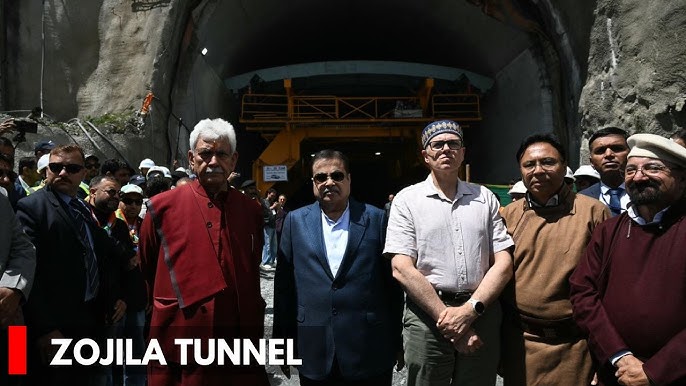
The breakthrough was triggered remotely by Union Road Transport and Highways Minister Nitin Gadkari from the East Portal near Meenamarg in Ladakh, symbolically connecting the two ends of a tunnel that has been carved through some of the most challenging mountain terrain in the world.
Stretching 13.153 kilometres beneath the rugged Zojila Pass, the tunnel will provide year-round connectivity between Kashmir and Ladakh, ending decades of seasonal isolation caused by heavy snowfall, avalanches, and harsh winter conditions.
While excavation has now been completed, engineers caution that substantial work remains before the tunnel becomes operational, including lining, ventilation systems, electrical infrastructure, safety installations, road surfacing, and finishing works.
Nevertheless, Tuesday’s breakthrough represents the most significant milestone since construction began.
Why Zojila Matters More Than Any Other Tunnel in the Region
For generations, the Zojila Pass has been both a lifeline and a barrier.
Situated at an altitude of over 11,500 feet, the mountain pass serves as the gateway connecting the Kashmir Valley with Kargil and Leh. Every winter, heavy snowfall forces authorities to close the route for weeks or even months, disrupting movement of people, goods, medical supplies, and essential services.
Entire communities in Ladakh have traditionally prepared months in advance for the seasonal closure.
The Zojila Tunnel is designed to change that reality forever.
Once operational, travel through the pass will no longer depend on weather conditions, ensuring uninterrupted road access throughout the year.
Officials estimate that travel time across the Zojila stretch will reduce dramatically while improving safety and reliability.
A Lifeline for Ladakh’s Economy
Beyond engineering achievements, the tunnel is expected to become one of the most transformative economic projects ever undertaken in Ladakh.
For businesses, transport operators, traders, and entrepreneurs, year-round connectivity means uninterrupted supply chains.
Currently, winter closures often result in:
- Delayed transportation of goods
- Increased logistics costs
- Supply shortages
- Higher consumer prices
- Reduced commercial activity
The tunnel is expected to significantly reduce these disruptions.
Businesses in Leh and Kargil will gain more reliable access to markets in Kashmir and the rest of India, creating opportunities for trade expansion and investment.
Experts believe improved connectivity could encourage greater private-sector participation in tourism, hospitality, retail, renewable energy, and logistics.
Tourism Sector Poised for Transformation
Tourism is likely to be among the biggest beneficiaries.
Each year, thousands of travelers visit Ladakh between May and September. However, winter tourism remains constrained by accessibility challenges.
The Zojila Tunnel could fundamentally alter this pattern.
With all-weather road connectivity, Ladakh may increasingly attract visitors throughout the year rather than only during the traditional summer season.
Potential benefits include:
- Growth of winter tourism
- Increased hotel occupancy
- Expansion of adventure tourism
- More reliable travel itineraries
- Better access for domestic tourists
The project is also expected to boost tourism in Sonamarg, Drass, Kargil, and surrounding regions that lie along the strategic corridor.
Strategic Importance Beyond Tourism
The tunnel’s significance extends far beyond economic development.
Ladakh shares sensitive borders with both Pakistan and China, making reliable transport infrastructure a strategic necessity.
Currently, weather-related disruptions can affect movement along key routes connecting forward areas.
Year-round access through Zojila will strengthen logistical capabilities and improve mobility in one of India’s most strategically important regions.
Infrastructure experts have long argued that all-weather connectivity is essential not only for civilian development but also for national security preparedness.
The tunnel is therefore viewed as both an economic asset and a strategic infrastructure project.
Engineering Against the Odds
Constructing a tunnel beneath the Himalayas is an extraordinary challenge.
Engineers have worked in:
- Fragile geological formations
- Avalanche-prone zones
- Sub-zero temperatures
- High-altitude conditions
- Remote mountainous terrain
Workers and engineers faced unpredictable rock conditions, difficult logistics, and extreme weather throughout the construction process.
The successful excavation of the main tunnel reflects years of planning, technological expertise, and on-ground execution under some of the toughest working conditions found anywhere in the world.
The project has been executed by Megha Engineering and Infrastructure Limited (MEIL) for the National Highways and Infrastructure Development Corporation Limited (NHIDCL).
Leaders Hail a Transformational Achievement
Union Minister Nitin Gadkari described the breakthrough as a historic moment in India’s infrastructure journey.
He emphasized that the tunnel has been built using world-class safety standards and would ensure all-weather connectivity between Kashmir and Ladakh.
Jammu and Kashmir Lieutenant Governor Manoj Sinha called the achievement the realization of a long-standing dream for Ladakh, highlighting the role of connectivity in regional development.
Chief Minister Omar Abdullah welcomed the milestone and stressed the need for timely completion of the remaining work. He noted that improved connectivity would transform access to education, healthcare, tourism, and markets across the region.
During the event, Omar Abdullah also renewed the demand for regular commercial flight connectivity to Kargil, describing it as one of the region’s remaining connectivity aspirations.
Meanwhile, Ladakh leaders, including Lieutenant Governor Vinai Kumar Saxena and Member of Parliament Mohmad Haneefa, termed the breakthrough a landmark moment that would end generations of winter isolation and open a new chapter of growth and opportunity.
What Happens Next?
Although the breakthrough is complete, the tunnel is not yet ready for public use.
The remaining stages include:
- Tunnel lining and reinforcement
- Installation of ventilation systems
- Fire and emergency response infrastructure
- Electrical and communication networks
- Road pavement works
- Safety testing and certification
Only after these processes are completed will authorities announce an operational timeline.
Industry experts note that the final stages of tunnel projects are often as complex as excavation itself and require rigorous testing before opening to traffic.
A Project That Could Redefine the Himalayas
Few infrastructure projects have the potential to reshape an entire region as profoundly as the Zojila Tunnel.
For the people of Ladakh, it promises uninterrupted connectivity, greater economic opportunities, better healthcare access, and improved mobility.
For businesses, it offers predictable logistics and lower transportation risks.
For tourists, it opens the possibility of year-round exploration of one of India’s most spectacular destinations.
And for India, it strengthens strategic infrastructure in one of the country’s most sensitive border regions.
The final breakthrough is not the end of the journey—but it is the moment when a decades-old dream moved decisively closer to reality.
Verified Facts
- Tunnel length: 13.153 km
- Location: Between Baltal (Kashmir) and Meenamarg (Ladakh)
- Elevation: Around 11,500–11,600 ft
- Final breakthrough achieved on June 10, 2026
- Executing agency: NHIDCL
- Contractor: MEIL
- Excavation phase completed
- Tunnel will provide all-weather Srinagar–Kargil–Leh connectivity