Cabinet Reshuffle Was the Trigger, Not the Cause: 18 Legislators Seek Major Changes as Ruhullah’s Exit Deepens the Party’s Ideological Crisis
By: Javid Amin | 01 November 2026
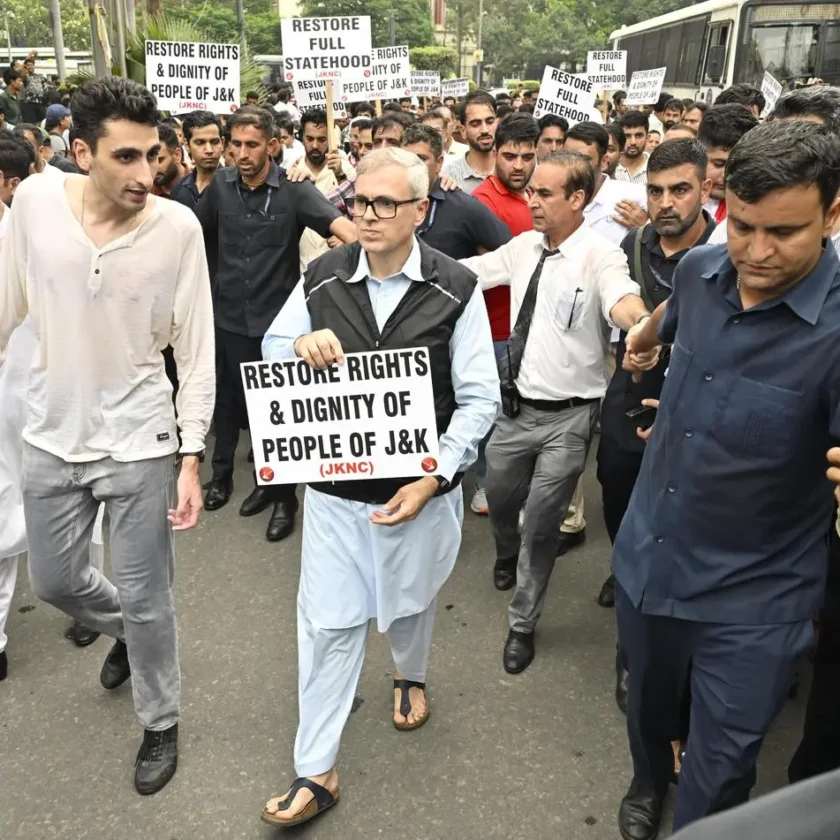
Srinagar: The National Conference (NC), which returned to power in Jammu and Kashmir with a strong electoral mandate in 2024, is facing an increasingly public test of internal cohesion. What initially appeared to be disappointment over the latest cabinet expansion has developed into a wider confrontation over political accountability, the concentration of decision-making, implementation of election promises and the party’s position on Article 370 and statehood.
The developments are significant not because they establish that the Omar Abdullah government is about to fall, but because they expose a growing gap between the expectations created during the election campaign and the political choices confronting the party in government.
Two developments have brought that gap into sharp focus: a memorandum signed by 18 NC legislators seeking substantial changes in government and party functioning, and Srinagar MP Aga Syed Ruhullah Mehdi’s announcement that he intends to leave both the party and Parliament on November 3.
These are connected by the wider question of the NC’s political direction, but they are not the same rebellion. The legislators are seeking institutional and political changes from within the party; Ruhullah has framed his departure as a matter of ideological and constitutional conviction.
That distinction is essential to understanding the crisis.
The first factual distinction: 18 signatories, not a confirmed 24-member rebellion
The numbers surrounding the legislators’ meeting have varied across media reports, and that matters when assessing the scale of the dissent.
The strongest documented detail is that 18 NC legislators signed a memorandum following a meeting at the residence of Lolab MLA Qaiser Jamsheed Lone. Reports say additional legislators supported the group remotely, but the reported number of online participants is inconsistent: some accounts mention six, others seven. Some reports consequently describe a group of 24 or 25.
For a fact-checked account, the defensible formulation is that 18 legislators signed the memorandum, with additional support reportedly expressed online. It would be misleading to state that 24 or 25 legislators physically attended or that all had formally joined a rebel faction.
The memorandum is more consequential than a routine expression of disappointment. It reportedly seeks a fresh cabinet restructuring, removal of Chief Minister Omar Abdullah’s political adviser Nasir Aslam Wani, a time-bound roadmap for the election manifesto, stronger consultation with legislators and a renewed campaign for statehood and Jammu and Kashmir’s constitutional identity. It also raises complaints about ministerial performance and alleged corruption. Those allegations remain allegations; they must not be presented as established findings.
The legislators have reportedly argued that their intervention is intended to strengthen the party and government, not bring them down. That claim should be weighed alongside their demand for substantial changes, rather than dismissed or accepted uncritically.
Cabinet expansion: Why the reshuffle became a political flashpoint
The latest cabinet exercise was expected to address vacancies and strengthen the administration. Instead, it exposed competing expectations within the ruling party and raised questions about regional representation.
On October 27, Lieutenant Governor Manoj Sinha administered the oath to four new ministers:
-
Ali Mohammad Sagar, MLA from Khanyar.
-
Shamima Firdous, MLA from Habba Kadal.
-
Mir Saifullah, MLA from Trehgam.
-
Altaf Ahmad Wani, popularly known as Kaloo, MLA from Pahalgam.
The reshuffle also saw Independent MLA Satish Sharma dropped from the Council of Ministers.
This was not an unlimited expansion. Under Section 53 of the Jammu and Kashmir Reorganisation Act, 2019, the Council of Ministers cannot exceed 10 per cent of the Assembly’s total membership. With a 90-member elected Assembly, the maximum strength is nine ministers, including the Chief Minister. The October exercise brought the council to that permitted strength.
The controversy, therefore, is not simply about how many ministers were inducted. It is about who was accommodated, who was left out and how the decisions were taken.
The regional representation question
The reshuffle also created a political problem in Jammu.
According to The Indian Express, seven members of the nine-member Council of Ministers, including Omar Abdullah, represent the Kashmir Valley, while the remaining two represent the Pir Panjal region. With Satish Sharma’s removal, the mainland Jammu districts of Jammu, Udhampur, Samba and Kathua no longer have a minister in the cabinet.
This has provided the BJP with an opportunity to question the government’s regional balance.
But the distinction between regional representation and party representation is important. The BJP’s strong electoral presence in mainland Jammu does not automatically mean that the NC-led government is constitutionally required to appoint a minister from that region. The political criticism is about representation and public perception, not a legal entitlement to a cabinet berth.
For Omar Abdullah, however, the optics are difficult. A government operating across a geographically and politically diverse Union Territory cannot afford to appear disconnected from one of its major regions.
The excluded legislators and the question of influence
The discontent is also personal and organisational.
Senior legislators Mubarak Gul and Abdul Majid Larmi have publicly expressed dissatisfaction over their exclusion from the Council of Ministers. Nazir Ahmad Khan of Gurez has also been reported to be unhappy with the leadership’s handling of the matter. Supporters of some excluded leaders reportedly staged protests seeking ministerial representation.
There is a further indication that the leadership recognises the need to manage the situation. After Ali Mohammad Sagar’s induction into the cabinet, Farooq Abdullah appointed Mubarak Gul as the party’s general secretary in his place. That move can be read as an attempt to accommodate a senior leader who had been left out of the ministry. It does not, by itself, establish that the wider dispute has been resolved.
The deeper complaint is that elected representatives believe their role in decision-making has diminished.
Some legislators have reportedly questioned the influence of people close to the Chief Minister who do not themselves hold an elected mandate. This is where the controversy over the Chief Minister’s adviser, Nasir Aslam Wani, becomes politically important.
The criticism should be understood as an allegation about the concentration of influence, not as proof that the adviser has unlawfully exercised authority. The central democratic question is whether elected representatives have adequate access to the Chief Minister and a meaningful role in shaping decisions that affect their constituencies.
A legislator who wins an election expects more than a seat in the Assembly. He or she expects access, consultation and a degree of influence over policy. When that expectation is frustrated, cabinet decisions can become a wider test of party management.
The memorandum: A demand for reform, not merely ministerial berths
The memorandum is the strongest evidence that the dissatisfaction has moved beyond private conversations.
Reports differ on whether the document is described as an eight-point or 10-point memorandum, apparently reflecting different accounts or presentations of its demands. The most consistently reported elements are a fresh cabinet review, changes to the Chief Minister’s advisory arrangements, a time-bound manifesto roadmap, stronger consultation with MLAs and renewed political efforts on statehood and constitutional identity.
One demand is particularly revealing: legislators have reportedly sought withdrawal of the Roads and Buildings portfolio from Deputy Chief Minister Surinder Choudhary.
This suggests that the disagreement is not restricted to the exclusion of individual leaders. It also concerns ministerial performance, the distribution of portfolios and the way the government responds to complaints raised by its own legislators.
The memorandum reportedly refers to corruption-related complaints against certain ministers. Those complaints have not been independently established in the reporting available for this article. They should not be treated as findings of wrongdoing, and any specific allegation requires verification through documentary evidence or an official investigation.
The proposed consultative mechanisms are equally significant. Reports describe demands for a more structured channel through which legislators can communicate political and administrative concerns to the Chief Minister.
That points to a problem of institutional communication.
A government may have a numerical majority and still suffer from poor internal coordination. It may have a full cabinet and still leave elected representatives feeling marginalised. And a ruling party may enjoy electoral legitimacy while struggling to maintain confidence among its own legislators.
That is the crisis the NC leadership now has to address.
The Dachigam meeting: The grievances did not emerge overnight
The current memorandum reportedly revives issues discussed at an earlier meeting of NC legislators at Dachigam, chaired by Omar Abdullah in June 2026.
According to subsequent reporting, some legislators had raised questions about ministerial performance and the functioning of the government, including concerns involving Deputy Chief Minister Surinder Choudhary and ministers Javid Ahmad Rana and Satish Sharma. The October cabinet exercise addressed some personnel and portfolio questions, but evidently did not satisfy all those who had raised concerns.
This chronology matters.
If the latest dispute had emerged entirely from the October reshuffle, it might have been possible to resolve it through a few organisational appointments or a limited cabinet adjustment.
But the reported continuation of grievances from the June meeting suggests that the problem is more deeply rooted.
The legislators appear to be asking for a change in how decisions are made, not simply a different distribution of ministerial positions.
That is a much harder demand for any party leadership to accommodate.
The coterie culture allegation: A political complaint with wider implications
The expression “coterie culture” has become central to the criticism surrounding the Chief Minister’s office.
The allegation is that a small group of people has disproportionate access to the leadership and that elected legislators are not sufficiently consulted before major political and administrative decisions are taken.
This is not an entirely new problem in the history of the National Conference. Like other long-established political parties, the NC has periodically faced tensions between its organisational leadership, elected representatives and influential figures close to the party’s top leadership.
But the present criticism has gained importance because it is being associated with a wider memorandum and demands for formal changes.
There are two sides to this issue.
The Chief Minister requires advisers and administrative support to run a government. Not every policy decision can be made through consultations with every legislator.
At the same time, advisers cannot become substitutes for elected representatives. MLAs are accountable to voters in their constituencies, and their ability to raise local concerns is a fundamental part of representative government.
The question is not whether a Chief Minister can have advisers. The question is whether the system provides elected legislators with meaningful access and whether decisions are made through transparent and accountable channels.
If the NC leadership fails to address that perception, the criticism could become a lasting organisational problem.
Article 370 and statehood: The ideological fault line beneath the cabinet crisis
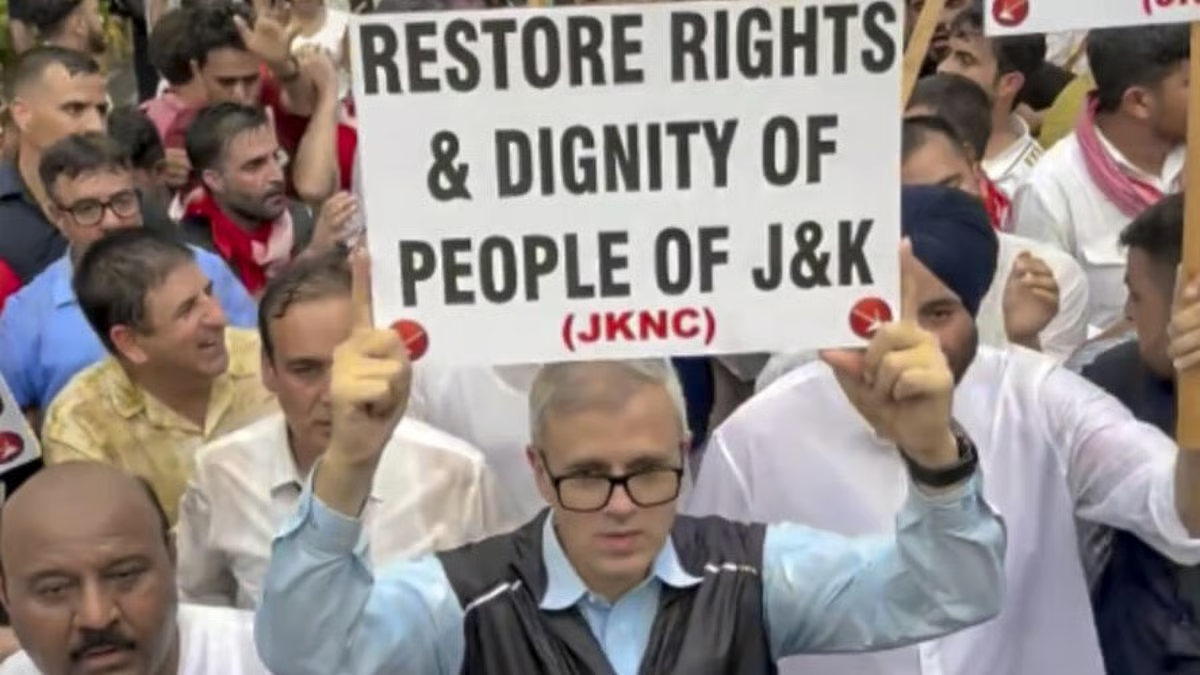
The most consequential aspect of the current unrest is that the memorandum reportedly raises statehood and special status alongside governance and organisational reforms.
This is important because the NC’s 2024 election campaign was not based exclusively on development or administrative performance. It also carried a political commitment to pursue the restoration of special status and constitutional guarantees.
In November 2024, the newly elected Jammu and Kashmir Assembly passed a resolution moved by Deputy Chief Minister Surinder Kumar Choudhary. It reaffirmed the importance of special status and constitutional guarantees, expressed concern over their unilateral removal and called upon the Union Government to initiate dialogue with elected representatives.
The resolution did not explicitly name Article 370 or Article 35A, although it was widely understood in the political context of the abrogation of Article 370.
That distinction matters.
The NC had taken a political position on the restoration of special status, but the Assembly resolution was carefully worded. It sought dialogue and constitutional mechanisms rather than claiming that the Assembly could itself restore the former constitutional arrangement.
The legal position is also clear. In December 2023, a five-judge Constitution Bench of the Supreme Court upheld the Union government’s 2019 decision on Article 370. The Court also recorded the Union government’s assurance that statehood would be restored and directed that restoration should take place at the earliest and as soon as possible.
These are two different political and constitutional questions.
Statehood restoration concerns the status of Jammu and Kashmir as a Union Territory and the return to statehood.
Restoration of Article 370 concerns the special constitutional provisions that were made inoperative in August 2019 and whose abrogation was upheld by the Supreme Court.
The elected government can advocate for both demands, but it cannot independently reverse the Supreme Court’s judgment or restore the former Article 370 arrangement through a cabinet decision.
This is the difficult political reality facing the NC.
Its leadership has to balance the expectations of voters who want a strong constitutional campaign with the limitations imposed by the existing legal and political framework.
Why the legislators are raising the issue again
The renewed demand for a stronger campaign suggests that some NC legislators do not want the party’s political commitments to become secondary to routine administration.
Their concern appears to be that the government could become so focused on day-to-day governance that the larger political demands which helped bring it to power lose momentum.
This is where the ideological disagreement with Ruhullah becomes relevant.
He has accused the leadership of retreating from its commitments on Article 370 and constitutional rights. The legislators’ memorandum reportedly raises similar political concerns, although it also contains demands focused on cabinet functioning and internal consultation.
The overlap is real, but it should not be exaggerated. A demand for a stronger statehood campaign does not automatically mean that every signatory supports Ruhullah’s position or his decision to resign.
Ruhullah’s impending exit: An ideological challenge to the party leadership
The decision of Srinagar MP Aga Syed Ruhullah Mehdi to resign from the NC and the Lok Sabha on November 3 has added a separate and more direct challenge to the party leadership.
Ruhullah has repeatedly accused the NC of abandoning its electoral commitments, particularly on Article 370 and constitutional rights. In his recent statements, he has also criticised the party leadership for what he describes as a retreat from its earlier political position.
In an interview reported by PTI and published by The Tribune, he said he intended to leave both the party and Parliament, and expressed a desire to return to the grassroots to find like-minded people who shared his political convictions. He also said he would consider political routes that could advance his stated objective of restoring constitutional rights and dignity.
His departure is significant for three reasons.
First, he is not an ordinary dissident. He has a substantial electoral profile and has been a prominent voice within the NC’s political ecosystem.
Second, his criticism challenges the party’s ideological credibility. It is not limited to cabinet representation or access to the Chief Minister.
Third, his proposed resignation from Parliament would mean surrendering an elected national platform. It would be a major political decision, not simply a symbolic exit from the party.
However, it is important to distinguish an announced intention from a completed resignation. As of November 2, his stated date is November 3. The parliamentary seat becomes vacant only after the resignation is formally submitted and accepted under the applicable procedure.
Ruhullah has also made clear that his struggle should not be conflated with the dissatisfaction of legislators over ministerial positions. That statement is important because it places a limit on speculation that he is already leading the group of 18 signatories.
The two developments may eventually intersect, but there is no verified evidence that the legislators have collectively decided to join him or form a common political platform.
Is the Omar Abdullah government in danger? The numbers tell a different story
Political headlines about an internal revolt can create the impression that a government is close to collapse. The Assembly arithmetic does not currently support that conclusion.
Jammu and Kashmir has a 90-member elected Legislative Assembly. The majority mark is therefore 46.
There is, however, a discrepancy worth identifying rather than concealing. The 2024 election result gave the National Conference 42 seats. The current party-wise representation displayed on the Assembly’s official e-Vidhan portal lists the NC at 41. The available portal does not explain the change, so it would be wrong to invent a reason for it. For present-day arithmetic, the current Assembly listing and recent reporting use 41.
Current Assembly position
90 – Elected Assembly seats | Majority mark – 46 | National Conference – 41 | BJP – 29 | Congress – 6 | Independents – 7 |
PDP – 4 | CPI(M), AAP and People’s Conference – 1 each
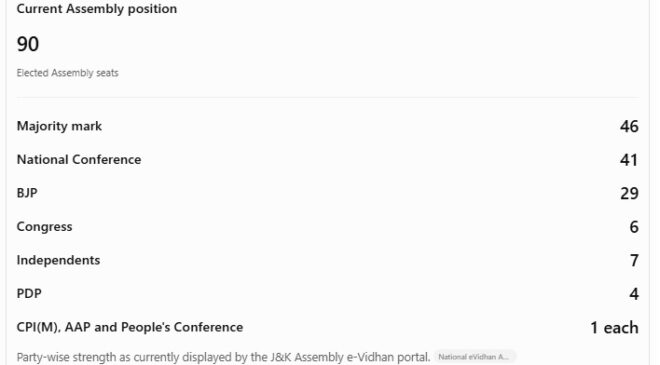
Party-wise strength as currently displayed by the J&K Assembly e-Vidhan portal.
| Support calculation | Seats |
|---|---|
| National Conference | 41 |
| Congress support | 6 |
| Supporting Independents | 5 |
| CPI(M) | 1 |
| Reported government support | 53 |
| Majority required | 46 |
This is the most important numerical point in the current crisis.
Even if the 18 legislators who signed the memorandum are dissatisfied with the leadership, that does not mean they have withdrawn support from the government. They remain NC legislators unless they take a formal step that changes their legislative status.
A memorandum demanding reforms is not a no-confidence motion. A closed-door meeting is not a resignation. And political dissatisfaction is not the same as a formal withdrawal of support.
For the government to face an immediate survival crisis, there would need to be a material change in the Assembly’s support arithmetic, followed by the appropriate legislative and constitutional process.
At present, no verified alternative coalition arrangement has emerged.
What if the dissenting MLAs resign?
That is a possibility raised in some reports, but it should not be confused with an event that has occurred.
If legislators resign, the legal and political consequences depend on the formal submission and acceptance of their resignations, the resulting membership of the House and the confidence position of the government.
A mass resignation would be a major political crisis, but it would not automatically install an alternative government. The constitutional process and the numbers on the floor of the Assembly would remain decisive.
For now, the more reasonable assessment is that the government is facing a serious internal-management problem, not an established loss of majority.
BJP and PDP: Political opportunities, but no alternative government in sight
The BJP has used the developments to attack the NC government.
Senior BJP leaders have described the internal tensions as evidence that the government is weakening. The party has also criticised the cabinet’s regional representation after Satish Sharma’s removal. These are legitimate opposition talking points, but statements predicting the government’s collapse are political claims, not evidence of a completed realignment.
The BJP remains the largest opposition party in the Assembly with 29 seats. But it cannot form a government on its own, and there is no verified evidence of a new coalition arrangement involving the BJP, PDP or dissident NC legislators.
The PDP has its own political reasons to watch the situation carefully. Any weakening of the NC’s ideological position could create an opportunity to attract voters who feel that the ruling party has become too cautious.
Yet the PDP’s four Assembly seats do not give it the numbers to become an alternative government without a much wider political realignment.
The People’s Conference, Independents and smaller parties may also become relevant if the political situation changes, but speculation about future alignments should not be presented as evidence of negotiations.
The opposition may benefit politically from the NC’s discomfort without being in a position to replace its government.
The real battle: Can the NC remain both a governing party and a political movement?
The most important question raised by the current crisis is whether the National Conference can perform two roles simultaneously.
One is the responsibility of government: delivering public services, managing administration, addressing unemployment, improving infrastructure and responding to people’s everyday concerns.
The other is the role of a political movement: defending its ideological commitments, pursuing constitutional demands, maintaining public mobilisation and ensuring that the promises made during the election campaign remain central to its identity.
The two roles are not mutually exclusive.
But they require political leadership capable of managing the tension between what is immediately achievable and what the party has promised to pursue.
For the NC, this is particularly important because the 2024 mandate was built around both governance and constitutional politics.
If the party focuses exclusively on administration, it risks alienating voters who expected a stronger campaign for political rights and constitutional protections.
If it focuses only on political mobilisation, it risks being judged for failing to deliver on jobs, development and public services.
The challenge is to show that governance and political advocacy can proceed together.
The memorandum from legislators suggests that some within the party believe the present balance is inadequate.
Ruhullah’s position goes further: he argues that the leadership has compromised the very political commitments that justified the party’s return to power.
That is why the current crisis cannot be resolved simply by offering another ministerial berth or changing a portfolio.
What happens next? Five developments to watch
The coming days will be important, particularly because Ruhullah’s announced resignation date is November 3.
1. Farooq Abdullah’s response to the memorandum
The party president will have to decide whether to treat the document as a routine expression of dissatisfaction or as a demand requiring formal political engagement. A meeting with the signatories could help prevent the issue from becoming a prolonged public confrontation.
2. Omar Abdullah’s response to the demand for consultation
The Chief Minister may need to establish a clearer mechanism through which legislators can raise constituency-level and administrative concerns. The demand for consultation is likely to remain central even if the cabinet itself is not reshuffled again.
3. Whether the memorandum’s signatories remain united
Eighteen signatures are politically significant, but the group’s cohesion will be tested when the leadership begins responding. The legislators may not all have identical priorities. Some may want cabinet changes, others organisational reform and still others a stronger political campaign.
4. Ruhullah’s November 3 announcement
His decision to leave Parliament and the NC will be a major political moment. The next question will be whether he remains an independent voice, begins building a platform or explores an alliance with other political actors.
5. The government’s performance
Ultimately, internal party management cannot replace public performance. Employment, recruitment, electricity, healthcare, education, infrastructure and administrative accountability will continue to shape public opinion.
A government that addresses these concerns effectively may reduce the political space available to its critics. A government that fails to do so may find the internal dispute becoming part of a wider public dissatisfaction.
Ground assessment: An internal revolt, but not yet a government crisis
The National Conference is facing a serious internal challenge. The evidence is stronger than a few isolated complaints: 18 legislators have signed a memorandum seeking major changes, senior leaders have publicly expressed dissatisfaction, and the cabinet reshuffle has exposed unresolved tensions over consultation, representation and political influence.
But the evidence does not establish that the government is about to collapse.
The current Assembly arithmetic indicates that the Omar Abdullah government retains support above the majority mark. The legislators’ memorandum is not a formal withdrawal of support, and there is no confirmed alternative coalition arrangement.
The bigger danger for the NC is political rather than numerical.
The party is being questioned from within over how it governs, how it consults its elected representatives and whether it is maintaining the ideological commitments that helped it return to power.
Ruhullah’s impending exit adds a particularly uncomfortable dimension because it challenges the party on constitutional politics rather than simply on ministerial distribution.
The NC leadership therefore faces two separate but related tasks: managing its legislators and rebuilding confidence in its political direction.
If it treats the memorandum as nothing more than ministerial disappointment, it risks missing the wider message. If it responds only with organisational appointments, it may fail to address the concerns about governance and political commitments.
The cabinet reshuffle triggered the confrontation, but the underlying dispute is about who controls the party’s political direction and what the National Conference stands for in the post-2019 landscape.
Jammu and Kashmir is not yet witnessing a confirmed change of government. It is witnessing a contest over the future identity of the party that leads it.
That may prove to be a much longer and more consequential struggle.