NTA Exam Calendar 2026–27: Turn the Exam Schedule Into a Career Roadmap
By : Javid Amin | 18 September 2026
For students preparing for competitive examinations, a date on an exam calendar is rarely just a date.
It can determine when to complete a syllabus, when to start mock tests, when to apply to universities, when to shortlist courses and, ultimately, which career path becomes possible.
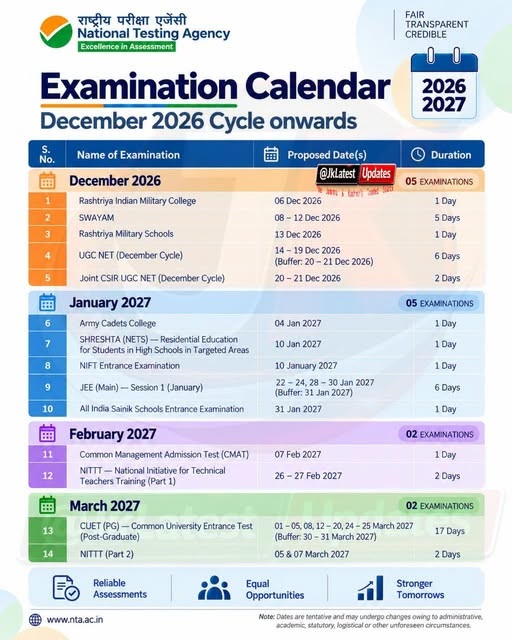
The National Testing Agency’s latest examination calendar up to March 2027 therefore deserves to be read as more than a list of examination dates. Released on September 16, 2026, the tentative calendar covers 14 examinations from December 2026 through March 2027, including major tests such as UGC-NET, JEE Main Session 1, CMAT, NIFT Entrance Examination and CUET-PG.
For students, the bigger message is simple: the next six months should be planned as a career-building phase, not merely an exam-preparation phase.
That distinction matters.
A student preparing for JEE Main is not simply preparing to clear an entrance test. They are potentially preparing for an engineering degree and a four-year professional pathway.
A UGC-NET aspirant is not simply chasing a score. The examination can form part of a longer academic and research pathway involving teaching, doctoral study and research.
A CUET-PG candidate is not merely preparing for another postgraduate entrance test. The result can influence the choice of university, subject specialisation and the direction of a professional or academic career.
The NTA calendar gives these aspirants something extremely valuable: a planning horizon.
NTA Exam Calendar 2026–27: What Has Changed?
The latest NTA calendar covers the examination cycle from December 2026 to March 2027. Importantly, the dates are tentative. NTA has stated that they may change because of administrative, academic, statutory, logistical or other unforeseen circumstances. The calendar also does not replace the detailed notification or Information Bulletin for any individual examination.
The major dates relevant to career planning include:
| Examination | Tentative Schedule | Career Route |
|---|---|---|
| UGC-NET December Cycle | December 14–19, 2026 | Teaching, research & PhD pathways |
| JEE Main Session 1 | January 22–24 & January 28–30, 2027 | Engineering & technical education |
| CMAT | February 7, 2027 | Management education |
| CUET-PG | March 1–5, 8, 12–20 & 24–25, 2027 | Postgraduate education |
| NITTT Part 1 | February 26–27, 2027 | Technical teacher training |
The complete NTA calendar contains 14 examinations, including several specialised entrance and eligibility tests.
For career planning, however, three examinations stand out because they represent distinctly different stages and pathways: JEE Main, UGC-NET and CUET-PG.
JEE Main 2027: The First Major Career Decision Point
For engineering aspirants, JEE Main is more than a competitive examination.
It is often the first major gateway between school education and professional technical education.
According to the current NTA calendar, JEE Main Session 1 is tentatively scheduled for January 22–24 and January 28–30, 2027, with January 31 listed as a buffer date.
One important point for students reading the calendar is that JEE Main Session 2 is not part of this December-to-March calendar release. Aspirants should therefore avoid assuming that a February 2027 Session 2 date has been announced. Separate official notifications should be followed for subsequent sessions.
What does JEE Main mean for a career?
For many students, the immediate objective is admission to engineering programmes, including those offered by NITs, IIITs and other participating institutions.
But the career decision begins much earlier.
Aspirants should ask:
- Do I actually enjoy mathematics and science?
- Do I prefer software, electronics, mechanical systems, civil infrastructure or another technical field?
- Am I choosing engineering because it interests me or simply because it is considered a conventional career?
- Which branch aligns with my strengths?
- What skills will I need beyond the degree?
The last question is increasingly important.
A strong engineering career is unlikely to depend solely on an entrance-exam rank or college name. Students entering engineering should also begin thinking about programming, analytical reasoning, communication, project work, internships and emerging technologies.
JEE preparation should therefore have two layers
Layer 1: Entrance preparation
Focus on:
- Physics
- Chemistry
- Mathematics
- NCERT fundamentals
- Previous-year questions
- Mock tests
- Time management
- Accuracy
- Error analysis
Layer 2: Career preparation
Begin developing:
- Basic programming
- Logical reasoning
- Communication
- Problem-solving
- Digital tools
- Research habits
- Project-building skills
The entrance exam opens the door. The skills developed afterward help determine what happens inside the career.
UGC-NET December 2026: From Examination to Academic Career
UGC-NET represents a very different career route.
The examination is conducted by NTA for determining eligibility related to Junior Research Fellowship, Assistant Professorship and certain PhD admission categories, depending on the qualification category. UGC-NET is conducted in computer-based test mode.
For the December 2026 cycle, the NTA calendar proposes the examination for December 14–19, 2026, with December 20–21 listed as buffer dates.
For students and researchers, this creates a very different preparation equation.
The goal should not be simply:
“How do I clear NET?”
A more useful career question is:
“What do I want to do with NET qualification?”
That question can change the entire preparation strategy.
Three possible directions
1. Academic teaching
Students interested in teaching at the university level can use UGC-NET as part of their academic career planning.
That means developing more than examination knowledge.
Subject mastery, academic writing, communication, presentation skills and the ability to explain complex concepts clearly become important long-term assets.
2. Research
For research-oriented candidates, NET preparation should be combined with a deeper understanding of research methodology.
Useful skills include:
- Literature review
- Academic writing
- Data interpretation
- Research methodology
- Citation practices
- Critical reading
- Statistical reasoning
- Conference and presentation skills
3. PhD pathway
Candidates interested in doctoral study should begin researching potential universities, departments, research areas and faculty interests well before the examination result.
A qualification can create an opportunity.
A well-defined research interest can turn that opportunity into a career direction.
CUET-PG 2027: The Postgraduate Career Crossroads
CUET-PG serves a different population: students looking to enter postgraduate programmes through a common entrance route.
The latest NTA calendar proposes CUET-PG across multiple dates in March 2027: March 1–5, March 8, March 12–20 and March 24–25, with March 30–31 listed as buffer dates.
The spread across multiple dates is particularly relevant for students applying to postgraduate programmes because the exam calendar needs to be considered alongside:
- University choices
- Programme eligibility
- Subject combinations
- Application requirements
- Academic records
- Career goals
- Financial considerations
- Location and campus preferences
CUET-PG should therefore not be treated as a single examination decision.
It is part of a larger postgraduate career decision.
Before preparing for CUET-PG, ask five questions
1. Which subject do I want to pursue?
A postgraduate degree should ideally deepen a subject rather than simply postpone a career decision.
2. Which universities offer the programme I want?
Create a university shortlist before the final preparation phase.
3. What careers follow the degree?
Research employment options, higher-study pathways and industry requirements.
4. Does the course provide practical exposure?
Look at internships, projects, laboratories, fieldwork and industry connections where relevant.
5. What additional skills will I need?
A postgraduate qualification and employability are related, but they are not identical.
The Biggest Career Mistake: Preparing for the Exam Without Preparing for the Next Step
Competitive-exam preparation can become an all-consuming routine.
Students wake up, study, solve questions, take mock tests, analyse scores and repeat the cycle.
That discipline is valuable.
But there is a potential problem.
A student can become extremely good at preparing for an examination while spending very little time thinking about what happens after the examination.
That is where career planning needs to enter the process.
Think in three stages
Stage 1 — Examination
What do I need to learn to perform well?
Stage 2 — Education
What course, university or qualification will I pursue?
Stage 3 — Career
What skills and experience will make that qualification useful in the employment market?
The three stages should connect.
September 2026: Build the Career Foundation
September should not be treated as a month to panic.
It should be treated as the month for diagnosis and planning.
JEE Main aspirants
- Complete a realistic syllabus audit.
- Identify weak chapters.
- Revisit NCERT fundamentals.
- Start maintaining an error notebook.
- Establish a daily problem-solving routine.
- Begin previous-year question practice.
UGC-NET aspirants
- Divide the syllabus into Paper I and subject-specific preparation.
- Identify high-weightage and difficult areas.
- Start systematic revision.
- Build concise subject notes.
- Strengthen research methodology and teaching aptitude.
CUET-PG aspirants
- Identify target postgraduate programmes.
- Check participating universities and eligibility.
- Download and study the relevant syllabus.
- Map strong and weak areas.
- Begin topic-wise MCQ practice.
Career task of the month: Create a one-page document titled My 2027 Career Plan.
It should include:
Exam → Course → University options → Skills → Possible career paths
October 2026: Move From Learning to Application
October should increasingly become a testing month.
Instead of asking:
“How many chapters have I completed?”
ask:
“How much can I solve accurately under pressure?”
JEE Main
Increase previous-year question practice and introduce timed sessions.
UGC-NET
Begin regular Paper I practice alongside subject preparation. Analyse recurring mistakes rather than simply counting scores.
CUET-PG
Introduce sectional tests and comprehension-based practice wherever relevant.
Career task
Research actual careers associated with your target course.
Do not rely only on social-media claims about salaries or “high-demand jobs”.
Look at:
- Job descriptions
- Required qualifications
- Skills
- Entry-level roles
- Internship expectations
- Career progression
This exercise can sometimes reveal that the degree a student originally planned is not the only route into their desired career.
November 2026: The Performance Month
By November, preparation should become increasingly exam-oriented.
The focus should shift toward:
Speed + accuracy + revision + stamina.
For every mock test, maintain four figures:
- Questions attempted
- Questions correct
- Questions incorrect
- Questions left unanswered
Then identify why mistakes happened.
Was it:
- Lack of knowledge?
- Misreading?
- Calculation error?
- Poor time management?
- Guessing?
- Anxiety?
- Failure to recognise the question type?
This is more useful than simply recording a test score.
Build a personal “mistake bank”
Every repeated mistake should become a learning item.
Over time, this can become one of the most valuable revision resources before the examination.
December 2026: The First Major Examination Window
December becomes especially important for UGC-NET aspirants.
The current calendar proposes UGC-NET from December 14 to 19, 2026, subject to the final notification and any subsequent changes.
For NET candidates, December preparation should be about refinement rather than attempting to learn everything from scratch.
Final-month priorities
- Full-length mock tests
- Short revision notes
- Previous-year questions
- Paper I revision
- Subject-wise revision
- Time management
- Sleep and routine
- Examination logistics
JEE Main and CUET-PG aspirants should also use December as a serious transition point.
The question should change from:
“Have I studied everything?”
to:
“Can I perform consistently?”
January 2027: JEE Main Enters the Picture
January is the critical month for engineering aspirants.
JEE Main Session 1 is tentatively scheduled for January 22–24 and January 28–30, 2027, with January 31 as a buffer date.
The weeks before the examination should not be used for massive experimentation.
The objective is consistency.
JEE final preparation should focus on:
- Revision
- Formula recall
- Previous-year questions
- Mock papers
- Error correction
- Time management
- Maintaining confidence
- Avoiding unnecessary resource overload
One of the most common preparation problems is continuously adding new books, channels, notes and test series.
At this stage, depth and revision generally matter more than collecting more material.
February 2027: Don’t Waste the Post-Exam Window
February is often treated as an empty space between examinations.
Career-focused students can use it differently.
Once JEE Main Session 1 is over, analyse performance objectively.
Ask:
- Which subjects performed well?
- Where were marks lost?
- Which chapters repeatedly caused problems?
- Was time management responsible?
- Did accuracy fall under pressure?
At the same time, students should begin researching the next stage rather than waiting for results.
For management aspirants, the NTA calendar proposes CMAT on February 7, 2027.
For students considering technical teacher training, NITTT Part 1 is proposed for February 26–27.
The broader lesson is important:
A good career plan should have more than one door.
March 2027: From Entrance Exam to Postgraduate Planning
CUET-PG dominates the March portion of the calendar.
The proposed CUET-PG dates span several days across the month, reflecting the multi-day nature of the examination schedule.
For postgraduate aspirants, March should therefore be viewed as the culmination of months of academic preparation—but not the end of career planning.
Once the examination is over, students should immediately shift toward:
- University research
- Programme comparison
- Application deadlines
- Documentation
- Scholarships
- Accommodation planning
- Internship opportunities
- Skill-building plans
The next question is no longer:
“How will I clear CUET-PG?”
It becomes:
“What will I do with the postgraduate degree?”
A Better Daily Strategy: Don’t Study for 10 Hours Just to Say You Did
The original preparation model of studying for fixed blocks such as four hours for JEE, three hours for NET and two hours for CUET-PG can become unrealistic when students have different academic backgrounds and only one primary examination.
A better approach is to allocate time according to the individual’s priority, weakness and proximity to the examination.
A practical framework is:
50% — Core learning
Concepts, theory and difficult topics.
25% — Practice
Questions, previous papers and sectional tests.
15% — Revision
Formula sheets, short notes and error correction.
10% — Career development
Researching courses, universities, career options, internships or relevant skills.
The percentages can change as the examination approaches.
The important idea is that career preparation should not disappear during exam preparation.
The Career Skills Students Should Build Alongside Exam Preparation
Entrance examinations measure specific academic abilities.
Careers demand a broader skill set.
Students can begin developing these skills even before entering college.
1. Communication
Being able to explain an idea clearly is valuable in almost every professional field.
2. Digital literacy
Students should become comfortable with productivity tools, research platforms, data handling and relevant digital technologies.
3. Problem-solving
Competitive examinations already develop this skill. The next step is learning to apply it outside textbook questions.
4. Research ability
Especially important for postgraduate, academic and research-oriented careers.
5. Analytical thinking
Students should learn to interpret information rather than simply memorise it.
6. AI literacy
AI tools are increasingly becoming part of education and professional work. Students should learn how to use them responsibly for research, productivity and learning while retaining independent judgment.
7. Project experience
A project, portfolio, internship or practical assignment can eventually demonstrate skills that an examination score cannot.
What Parents Should Understand About the NTA Calendar
The calendar is useful for parents too.
The role of parents should not be reduced to asking:
“How many hours did you study today?”
More useful questions include:
- What are you struggling with?
- What did your mock test teach you?
- What course are you targeting?
- What are your backup options?
- What skills do you want to develop?
- What do you want to do after graduation?
Career planning works better when students feel that they are building a future rather than simply trying to survive an examination season.
Don’t Confuse an Exam With a Career
This may be the most important lesson from the NTA calendar.
JEE Main is not a career.
It is an entrance examination.
UGC-NET is not automatically a career.
It is an eligibility examination that can form part of academic and research pathways.
CUET-PG is not a career either.
It is an entrance route into postgraduate education.
The career comes later—and depends on what students do with the opportunities created by these examinations.
That means preparation should operate on two tracks:
Track One: Clear the examination
Study the syllabus. Practise. Revise. Take mocks. Improve accuracy.
Track Two: Build the person who comes after the examination
Develop communication. Learn technology. Research career options. Build projects. Explore internships. Understand the industry.
That second track is often overlooked.
A Six-Month Career Roadmap: September 2026 to March 2027
| Month | Exam Focus | Career Focus |
|---|---|---|
| September 2026 | Foundation & diagnosis | Identify target course and career |
| October 2026 | Concept consolidation | Research universities and career paths |
| November 2026 | Intensive practice | Build skills alongside preparation |
| December 2026 | UGC-NET & revision | Review academic/career options |
| January 2027 | JEE Main Session 1 | Evaluate engineering branches and colleges |
| February 2027 | Analysis & alternative exams | Build backup routes and skill plans |
| March 2027 | CUET-PG | Compare postgraduate pathways and next steps |
This is the difference between an exam timetable and a career roadmap.
What Aspirants Should Do When Dates Change
Because NTA has clearly stated that the calendar is tentative, students should not build a preparation plan that collapses if an examination moves by a few days.
Instead, build buffer weeks into the schedule.
Maintain:
- A primary study plan
- A revision plan
- A mock-test plan
- A backup timetable
- A document checklist
- A university/application tracker
Students should also regularly check the official NTA website and the respective examination portals for application schedules, city-intimation information, admit cards, answer keys and results. NTA has specifically advised candidates to rely on official sources and the detailed examination notices issued later.
The Bigger Career Picture
The NTA calendar arrives at an important stage in the academic year.
For thousands of students, the period between September 2026 and March 2027 will determine what they study next, where they study and which professional direction they pursue.
But the smartest approach is not to treat every examination as an isolated event.
Think of the sequence as:
Preparation → Examination → Course → Skills → Experience → Career
A high score can create an opportunity.
A good university can provide an environment.
A relevant degree can provide academic foundation.
But skills, experience, adaptability and continuous learning increasingly determine how students convert education into professional opportunities.
The NTA calendar gives aspirants something that is often missing during competitive-exam preparation: time to plan.
Use it.
Don’t simply circle the examination date on a calendar.
Circle the career you want to build—and work backward from there.
NTA Exam Calendar 2026–27: Important Disclaimer
The NTA examination calendar for December 2026 to March 2027 is tentative. Dates may change because of administrative, academic, statutory, logistical or other unforeseen circumstances. The calendar itself is not an examination notification. Candidates should wait for the respective examination’s detailed Information Bulletin and official notification for eligibility, application dates, syllabus, examination pattern and other requirements.
For UGC-NET, candidates should also refer to the official UGC-NET portal, which confirms that the examination is conducted by NTA in computer-based mode and covers eligibility categories including JRF, Assistant Professorship and specified PhD admission routes.