J&K’s Plastic Problem: Years of Bans, Yet Polythene Still Chokes Rivers, Lakes and Tourist Spots
By: News Desk | 14 September 2026
The ban exists. The plastic problem does too.
For Jammu and Kashmir, the plastic problem is no longer simply about discarded polythene bags lying on a roadside.
It is becoming a test of whether environmental laws can actually translate into everyday behaviour.
For years, governments have announced restrictions on polythene and single-use plastic. Jammu and Kashmir has had a statutory framework prohibiting plastic carry bags and other non-biodegradable materials, while the Union Territory has also implemented the national restrictions on identified single-use plastic items. The official framework remains firmly in place.
Yet plastic bags, bottles, wrappers and other disposable packaging continue to appear in markets, drains, roadside dumping points, streams and water bodies.
The contradiction is increasingly visible.
In 2025-26 alone, the J&K Pollution Control Committee reported seizing 48,723.80 kg of illegal polythene by January 2026, along with 2,196.29 kg of identified single-use plastic. Compounding of offences had generated more than ₹4.32 lakh by that point.
Those numbers demonstrate enforcement activity.
But they also raise a difficult question:
If tens of tonnes of banned polythene are still being seized, how much more is entering the system undetected?
That is where the story of Kashmir’s plastic pollution becomes a story about governance, waste infrastructure and consumer behaviour rather than simply another story about litter.
A ban dating back years has not eliminated the bag
Jammu and Kashmir’s restrictions on polythene are not new.
The Union Territory inherited a framework that included the 2017 ban on the manufacture, stocking, distribution, sale and use of polyethylene carry bags and certain plastic sheets and packaging below specified thicknesses. Earlier state legislation also placed responsibility for implementation on municipal authorities.
The national framework has subsequently evolved.
The Plastic Waste Management Rules, including amendments in 2021, prohibit several identified single-use plastic products and impose obligations on producers, importers, brand owners and waste-management systems.
J&K has continued updating its administrative framework. The official Swachh J&K portal lists the Plastic Waste Management Amendment Rules 2026, alongside the new Solid Waste Management Rules 2026 and other waste-related initiatives.
On paper, therefore, the regulatory architecture is extensive.
The difficulty is what happens after the notification.
When enforcement becomes a cycle rather than a solution
The pattern is familiar.
A ban is announced.
Enforcement teams conduct inspections.
Plastic is seized.
Fines are imposed.
Awareness campaigns are organised.
And months later, the same plastic products are again easily available.
This does not mean enforcement is absent.
In fact, official figures show the opposite.
The problem is that intermittent enforcement struggles against a continuous supply chain and deeply established consumer habits.
Jammu Municipal Corporation’s own figures illustrate both sides of the equation.
Between April 2025 and March 2026, JMC says its Health and Sanitation Wing imposed around ₹14.39 lakh in fines on violators. About ₹3.59 lakh related specifically to polythene use, while more than 3,000 challans were issued and referred to courts for further proceedings.
That is meaningful enforcement.
But the continued visibility of plastic suggests that fines alone are not changing the underlying economics of the problem.
A cheap plastic bag remains convenient.
A disposable bottle remains convenient.
A snack wrapper remains convenient.
And where alternatives cost more or waste collection is unreliable, convenience usually wins.
The real problem begins after the consumer throws it away
Plastic pollution is often described as a littering problem.
It is much bigger than that.
A plastic bottle thrown beside a road can enter a storm drain.
A polythene bag can obstruct a drainage channel.
A food wrapper can be carried into a stream.
Lightweight packaging can be transported by wind.
And waste dumped near a water body can eventually become part of the aquatic ecosystem.
Once plastic enters a river or lake, removing every fragment becomes dramatically more difficult.
This is particularly worrying in Kashmir because the Valley’s urban and natural systems are tightly interconnected.
Streams feed rivers.
Rivers connect to wetlands and lakes.
Lakes support fisheries, tourism and local livelihoods.
And drainage networks connect densely populated neighbourhoods to those water systems.
Plastic therefore does not remain where it was discarded.
It travels.
Dal Lake is already carrying the evidence
Dal Lake offers perhaps the clearest warning.
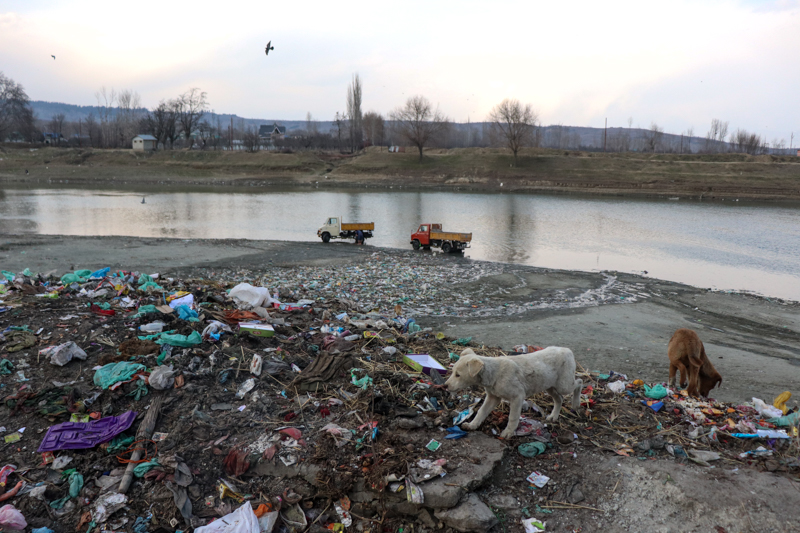
Recent observations from Srinagar have documented plastic bottles, food wrappers, cans and other solid waste in parts of the lake, alongside expanding aquatic weeds and other signs of ecological stress.
But the more worrying evidence is hidden below the surface.
A 2025 study published in Science of the Total Environment found microplastics in Dal Lake’s water, sediments and fish.
Researchers recorded concentrations ranging from 10 to 157 microplastic particles per litre in water, while sediments contained between 385 and 9,178 particles per kilogram of dry weight. Microplastics were also detected in fish, with researchers identifying polyethylene, polypropylene, polystyrene and other polymers.
Another study found substantial microplastic contamination in Dal Lake’s shoreline sediments, with concentrations ranging from 503 to 3,154 particles per kilogram.
These findings change the nature of the conversation.
The problem is no longer merely whether visitors can see plastic floating on the lake.
The question is how much plastic has already fragmented into particles small enough to enter sediments and aquatic organisms.
Fish are now part of the plastic story
Research published in 2025 reported microplastics in commercially important fish and water from the Dal Lake ecosystem.
The study recorded an average abundance of about 196.65 microplastic particles per litre in sampled water, while fish contained varying numbers of particles depending on species. Polyethylene was the most abundant polymer detected.
The researchers noted that the presence of microplastics in aquatic organisms raises concerns about movement through food webs.
This does not mean that eating fish from Dal Lake automatically causes a specific disease or that a public-health emergency has been established.
It means something more basic and more concerning:
Plastic pollution has entered the biological system of one of Kashmir’s most important freshwater ecosystems.
That should be enough to force a rethink of waste management.
Jhelum cannot be treated as a waste conveyor belt
The same problem extends beyond Dal Lake.
The Jhelum is both an ecological asset and a crucial component of Kashmir’s water system.
Yet stretches of its urban banks have repeatedly been reported as receiving plastic bottles, polythene bags and other discarded waste. Local accounts and environmental reporting have described sections of the riverfront as informal dumping grounds.
This creates a dangerous feedback loop.
Poor waste collection encourages dumping.
Dumping places pressure on drains and waterways.
Polluted waterways increase the cost of restoration.
And once waste enters rivers and lakes, municipalities have to spend public money removing it.
In other words:
The cheaper option — preventing plastic from entering the environment — is replaced by the much more expensive option of cleaning it out later.
Tourism is multiplying the pressure
Kashmir’s tourism success has an environmental price that cannot be ignored.
Jammu and Kashmir recorded more than 1.61 crore tourist visits in 2025, according to the UT government’s 2026-27 Budget Speech. The government has simultaneously acknowledged the need to strengthen environmental infrastructure at major destinations.
More visitors mean more economic activity.
They also mean more bottles, food packaging, disposable items and other waste unless collection systems expand at the same pace.
Recent reporting from Kashmir’s offbeat destinations found residents raising concerns over plastic bottles, wrappers and other waste being discarded in places including Gurez, Tulail, Uri, Sonamarg and Keran Valley amid increased tourist activity.
The issue is particularly serious in mountain environments.
A plastic wrapper discarded beside a city road is already a problem.
The same wrapper discarded beside a high-altitude stream or meadow can become a much harder environmental challenge because collection, transportation and disposal infrastructure is limited.
Pahalgam has recognised the problem — but enforcement must last
There are examples of authorities attempting a more aggressive approach.
In February 2026, the Pahalgam Development Authority declared its jurisdiction a polythene-free zone, prohibiting the carrying and use of a broad range of plastic items across tourist spots, parks, streams, forests, markets, residential and commercial areas and other locations.
The order reportedly prescribed a ₹2,000 fine for violations, with stronger action for repeated offences, including possible cancellation of tourism registration.
Such destination-specific regulation can work if it is backed by:
- adequate inspection teams;
- alternative packaging;
- waste collection points;
- vendor compliance;
- tourist awareness;
- and consistent penalties.
The real test is not whether an authority can impose a ban for a few months.
It is whether the destination can remain effectively plastic-controlled during the busiest tourist periods year after year.
Gulmarg shows why cleaning alone is not enough
Gulmarg has also faced visible plastic-waste problems.
A 2026 report submitted before the National Green Tribunal described solid-waste management arrangements at Gulmarg, including a 3-tonne solid-waste treatment plant, a dedicated fenced dumping area and segregation of biodegradable and non-biodegradable waste. It also recorded periodic clean-up drives in areas including Kangdoori, Afarwat and Gulmarg meadows.
Yet in April 2026, a viral video showing discarded plastic bags, bottles and food waste in snow at Gulmarg triggered public outrage.
The lesson is uncomfortable.
Infrastructure and clean-up drives can exist alongside irresponsible behaviour.
A destination needs both.
Waste-processing capacity without enforcement will be overwhelmed.
Enforcement without adequate collection will frustrate residents and businesses.
Awareness without convenient alternatives will have limited effect.
Jammu’s experience offers another lesson
The problem is not confined to Kashmir.
Jammu Municipal Corporation has been actively imposing penalties for polythene use and other forms of improper waste disposal.
Its 2025-26 figures show that the corporation collected substantial fines and issued thousands of challans. It has also run awareness campaigns discouraging residents from throwing waste into drains, rivers and other water bodies.
At the same time, the District Jammu administration issued an order in August 2026 prohibiting open dumping and disposal of waste within a 10-kilometre radius of Jammu Airport.
These measures show that the administration recognises the problem.
But they also reveal how much enforcement remains necessary.
A mature waste-management system should ultimately reduce dependence on repeated emergency orders and fines.
The bigger weakness: segregation
Plastic pollution cannot be solved only at the point of sale.
It must be managed at the point where waste is generated.
J&K’s own 2026 urban sanitation planning recognises this.
The UT’s Swachh J&K programme has been promoting four-stream waste segregation at source, including wet, dry, domestic hazardous and sanitary waste, alongside home composting and stronger management of bulk waste generators. The programme covers all 80 urban local bodies.
This is a significant policy direction.
But segregation must actually happen inside homes, hotels, restaurants, shops, institutions and markets.
If everything is mixed together in one collection vehicle, recyclable plastic becomes contaminated with food waste and other materials, making recovery more difficult and expensive.
The objective should therefore be:
segregate → collect separately → recover → recycle → safely dispose of residual waste.
Without that chain, a plastic ban remains incomplete.
Waste workers are an essential part of the solution
There is another dimension that is often missing from public discussions.
Waste management depends on sanitation workers.
Collection, sorting, transportation and cleaning are physically demanding jobs. If workers are poorly equipped, insufficiently protected or inadequately supported, the quality of the entire waste-management chain suffers.
The J&K Legislative Assembly’s Committee on Environment raised concerns in June 2026 about the region’s plastic pollution while also calling for dialogue to resolve a strike by sanitation workers.
That connection matters.
A city cannot demand cleaner streets while treating the people responsible for keeping those streets clean as an afterthought.
Better waste management requires better worker safety, reliable equipment, training, staffing and institutional support.
Plastic burning creates another environmental problem
When collection systems fail, households sometimes resort to burning waste.
That is particularly dangerous when the waste stream contains plastic.
Open burning releases particulate matter and a range of potentially harmful pollutants. It also converts a visible solid-waste problem into an air-pollution problem.
A 2026 investigation from Kashmir documented roadside and village-level plastic waste accumulation and reported instances of open waste burning where residents lacked adequate waste-management facilities.
This creates a vicious cycle:
poor collection → dumping or burning → air and water pollution → greater health and environmental pressure.
Therefore, enforcement against burning must go hand in hand with reliable collection.
Simply telling residents not to burn waste without giving them a functioning alternative is unlikely to produce lasting results.
The problem is not just “lack of awareness”
Public awareness is important.
But blaming consumers alone would be too easy.
A shopper may choose a reusable bag when one is available.
A tourist may carry a bottle.
A hotel may segregate waste.
A shopkeeper may refuse banned packaging.
But behaviour becomes much easier to change when the system makes the environmentally responsible choice convenient and affordable.
That means authorities need to work simultaneously on:
supply, enforcement, infrastructure and behaviour.
If banned bags continue entering markets, consumers will continue using them.
If collection points are absent, visitors will continue leaving waste where they can.
If waste is collected mixed, recycling will remain inefficient.
If penalties are occasional, violators will treat them as a manageable business cost.
The problem is therefore systemic.
Alternatives must be genuinely viable
The answer cannot simply be “replace plastic with something else”.
Paper, cloth, jute and certified compostable alternatives have different costs and environmental footprints.
A reusable cloth or jute bag can be effective because it can replace hundreds of disposable bags if actually reused.
But alternatives must be:
- affordable;
- durable;
- locally available;
- convenient for consumers;
- and supported by consistent standards.
Otherwise, the market will continue returning to the cheapest disposable option.
Government procurement and tourism policy could help create demand for sustainable packaging by requiring hotels, government offices, events and tourist facilities to reduce disposable plastic use.
Kashmir needs to move from clean-up drives to prevention
Clean-up campaigns have value.
They remove waste immediately.
They generate public awareness.
They can reconnect communities with their environment.
But they cannot become a substitute for prevention.
Picking up 10,000 bottles from a lake shore is useful.
Stopping those bottles from reaching the lake in the first place is better.
The policy hierarchy should therefore be:
reduce → reuse → recover → recycle → dispose safely.
Cleanup should remain the final safety net rather than the primary strategy.
A plastic-free Kashmir will require stronger tourism rules
Tourism authorities have an opportunity to make environmental protection part of the visitor experience.
At major destinations, authorities could require:
- reusable or refillable drinking-water systems;
- deposit-return mechanisms for bottles;
- clearly marked waste segregation stations;
- mandatory waste take-back arrangements for commercial operators;
- restrictions on disposable packaging;
- vendor-level plastic audits;
- and penalties linked to tourism licences.
The principle should be simple:
If a business earns money from a fragile landscape, it should also share responsibility for protecting that landscape.
That applies to hotels, restaurants, camps, vendors, transport operators, adventure-tourism companies and event organisers.
Dal Lake needs a different level of urgency
Dal Lake is not simply another urban water body.
It is an ecological system, tourism asset, cultural symbol and livelihood space.
The discovery of microplastics in its water, sediments and fish means that the plastic problem has moved beyond aesthetics.
Every bottle removed from the lake matters.
But so does every bottle prevented from entering it.
The same applies to the Jhelum, Wular and Kashmir’s network of streams and wetlands.
Water bodies cannot be expected to absorb the consequences of an inadequate urban waste system indefinitely.
The governance gap is the real story
It would be inaccurate to say J&K has no plastic policy.
It has laws.
It has bans.
It has inspections.
It has seizures.
It has fines.
It has awareness programmes.
It has waste-management projects.
It has plastic-free tourism initiatives.
The problem is the gap between all of those measures and what residents can still see on the ground.
That gap is the real environmental story.
A successful plastic policy should eventually make illegal plastic difficult to find, waste segregation normal, recycling economically viable and littering socially unacceptable.
J&K has not reached that point yet.
What needs to change
1. Make enforcement continuous
Plastic enforcement should not intensify only during festivals, tourist seasons or inspection drives.
Markets need regular monitoring throughout the year.
2. Track the entire plastic supply chain
Authorities need to identify where banned plastic enters the UT, who distributes it and where it reaches consumers.
3. Strengthen source segregation
Every household, hotel, restaurant, market and institution should be integrated into a functioning segregated collection system.
4. Create destination-specific waste plans
Gulmarg, Pahalgam, Sonamarg, Dal Lake and other high-footfall destinations require waste systems designed around their seasonal visitor loads.
5. Make producers share responsibility
Plastic packaging cannot be treated solely as a municipal problem. Extended Producer Responsibility must work in practice, with collection and recycling obligations properly monitored.
6. Protect drains and waterways
Litter traps, drain screening, routine desilting and rapid removal of floating waste can reduce the amount of plastic reaching rivers and lakes.
7. Give sanitation workers institutional support
Adequate staffing, protective equipment, mechanisation, training and timely wages are basic requirements of an effective waste system.
8. Publish enforcement data
Citizens should know how much plastic has been seized, how many violations were recorded, how much was recovered, how many cases resulted in penalties and how much waste was actually recycled.
Transparency can turn enforcement from a headline into an accountable system.
Kashmir cannot ban its way out of the plastic crisis
A ban is necessary when a product creates unacceptable environmental costs.
But a ban alone does not eliminate demand.
Nor does it create collection infrastructure.
Nor does it automatically change consumer behaviour.
Nor does it prevent plastic from entering through informal channels.
Jammu and Kashmir’s own enforcement figures demonstrate this contradiction: tens of thousands of kilograms of illegal polythene continue to be seized despite years of restrictions.
The answer is therefore not another announcement followed by another short-lived campaign.
It is a permanent system.
A system in which plastic reduction begins with manufacturers and suppliers, continues through retailers and consumers, and ends with scientifically managed recovery and disposal.
The choice is between prevention and perpetual cleanup
Kashmir’s natural environment cannot carry an unlimited plastic burden.
The mountains generate the water.
The rivers carry it.
The lakes store it.
The wetlands filter it.
And tourism depends on the beauty of the entire landscape.
If plastic continues entering that system faster than authorities can remove it, every cleanup operation will simply be chasing the symptom.
The real measure of success should not be how much plastic officials collect during a drive.
It should be how little plastic reaches the environment in the first place.
Jammu and Kashmir has already written the rules.
It has already announced the bans.
It has already demonstrated that officials can seize illegal plastic and impose penalties.
The next challenge is harder:
make those rules work every day, in every market, at every tourist destination and along every vulnerable waterway.
Until that happens, the plastic bag will remain a small object carrying a much bigger message about the gap between environmental policy and environmental reality.