El Niño Warning for J&K: A Milder, Drier Winter Could Put Snow, Water and Tourism Under Pressure
By: News Desk | 14 September 2026
Kashmir’s winter is unlikely to disappear — but it could arrive differently
For Jammu and Kashmir, winter is much more than a season of cold.
Snowfall replenishes mountain water stores, supports downstream river flows, sustains agriculture and horticulture, feeds springs and adds the white landscape on which much of the Valley’s winter-tourism economy depends.
That is why the latest warning from the Meteorological Department deserves attention.
Director of Meteorological Department Srinagar Dr Mukhtar Ahmad has said Jammu and Kashmir could experience a relatively mild and drier-than-normal winter during late 2026 and early 2027 under the influence of El Niño. At the same time, he has cautioned against treating the seasonal outlook as a certainty, saying one or two significant snowfall spells during the peak winter period cannot be ruled out.
That qualification is crucial.
The forecast is not that winter will vanish, nor that Kashmir will receive no snow.
The concern is that the overall season could contain longer dry periods, warmer temperatures and less persistent snow cover, with occasional heavy snowfall still possible when strong Western Disturbances reach the region.
For a Himalayan territory where snow functions as both a tourism asset and a natural water reservoir, that distinction could have consequences extending well beyond the winter months.
El Niño is strengthening globally
The warning comes against the backdrop of an unusually strong El Niño developing in the tropical Pacific.
The US National Oceanic and Atmospheric Administration’s Climate Prediction Center said on September 10 that El Niño was strengthening and put the probability of a very strong event during the Northern Hemisphere autumn and winter of 2026–27 above 90 percent. The agency also estimated a 75 percent chance that the October–December 2026 period could produce an event stronger than previous El Niños since 1950 under its historical threshold.
Pacific Ocean temperatures are already substantially above average in key monitoring regions.
That does not mean every consequence of El Niño can be predicted with certainty for Kashmir. Global climate teleconnections interact with regional atmospheric systems, and the weather over the western Himalayas is particularly sensitive to the behaviour of Western Disturbances, moisture availability and other circulation patterns.
This is why seasonal forecasts should be interpreted as probabilities rather than guarantees.
Still, the background signal is significant.
Why Western Disturbances matter more to Kashmir than a simple El Niño headline suggests
The winter weather of Jammu and Kashmir cannot be explained by El Niño alone.
One of the most important mechanisms is the arrival of Western Disturbances — eastward-moving weather systems that bring winter precipitation to the western Himalayas.
An IMD-linked study examining J&K weather between 1980 and 2019 recorded 600 Western Disturbance cases during November–April and found a relationship between their frequency and precipitation.
Another study of Kashmir Himalaya found that winter precipitation has substantial variability associated with Western Disturbances and broader climate teleconnections, including ENSO. It also reported a decline in the frequency of Western Disturbances after 2000, although the trend in total winter precipitation was more complex and not simply a uniform decline.
This helps explain why a single strong Western Disturbance can transform the winter outlook.
A season may begin unusually dry, only for a major storm to bring substantial snowfall in a few days.
Conversely, frequent but weak systems may produce clouds and occasional light precipitation without generating the sustained snowpack needed by the mountains.
That is essentially the uncertainty facing J&K this winter.
“Milder” does not mean “no cold”
The MeT Director has specifically rejected social-media claims that winter will somehow not occur in India.
Winter will arrive.
Cold spells will occur.
Snowfall will occur.
The question is the overall character of the season.
Dr Ahmad said J&K has already experienced relatively mild winters in recent years, with prolonged dry periods sometimes interrupted by one or two snowfall spells. He also noted that frequent Western Disturbances currently affecting the region have generally been weak.
This distinction matters because a warmer winter can alter what happens after precipitation arrives.
If temperatures are higher, snow may melt sooner.
If snowfall arrives late, its persistence can be shorter.
And if precipitation falls as rain rather than snow at lower and middle elevations, the immediate water may reach streams while the longer-term snow reservoir is reduced.
For the Himalayas, when precipitation falls can be nearly as important as how much precipitation falls.
Kashmir’s snowpack is a natural water reservoir
The biggest concern may not be the winter landscape itself.
It is what happens to the water cycle afterward.
Research on the western Himalayas has established the importance of snow and glacier melt in regulating seasonal river discharge. Studies of the Liddar watershed, for example, show that snowmelt and glacier/ice melt play an important role in the seasonal hydrology of the Kashmir Himalaya.
A recent assessment of snow resources across Jammu and Kashmir, covering 1974–2024, reported declining snow-water equivalent and snow cover in several high-altitude areas, alongside warming trends and shorter snow-cover duration. The study linked these changes to declining contributions to summer runoff and growing water-security concerns.
This makes a dry winter potentially consequential.
Less persistent snow does not automatically mean less water everywhere — rainfall, groundwater, glacier melt and individual storm events also matter.
But a reduced snow reservoir can change the timing and reliability of water availability, particularly during the spring and summer transition.
For farmers, that is an issue worth watching now rather than after the snow disappears.
Agriculture could feel the effects beyond snowfall totals
The impact on agriculture is more complicated than simply saying “less snow means fewer crops.”
Different crops respond to different combinations of temperature, rainfall, soil moisture and seasonal timing.
For saffron, for example, rainfall is particularly important because cultivation in Kashmir is largely rainfed. Research from SKUAST-linked authors found positive relationships between saffron production and rainfall in August and October, while periods of low rainfall and drought created a need for supplementary irrigation.
Recent research from Kashmir has also found that minimum temperature and rainfall influence saffron quality, demonstrating that weather conditions during the flowering period can affect the crop’s biochemical characteristics.
So the winter forecast should not be interpreted as an immediate prediction of saffron losses.
The bigger issue is seasonal water balance.
If a relatively dry winter is followed by inadequate spring precipitation, rainfed agricultural systems could face greater moisture stress.
Apples have a different vulnerability
Apple cultivation presents another dimension.
Apple trees require adequate winter chilling to complete their dormancy cycle. Research on apple cultivation in the Indian Himalayas has found that insufficient chilling can adversely affect fruit formation, while unusually delayed cold during December and January can interfere with the chilling requirement of some cultivars.
This means a warmer winter is not automatically beneficial for horticulture.
Farmers may welcome relief from extreme cold, but persistent winter warming can interfere with biological processes that depend on seasonal temperature cycles.
At the same time, extreme cold and frost can also damage crops.
The relationship is therefore not linear.
For Kashmir’s horticulture economy, what matters is whether temperatures, snowfall, rainfall and cold periods remain within conditions that established crop varieties can tolerate.
Paddy and spring agriculture face a different water question
Paddy and other spring/summer crops are more directly exposed to water availability.
A snowpack accumulated during winter can act as delayed storage. Meltwater contributes to streams and river systems during the warmer months, when agricultural demand is rising.
Research on the Kashmir Valley’s Upper Jhelum Basin describes snow, rainfall, meltwater and groundwater as important components of the region’s water resources, with agriculture, horticulture and hydropower dependent on these supplies.
This is why hydrologists are increasingly concerned not merely with annual precipitation totals but with precipitation form, timing and runoff.
Two winters can receive similar amounts of total precipitation but produce very different hydrological outcomes if one stores a large share as snow and the other delivers more rainfall.
Tourism will be watching the sky
Few sectors have a more immediate relationship with snowfall than Kashmir’s winter-tourism industry.
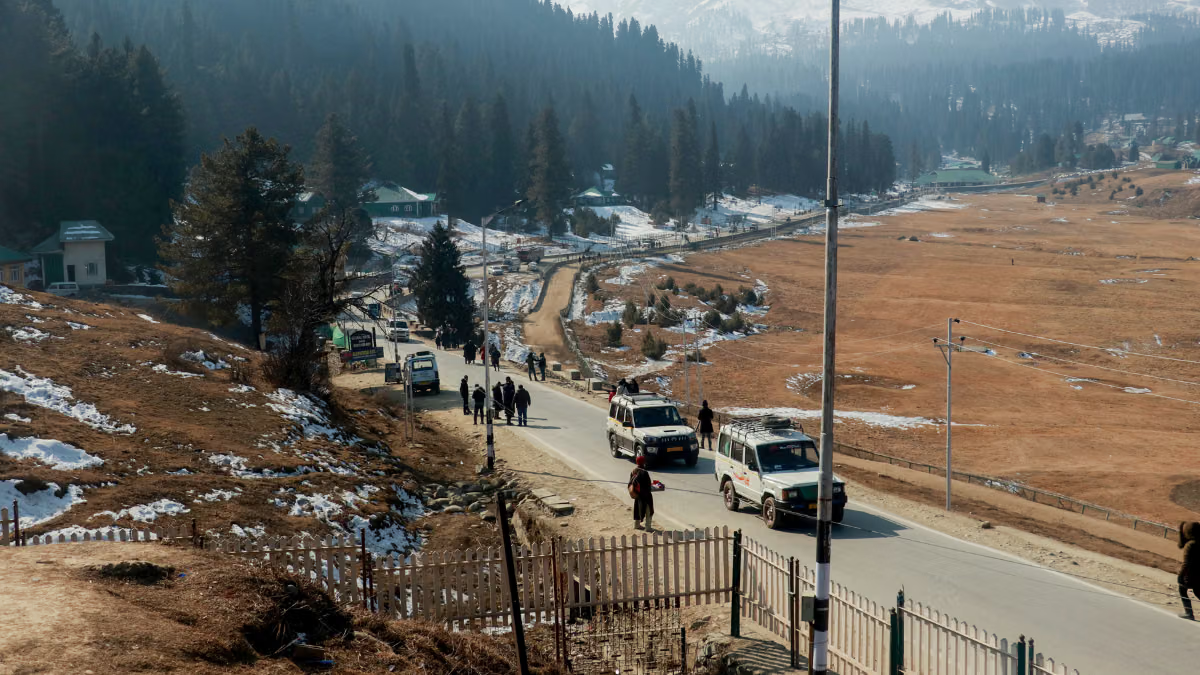
Gulmarg, Pahalgam and other high-altitude destinations depend heavily on reliable snow conditions, particularly for skiing and other winter activities.
Long-term research on Kashmir’s winter tourism has already documented concerns over declining and shifting snowfall patterns, increasing temperatures and shorter or less reliable snow-cover periods.
A study focusing specifically on snowfall variability at Gulmarg and Pahalgam found declining snowfall trends at several seasonal timescales and linked changing snowfall characteristics with rising temperatures. It also noted the economic importance of snowfall for tourism in these destinations.
The vulnerability is therefore straightforward.
A short-lived snowfall event can make a destination look spectacular for a few days.
But ski tourism requires persistent snow cover, not merely one dramatic storm.
If temperatures remain relatively high afterward, snow can melt rapidly.
That creates a difficult business environment for hotels, transport operators, guides, ski instructors, equipment providers, pony operators, restaurants and thousands of workers whose incomes rise during the winter season.
Gulmarg may not lose its winter season — but reliability is the issue
It would be premature to predict a failed ski season.
The MeT Director has explicitly said one or two major snowfall spells remain possible during peak winter if strong Western Disturbances and sufficient moisture reach the region.
That means the critical question for tourism operators will be snow reliability.
When does the first substantial snowfall arrive?
How long does it remain?
Does another Western Disturbance replenish the snowpack?
Are temperatures cold enough to preserve the snow?
And does the peak tourism period coincide with adequate snow?
These questions cannot be answered in September.
But they explain why the seasonal outlook matters.
The climate-change backdrop makes the warning more serious
El Niño is a natural climate phenomenon.
It should not be used as a catch-all explanation for every recent change in Kashmir’s winter.
The Valley is also experiencing longer-term warming and changes in snow behaviour.
A 2025 study of J&K snow resources reported significant declines in snow-water equivalent and snow cover over several decades and linked these changes to rising temperatures and shorter snow-cover duration.
Research on Gulmarg and Pahalgam has similarly documented warming alongside changing snowfall patterns.
That means El Niño is arriving on top of an already changing climate system.
The concern is therefore not simply:
“Will El Niño reduce snowfall this winter?”
The more important question is:
“What happens when a potentially warm, dry winter interacts with a Himalayan system that is already experiencing declining snow storage and warming?”
That is where water security becomes the central issue.
The water-security warning should begin before winter
Authorities should not wait until February to assess the consequences of a dry winter.
If seasonal snowfall remains below normal, departments responsible for agriculture, water resources, horticulture, hydropower and disaster management should begin tracking the implications for spring and summer water availability.
Snow-water equivalent measurements, snow-cover mapping, reservoir levels, streamflow and groundwater conditions can provide an early indication of whether a dry winter is developing into a larger water-management problem.
The 2025 J&K snow-resource study specifically points toward real-time snow monitoring and sustainable water management as important adaptation measures.
For farmers, early information is valuable.
For tourism operators, it can inform business planning.
For water managers, it can help identify emerging shortages before they become crises.
There is also a hidden benefit — lower heating demand
A milder winter would not be entirely negative.
Warmer conditions can reduce heating requirements for households and businesses, potentially easing energy demand and winter hardship.
But that benefit should not obscure the wider trade-off.
If the same mild conditions reduce persistent snow cover and contribute to earlier melt, the short-term comfort of a warmer winter could be accompanied by longer-term pressure on water resources.
In a Himalayan region, cold itself is not necessarily the problem; an altered seasonal water cycle can be.
The real wildcard remains the Western Disturbance
For all the attention on El Niño, the immediate weather-maker for Kashmir this winter will still be the atmospheric systems that actually deliver precipitation.
A strong Western Disturbance carrying sufficient moisture can bring substantial snowfall even during an otherwise dry seasonal pattern.
The MeT Director has made precisely this point, noting that one or two strong spells could still make a meaningful difference during the peak winter months.
This is why forecasts will need to be updated as winter approaches.
September’s seasonal outlook cannot tell Kashmir whether a particular week in January will receive heavy snow.
Short- and medium-range forecasts closer to the event will be far more useful for that purpose.
What J&K should prepare for
Rather than treating the forecast as either good news or bad news, authorities should prepare for several scenarios.
Scenario one: Mild and dry winter.
Snow accumulation remains below normal and spring water availability comes under pressure.
Scenario two: Dry start followed by major snowfall.
Tourism receives a late-season boost, while water resources may still recover depending on snow persistence and subsequent temperatures.
Scenario three: Repeated moderate snowfall events.
Snowpack builds gradually and the hydrological consequences are less severe than the headline seasonal forecast might suggest.
Scenario four: Warm winter with rain replacing some snowfall.
Immediate precipitation may occur without creating an equivalent long-lasting mountain snow reservoir.
The fourth scenario could be particularly important at elevations where temperatures increasingly hover around the rain-snow transition zone.
Kashmir should watch the snow, not just the temperature
The temptation with a “milder winter” headline is to focus on temperature.
For Kashmir, that would miss half the story.
The more important indicators will include:
- cumulative snowfall at key elevations;
- snow-water equivalent;
- duration of snow cover;
- frequency and intensity of Western Disturbances;
- rainfall-versus-snowfall share;
- spring streamflow;
- reservoir and groundwater conditions;
- winter soil moisture;
- and the persistence of snow in major tourism destinations.
Those indicators will tell authorities far more about the coming water year than a simple seasonal temperature average.
A warning for Gulmarg, farmers and water managers — but not a prediction of disaster
Jammu and Kashmir has experienced several recent winters in which prolonged dry periods were punctuated by short snowfall spells. The MeT Department itself has urged people not to draw extreme conclusions from long-range forecasts.
That is the right approach.
The latest forecast should neither be ignored nor sensationalised.
A warmer and drier winter is more likely, according to the current outlook, but the season will still be shaped by Western Disturbances and moisture availability.
For tourism, that means uncertainty over snow reliability.
For agriculture, it means watching soil moisture and later-season water availability.
For hydrology, it means monitoring the snow reservoir.
For households, it could mean lower heating demand but potentially greater concern about water availability later in the year.
And for policymakers, it means one simple thing:
The best time to prepare for a weak snow season is before the snow season begins.
Kashmir’s mountains store water in winter for use much later.
If El Niño helps produce a milder and drier winter, the most important question will not be whether Srinagar feels a few degrees warmer.
It will be whether the mountains receive — and retain — enough snow to carry the Valley through the seasons that follow.