Mian Altaf Ahmad Flags J&K’s Political Uncertainty, Puts Unemployment, Healthcare and Statehood Back in Focus
By: News Desk | 12 September 2026
Srinagar: A senior National Conference (NC) voice has once again highlighted the growing gap between political expectations and day-to-day governance in Jammu & Kashmir, with party MP Mian Altaf Ahmad saying he is not satisfied with the prevailing political situation and describing it as uncertain.
His remarks are significant not simply because they come from an opposition leader, but because Ahmad is himself a senior NC parliamentarian representing the Anantnag-Rajouri constituency and has previously voiced concerns about the performance of the Omar Abdullah government.
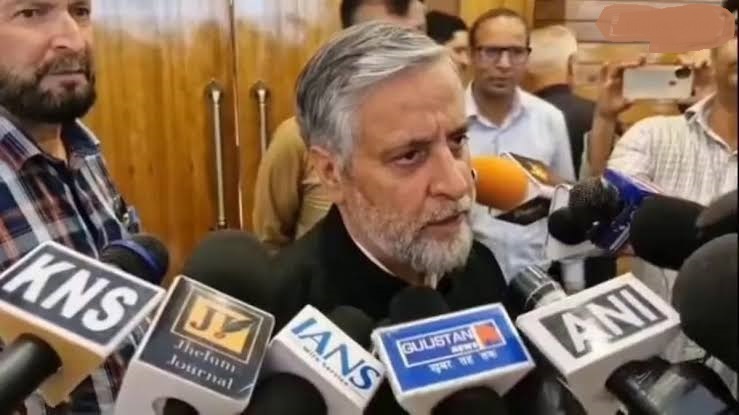
Speaking recently, Ahmad said the government must do more to meet public expectations, particularly on unemployment and healthcare, while reiterating that the restoration of Jammu & Kashmir’s statehood remains a demand that people across the region want addressed.
The comments put three issues—political uncertainty, economic frustration and incomplete institutional restoration—at the centre of the J&K debate once again.
Mian Altaf Ahmad’s Unusual Admission: “No One Is Satisfied”
Ahmad’s assessment was unusually candid.
He said the political conditions in Jammu & Kashmir are uncertain and that he himself is not satisfied with the situation. Rather than limiting his criticism to a particular department or administrative decision, he connected the political atmosphere with the expectations people have from the government.
That distinction matters.
The NC returned to power after the 2024 Assembly elections on a platform that included governance reforms as well as political commitments. Nearly two years into the government’s tenure, questions over the pace of delivery have increasingly become part of the political conversation—even within the NC itself.
Ahmad’s latest comments therefore reflect a broader tension: the difference between winning political power and demonstrating visible improvements in people’s everyday lives.
He specifically called for the government to make greater efforts to fulfil people’s expectations, with unemployment among the issues requiring particular attention.
Unemployment Remains the Biggest Pressure Point
For Jammu & Kashmir’s young population, employment remains one of the most politically sensitive issues.
Ahmad’s criticism is not occurring in isolation. In October 2025, he had already expressed dissatisfaction with the government’s handling of unemployment and argued that vacant posts should have been referred to recruitment agencies quickly, with recruitment conducted transparently. He also said there had been insufficient progress on some of the government’s political commitments.
That earlier criticism makes his latest remarks more consequential.
The concern is no longer simply about the number of government jobs. It encompasses:
- delays in recruitment;
- uncertainty surrounding vacancies and selection processes;
- limited employment opportunities in the private sector;
- expectations among educated young people;
- and the wider perception that political change has not yet translated into sufficient economic opportunity.
For a region where government employment has historically been particularly important, delays or uncertainty in recruitment can quickly become a political issue.
Ahmad’s message is therefore straightforward: political stability cannot be separated from economic confidence.
Rajouri and Poonch: Healthcare Becomes a Local Test of Governance
The second major issue raised by Ahmad was healthcare, particularly in Rajouri and Poonch.
The timing is notable because he had already raised concerns about healthcare infrastructure in Rajouri earlier this month.
On September 5, Ahmad called for an overhaul of health infrastructure and the filling of critical vacancies in hospitals and primary healthcare facilities. He specifically pointed to operational constraints at Government Medical College Rajouri, sub-district hospitals and rural health facilities, including shortages of specialist doctors, medical officers, nurses and technical personnel.
He also called for better-equipped primary and community health centres, essential diagnostic equipment, adequate supplies of life-saving medicines, reliable power backup and advanced life-support ambulances for remote areas.
This gives his latest political statement a practical dimension.
For people living in remote, mountainous and border areas, healthcare is not an abstract governance issue. Distance, difficult terrain and shortages of specialists can turn routine medical treatment into a major logistical problem.
Rajouri and Poonch therefore provide an important test of whether government investment is reaching areas outside the major urban centres.
Statehood Remains the Political Question Hanging Over J&K
Perhaps the most politically significant part of Ahmad’s latest statement was his renewed call for restoration of statehood.
He said that people across Jammu & Kashmir want statehood restored and that the benefits of governance should reach the people.
This has been a consistent position for Ahmad.
In June 2026, he described the restoration of statehood as a democratic demand and supported the NC’s proposed demonstration in New Delhi. He said peaceful protest over statehood was a legitimate democratic right.
His latest remarks therefore reinforce, rather than introduce, the NC’s continuing statehood campaign.
The political significance is considerable.
Jammu & Kashmir has elected its government, but it continues to function as a Union Territory rather than as a full-fledged state. The distinction affects the distribution of powers and remains deeply embedded in the political debate.
For the NC, restoration of statehood has consequently become one of the most important issues through which it measures the post-2019 political settlement.
Omar Abdullah’s Communication With Delhi Adds Another Layer
Ahmad’s comments come shortly after Chief Minister Omar Abdullah said he remains in continuous communication with Union Home Minister Amit Shah over several issues concerning Jammu & Kashmir and the Centre.
According to Omar, the discussions include statehood, business rules and reservation-related matters. He also pointed to the absence of a regular Advocate General for almost two years as one of the administrative issues requiring attention.
This is an important counterpoint to the criticism coming from within the NC.
The government can argue that several matters affecting J&K cannot be resolved entirely within the jurisdiction of the Union Territory administration. Some require decisions or cooperation from the Centre.
At the same time, Ahmad’s intervention illustrates why that explanation may not be enough for everyone.
For ordinary citizens, the distinction between a matter controlled by Srinagar and one requiring New Delhi’s approval can be less important than the outcome.
They want jobs. They want functioning hospitals. They want predictable administration. And they want political commitments to produce visible results.
Is This a Challenge to Omar Abdullah?
It would be too simplistic to interpret every critical statement by an NC leader as an open rebellion against Omar Abdullah.
Ahmad has previously made clear that his criticism is intended to push the government towards better performance. In 2025, while criticising governance, he said that pretending everything was fine would itself amount to betraying Omar Abdullah.
That suggests something more complicated than a straightforward leadership revolt.
The NC contains leaders with different political constituencies and political priorities. Ahmad has considerable influence in the Rajouri-Poonch and wider Gujjar-Pahari belt, while other senior NC figures represent different social and regional constituencies.
Their concerns may overlap, but their political emphasis is not always identical.
The emerging message from leaders such as Ahmad and Aga Syed Ruhullah Mehdi is that the Omar Abdullah government cannot afford to allow political promises and governance performance to drift apart.
The Trust Deficit Is Bigger Than One Party
Ahmad’s remarks also point to a wider problem in J&K politics: the question of public trust.
The region has undergone enormous political change since 2019. The special constitutional position was removed, the former state was reorganised into two Union Territories, Assembly elections were eventually held, and an elected government returned to office in 2024.
Yet many of the political questions generated by that transformation remain unresolved or contested.
Statehood is the clearest example.
At the same time, citizens judge governments through much more immediate concerns. A young graduate waiting for recruitment, a patient travelling from a remote village to a specialist hospital, or a family struggling with infrastructure problems is likely to assess governance through everyday experience rather than constitutional arguments alone.
That is why Ahmad’s decision to put employment and healthcare alongside statehood is politically significant.
It connects the constitutional debate with the daily experience of citizens.
Rajouri-Poonch Could Become an Important Political Barometer
The Anantnag-Rajouri parliamentary constituency is geographically and socially diverse, stretching across areas with very different political histories and developmental challenges.
Rajouri and Poonch have particular importance because of their mountainous terrain, border location and infrastructure constraints.
The healthcare concerns raised by Ahmad consequently have a significance beyond one parliamentary constituency.
If the government can improve medical infrastructure, recruitment, roads, public services and employment opportunities in such difficult terrain, it can demonstrate that political change is translating into tangible governance.
If improvements remain slow, opposition parties—and increasingly voices within the NC itself—will have greater room to argue that public expectations have not been met.
NC’s Balancing Act: Governance Versus Political Commitments
The latest comments expose the balancing act facing the National Conference.
On one side, the party has to govern within the constitutional and administrative framework that currently exists.
On the other, it must continue addressing the political expectations that helped mobilise its support base, particularly the demand for restoration of statehood and broader political rights.
Omar Abdullah’s government has repeatedly maintained that it is pursuing statehood while focusing on governance.
Ahmad’s comments suggest that supporters want both tracks to move forward.
They do not see development and political rights as competing priorities.
Instead, they expect the government to deliver on both.
What Mian Altaf’s Remarks Mean for J&K Politics
The immediate significance of Ahmad’s statement is that criticism of the government’s performance is no longer confined to opposition parties.
It is coming from within the ruling National Conference itself.
That does not necessarily signal a split. But it does indicate that the leadership will have to manage internal expectations alongside pressure from opposition parties and the Centre.
Three questions will increasingly define the political debate:
First, when will statehood be restored?
Second, how quickly can unemployment and recruitment concerns be addressed?
Third, can healthcare and other public services improve sufficiently for people to feel that elected government has made a meaningful difference?
The answers will shape how the NC is judged during the remainder of its term.
The Bigger Picture: People Want Results
Mian Altaf Ahmad’s intervention ultimately brings the J&K debate back to a simple political reality.
Constitutional questions remain important. Statehood remains a central demand. Administrative relations with New Delhi remain politically sensitive.
But governments are also judged in hospitals, recruitment offices, schools, roads and villages.
Ahmad’s message is that uncertainty at the political level cannot be allowed to become stagnation at the governance level.
His criticism is therefore both a warning to the Omar Abdullah government and a reminder of the challenge facing the NC: it must convince people that the return of an elected government can deliver not only political representation, but also jobs, healthcare, institutional stability and a credible path back to statehood.
For Jammu & Kashmir, that gap between expectation and delivery may prove to be one of the defining political stories of the coming years.