Mirwaiz Umar Farooq, Two Kashmiri Shia Leaders Attend Iran-Hosted Event in Delhi, Meet Pezeshkian
By: News Desk | 11 September 2026
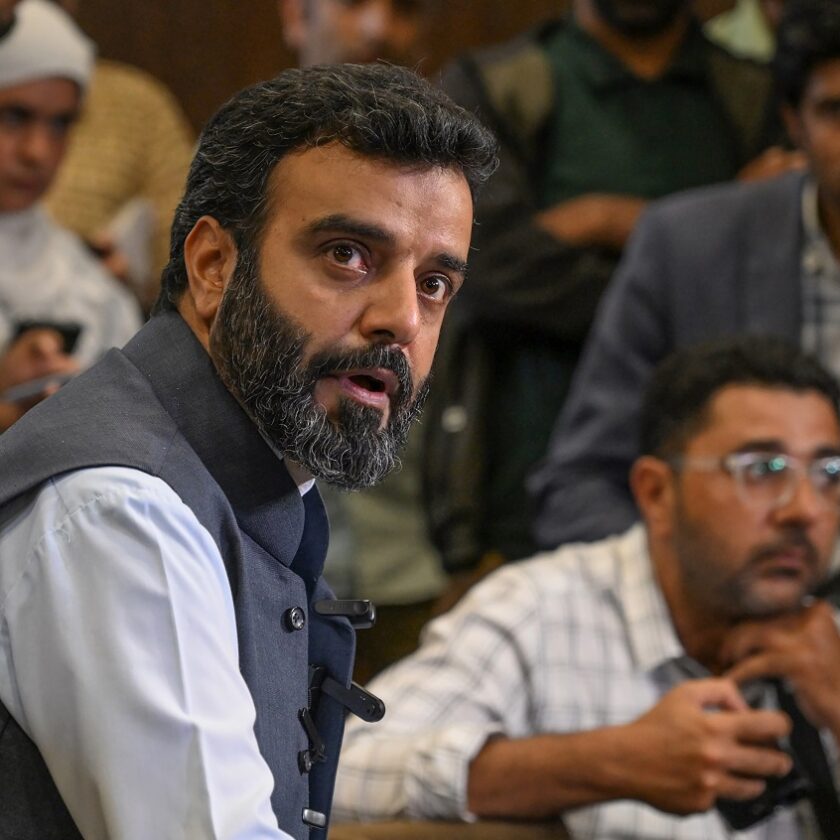
New Delhi/Srinagar, Sept 12: Kashmir’s chief cleric Mirwaiz Umar Farooq, accompanied by prominent Shia leaders Aga Syed Hassan Mosavi Al Safavi and Imran Reza Ansari, attended an event hosted by the Iranian Embassy in New Delhi on Friday, bringing Kashmiri religious leadership into a high-profile diplomatic setting involving Iranian President Masoud Pezeshkian.
The gathering took place as Pezeshkian was in the Indian capital for the BRICS summit. According to reports, the three Kashmiri religious figures were among the invitees to an interaction hosted by Iran’s Ambassador to India, Mohammad Fathali. Mirwaiz later met Pezeshkian at the event.
The development is significant not only because of the presence of the Kashmir clerics but also because it comes against the backdrop of the longstanding cultural, religious and intellectual links between Kashmir and Iran.
From exhibition to diplomatic interaction
The event should be viewed in the context of Iran’s wider public diplomacy in India rather than simply as a routine cultural programme.
Earlier this year, the Iranian Embassy in New Delhi hosted exhibitions displaying drawings recovered from the rubble of a school in Minab, southern Iran. The artwork was presented as a record of the civilian toll of the conflict and the deaths of children. An April exhibition titled “Minab Children Still Draw the Sun” displayed scanned and restored drawings recovered by rescue teams from the destroyed school.
The September gathering involving Kashmiri religious leaders was similarly connected in reports to the commemoration of children killed in Minab. This gives the meeting a humanitarian and political context beyond cultural exchange.
The presence of Mirwaiz and the two Shia scholars therefore placed Kashmir’s religious leadership within a wider conversation involving Iran’s regional concerns, religious networks and diplomatic outreach.
Mirwaiz-Pezeshkian meeting draws attention
The most politically significant aspect of the Delhi visit was the interaction between Mirwaiz and President Pezeshkian.
The meeting comes after a previous engagement between Mirwaiz-led Kashmiri religious leaders and Iran’s ambassador in March 2026. At that time, a delegation of the Mutahida Majlis-e-Ulema met Mohammad Fathali in New Delhi and expressed condolences following the killing of Iran’s Supreme Leader Ayatollah Ali Khamenei.
During that March visit, Mirwaiz publicly highlighted the historical and religious relationship between Kashmir and Iran and described Kashmir as having long been referred to as “Iran-e-Sagheer”, or Little Iran.
The September meeting consequently represents another high-level contact between Kashmir’s religious leadership and Iran’s diplomatic establishment.
Kashmir’s Persian and Islamic cultural connection
The relationship between Kashmir and Iran has deep historical roots.
Persian language, literature and Sufi traditions played an important role in shaping Kashmir’s intellectual and cultural history. Persian was historically used extensively in administration and scholarship, while scholars, Sufis and poets from the wider Persianate world contributed to Kashmir’s religious and literary traditions.
That history gives contemporary interactions between Kashmiri religious figures and Iranian representatives an additional cultural dimension.
At the same time, the modern political context cannot be ignored. Mirwaiz is not merely a religious figure. He has historically occupied an important political and public position in Kashmir and remains chairman of the Hurriyat Conference faction associated with him. His public engagements outside Jammu and Kashmir therefore tend to attract attention beyond the religious sphere.
Why the Delhi meeting matters
The timing of the interaction is particularly notable.
Pezeshkian was in India for the BRICS summit, placing the meeting within a broader India-Iran diplomatic environment. The Iranian president’s engagement with Kashmiri religious figures thus occurred alongside formal state-to-state diplomacy between New Delhi and Tehran.
For Iran, engagement with religious and intellectual constituencies can serve a cultural diplomacy function. For Kashmiri leaders, such platforms provide opportunities to maintain contacts with influential Islamic and Persianate institutions outside the Valley.
But the meeting should not automatically be interpreted as evidence of a change in India’s Kashmir policy or as an official political channel between New Delhi and Tehran. The available reporting establishes an invitation, participation and interaction, but does not establish any formal political agreement arising from the meeting.
A relationship that extends beyond politics
The September gathering also needs to be understood against the longer history of Kashmir-Iran interaction.
In March, when the MMU delegation met Iran’s ambassador, the Kashmiri representatives themselves stressed the cultural, historical and religious connections between the two societies.
Those connections have survived changes in governments, geopolitical alignments and regional conflicts.
The latest meeting in New Delhi once again placed that relationship in the public eye. But unlike a conventional cultural exhibition, the event carried several layers at once: religious engagement, humanitarian messaging, cultural diplomacy and high-level India-Iran interaction.
For Kashmir, the participation of Mirwaiz Umar Farooq, Aga Syed Hassan Mosavi Al Safavi and Imran Reza Ansari also demonstrated the representation of both Sunni and Shia religious leadership in the engagement.
The larger picture
The Delhi event comes at a time when Iran’s relationship with India continues to operate across several levels, from diplomacy and trade to multilateral cooperation and cultural links.
The presence of Kashmiri religious leaders adds another layer to that relationship.
It would be premature to read the meeting as a formal political development. But it does underline the continuing relevance of Kashmir’s historical links with the Persian and Iranian cultural sphere, while showing how religious and intellectual networks can intersect with contemporary diplomacy.
For Mirwaiz, the meeting also marks another prominent public engagement outside Kashmir following his March interaction with Iran’s ambassador. For Tehran, inviting Kashmiri religious figures to an event involving its president provided an opportunity to connect its diplomatic outreach with communities that have longstanding cultural and religious associations with Iran.
The significance of the meeting, therefore, lies less in any immediate political announcement and more in the convergence of Kashmir’s religious leadership, Iran’s cultural diplomacy and India’s wider engagement with Tehran.