Power-Rich, Power-Starved: Why Kashmir Valley Keeps Going Dark Despite Its Hydropower Riches
By: Javid Amin | 07 July 2026
Srinagar: Fans stall mid-spin, oxygen concentrators wheeze onto backup batteries, online classes freeze on half-loaded screens — this is not a one-off breakdown but a recurring reality for a region that sits on one of India’s largest hydropower reserves. For weeks now, homes, schools, hospitals and offices across the Kashmir Valley have battled long, often unannounced power cuts, even as officials confirm that electricity availability this season is among the highest on record.
The irony is hard to miss: a region whose rivers help light up towns and cities hundreds of kilometres away cannot keep the lights on in its own homes for more than a few hours at a stretch.
A Familiar Complaint, In Every Season
Kashmir’s power troubles are not new, and they are not confined to one season. In winter, frozen and low-flowing rivers shrink hydropower output, and residents can be left with barely five to six hours of electricity a day even in fully metered localities. This past winter, generation from local hydro projects reportedly fell to as little as 400–500 MW, a steep drop from the levels seen when rivers run full.
Now, in the middle of summer — traditionally the season when Himalayan snowmelt and monsoon flows should make power generation abundant — the complaints sound identical. Residents describe unscheduled, hours-long outages even in areas that pay their bills regularly and are fully metered. What has changed is the excuse: officials no longer point to water shortage, since generation has, by most accounts, been unusually healthy this year.
The Numbers Don’t Add Up — On Paper, Kashmir Should Have Surplus Power
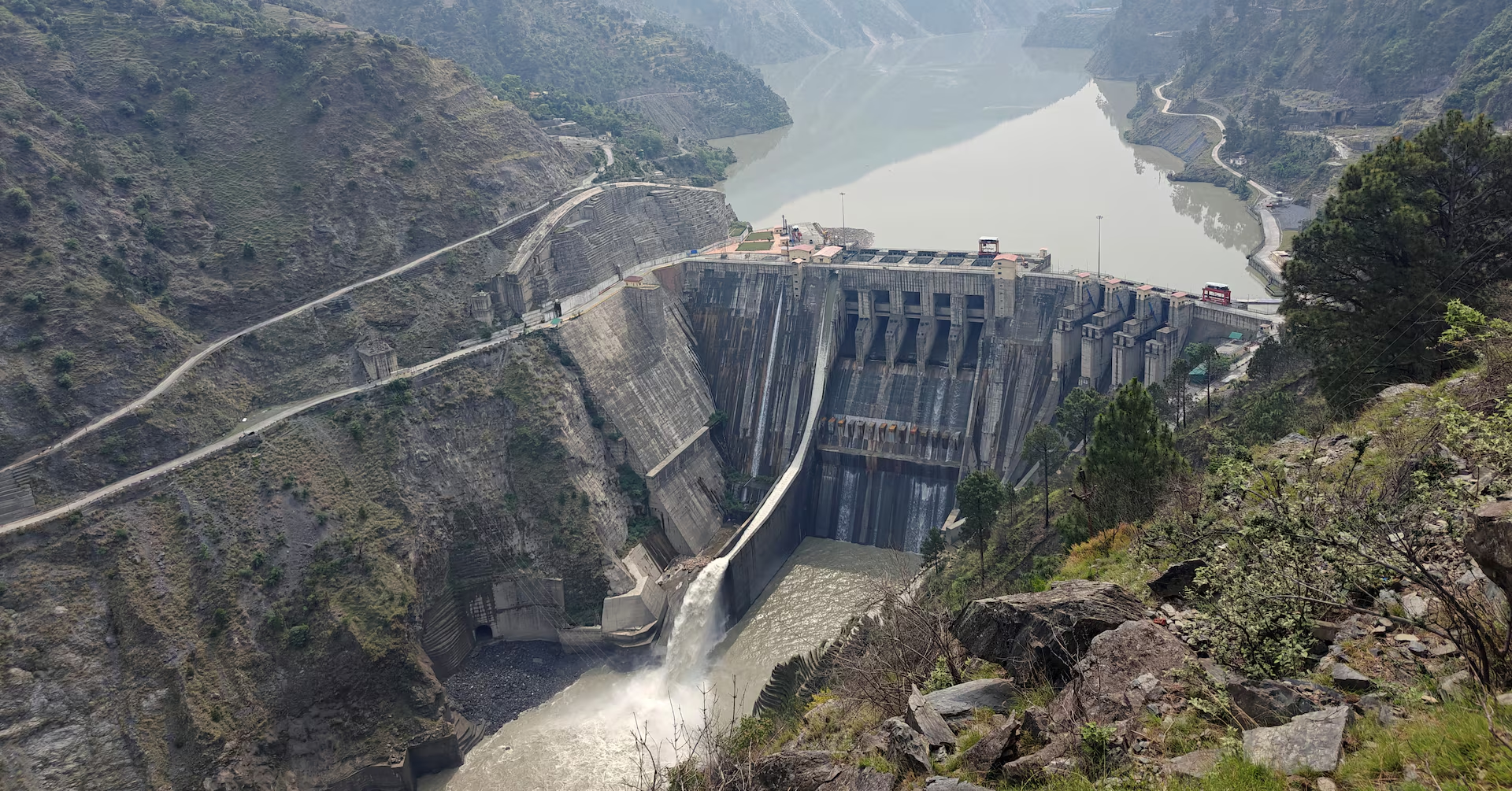
Jammu & Kashmir is frequently cited as sitting on close to 18,000–20,000 MW of assessed hydropower potential — among the largest of any Indian state or Union Territory — yet only a fraction of that capacity, generally estimated between 3,000 and 3,500 MW, has actually been developed over the decades.
Even that limited capacity has reportedly performed well this summer. Central Sector power projects allocated to Jammu and Kashmir are said to be generating over 2,100 MW, while UT-owned hydel stations are contributing over 1,000 MW more — pushing combined seasonal availability past the 3,100 MW mark, according to officials cited by regional media. That is dramatically higher than the winter trough, when local hydro output can crash to under 500 MW.
On paper, this should translate into relief for Valley consumers. In practice, residents say the outages have only worsened, prompting many to ask a pointed question: if there is more power available than ever, why are the cuts getting longer, not shorter?
Distribution Bottlenecks, Not Generation Shortfalls, Are the Real Culprit
Energy officials and independent experts largely agree that Kashmir’s problem is not how much electricity is produced, but how it reaches — or fails to reach — the consumer.
1. An ageing, overloaded distribution network Much of the Valley’s power infrastructure — 33 kV feeders, transformers, and substations — is old, poorly automated, and easily overwhelmed. Faults take longer to detect and rectify, and localized breakdowns cascade into broader outages.
2. Constant maintenance shutdowns The Kashmir Power Distribution Corporation Limited (KPDCL) has been issuing near-daily shutdown notices through June and into July 2026, affecting dozens of localities across Srinagar, Baramulla, Bandipora, Sopore, Kupwara, Anantnag and Pulwama districts. These planned outages, typically lasting four to six hours between 8 a.m. and 2 p.m., are meant to allow line upgrades and repairs — but they stack on top of unscheduled cuts, leaving many areas without power for a large part of the day, several days a week.
3. Skewed seasonal allocation between Jammu and Kashmir regions Officials have acknowledged that under a long-standing seasonal practice, the Jammu region — where summer cooling demand peaks — receives a comparatively larger share of available power, while the Valley gets a smaller allocation even though its own demand does not fall in summer. This seasonal swap runs in reverse come winter, when Kashmir’s heating needs are supposed to take precedence, but residents say relief rarely follows either way.
4. A structural “power paradox” A deeper, long-running grievance in the Valley is that the bulk of large hydropower projects — Salal, Uri, Dul Hasti, Kishanganga and others — are run by central agencies like NHPC, with Jammu & Kashmir entitled only to a limited free-power share (commonly cited around 12%) as royalty. The region then has to buy back power, often at high cost, to meet its own needs, even though its rivers feed the national grid. Politicians across the spectrum in J&K have increasingly acknowledged this as a matter of ownership and equity, not merely engineering.
Life on the Ground: Classrooms, Clinics and Kitchens Without Power
The human cost of these outages is mounting across every corner of daily life:
- Students attending online classes or preparing for exams find lessons interrupted mid-session, with routers and laptops running out of charge during multi-hour cuts.
- Remote-working professionals, increasingly common in Srinagar’s growing tech and services sector, lose connectivity for hours, missing calls and deadlines.
- Patients dependent on electrical medical equipment — oxygen concentrators, nebulizers, dialysis-linked devices — face dangerous gaps in care, particularly in areas without hospital-grade backup power.
- Shopkeepers, hoteliers and small businesses are forced to run costly diesel generators to stay operational, squeezing already thin margins, especially during the peak summer tourist season.
- Ordinary households are left to endure humid, sweltering conditions without fans or coolers in summer, and freezing rooms without heaters in winter — a hardship that residents describe as a leveller across income lines, since even those who pay bills on time and live in “fully metered” localities are not spared.
What Needs to Change
Experts and residents point to a familiar set of fixes that have been discussed for years but remain only partially implemented:
- Modernizing transformers, feeders and substations to cut technical losses and reduce fault-related outages.
- Building water storage and reservoir capacity to smooth out the sharp winter dip in hydropower generation.
- Expanding rooftop solar and other renewables to supplement hydropower, particularly during long summer daylight hours.
- Publishing a transparent, predictable curtailment schedule instead of relying on unscheduled cuts, so families, schools and hospitals can plan around outages.
- Revisiting the revenue-sharing and free-power arrangements tied to central hydropower projects, so that a region generating thousands of megawatts is not left buying back its own power at a premium.
The Bottom Line
Kashmir’s electricity crisis is less a story of scarcity and more one of infrastructure and allocation. Whether it is winter’s frozen rivers or summer’s supposed power surplus, the outcome for ordinary residents looks the same: long, unpredictable hours without electricity. Until ageing distribution networks are upgraded and the region gets a fairer, more transparent share of the power its own rivers generate, the Valley’s promise of hydropower abundance will keep clashing with the daily reality of darkness.