Kashmir’s Mutton Crisis: When a Supply Chain Breakdown Threatens a ₹14 Crore Daily Trade
By: Javid Amin | 30 June 2026
A shortage of mutton in Kashmir has now moved beyond empty market shelves. What started as a disruption in livestock transportation has turned into a wider economic and cultural concern, affecting traders, consumers and one of the Valley’s most cherished traditions — Kashmiri Wazwan.
The livestock trade connected to Kashmir’s meat markets is estimated to involve business worth nearly ₹14 crore every day, supporting a large network of livestock suppliers, transporters, wholesalers and butchers.
With supply routes disrupted, the impact is being felt across the Valley — from busy markets of Srinagar to family kitchens and wedding halls where mutton remains a central part of traditional hospitality.
How the Kashmir Mutton Supply Chain Broke Down
Highway Restrictions and Transit Charges Create Bottlenecks
Kashmir’s mutton market depends heavily on livestock arriving from outside the Union Territory, particularly through routes passing via Punjab.
According to traders, the movement of livestock trucks has slowed after disputes over highway-related charges, transit fees and regulatory checks. The delays have affected the regular flow of animals into Kashmir markets.
A supply chain that normally operates continuously has suddenly faced interruptions, leaving traders unable to maintain normal stock levels.
The problem highlights a major challenge for Kashmir’s economy — its dependence on external supply routes for essential commodities.
Empty Shops and Rising Prices Across Kashmir Markets
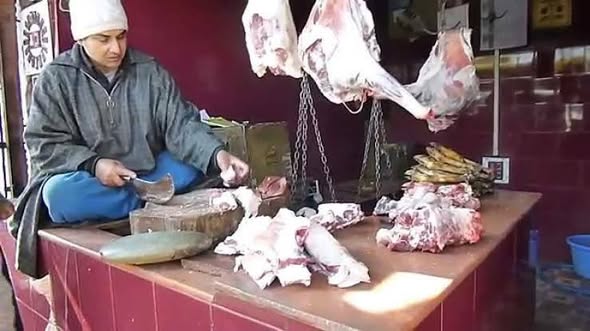
The first visible sign of the crisis appeared at the retail level.
Butchers across several areas reported:
- Reduced availability of mutton
- Empty shops and limited stock
- Rising wholesale costs
- Increasing pressure from customers
For consumers, the shortage has created uncertainty. Mutton, which is already a relatively expensive food item, could become even less affordable if supply restrictions continue.
Families preparing for weddings, social gatherings and traditional occasions are particularly concerned because mutton is not easily replaced in Kashmiri cuisine.
₹14 Crore Daily Trade at Risk: Economic Impact on Thousands
The mutton industry is not limited to sellers at meat shops. It supports an entire economic chain.
The disruption affects:
Livestock Traders
Those purchasing and supplying animals face losses as movement slows and animals remain stuck in transit.
Transport Operators
Truck operators depend on regular movement and timely delivery. Delays increase operational costs.
Butchers and Retail Sellers
With reduced supply, daily business activity has dropped sharply.
Consumers
Higher prices and reduced availability directly impact household budgets.
A prolonged crisis could create financial stress for thousands of people associated with the livestock economy.
Wazwan Under Pressure: Why the Shortage Is More Than a Food Issue
In Kashmir, mutton is closely linked with culture and identity.
The traditional Wazwan — a multi-course feast that represents Kashmiri hospitality — depends heavily on meat-based dishes.
From weddings to major family gatherings, dishes such as:
- Rogan Josh
- Rista
- Gushtaba
- Tabak Maaz
hold a special place in Kashmiri celebrations.
Because of this cultural connection, the shortage has created anxiety beyond ordinary market concerns.
A disruption in mutton supply affects not only business but also traditions passed through generations.
Weddings, Festivals and Social Gatherings Face Challenges
Summer is often an important season for weddings and social events in Kashmir.
Large gatherings typically require organised food arrangements where mutton plays a central role.
Caterers and families now face difficult questions:
- Will enough supply be available?
- Will prices increase further?
- Will traditional menus need changes?
For many households, reducing mutton from celebrations is not simply a budget decision — it affects the nature of the occasion itself.
Political Pressure Grows Over Kashmir Mutton Shortage
The crisis has also entered the political arena.
The government has faced pressure to ensure uninterrupted supply, while opposition parties have questioned administrative handling of the situation.
The debate has expanded into larger issues:
- Interstate coordination
- Transportation policies
- Essential commodity management
- Protection of local businesses
The shortage has become a political flashpoint because it directly touches public sentiment.
A Larger Question: Can Kashmir Reduce Dependence on External Supply?
The current disruption has exposed a long-standing challenge.
While Kashmir has its own livestock sector, local production has not fully matched consumer demand.
This dependence means that any disruption outside the Valley can quickly affect local markets.
Experts and traders have often highlighted the need for:
- Strengthening local livestock production
- Improving supply infrastructure
- Creating more resilient transportation networks
- Reducing vulnerability to external disruptions
Kashmir Mutton Crisis: Key Numbers at a Glance
| Factor | Details | Impact |
|---|---|---|
| Daily Trade Value | Nearly ₹14 crore | Livelihoods of thousands affected |
| Supply Route | Livestock movement through Punjab | Delays and shortages |
| Market Condition | Reduced availability | Prices rising |
| Cultural Impact | Wazwan depends on mutton | Weddings and traditions affected |
| Political Impact | Government under pressure | Governance debate intensifies |
The Road Ahead
The immediate priority remains restoring normal livestock movement and ensuring markets receive regular supplies.
But the crisis has also opened a wider discussion about Kashmir’s food security and economic dependence.
A temporary shortage may end once transportation issues are resolved, but the larger lesson remains clear: essential supply chains need stronger planning because their disruption can affect not only markets, but also culture, livelihoods and everyday life.