Faith, Memory and Hope: Why Kashmiri Pandits Are Looking Toward a Return to the Valley After Decades of Displacement
By: Javid Amin | 22 June 2026
As Calls for Reconciliation Grow, Many Kashmiri Pandits See a New Opportunity to Reconnect With Their Homeland
More than three decades after one of the most painful chapters in Kashmir’s modern history, a cautious sense of optimism is beginning to emerge among sections of the Kashmiri Pandit community.
For many displaced families, the dream of returning to their ancestral homeland has never faded. What has changed, however, is the growing belief among some community leaders, civil society groups and policymakers that conditions may gradually be moving toward a future where return and rehabilitation become more achievable.
The conversation is no longer confined to questions of security alone. Increasingly, it revolves around dignity, livelihood, cultural preservation and the rebuilding of trust between communities that once shared a deeply intertwined social and cultural life.
While significant challenges remain, the renewed discussion surrounding the return of Kashmiri Pandits is being viewed as an important step toward restoring Kashmir’s pluralistic identity and healing wounds that have shaped generations.
A Community Shaped by Displacement
The story of the Kashmiri Pandits is inseparable from the larger history of Kashmir.
In the early 1990s, amid the eruption of militancy and widespread insecurity in the Valley, a large number of Kashmiri Pandit families left their homes and migrated to different parts of India, particularly Jammu, Delhi and other urban centres.
The displacement transformed not only the lives of those who left but also the social fabric of Kashmir itself.
Entire neighbourhoods that once reflected centuries of coexistence witnessed dramatic demographic changes. Temples, community spaces and ancestral homes were abandoned, while families struggled to rebuild their lives away from their homeland.
For many Pandits, displacement became more than a physical separation—it became an emotional and cultural rupture that affected multiple generations.
Children born outside Kashmir grew up hearing stories of villages, traditions and homes they had never seen, while older generations carried memories of a place they hoped to return to someday.
A Shift From Trauma to Aspiration
For years, public discussions surrounding the Kashmiri Pandit issue largely focused on pain, loss and injustice.
Today, while those memories remain deeply significant, there is also an emerging focus on the future.
Community representatives increasingly speak about creating conditions that make return possible rather than merely recounting the circumstances that led to displacement.
This shift does not mean that historical grievances have disappeared.
Instead, it reflects a growing recognition that sustainable solutions require practical pathways forward.
Many Pandits now emphasize three key requirements:
Security
Families want confidence that they can live safely without fear or uncertainty.
Livelihood Opportunities
Economic stability is considered just as important as physical security.
Dignified Rehabilitation
Many believe return must be voluntary, respectful and rooted in community integration rather than symbolic gestures.
The emphasis on dignity has become central to contemporary discussions on rehabilitation.
Government Initiatives and the Search for Sustainable Solutions
Successive governments have introduced various measures aimed at facilitating the return and rehabilitation of displaced Kashmiri Pandits.
These efforts have included:
Employment Packages
Special recruitment drives have been launched to create government employment opportunities for members of the displaced community.
Housing Projects
Transit accommodation and residential clusters have been developed in selected locations to facilitate resettlement.
Temple Restoration
Several heritage temples and religious sites have undergone restoration and preservation work to protect Kashmir’s civilizational legacy.
Financial Assistance
Various relief and rehabilitation schemes have sought to support displaced families.
However, many community members argue that rehabilitation must go beyond infrastructure and financial packages.
The long-term success of any return initiative, they say, will depend on whether people can build sustainable lives, access quality education, find employment opportunities and feel socially accepted within the broader community.
Faith as a Bridge, Not a Barrier
One of the most significant developments in recent years has been the growing role of faith-based and civil society initiatives focused on reconciliation.
Religious and community leaders from different backgrounds have increasingly emphasized the importance of restoring the Valley’s historic tradition of coexistence.
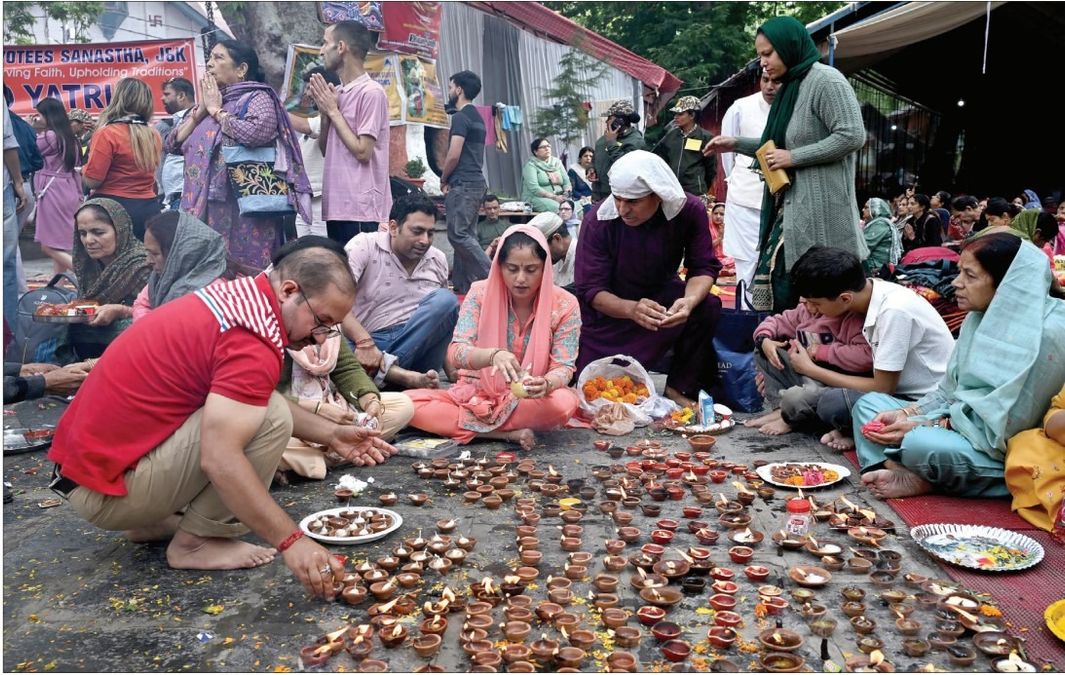
For centuries, Kashmir’s cultural identity was shaped by a shared heritage often described through the spirit of “Kashmiriyat”—a tradition rooted in mutual respect, spirituality and social harmony.
Many advocates of reconciliation believe that rebuilding trust requires acknowledging the pain experienced by all communities while simultaneously creating opportunities for dialogue and cooperation.
In this context, faith is increasingly being viewed not as a source of division but as a bridge capable of reconnecting people with shared cultural roots.
Why the Return of Pandits Matters Beyond Politics
The discussion surrounding the return of Kashmiri Pandits extends far beyond electoral politics or government policy.
Its significance lies in what it represents for Kashmir’s collective future.
Restoration of Pluralism
The presence of multiple communities has historically been a defining feature of Kashmir’s identity.
A successful return could strengthen that pluralistic character.
Cultural Revival
Ancient temples, traditional neighbourhoods, festivals and cultural practices form an integral part of Kashmir’s heritage.
Their revival could enrich the Valley’s social and cultural landscape.
Symbol of Reconciliation
A dignified return would serve as a powerful indication that communities divided by conflict can rebuild relationships and move forward together.
Confidence Building
Successful rehabilitation could foster greater confidence in long-term peace and stability.
The Challenges Remain Real
Despite growing optimism, significant obstacles continue to complicate the prospect of large-scale return.
Security Concerns
Although the security situation has improved in many areas compared to previous decades, isolated incidents of violence continue to influence perceptions.
Many families remain cautious about making permanent relocation decisions.
Economic Viability
Employment opportunities remain a critical concern.
Without sustainable economic prospects, rehabilitation efforts may struggle to attract significant numbers of returnees.
Property and Infrastructure Issues
Questions surrounding ancestral properties, housing and local infrastructure continue to require attention.
Social Reintegration
Rebuilding social relationships after decades of separation represents one of the most complex challenges.
Trust cannot be restored through policy measures alone; it requires sustained community engagement over time.
The Role of Kashmir’s Muslim Community
Many observers argue that meaningful reconciliation cannot occur without active participation from Kashmir’s Muslim majority.
Across the Valley, several civil society initiatives have sought to promote dialogue, acknowledge past suffering and encourage renewed interaction between communities.
Community leaders frequently stress that the return of Pandits should not be viewed solely as a government project but as a collective societal responsibility.
The willingness of local communities to welcome returning families, support integration and foster inclusive environments will play a crucial role in determining the success of rehabilitation efforts.
A New Generation and a New Possibility
Perhaps the most important factor shaping the future is the emergence of a new generation on both sides of the divide.
Many young Kashmiris—both Pandits and Muslims—have grown up without experiencing the shared social reality that once characterized life in the Valley.
For them, reconciliation is not merely about restoring the past; it is about creating a different future.
This generational perspective has introduced fresh conversations about identity, coexistence and shared aspirations.
Rather than focusing exclusively on historical divisions, many young people are exploring ways to build connections based on education, culture, entrepreneurship and community engagement.
The Road Ahead
The renewed hope surrounding the return of Kashmiri Pandits reflects an important evolution in Kashmir’s public discourse.
The conversation is gradually shifting from displacement to rehabilitation, from trauma to aspiration, and from division to dialogue.
Yet optimism alone will not be enough.
Meaningful progress will require comprehensive policies, robust security arrangements, sustainable economic opportunities and genuine efforts to rebuild trust between communities.
If these elements come together, the return of Kashmiri Pandits could become more than a rehabilitation initiative.
It could emerge as one of the most powerful symbols of reconciliation in modern Kashmir—an affirmation that despite decades of conflict and separation, the Valley’s plural identity remains alive and capable of renewal.
In that sense, the journey home is not only about geography. It is also about restoring relationships, reviving shared heritage and rebuilding a future in which every community feels a sense of belonging in Kashmir.