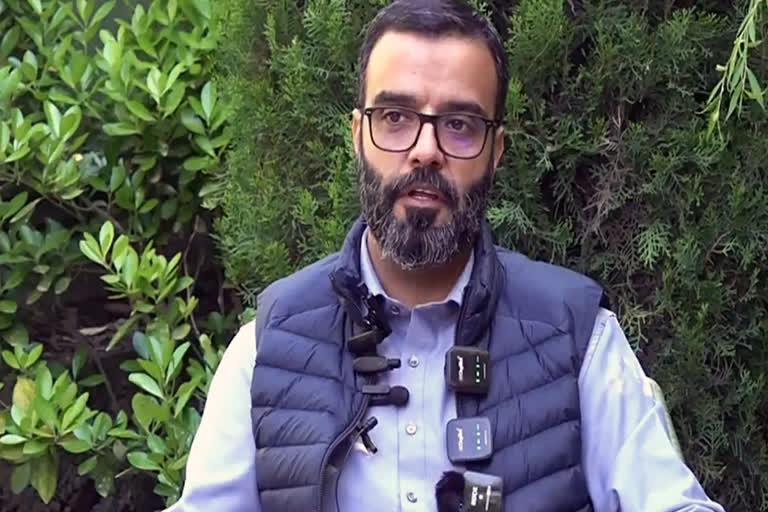
No Theatrics, Only Consistency: Aga Ruhullah Mehdi Redefines J&K Statehood Debate
By: Javid Amin | 04 June 2026
A Message That Resonated Beyond the Party
At a time when Jammu and Kashmir’s political discourse is once again revolving around statehood restoration, one statement from National Conference MP Aga Ruhullah Mehdi has triggered conversations far beyond party circles.
“No theatrics, only consistency.”
The phrase may appear simple, but in Kashmir’s current political climate it carries significant weight.
Coming just days after the National Conference’s high-profile Dachigam retreat—a meeting Ruhullah notably did not attend—the remark has been interpreted by many as both a political principle and a subtle critique of how mainstream politics in Jammu and Kashmir has often approached major constitutional issues.
More importantly, it shifts the debate from symbolism to strategy.
The question Ruhullah appears to be asking is straightforward: Can statehood be achieved through occasional political mobilization, or does it require a sustained and consistent campaign that survives beyond headlines and political events?
Statehood Is Back at the Centre of Political Debate
The issue of statehood restoration remains one of the most emotionally and politically significant questions in Jammu and Kashmir.
Since the reorganization of the former state in August 2019, regional parties have repeatedly promised to pursue restoration of statehood.
Successive political statements, legislative speeches, election campaigns and meetings with New Delhi have reinforced that commitment.
Yet for many citizens, the frustration stems from a simple reality.
The demand remains active.
The timeline remains absent.
As public impatience grows, political leaders are increasingly being asked not whether they support statehood, but how they intend to secure it.
That is the context in which Ruhullah’s intervention has attracted attention.
More Than a Slogan: What Ruhullah Is Actually Saying
A superficial reading of his statement might frame it as another political soundbite.
A deeper reading suggests something more consequential.
Ruhullah’s argument appears to rest on three ideas.
Consistency Matters More Than Occasional Mobilization
According to this view, constitutional demands cannot be pursued only when political pressure mounts or when public frustration becomes visible.
Instead, advocacy must be continuous, organized and visible over time.
Credibility Is Built Through Persistence
Many Kashmiris have heard promises on statehood for years.
Ruhullah’s message resonates because it implicitly acknowledges a growing trust deficit between political promises and political outcomes.
Results Matter More Than Optics
The statement reflects a broader sentiment among sections of the electorate who are increasingly skeptical of symbolic meetings, carefully staged photographs and repetitive declarations unaccompanied by measurable progress.
The Shadow of Dachigam
Whether intended or not, Ruhullah’s remarks cannot be separated from the political backdrop of the June 3 Dachigam retreat.
The National Conference had projected the retreat as a governance review and strategic consultation.
However, the meeting generated debate for several reasons.
Most notably:
- No major public announcement emerged.
- Cabinet expansion questions remained unresolved.
- Opposition parties mocked the event as a loyalty exercise.
- Ruhullah himself remained absent.
His absence became one of the most discussed aspects of the gathering.
Although there is no evidence of a formal boycott, political observers widely interpreted the no-show as a reflection of broader ideological differences within the party.
Against that backdrop, the timing of his latest remarks has only intensified speculation.
A Reformist Voice Inside the National Conference?
Over the past few years, Ruhullah has gradually carved out a distinct political identity.
Unlike many traditional party figures, he has often been willing to publicly articulate uncomfortable questions regarding:
- Post-2019 political strategy
- Democratic representation
- Public accountability
- Engagement with New Delhi
- Constitutional rights
This does not necessarily place him outside the National Conference.
But it does position him differently within it.
Increasingly, he is seen by supporters as a voice willing to challenge conventional political habits rather than simply defend them.
That perception gives added significance to his comments on statehood.
A Challenge to Omar Abdullah?
The most debated question emerging from the statement is whether it should be viewed as an indirect challenge to Chief Minister Omar Abdullah.
A careful assessment suggests caution.
Ruhullah did not directly criticize Omar Abdullah.
Nor did he reject the National Conference’s statehood demand.
However, his emphasis on consistency over theatrics inevitably invites comparisons with broader political strategies pursued by mainstream parties.
For critics of the leadership, the statement reinforces concerns that statehood is often invoked rhetorically without a corresponding roadmap.
For supporters of the leadership, it can be viewed as a complementary call for greater persistence rather than a confrontation.
The reality likely lies somewhere in between.
Why the Public May Be Listening
The reason Ruhullah’s remarks have gained traction is not merely because of party politics.
They resonate with a wider public mood.
Across Jammu and Kashmir, there is increasing fatigue with:
- Repeated announcements
- Delayed implementation
- Symbolic political exercises
- Unfinished promises
- Unclear timelines
Statehood is only one example.
The same frustrations are visible in debates surrounding employment, reservations, rehabilitation policies, infrastructure projects and governance reforms.
In that environment, a message emphasizing consistency over spectacle naturally finds an audience.
The Emerging Divide Inside Kashmir Politics
The controversy also reflects a larger shift taking place within mainstream politics.
Increasingly, two competing approaches are becoming visible.
Politics of Optics
This approach relies on major events, symbolic meetings, public declarations and headline-driven initiatives to demonstrate political engagement.
Politics of Persistence
This approach emphasizes sustained advocacy, institutional engagement and long-term pressure regardless of media attention.
Ruhullah’s statement places him firmly in the second camp.
Whether that approach gains broader traction remains to be seen.
What Happens Next?
The coming months will reveal whether the National Conference translates its renewed focus on statehood into a sustained political campaign.
Several developments will be closely watched:
Delhi Engagement
Will the party intensify direct outreach with the Union Government?
Organizational Unity
Can internal differences be managed while maintaining a coherent statehood strategy?
Public Communication
Will citizens see a clear roadmap rather than broad declarations?
Measurable Outcomes
Can political advocacy produce tangible movement on the statehood question?
These questions will shape the next phase of Jammu and Kashmir’s political discourse.
Conclusion
Aga Ruhullah Mehdi’s message may ultimately be remembered not for its criticism but for its challenge.
By insisting that the statehood struggle requires consistency rather than theatrics, he has shifted attention from political performance to political persistence.
In doing so, he has articulated a concern increasingly shared by many citizens: that constitutional aspirations cannot be sustained by symbolism alone.
Whether the National Conference, the opposition, or the wider political establishment embraces that lesson remains uncertain.
What is certain is that the debate over statehood has entered a new phase—one where voters are increasingly demanding not just promises, but proof of purpose and persistence.
And in that debate, Ruhullah’s intervention has ensured that the conversation is no longer merely about statehood itself, but about how the fight for it should be fought.