MPs Visit Engineer Rashid’s Family in Kashmir, Renew Calls for Release and Political Dialogue
By: Javid Amin | 30 May 2026
Cross-Party Delegation Calls for Political Engagement as Questions Over Detention, Representation and Reconciliation Return to Centre Stage
A visit by Members of Parliament to the family of jailed Baramulla MP Engineer Rashid has once again brought Kashmir’s unresolved political questions into national focus.
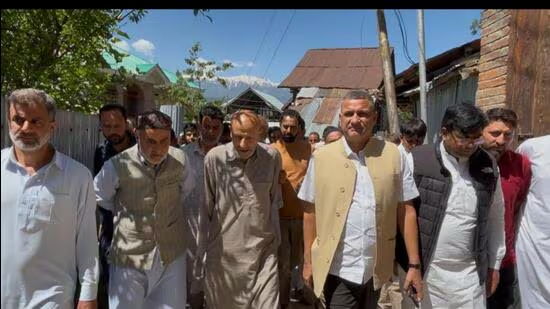
The delegation, which travelled to Rashid’s native area in north Kashmir, met his family to offer condolences following the recent death of his father and expressed solidarity over what they described as prolonged suffering and political uncertainty. During the visit, the MPs also renewed calls for his release and stressed the importance of meaningful dialogue in Jammu and Kashmir.
While officially framed as a humanitarian outreach, the visit carries political significance far beyond a condolence meeting. It comes at a time when discussions around democratic participation, political detentions, statehood restoration and post-Article 370 reconciliation are increasingly re-entering public discourse.
Why the Visit Matters
The delegation included Independent MP Umesh Patel and Rashtriya Janata Dal MP Sudhakar Singh, who met Rashid’s family and later addressed the media.
The MPs argued that Kashmir’s future cannot be shaped through silence or disengagement and stressed that democratic processes require the participation of all elected representatives. They maintained that continued dialogue between New Delhi and the people of Jammu and Kashmir remains essential for long-term stability and reconciliation.
Sudhakar Singh stated that the voices of Kashmiris must be heard and argued that the incarceration of an elected Member of Parliament weakens the democratic connection between the region and the national political system.
The remarks reflect a growing sentiment among sections of the political class that Kashmir’s challenges cannot be addressed solely through administrative or security frameworks.
Engineer Rashid: The Elected MP Behind Bars
Engineer Rashid, whose full name is Sheikh Abdul Rashid, represents the Baramulla Lok Sabha constituency and remains one of the most politically significant figures in contemporary Kashmir politics.
Despite being incarcerated under the Unlawful Activities (Prevention) Act (UAPA) since 2019, Rashid won the parliamentary election from Baramulla, transforming his detention into a major political issue in the Valley.
His supporters view his electoral victory as a reflection of public frustration and a demand for political representation. Critics, however, point to the seriousness of the legal charges against him and argue that judicial processes must proceed independently.
The debate surrounding Rashid therefore extends beyond one individual. It touches larger questions about representation, legitimacy and democratic participation in conflict-affected regions.
A Humanitarian Moment That Became Political
The MPs’ visit comes shortly after Rashid received interim bail to attend the funeral of his father, Haji Khazir Mohammad Sheikh, who died after a prolonged illness. The Delhi High Court granted temporary relief allowing him to participate in funeral rites and family ceremonies.
Earlier, the court had also allowed him to visit his critically ill father under strict conditions, leading to emotional scenes at hospitals in Srinagar and New Delhi.
The death of Rashid’s father generated sympathy across sections of Kashmir’s political spectrum. Multiple parties, including leaders who disagree sharply on political issues, urged authorities to consider humanitarian grounds for temporary relief.
That broad response demonstrated how personal tragedies in politically sensitive cases often become moments that transcend party lines.
Kashmir’s Larger Political Question: Can Stability Exist Without Dialogue?
The MPs did not limit their remarks to Rashid’s case alone.
They argued that genuine peace requires political engagement, confidence-building measures and dialogue involving stakeholders across society. According to them, reconciliation cannot emerge through governance mechanisms alone; it requires participation, trust and communication.
This argument has increasingly resurfaced in Jammu and Kashmir’s political discourse.
In recent months, several mainstream and non-mainstream political voices have called for renewed engagement on issues ranging from statehood restoration to civil liberties and democratic participation.
The recurring theme remains consistent: dialogue is being presented as a political necessity rather than merely a symbolic gesture.
The Shadow of Article 370
Although the MPs did not frame their visit exclusively around Article 370, the broader context remains unavoidable.
Since the revocation of Article 370 and the reorganisation of Jammu and Kashmir in August 2019, regional politics has undergone a dramatic transformation.
The Centre has repeatedly highlighted improvements in security indicators, infrastructure development and investment initiatives. Supporters of the constitutional changes argue that integration and development have accelerated under the new framework.
However, critics continue to raise concerns regarding political representation, statehood restoration and the shrinking space for democratic engagement.
The visit to Rashid’s family reflects this larger debate: whether political normalcy can be fully achieved without broader reconciliation and inclusive participation.
Growing Concerns Over Democratic Representation
One of the most sensitive aspects of the discussion concerns democratic legitimacy.
When an elected Member of Parliament remains incarcerated while continuing to represent a constituency, questions inevitably arise regarding how effectively that mandate can be exercised.
The MPs who visited Rashid’s family argued that prolonged detention affects not only the individual politician but also the voters who elected him.
Supporters view this as a democratic concern.
The government and investigating agencies, meanwhile, maintain that legal proceedings must follow due process and remain separate from political considerations.
The tension between democratic representation and national security concerns continues to define much of the debate around Rashid’s case.
Public Sentiment: Between Fatigue and Hope
Across Kashmir, public opinion remains diverse and often deeply divided.
Some residents see dialogue as the only realistic path toward reducing mistrust and restoring political confidence. Others remain sceptical after years of repeated calls for engagement that have produced limited visible outcomes.
At the same time, there is a growing sense of political fatigue.
Many Kashmiris increasingly express frustration with prolonged uncertainty, recurring political stand-offs and the absence of a clear roadmap for long-term reconciliation.
The MPs’ visit has therefore resonated not simply because of Rashid’s legal case, but because it has reopened a conversation many believe has remained unresolved.
Challenges Ahead
Legal Complexities
Engineer Rashid’s case is linked to UAPA proceedings and ongoing judicial processes. Any decision regarding his release involves legal considerations that extend beyond political appeals.
Political Sensitivities
The Centre may view external political pressure cautiously, particularly on issues connected to national security and terrorism-related investigations.
Expanding Expectations
If humanitarian considerations become a central argument in Rashid’s case, similar demands could emerge regarding other detainees and political prisoners, potentially broadening the debate significantly.
Trust Deficit
Even where dialogue is proposed, rebuilding trust between institutions and communities remains a long and difficult process.
More Than a Condolence Visit
At one level, the MPs’ visit was a gesture of sympathy towards a grieving family.
At another level, it carried a clear political message.
The delegation’s remarks suggest that concerns surrounding democratic participation, representation and reconciliation in Jammu and Kashmir remain alive despite repeated declarations of political normalcy.
Whether or not their appeal leads to immediate policy changes, the visit has revived a question that continues to shape Kashmir’s future: can lasting peace emerge without sustained political dialogue?
For many observers, that remains the central challenge of post-Article 370 Kashmir.
Key Takeaway
The visit by Members of Parliament to Engineer Rashid’s family has become more than a humanitarian gesture. It has reignited debate over democratic representation, political detentions and the need for meaningful engagement in Jammu and Kashmir. By linking Rashid’s continued incarceration to broader concerns about dialogue and reconciliation, the delegation has once again highlighted a reality that many political actors continue to emphasise: durable peace requires political participation, trust-building and the willingness to engage across divides.