Chief Minister defends his government’s performance under the Union Territory framework, accuses BJP of weakening elected representatives and demands a clear timeline from New Delhi
By: Javid Amin | 18 November 2026
Has the restoration of Jammu and Kashmir’s statehood become a question of political convenience? Is the BJP-led Centre waiting for its own party to form a government in the Union Territory before returning full statehood? And why does the promise of restoration continue to depend on an undefined “appropriate time”, even after delimitation and Assembly elections have been completed?
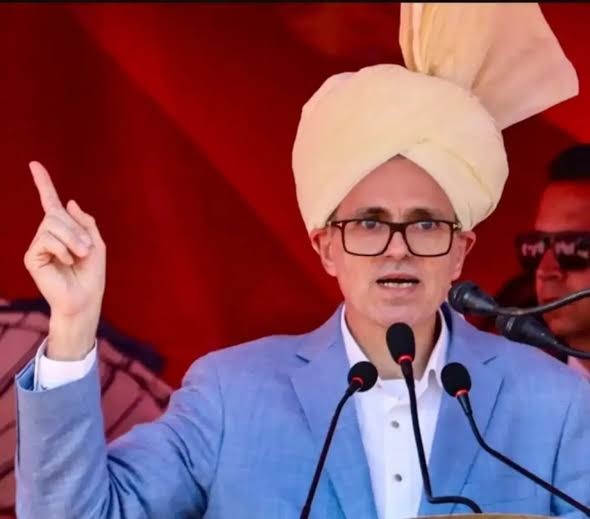
These were the questions raised by Chief Minister Omar Abdullah during a public rally in Mendhar, Poonch district, on Wednesday, November 18, as he launched one of his strongest public attacks yet on the Centre over the continued delay in restoring Jammu and Kashmir’s statehood.
In a pointed challenge to the BJP, Abdullah questioned whether the restoration process was being deliberately held back until the party secured its own Chief Minister in Jammu and Kashmir.
“If it is your wish not to restore statehood until the BJP has its own Chief Minister in Jammu and Kashmir, then say it openly. Tell the people clearly so that they are not kept under any illusion, and we are not humiliated repeatedly,” he said.
The remark represents a sharper political turn in the Chief Minister’s campaign for statehood. For much of his government’s tenure, Abdullah has repeatedly raised the issue through meetings with Prime Minister Narendra Modi and Union Home Minister Amit Shah, while maintaining that the Centre would eventually honour its commitment.
His latest intervention suggests growing frustration with the absence of a definite timeline.
But the Mendhar rally was about more than statehood. Abdullah also defended his government’s performance under the Union Territory framework, accused the BJP of attempting to weaken elected representatives, questioned the difference in official protocol between state and Union Territory functionaries, and highlighted welfare initiatives and development commitments.
The larger political message was clear: the elected government wants to be judged on its performance, but it also wants the administrative authority and constitutional status that it says are necessary to govern effectively.
‘Appropriate Time’ Has Become an Empty Promise, Says Omar
The expression “appropriate time” has become the central point of contention between the Jammu and Kashmir government and the Centre.
The Union government has repeatedly maintained that statehood will be restored at an appropriate time. However, it has not publicly provided a specific date or a clearly defined set of conditions that would trigger the restoration.
Abdullah questioned the logic behind this uncertainty.
He pointed out that the delimitation exercise had been completed in 2022 and Assembly elections were held in September–October 2024. The elected government subsequently assumed office in October 2024, completing the two major steps that had been publicly associated with the Centre’s earlier assurances.
Yet Jammu and Kashmir continues to function as a Union Territory.
The Chief Minister said that more than two years and one month had passed since his government took office, but the people still had no clarity about when the region would regain statehood.
He questioned what yardstick the Centre was using to determine the “appropriate time” and why the people of Jammu and Kashmir were being asked to wait indefinitely.
The criticism is significant because it shifts the debate from whether statehood has been promised to whether the Centre has established any transparent mechanism for fulfilling that promise.
Without a timeline or publicly stated benchmarks, the phrase leaves considerable discretion with the Union government.
For the elected administration, that uncertainty creates a continuing political and administrative problem. It has to govern the Union Territory while responding to public expectations that were shaped by the promise of an eventual return to statehood.
What Did the Centre Promise Before the Supreme Court?
The statehood dispute is rooted in the constitutional and political developments following the abrogation of Article 370 in August 2019.
The former state of Jammu and Kashmir was reorganised into two Union Territories: Jammu and Kashmir, with a Legislative Assembly, and Ladakh, without one.
The Union government defended the reorganisation as part of a wider administrative and security-related restructuring. At the same time, senior government representatives assured Parliament and the Supreme Court that Jammu and Kashmir’s statehood would eventually be restored.
During the Supreme Court proceedings on the constitutional challenge to the 2019 changes, Solicitor General Tushar Mehta told the court that the Union Territory status of Jammu and Kashmir was temporary and that statehood would be restored.
In its December 11, 2023 judgment, the Supreme Court took note of the Union government’s submission. The court directed that Assembly elections be conducted by September 30, 2024, and stated that restoration of statehood should take place at the earliest and as soon as possible.
This is a crucial part of the present controversy.
The Supreme Court did not prescribe a fixed calendar date for restoring statehood. However, its observation that restoration should take place at the earliest and as soon as possible gave the demand a significant constitutional and judicial context.
The Union government’s earlier position was also reflected in a July 2022 written reply in the Rajya Sabha, where the Ministry of Home Affairs stated that statehood would be granted at an “appropriate time”.
Union Home Minister Amit Shah reiterated in September 2024 that statehood would be restored after the Assembly elections, maintaining that the decision rested with the Central government and Prime Minister Narendra Modi.
The elections have since taken place, and an elected government is functioning. That is why Abdullah is now questioning what remains to be completed before the Centre acts.
The unresolved issue is not whether assurances were made. They were. It is why the Centre has not announced a definite restoration timetable.
Assembly Resolution Adds Pressure on the Centre
The demand for statehood has also moved beyond speeches and political statements.
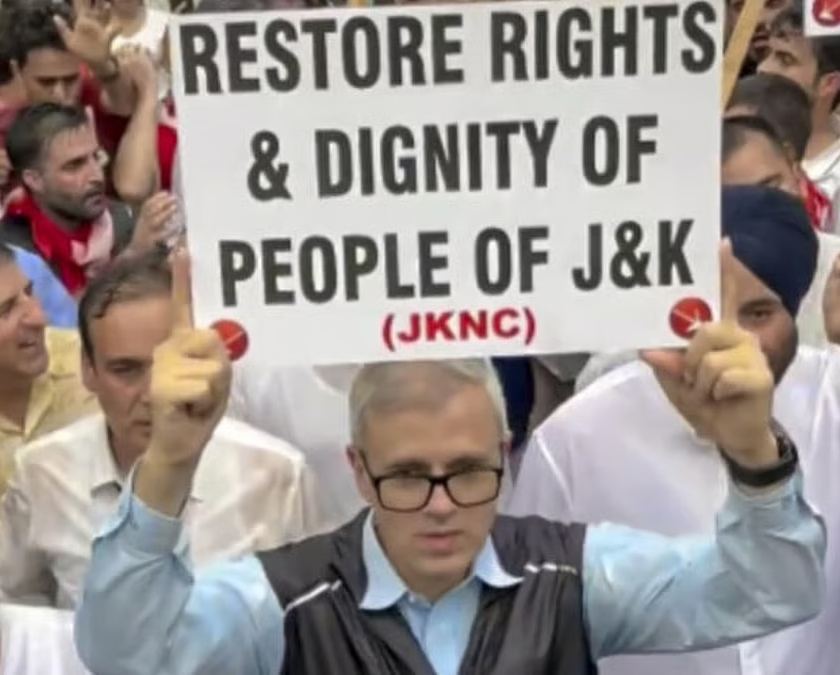
On September 25, 2026, Chief Minister Omar Abdullah moved a resolution in the Jammu and Kashmir Legislative Assembly seeking the immediate and urgent restoration of full statehood.
After a heated debate, the resolution was passed on September 28, amid protests and a walkout by BJP legislators.
The resolution called upon the Government of India to restore full statehood and referred to earlier resolutions passed by the Assembly in June 2000 and November 2024.
The September 2026 resolution was particularly important because it attempted to secure wider political support around the statehood demand, rather than presenting it solely as a National Conference position.
The BJP, however, opposed the proceedings and objected to attempts to bring references to the pre-August 2019 constitutional arrangement into the debate.
This distinction matters. The restoration of statehood and the restoration of Article 370 are separate political and constitutional questions, even though they are often discussed together in Jammu and Kashmir.
The September resolution focused on the immediate restoration of full statehood. The political disagreement surrounding it demonstrated that different parties continue to approach the region’s constitutional future from sharply different positions.
The Assembly can formally express the will of its elected representatives, but its resolution cannot independently restore statehood. The necessary action must come from the Union government and Parliament.
The Mendhar remarks are therefore a continuation of an institutional demand that has now been formally recorded by the elected legislature.
Why Omar Says Security Incidents Cannot Be Used to Delay Statehood
Another major part of the Chief Minister’s argument concerns the division of administrative powers under the present Union Territory framework.
Abdullah referred to security incidents in Pahalgam, Kulgam, Reasi and Kishtwar, questioning why the elected government should be held responsible for security failures when it does not control the police or public order.
He argued that incidents beyond the elected administration’s direct jurisdiction should not become an indefinite justification for withholding statehood.
“We have no control over the police or law and order,” he said, questioning how his government could be held accountable for matters over which it has no direct authority.
The constitutional position provides context to this argument.
Under Section 32 of the Jammu and Kashmir Reorganisation Act, 2019, the Legislative Assembly can legislate on matters in the State List, except public order and police, subject to the provisions of the Act.
These subjects remain outside the elected government’s ordinary legislative domain. The Lieutenant Governor and the Union administration retain important responsibilities in these areas.
This arrangement creates a complicated accountability structure.
The Chief Minister and elected ministers face public scrutiny over governance, development and public services. However, they do not exercise the same degree of authority over police and public order that a state government ordinarily enjoys.
That division of responsibility has repeatedly become a political point of friction between the elected government and the Lieutenant Governor’s administration.
Abdullah’s argument is that the Centre cannot expect the elected government to shoulder responsibility for the entire security situation while withholding the constitutional powers associated with statehood.
The Centre, on the other hand, has not publicly accepted the Chief Minister’s suggestion that security incidents are being used as a political pretext to delay restoration.
The distinction between administrative responsibility and political accountability is therefore central to the current dispute.
Is the BJP Waiting to Form Its Own Government?
The most politically explosive part of Abdullah’s speech was his suggestion that the Centre might be waiting for the BJP to secure its own Chief Minister before restoring statehood.
This was not an announcement of any established government policy. It was a political challenge directed at the BJP and the Union government.
The BJP won 29 Assembly seats in the 2024 election, making it the second-largest party in the 90-member House. The National Conference won 42 seats and formed the government with support from its allies.
The electoral outcome gave Jammu and Kashmir an elected government led by Omar Abdullah, while the BJP remained the principal opposition party.
Against this background, Abdullah’s remark raises a wider political question: is the restoration of statehood being treated purely as an administrative and constitutional matter, or is it also being influenced by the political configuration of the Assembly?
There is no publicly established evidence that the Centre has formally linked restoration to the BJP forming a government. Abdullah’s statement should therefore be understood as an allegation and a demand for transparency, not as proof of a hidden political arrangement.
Nevertheless, the question has political force because the Centre has not provided a clear timeline or a detailed explanation of the conditions it considers necessary.
For the BJP, the challenge is to explain its position on statehood and clarify whether the earlier assurances remain binding in the present political circumstances.
For the National Conference, the challenge is to maintain pressure without allowing the statehood dispute to overshadow the government’s own performance and administrative responsibilities.
‘We Are Not Cowards Who Make Excuses’: Omar Defends Government Performance
Alongside his criticism of the Centre, Abdullah used the Mendhar rally to defend his administration’s record.
He argued that his government had continued working despite the restrictions and limited resources associated with the Union Territory framework.
“We are part of a Union Territory with limited resources, but none of my colleagues has ever given that as an excuse. We are not cowards,” he said.
The statement was directed at criticism that the elected government had failed to deliver on its promises or was using the absence of statehood to explain administrative shortcomings.
Abdullah maintained that his administration had continued implementing welfare measures and development programmes instead of treating the Union Territory arrangement as a reason for inaction.
He cited several initiatives, including free LPG cylinders for eligible families, relief through solar-based electricity initiatives, higher social welfare pensions, increased marriage assistance and free travel for women in government buses.
The measures form part of the government’s broader welfare and budgetary agenda.
However, the eligibility conditions and implementation status need to be understood separately.
The six free LPG cylinders announced in the 2026–27 Budget are intended for households covered under the Antyodaya Anna Yojana, rather than every household in Jammu and Kashmir.
Similarly, the government’s reference to 200 units of electricity through solar initiatives should not be confused with an unconditional, universal electricity waiver. The actual benefit depends on the applicable scheme, eligibility and implementation arrangements.
The Chief Minister’s broader point was that his government was attempting to deliver on its electoral commitments despite operating under a restricted administrative structure.
Whether all these commitments have been fully implemented is a separate question that requires scheme-wise assessment, beneficiary data and official expenditure figures.
Welfare Measures and the Question of Delivery
The welfare initiatives cited by Abdullah are significant because they address everyday household concerns.
For economically vulnerable families, free LPG support can reduce the cost of cooking fuel and encourage cleaner household energy use.
Solar-based electricity initiatives can help reduce household electricity expenses while supporting renewable energy adoption.
Higher social welfare pensions and marriage assistance can provide financial support to vulnerable families, elderly residents and eligible beneficiaries.
Free travel for women on government buses can improve mobility and reduce commuting expenses, particularly for women who depend on public transport for education, employment and access to public services.
But welfare announcements and actual delivery are not the same thing.
The government must be assessed on how many eligible households have received the benefits, how quickly applications are processed, whether payments reach beneficiaries without delays and whether the schemes are financially sustainable.
This distinction is important because political claims of achievement should ultimately be supported by administrative records.
The Chief Minister’s defence of his government will carry greater weight when supported by transparent beneficiary figures, expenditure details and measurable improvements in public services.
BJP Accused of Weakening Elected Representatives
Abdullah also accused the BJP of attempting to undermine the authority and dignity of elected representatives.
He questioned why the official order of precedence places elected representatives in a Union Territory at a different level from their counterparts in a full-fledged state, even when senior bureaucratic and judicial functionaries enjoy comparable protocol positions.
He argued that the arrangement reflected a wider institutional imbalance.
The Chief Minister said that while the positions of the Chief Secretary and Chief Justice remained comparable across state and Union Territory administrations, elected representatives were treated differently.
His argument was that the elected government should not be reduced to a limited administrative arrangement in which political representatives carry public responsibility without equivalent constitutional authority.
The issue of protocol may appear symbolic, but it reflects a deeper debate about the status of elected institutions under the Union Territory framework.
A Chief Minister in a full-fledged state operates within a different constitutional and administrative structure from a Chief Minister in a Union Territory where the Lieutenant Governor and the Union government retain greater authority over specified subjects.
For Jammu and Kashmir, this difference has become especially sensitive because the region was a full-fledged state before the 2019 reorganisation.
The demand for statehood is therefore not only about administrative convenience. It is also about restoring the constitutional position and political authority that existed before the reorganisation.
Darbar Move, Mughal Road Tunnel and Pir Panjal Development
The Chief Minister also highlighted development-related initiatives during the Mendhar rally, with particular attention to the Pir Panjal region.
He referred to the resumption of the Darbar Move practice, which involved the seasonal shifting of the government administration between Srinagar and Jammu.
The practice was discontinued in 2021 by the then administration, which cited savings in expenditure and the benefits of digital governance.
The NC government has argued that reviving the practice can support economic activity in both cities, particularly businesses and service providers that benefited from the seasonal movement of officials and visitors.
Abdullah also spoke about the proposed Mughal Road tunnel, which could improve all-weather connectivity between the Rajouri-Poonch region and the Kashmir Valley.
The Mughal Road is an important alternative route, but its movement is affected by snowfall, landslides and difficult weather conditions. A tunnel could reduce seasonal disruption and improve transport reliability.
The Chief Minister said that the detailed project report process was underway and credited his government and Deputy Chief Minister Surinder Choudhary with pursuing the matter with the Centre.
However, a project moving into the DPR stage should not be confused with construction approval or completion. Its progress will depend on technical clearances, financial approval, alignment, cost assessment and execution.
For residents of Mendhar, Poonch and Rajouri, the proposed tunnel carries practical significance. Improved connectivity could support tourism, trade, access to healthcare and the movement of agricultural produce.
The government will eventually be judged on whether the project moves beyond announcements and preliminary planning.
Reservation Policy: Another Area of Friction With the Centre
Abdullah also raised the issue of reservation policy, saying that the government’s committee reports had been submitted to the appropriate authorities but were repeatedly returned with objections.
He alleged that the process was being delayed through repeated queries, despite the administration responding to the concerns raised.
Reservation policy remains one of the most sensitive public issues in Jammu and Kashmir, involving competing demands from different social and regional groups.
The controversy has generated strong reactions among students, job aspirants and community organisations, particularly over the distribution of reserved and open-category seats in education and recruitment.
The Chief Minister’s remarks suggest that his administration wants the Centre to take a decision on the recommendations rather than allowing the issue to remain unresolved.
The details of the committee’s recommendations, the objections raised by the Centre and the government’s replies are necessary to establish precisely where the process stands.
Until those documents are examined together, the allegation that the Centre is deliberately stalling a solution remains the Chief Minister’s account of the administrative process.
The issue nevertheless illustrates the wider problem facing the elected government: several politically important matters require coordination or approval beyond its direct authority.
The Larger Political Question: Who Is Accountable for Jammu and Kashmir?
The Mendhar rally exposed a fundamental tension in Jammu and Kashmir’s present political structure.
The elected government is expected to answer to voters on employment, development, education, healthcare, welfare and infrastructure. Yet its powers over police and public order remain outside its ordinary legislative control.
The Lieutenant Governor and the Union administration retain important responsibilities under the existing arrangement, while the elected government must operate within the boundaries of the Reorganisation Act and the applicable rules.
This creates a situation in which political accountability and administrative authority are not always aligned.
The National Conference argues that restoring statehood would provide a more conventional relationship between elected representatives and the administration.
The BJP and the Union government have maintained that statehood will be restored at an appropriate time, while the security and administrative context remains part of the wider debate.
The unresolved question is what precisely constitutes that appropriate time and who decides when the conditions have been met.
Without a public explanation, the issue is likely to remain a source of political confrontation.
What Happens Next?
Three developments will be important in determining the direction of the statehood debate.
First, the Union government will need to clarify whether it has a timeline or specific benchmarks for restoration. Repeating the phrase “appropriate time” without further explanation is unlikely to satisfy the elected administration or the wider political demand.
Second, the Centre’s response to the September 2026 Assembly resolution will be closely watched. The resolution reflects the position adopted by the elected legislature, although it does not itself compel the Union government to restore statehood.
Third, the Omar Abdullah government will need to demonstrate measurable progress on the promises it has made. Its welfare schemes, development projects and governance record will remain subject to public scrutiny regardless of the constitutional status of Jammu and Kashmir.
The BJP, meanwhile, will face questions about how its position on statehood aligns with the assurances made by its senior leaders before Parliament and the Supreme Court.
Conclusion: Statehood Has Become a Test of Political Accountability
Omar Abdullah’s Mendhar remarks have brought the statehood debate back into sharp political focus.
His suggestion that the BJP may be waiting to form its own government before restoring statehood is an allegation, not an established policy. But his central question remains unanswered: what does the Centre mean by “appropriate time”, and what conditions must be fulfilled before Jammu and Kashmir regains full statehood?
The delimitation exercise is complete. Assembly elections have been held. An elected government has taken office, and the Supreme Court has already stated that statehood should be restored at the earliest and as soon as possible.
The absence of a clear timetable has consequently become the central source of political friction.
At the same time, the elected government cannot avoid scrutiny of its own performance. Its welfare announcements, infrastructure projects, recruitment decisions and administrative record must be judged through measurable results rather than political speeches.
Ultimately, the statehood question is about more than the position of one Chief Minister or the fortunes of one political party. It concerns the authority of elected representatives, the distribution of constitutional powers and the ability of the people of Jammu and Kashmir to hold their government accountable.
The Centre’s next response will determine whether the issue moves towards a defined constitutional process or remains trapped in another cycle of assurances and political confrontation.