Kashmir IGP Orders Security Checkpoint Realignment in Srinagar to Ease Traffic, Strengthen Surveillance
By: News Desk | 21 September 2026
Sujit Kumar asks police and security agencies to reposition naka points, reinforce city entry and exit posts and use technology for faster coordination
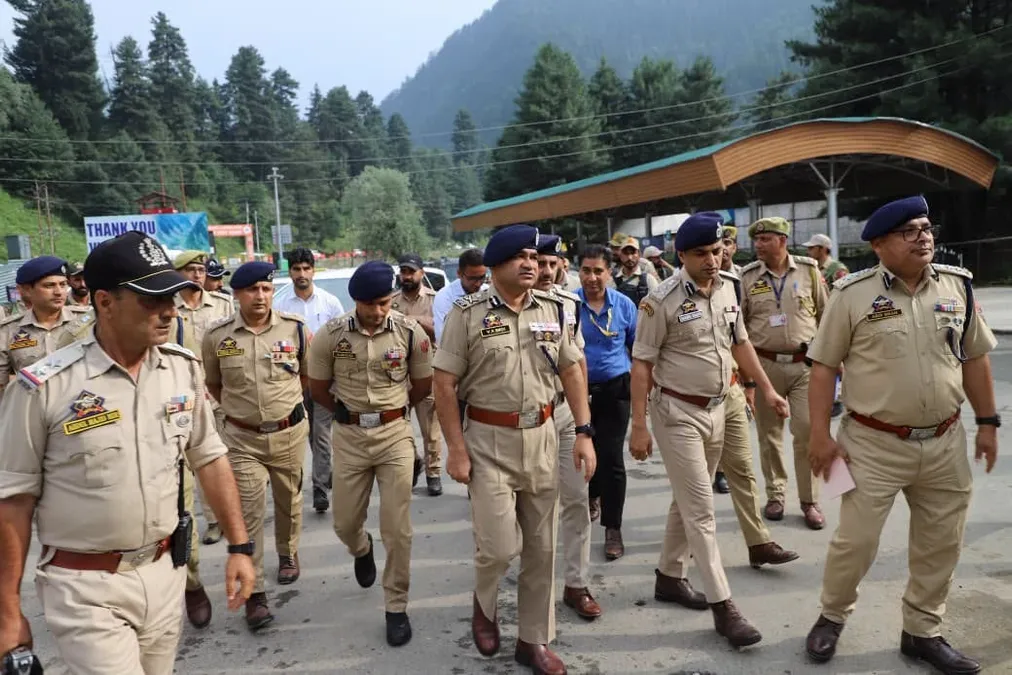
Srinagar, September 22, 2026: Jammu and Kashmir Police have begun a review of the security grid in Srinagar, with Kashmir Inspector General of Police Sujit Kumar directing officials to realign security checkpoints in locations where they can maintain security coverage while reducing traffic congestion.
The directions came during a security-review-cum-traffic-management meeting held at Police Control Room (PCR) Kashmir on Monday. Senior officers from the police, traffic police, CRPF and intelligence agencies participated in the meeting, where the existing deployment pattern and traffic situation across Srinagar were reviewed.
The move is significant because Srinagar’s security architecture operates alongside one of the Valley’s busiest urban road networks. Security checks at strategic locations remain an important part of the policing system, but their positioning can also affect traffic movement, particularly at busy junctions and entry points.
The latest directive seeks to address both requirements rather than treating traffic management and security deployment as separate exercises.
IGP Kashmir Calls for Realignment of Naka Points
During the meeting, officers briefed the IGP about the prevailing security situation in their respective areas and put forward suggestions on strengthening the security grid and improving traffic management.
The existing deployment of personnel and security checkpoints across Srinagar was examined, with particular attention to realigning naka points wherever required.
The stated objective is twofold: maintain security coverage while reducing congestion at locations where checkpoints contribute to traffic bottlenecks.
Officials have been directed to ensure security arrangements across intra-zone, inter-zone, inter-district and peripheral areas.
That indicates that the exercise is not limited to shifting a few checkpoints within central Srinagar. The police are looking at the wider relationship between different security zones and how information and personnel deployment can work across them.
Srinagar Entry and Exit Points to Get Stronger Checks
While some naka points are being considered for realignment, the police have simultaneously called for stronger security at Srinagar’s entry and exit points.
The IGP directed that these check posts be reinforced and that Traffic Police, District Police and personnel manning the checkpoints maintain seamless coordination and real-time information sharing.
The logic is straightforward.
Instead of having security checks distributed in ways that unnecessarily slow movement at already congested urban locations, the security apparatus can concentrate monitoring at strategically important access points while maintaining coverage within the city.
However, the effectiveness of that approach will depend on implementation.
A checkpoint moved from one road to another does not automatically create better security. Its value depends on intelligence, manpower, response time, surveillance capability and coordination between agencies.
Technology Becomes a Bigger Part of the Security Grid
Another important component of the meeting was the emphasis on technology.
Kumar directed officers to make greater use of technology for traffic regulation, surveillance, coordination and information sharing.
This points towards a gradual shift from relying solely on physical deployment towards a combination of personnel and technological monitoring.
For a city such as Srinagar, that can be particularly relevant.
Traffic officers need real-time information about congestion.
District police need rapid access to information from checkpoints.
Security agencies need to communicate across jurisdictional boundaries.
And emergency responses depend on how quickly information moves from the point of detection to the personnel who can act on it.
The police have not publicly detailed which specific technological systems will be expanded or how individual checkpoints will be equipped. The current directive therefore establishes the objective rather than providing a detailed technology rollout.
A Meeting Involving Multiple Security Stakeholders
The meeting brought together officers representing several components of the security and traffic-management system.
Those attending included senior officials from Traffic Police, Srinagar Police, the Central Kashmir Range, CRPF formations and intelligence agencies, according to local reporting.
The participation of multiple agencies reflects the layered nature of security arrangements in Srinagar.
Traffic management is primarily a policing and civic issue, but security deployment involves several agencies operating in overlapping areas.
Without coordination, that can create duplication in some places and gaps in others.
The IGP’s emphasis on real-time information sharing appears aimed at reducing that problem.
Security Versus Traffic: A Balancing Act
For Srinagar residents, the practical impact of the decision will ultimately be measured on the roads.
Security checkpoints are a familiar part of life in the city. At the same time, Srinagar faces persistent congestion around commercial centres, major junctions, bridges, educational institutions and arterial roads.
A security arrangement that causes prolonged traffic queues can create secondary problems.
Emergency vehicles can be delayed.
Public transport becomes less predictable.
Office and school commuters lose time.
Traffic spills into adjoining roads.
And congestion itself can make it more difficult for security personnel to respond quickly when an incident occurs.
That is why the police directive is framed around maintaining the security grid while improving vehicular movement rather than simply removing checkpoints.
The distinction is important.
The instruction is realignment, not abandonment of the security network.
Why the Timing Matters
The decision comes as Srinagar continues to host large public, political and administrative activity.
The Jammu and Kashmir Assembly is currently in session in Srinagar, while the city remains the principal administrative and commercial centre of the Valley.
Security arrangements around important government installations, public institutions and major movement corridors therefore have to account for both routine urban traffic and heightened security requirements.
The latest meeting appears to be part of an ongoing process of reviewing deployment rather than a response publicly attributed to one specific security incident.
The police have not said that the entire Srinagar security architecture is being dismantled or fundamentally redesigned.
Instead, the emphasis is on continuous review and adjustment.
The Larger Shift: A More Dynamic Security Grid
The most notable aspect of the directive may therefore be its emphasis on adaptability.
A fixed security grid can become less effective when traffic patterns change, new roads open, population movement shifts or congestion develops around particular points.
Realignment allows authorities to respond to those changes.
The challenge is to ensure that traffic decongestion does not create unintended gaps in surveillance.
That will require regular assessment rather than a one-time relocation of checkpoints.
The police have specifically called for continuous review and close coordination among the agencies involved.
In practical terms, the Srinagar experiment will have two measures of success.
Can vehicles move more efficiently?
And can security personnel detect and respond to threats just as effectively, or more effectively, after the changes?
Both will matter.
What Changes for Commuters?
For ordinary Srinagar residents, the immediate expectation is that some security checkpoints may be repositioned away from particularly congested stretches, while major city entry and exit points receive stronger monitoring.
The exact locations and timing of individual changes have not been publicly detailed in the reports available so far.
That means commuters should not assume that every existing checkpoint will disappear or that traffic delays will immediately end.
The police have instead ordered a review of where checkpoints are located and how different agencies coordinate around them.
If implemented effectively, the approach could reduce unnecessary bottlenecks without weakening the broader security network.
But that outcome will depend on how the realignment is carried out on the ground.
Security Review Moves Beyond the Checkpoint
The latest directive also reflects a broader reality of modern policing.
A security checkpoint is only one component of a security system.
Surveillance, intelligence gathering, communications, traffic monitoring, rapid response and inter-agency coordination increasingly determine how effectively authorities can manage a large urban environment.
That is why the IGP’s instructions on technology and real-time information sharing are as important as the physical repositioning of naka points.
For Srinagar, the immediate challenge is familiar: keep people moving while keeping the city secure.
The police’s latest instructions attempt to address both at the same time.
The coming weeks will show whether the revised deployment can deliver the balance authorities are seeking.
Key Takeaway
The Kashmir Police have ordered a realignment of security checkpoints in Srinagar, not a withdrawal of the security grid. The plan involves repositioning naka points where necessary, strengthening entry and exit checkpoints, improving coordination between Traffic Police and District Police, and using technology for surveillance and information sharing.