‘If People Lose Faith in Elections, What Is Left of Democracy?’ Omar Abdullah Seeks Corrective Action
By: News Desk | 23 September 2026
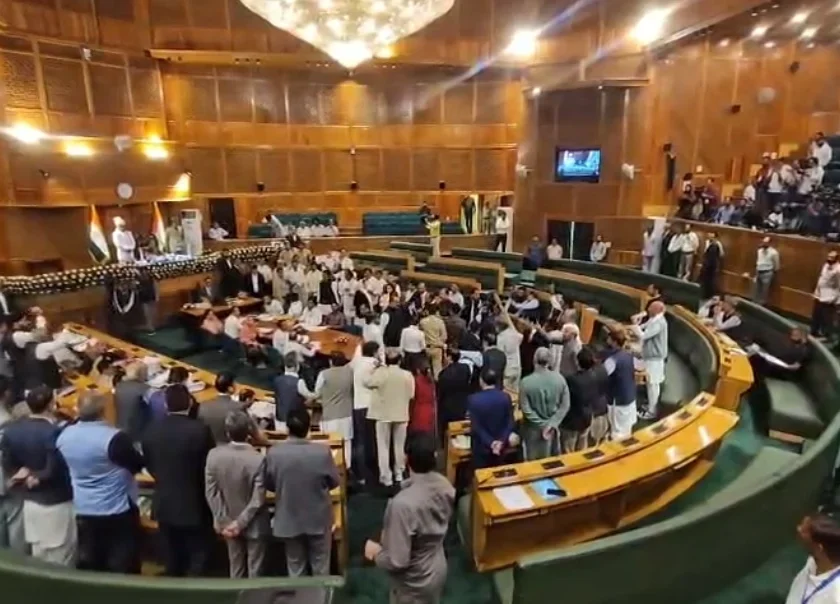
Srinagar, September 24: Jammu and Kashmir Chief Minister Omar Abdullah has called for “corrective action” in the functioning of the Election Commission of India, saying that any sustained erosion of public confidence in the electoral process could have serious consequences for democratic participation.
Omar’s remarks came after a report by The Indian Express detailed repeated objections allegedly recorded by two of the Election Commission’s three members over decisions relating to electoral rolls and the Special Intensive Revision (SIR) process.
Speaking to reporters in Srinagar, the J&K Chief Minister said the developments raised questions that the Election Commission and the Union government needed to address.
“If people lose trust in elections, then what is left in democracy?” Omar said, stressing that elections constitute the foundation of representative government.
His intervention places J&K’s political leadership directly within a rapidly widening national debate over the functioning of India’s election machinery, voter-list revisions and the internal decision-making process of the constitutional poll body.
But the controversy requires a distinction between reported internal disagreements within the Election Commission and allegations that electoral decisions themselves were unlawful or manipulated. The former has been acknowledged by the ECI as part of its deliberative process; the latter remain matters of political allegation and dispute.
What triggered Omar Abdullah’s intervention?
The immediate trigger was an Indian Express investigation reporting that Election Commissioners Sukhbir Singh Sandhu and Vivek Joshi had recorded objections on at least 14 occasions over a period of 10 months concerning decisions related to electoral rolls and the SIR exercise.
The reported objections covered issues including voter additions and deletions, changes relating to Form 6 and aspects of voter-data and software management.
The report said the two commissioners had raised concerns about decisions allegedly taken without their knowledge or concurrence.
The Election Commission subsequently acknowledged the existence of written notes, observations, technical suggestions and internal checks and balances.
However, the Commission described such exchanges as part of its normal decision-making process and said that its orders over the preceding year had been unanimous.
That distinction is at the heart of the controversy.
The existence of disagreement within a constitutional institution is not, by itself, proof that the institution has failed in its constitutional responsibilities.
At the same time, questions about whether members were adequately consulted on important electoral decisions can naturally become politically significant because the Election Commission’s credibility depends heavily on public confidence in its independence and procedures.
Omar: corrective action is needed
Omar Abdullah did not merely comment on the existence of differences.
He argued that the episode should prompt the Election Commission and the Union government to reflect on whether public confidence in elections could be affected.
“The members of the Election Commission and the Government of India need to think about this,” he said, according to The Indian Express.
The Chief Minister’s argument is essentially about institutional credibility.
Elections rely not only on rules and technology but also on public acceptance of the process.
A voter must believe that registration, electoral-roll revision, polling, counting and the declaration of results are governed by procedures that are transparent and applied impartially.
If confidence in those processes weakens, participation itself can become harder to sustain.
That is the concern Omar was highlighting.
The Election Commission’s response changes the context
The ECI has pushed back against the interpretation that internal differences automatically indicate institutional dysfunction.
Following the Indian Express report, the Commission acknowledged that written notes and observations had been exchanged among members but characterised these as normal institutional checks and balances.
It also stated that its orders over the previous year had been unanimous.
That response is important because it provides the other side of the controversy.
In a multi-member constitutional body, disagreement during internal deliberations can be expected. Members may raise objections, suggest technical changes or seek clarification before a final decision is reached.
The crucial question, therefore, is not simply whether disagreements occurred.
It is how those disagreements were handled, whether the statutory decision-making procedure was followed and whether final decisions were properly authorised and recorded.
Those are substantially different questions from whether commissioners ever disagreed with one another.
Why the SIR controversy matters
The dispute has emerged against the backdrop of the Special Intensive Revision of electoral rolls, an exercise intended to examine and update voter lists.
Electoral-roll revision is not unusual.
The Election Commission routinely undertakes revision to identify eligible voters, correct errors and remove entries relating to people who have died, shifted residence or are otherwise ineligible.
But SIR has become politically contentious because of the scale and consequences of the exercise in several States.
Opposition parties have raised concerns about eligible voters potentially being excluded from electoral rolls, while the Election Commission has defended the exercise as necessary for maintaining accurate electoral registers.
The stakes are high because an error in a voter list is different from an ordinary administrative error.
If an eligible citizen is missing from the electoral roll and cannot get the issue corrected before polling, that person may effectively lose the ability to exercise the franchise in that election.
At the same time, an accurate voter list is essential to ensuring that electoral contests are conducted on the basis of eligible voters.
The challenge for election administrators is therefore two-sided:
remove ineligible or duplicate entries without excluding eligible citizens.
The West Bengal experience illustrates the scale of the challenge
The controversy has already generated substantial scrutiny in West Bengal.
The Election Commission told the Supreme Court that 27.16 lakh voters had been removed during the SIR process there and that more than 22 lakh had filed appeals seeking reinstatement.
The Commission attributed deletions to categories including absent, shifted, deceased and duplicate voters and maintained that the process was subject to legal safeguards and appeals.
The numbers illustrate why electoral-roll revision can become politically explosive.
A voter-list exercise involving millions of people inevitably generates disputes.
The key issue is not merely how many names are removed.
It is how many removals are subsequently found to be erroneous, how efficiently citizens can appeal, how quickly corrections are made and whether eligible voters have adequate opportunity to establish their entitlement before an election.
That is where administrative transparency becomes crucial.
Omar connects the national controversy with J&K’s experience
For Omar Abdullah, the current national controversy also has a local history.
He pointed to the delimitation exercise in Jammu and Kashmir, saying that concerns about the Election Commission’s functioning were not new for the region.
Omar has previously criticised the J&K delimitation process, arguing that it lacked transparency and was flawed.
During his latest comments, he linked those earlier concerns with the present controversy surrounding internal differences within the Election Commission.
These claims are Omar’s political assessment and remain contested.
The J&K delimitation process itself was conducted through a statutory Delimitation Commission, and its final recommendations were notified in 2022.
The political disagreement surrounding the exercise, however, has continued, particularly over the allocation of Assembly constituencies and the broader consequences of the reorganisation of J&K’s electoral map.
For the National Conference, delimitation has remained part of a larger argument about representation and the political restructuring of Jammu and Kashmir.
The constitutional importance of the Election Commission
The Election Commission occupies a distinctive position in India’s constitutional system.
Article 324 of the Constitution vests the superintendence, direction and control of elections in the Election Commission.
That includes elections to Parliament, State legislatures and the offices of President and Vice-President.
The institution therefore sits at the centre of India’s representative system.
Its responsibilities extend beyond conducting polling days.
Electoral registration, voter rolls, election schedules, candidate processes, party recognition and symbols, polling arrangements and counting all form part of the broader electoral architecture.
This is why questions about the Commission’s internal functioning receive disproportionate public attention.
The issue is not simply administrative.
It concerns an institution responsible for administering the mechanism through which governments derive electoral mandates.
The argument over internal dissent
There are two competing ways of looking at the reported disagreements within the Commission.
The first is that internal objections demonstrate that commissioners are independently scrutinising decisions rather than simply accepting a single institutional line.
Under this interpretation, disagreement can actually be part of institutional checks and balances.
The second view is that repeated objections by two members over important electoral matters could raise questions about whether the Commission’s internal consultation process is functioning as it should.
Neither interpretation can be established merely from the existence of objections.
The decisive evidence would lie in the underlying records: what decisions were proposed, what objections were made, whether those objections were addressed, how the final decisions were taken and whether the applicable statutory procedures were followed.
That is why the current controversy is likely to generate further demands for disclosure and scrutiny.
Why voter confidence matters
Omar’s most important point was not about one election or one voter list.
It was about trust.
An election is ultimately a process in which competing political forces agree to accept a common set of rules and procedures.
Candidates can challenge decisions.
Parties can campaign aggressively.
Voters can change governments.
But the system depends on broad acceptance that the process itself is legitimate.
That does not mean election authorities are immune from criticism.
Quite the opposite.
The more powerful an electoral institution is, the greater the need for transparency and accountability around its decisions.
Public trust is strengthened when voters can understand how decisions are made, how errors are corrected and how disputes are resolved.
What happens when eligible voters are left out?
Omar also raised another sensitive issue: situations in which eligible citizens may be prevented from voting.
This is particularly important in the context of electoral-roll revision.
The right to vote in India is exercised through inclusion in the electoral roll, subject to the statutory framework governing elections.
If an eligible person is incorrectly excluded, the remedy mechanisms must work quickly enough to restore the person’s name where appropriate.
The challenge becomes especially difficult when revisions occur close to polling dates.
A correction made after an election cannot restore a vote that was already lost.
That is why the speed and accessibility of appeals are just as important as the initial revision process.
The debate is bigger than the political parties
The latest controversy has quickly become another battlefield between the government and opposition.
Opposition parties have demanded action against Chief Election Commissioner Gyanesh Kumar and questioned the conduct of the Election Commission.
The BJP has defended the poll panel and argued that internal differences among commissioners are part of democratic institutional functioning.
The ECI itself has maintained that its final decisions were unanimous.
These competing positions should not be confused with established findings.
Political parties have obvious interests in electoral processes because their political fortunes depend on them.
The institutional question is therefore best examined through documentary records, statutory procedures, judicial scrutiny and publicly verifiable data.
J&K’s political stakes are particularly high
For Jammu and Kashmir, the issue carries additional weight.
The Union Territory returned to an elected government in October 2024 after a prolonged period without an elected Assembly government.
The electoral process therefore has particular political significance in the region.
Questions surrounding delimitation, representation, voter registration and the powers of elected institutions have repeatedly featured in J&K’s political discourse.
Omar Abdullah’s intervention should be viewed within that context.
His remarks are not simply about a dispute in Delhi.
They reflect a political environment in which the credibility of electoral institutions has long been closely linked to questions of representation and public confidence in Jammu and Kashmir.
The real test will be transparency
The political rhetoric surrounding the Election Commission is unlikely to disappear quickly.
The more useful question now is what happens institutionally.
Will the Election Commission provide additional information about the objections raised by its members?
Will the government and Parliament examine the concerns?
Will courts be asked to review specific decisions?
Will electoral-roll procedures be modified where genuine administrative weaknesses are identified?
And, most importantly, will citizens have clear and accessible mechanisms to challenge erroneous exclusions from voter lists?
Those questions are more consequential than the political slogans surrounding the controversy.
A credibility issue that extends beyond one election
Omar Abdullah’s warning that a loss of public confidence could damage democratic participation reflects a broader principle of electoral governance: elections require both procedural integrity and public legitimacy.
The current dispute does not establish that India’s electoral system has ceased to function, nor does the existence of internal disagreements within the Election Commission by itself establish wrongdoing.
But the controversy does underline why election authorities are expected to maintain clear procedures, institutional transparency and effective avenues for correcting errors.
For Jammu and Kashmir’s Chief Minister, the message is straightforward: the Election Commission and the Union government should respond to the concerns raised and take corrective measures where necessary.
For the Election Commission, the challenge is equally clear: explain its procedures and decisions in a manner that allows citizens to distinguish ordinary institutional disagreement from genuine procedural failure.
And for voters, the immediate issue is practical rather than political — whether their names are on the electoral roll, whether they can exercise their franchise and whether an effective remedy exists if something goes wrong.
That is where public confidence in an election system is ultimately built: not only in the speeches of politicians or statements from institutions, but in the ability of an ordinary citizen to see, understand and trust the process through which their vote is counted.