Veteran BJP Organiser Relinquishes Charge After Nearly 12 Years; Leadership Transition Comes Amid Wider Party Restructuring
By: News Desk | 26 September 2026
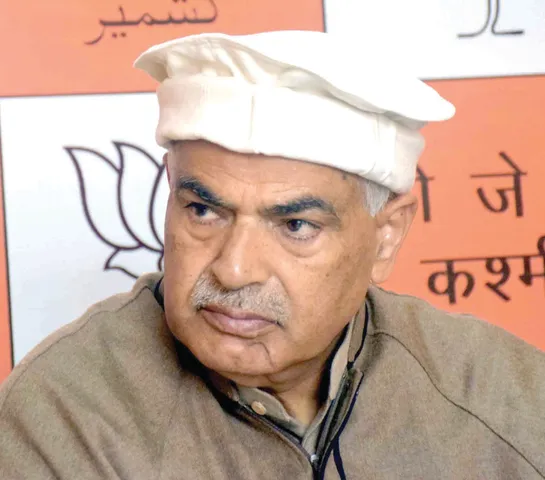
Srinagar: Senior BJP leader Ashok Koul has relinquished charge as the party’s General Secretary (Organisation) for Jammu and Kashmir and Ladakh after nearly 12 years in the influential organisational post, bringing an end to one of the longest tenures in the BJP’s J&K organisational structure.
The BJP has clarified that Koul’s departure should be understood as the completion of his tenure, rather than a resignation or removal.
Party sources said Koul has completed his organisational term and will return to his parent organisation. Koul himself confirmed that he had relinquished charge and indicated that age was one of the factors behind the decision. (tribuneindia.com)
The transition comes as the BJP is undertaking wider organisational changes following the appointment of Nitin Nabin as party president. The party has also appointed new organisational in-charges for Jammu and Kashmir, indicating that further changes in the Union Territory’s BJP structure could follow. (tribuneindia.com)
Koul’s departure is significant because the organisational general secretary’s role is different from that of a conventional political office-bearer. The position is closely associated with cadre building, booth-level organisation, coordination between the party’s political and organisational wings and implementation of the central leadership’s strategy.
For more than a decade, Koul occupied that position through some of the most consequential political changes in Jammu and Kashmir.
Not a resignation, BJP clarifies
Initial reports described Koul as having “stepped down” or “resigned” from the organisational post.
The BJP subsequently clarified the terminology.
Party sources said Koul had completed his tenure and relinquished charge, and would return to his parent organisation. BJP spokesperson Altaf Thakur also issued a clarification saying that reports suggesting Koul had been removed or had resigned were misleading and that the veteran leader had decided to relinquish his organisational responsibilities considering his age and personal circumstances. (srinagarnews.net)
Another report citing party sources similarly said Koul had completed his 12-year tenure rather than resigned from the BJP. (theins.in)
The distinction matters because it changes the political interpretation of the transition.
There is currently no verified evidence in the reporting that Koul was removed because of an internal dispute or organisational failure.
Instead, the available accounts point to a planned transition following the completion of a long tenure, with age and personal circumstances also cited.
Nearly 12 years at the centre of BJP’s J&K organisation
Koul has served as General Secretary (Organisation) in Jammu and Kashmir since 2012.
Over that period, he remained one of the BJP’s most important organisational figures in the region.
Unlike elected representatives whose roles are tied to constituencies, the organisational general secretary works largely behind the scenes.
The job involves building party structures, coordinating cadres, overseeing organisational programmes and helping translate the party’s broader political strategy into ground-level activity.
Koul’s long tenure therefore coincided with the BJP’s transformation from a predominantly Jammu-centred political force into a party seeking a wider organisational footprint across both regions of the erstwhile state.
BJP leaders have credited him with expanding the party’s grassroots network, particularly through booth-level structures and organisational outreach in Kashmir. (tribuneindia.com)
A Kashmiri Pandit himself, Koul also became one of the BJP’s most recognisable organisational faces in the Valley.
The BJP’s organisational expansion in Kashmir
One of the most notable aspects of Koul’s tenure was the BJP’s effort to establish a more systematic organisational presence in Kashmir.
Party leaders have said that booth committees were established across the Valley during his tenure and that the BJP’s membership expanded substantially.
BJP spokesperson Altaf Thakur has credited the organisation with increasing its membership to more than five lakh, while party leaders have highlighted the development of booth-level structures across Kashmir. (hindustantimes.com)
Those figures are party claims rather than independently audited membership statistics.
Nevertheless, the organisational expansion is visible in the BJP’s increased political activity in areas where its electoral presence was historically limited.
The party’s organisational strategy became especially important after 2019, when Jammu and Kashmir’s political and constitutional structure changed significantly.
From coalition government to post-2019 politics
Koul’s tenure covered several distinct phases of Jammu and Kashmir’s political history.
In 2015, the BJP entered government in the erstwhile state for the first time as part of a coalition with the PDP.
The coalition brought the BJP into an entirely new political role in J&K.
Koul was operating the party’s organisational machinery during this period, as the BJP attempted to consolidate its position in Jammu while expanding its reach in Kashmir.
The coalition ended in 2018 after the BJP withdrew support from the PDP government.
A year later, the constitutional and administrative structure of Jammu and Kashmir changed fundamentally following the Centre’s August 2019 decisions, including the reorganisation of the erstwhile state into the Union Territories of Jammu and Kashmir and Ladakh.
The BJP subsequently operated in a dramatically different political environment.
Koul remained at the organisational helm throughout that transition.
The 2024 Assembly election: BJP’s Jammu strength
The latest electoral results provide an important measure of the BJP’s political position in J&K.
In the 2024 Assembly election, the BJP won 29 of the 90 Assembly seats, finishing as the second-largest party by seats after the National Conference’s 42. The BJP’s 29 seats were all outside the Kashmir Valley. (indianexpress.com)
The party also increased its tally compared with the 2014 election, when it had won 25 seats.
The geographical distribution of those seats, however, remains significant.
The BJP won heavily across the Jammu region but did not secure an Assembly seat in the Kashmir Valley in the 2024 election. (indianexpress.com)
That creates a complicated picture of Koul’s organisational legacy.
On one side, the BJP has built a strong and electorally successful organisation in Jammu.
On the other, the party continues to face a substantial electoral challenge in Kashmir, where organisational expansion has not yet translated into Assembly representation.
A Kashmiri Pandit face in the BJP’s Valley strategy
Koul’s background also gave his organisational role particular visibility.
As a Kashmiri Pandit, he was among the BJP’s senior leaders with a direct connection to the Valley’s displaced Pandit community and its political concerns.
His role in the party was not restricted to the Jammu region.
Reports have highlighted his repeated engagement with Kashmir’s organisational units and the BJP’s efforts to establish a broader cadre base there. (tribuneindia.com)
The challenge for his successor will therefore not simply be maintaining the existing Jammu organisation.
It will also involve deciding how the party approaches Kashmir, where the BJP has invested heavily in organisational expansion but remains without an elected Assembly seat.
The limits of organisational expansion
The BJP’s experience under Koul illustrates the difference between organisational presence and electoral representation.
A party can establish booth committees, recruit members and maintain a political network without necessarily converting that structure into electoral victories.
The 2024 results demonstrate this clearly.
The BJP’s 29 seats made it a major force in the 90-member Assembly, but the party’s representation was geographically concentrated in Jammu.
The Kashmir Valley remains the harder political terrain.
That will likely be one of the most important challenges facing whoever takes charge of the organisational machinery next.
Why the transition comes at an important time
Koul’s departure comes during a period of broader change within the BJP organisation.
Nitin Nabin has recently taken over as BJP president, and the party has begun making organisational appointments in different states and Union Territories.
In Jammu and Kashmir, Satish Poonia has been appointed the new party in-charge, while Reena Kashyap has been named co-in-charge. (tribuneindia.com)
The changes suggest that the BJP’s J&K organisation is entering a new phase of leadership and organisational management.
Koul’s departure is therefore not occurring in isolation.
It forms part of a broader organisational transition.
Who could replace Ashok Koul?
The BJP has not yet publicly announced Koul’s successor.
Reports have suggested that several names could be considered as the party reorganises its J&K structure.
Some reports have mentioned Akshay Kumar, associated with Himachal Pradesh, among possible names.
However, that remains speculation unless and until the BJP formally announces an appointment.
There is also no indication that the party has finalised the successor merely because a particular name has appeared in media reports.
The eventual appointment could provide clues about the BJP’s organisational priorities in J&K.
A leader with a strong Jammu organisational background could indicate continuity.
A leader with deeper Valley experience could signal greater emphasis on Kashmir outreach.
A centrally experienced organiser could instead reflect an effort to integrate the J&K unit more closely with the BJP’s wider national organisational structure.
At present, those remain possibilities rather than established decisions.
The organisation Koul leaves behind
The BJP’s organisational structure in J&K has changed considerably since Koul first assumed the post in 2012.
The party now has:
- a substantial Assembly presence;
- an established organisational network across Jammu;
- a larger membership base claimed by the party;
- booth-level structures extending into Kashmir;
- a much stronger institutional presence than it had a decade ago; and
- a political role as the principal Opposition party in the J&K Assembly.
The 2024 Assembly election gave the BJP 29 seats, compared with 25 in 2014. (indianexpress.com)
At the same time, the party has not yet overcome the Valley-specific electoral barrier.
That means the next organisational general secretary inherits both an expanded structure and a clearly defined political challenge.
The Kashmir question remains the biggest organisational challenge
The BJP’s Kashmir strategy has evolved substantially over the past decade.
The party has attempted to expand its membership, create local-level organisational structures and establish a political presence beyond its traditional support base.
But electoral representation in the Valley remains elusive.
The 2024 Assembly results underline that limitation.
The BJP did not win any of the 47 Assembly constituencies in the Kashmir division, while its 29 seats came from the Jammu division. (indianexpress.com)
For the successor to Koul, therefore, the question will not simply be how to preserve the BJP’s Jammu base.
It will be whether the organisation can turn its long-term investment in Kashmir into measurable political representation.
That will require a different organisational approach from simply expanding booth structures.
A changing political environment
The political environment in J&K has also changed since Koul took charge.
In 2012, the BJP was in Opposition and Jammu and Kashmir was still a full-fledged state.
By 2015, it was part of the government.
By 2018, it was back in Opposition.
In 2019, the state was reorganised into two Union Territories.
In 2024, elections returned an elected Assembly and government to the Union Territory of Jammu and Kashmir.
And by 2026, the restoration of statehood has again become one of the principal political issues in the Assembly.
Koul’s tenure therefore spans almost the entire modern transformation of the BJP’s organisational and political role in J&K.
A transition, not necessarily a political exit
Koul’s departure from the organisational general secretary’s position does not mean that he is leaving the BJP.
Party sources have said he will return to his parent organisation after relinquishing the J&K organisational responsibility. (theins.in)
That makes the current development better understood as an organisational transition rather than a complete political retirement.
The BJP has not indicated that Koul is being expelled, removed or sidelined.
Instead, the available party clarification points to the completion of his long tenure and a return to organisational work.
His next assignment, if any, could therefore determine how much of his experience remains directly connected to the J&K unit.
What changes with a new organisational general secretary?
The organisational general secretary occupies a crucial position because the office links the party’s cadre network with its political leadership.
The successor will inherit responsibility for coordinating a party that has:
29 Assembly MLAs,
a strong Jammu base,
an expanding but electorally unproven Kashmir network,
and
a political environment increasingly shaped by the statehood question.
The next organisational leader will also have to work with a new state leadership structure and the recently appointed central in-charge and co-in-charge.
That makes the appointment more than a routine personnel change.
It could influence the BJP’s organisational priorities for the next phase of J&K politics.
The bigger question: can BJP’s organisational footprint expand beyond Jammu?
Koul’s 12-year tenure leaves behind a mixed organisational picture.
The BJP has significantly strengthened its position in Jammu and emerged as a major electoral force in the Union Territory.
Its 29 Assembly seats in 2024 confirm that the party has consolidated a substantial political base. (indianexpress.com)
At the same time, the party’s inability to win a Kashmir Valley Assembly seat in 2024 demonstrates the limits of that expansion.
The next phase will therefore be less about simply building an organisation and more about determining how that organisation operates in two politically different regions.
The BJP’s Jammu strategy and its Kashmir strategy cannot necessarily be identical.
The successor to Koul will inherit responsibility for managing both.
The end of an organisational era
Ashok Koul’s departure closes a 12-year chapter in the BJP’s organisational history in Jammu and Kashmir and Ladakh.
His tenure covered coalition politics, the end of that coalition, the 2019 constitutional reorganisation, the transition to Union Territory politics, the return of an elected Assembly and the BJP’s consolidation as a major force in Jammu.
The party now faces a new organisational phase.
The immediate question is who will replace Koul.
The larger question is what the BJP wants its J&K organisation to achieve next.
Will the emphasis remain on consolidating Jammu?
Will the party intensify its Valley outreach?
Will it attempt to build a political bridge between its strong Jammu organisation and a Kashmir electorate where it has yet to secure Assembly representation?
And how will the new organisational leadership respond to a political landscape increasingly dominated by demands for restoration of statehood?
Those questions will become clearer once the BJP announces its next organisational general secretary.
For now, the party’s message is clear: Koul’s long tenure has ended, but his organisational chapter in J&K is not necessarily his final role within the BJP.