Sonam Wangchuk on CJP Leaders: ‘No Saints’ and Political Ambitions Behind Student Movements
By: Javid Amin | 30 August 2026
Activist says political aspirations are not inherently wrong—but insists student movements must remain neutral and free from party agendas
Political ambition is often treated as a dirty word when it appears inside a protest movement. Activists are expected to be selfless. Student leaders are expected to remain idealistic. Public movements are often judged by how far they appear from electoral politics.
Sonam Wangchuk has now challenged that assumption.
The Ladakh-based educationist and climate activist has said that the leaders associated with the CJP, or Cockroach Janta Party, appear to have political ambitions. But instead of presenting that as a scandal, Wangchuk made a more nuanced argument: there is nothing inherently wrong with young people wanting to enter politics.
The real question, he suggested, is whether personal political ambitions are allowed to hijack a public movement.
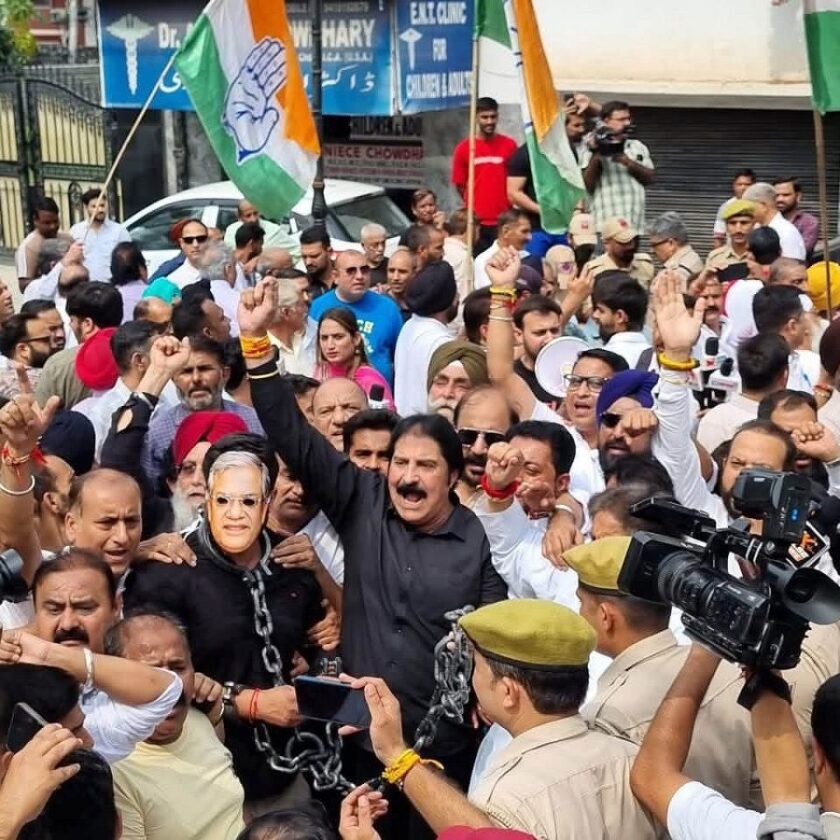
Wangchuk’s remarks, made after his close association with CJP organisers during a student-led protest at Delhi’s Jantar Mantar, have opened a wider debate about the complicated relationship between activism and politics.
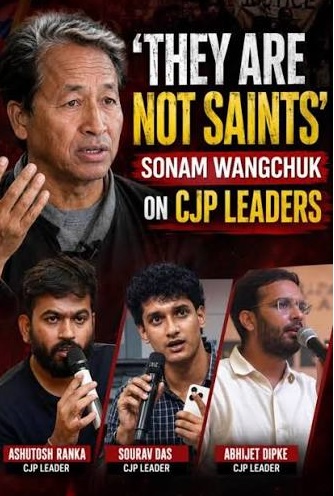
“They are not saints,” Wangchuk said while discussing what he believed to be the political aspirations of the group’s leaders. Yet his larger argument was not an attack on them. If anything, it was a warning against unrealistic expectations.
Activists, he appeared to suggest, are human beings. They can have ideals and ambitions at the same time.
The challenge is ensuring that one does not corrupt the other.
A Crucial Correction: What Is CJP and Where Did This Debate Begin?
The controversy surrounding Wangchuk’s remarks has also exposed the importance of getting the basic facts right.
CJP in this case refers to the Cockroach Janta Party, a youth-led political and protest grouping associated with the student movement that emerged around demands for accountability in the education sector.
It is not the “Citizens’ Joint Platform,” and the episode did not emerge from Kashmir’s political landscape.
According to reports by The Tribune, Hindustan Times, Times of India and Moneycontrol, Wangchuk worked closely with CJP organisers, including Abhijeet Dipke, Saurav Das and Ashutosh Ranka, during a nearly two-month-long protest at Jantar Mantar in New Delhi.
The movement had been demanding action against then Education Minister Dharmendra Pradhan and sought to keep its identity centred on student concerns rather than party politics.
That distinction matters.
Because Wangchuk’s comments were not really about whether politicians can be trusted. They were about a more complicated dilemma: Can a movement remain politically independent when some of the people leading it may eventually want political careers?
‘They Are Not Saints’: What Sonam Wangchuk Actually Said
Wangchuk’s comments were more nuanced than the headline-grabbing phrase “they are not saints” might initially suggest.
Speaking on a podcast with Prakhar Gupta, Wangchuk said his assessment was that the CJP founders had political ambitions. However, he also clarified that they had not directly told him about any such plans.
That distinction is important.
This was not an accusation based on documentary evidence or an admission by the CJP leaders themselves. Wangchuk explicitly described it as his own assessment after observing and working with them closely.
His argument was straightforward: political ambition is normal.
In fact, Wangchuk suggested that it could be healthy for young people involved in public movements to eventually enter formal politics, either by joining existing parties or creating new political platforms.
What concerned him was something else.
He repeatedly advised the organisers that their personal political futures should not influence the student movement they were currently leading.
The platform, he argued, needed to remain neutral, apolitical and function as a pressure group.
That was the real heart of his message.
The Fine Line Between a Movement and a Political Launchpad
India has seen this story before.
Many major political movements begin outside formal electoral politics. Students, activists, lawyers, social workers and civil society figures mobilise around a public issue. Over time, some leaders emerge as recognisable political figures.
The transition from activism to politics is therefore not unusual.
But it raises a persistent question: when does a public movement stop being a movement and become a vehicle for political ambition?
Wangchuk appears to recognise that the boundary can be difficult to maintain.
During the Jantar Mantar protest, he reportedly told the organisers that even if they had ambitions to enter politics in the future, those ambitions should not determine the direction of the student platform.
His reasoning was practical as much as ideological.
A movement that is seen as belonging to one political party can lose support from people who disagree with that party. A neutral pressure group, by contrast, can potentially attract students and citizens across ideological lines.
Wangchuk said he was satisfied that the organisers had maintained that distinction during the protest.
That makes his remarks considerably different from a straightforward criticism of CJP.
He was not saying political ambition had discredited the movement.
He was saying political ambition must not be allowed to capture it.
Why Political Ambition Is Not Necessarily a Bad Thing
There is a tendency in public discourse to divide people into two neat categories.
On one side are activists, portrayed as morally pure and detached from power.
On the other are politicians, portrayed as ambitious and interested in power.
Real life is rarely that simple.
Politics, after all, is one of the ways societies make decisions about laws, institutions, public money and power. Someone who wants to change the education system, environmental policy or governance may eventually conclude that protest alone is not enough.
Entering politics can become the next stage of that journey.
Wangchuk’s argument appears rooted in this reality.
Young leaders with political ambitions should not automatically be treated with suspicion, he suggested. The more important questions are about their methods, their accountability and whether they misuse public trust.
In this sense, his remarks could be read as a defence of political participation rather than a condemnation of it.
A young activist becoming a politician is not necessarily a betrayal of activism.
The danger begins when activism is deliberately used as a disguise for a political project without transparency.
The Question of Abhijeet Dipke’s Political Background
Wangchuk also addressed criticism concerning CJP founder Abhijeet Dipke’s earlier association with the Aam Aadmi Party.
According to reports, Wangchuk said he was aware that critics had raised the issue but did not consider a person’s previous association with a political party to be inherently problematic.
Again, his position was consistent.
Working with a political party is not a crime.
Having political ambitions is not a moral failure.
What matters, Wangchuk argued, is whether the current student platform remains independent from party agendas.
That distinction may become increasingly important for CJP as the organisation grows and expands its public presence.
Any emerging political movement faces scrutiny over funding, affiliations, leadership ambitions and ideological direction. The more visible it becomes, the harder it becomes to maintain the image of being simply an informal public movement.
CJP may therefore find itself confronting the very challenge Wangchuk identified: how to preserve the trust of supporters while its leaders develop larger political ambitions.
A Pressure Group or a Future Political Force?
This is where Wangchuk’s intervention becomes politically significant.
Pressure groups and political parties perform different roles.
A political party seeks power through elections.
A pressure group seeks to influence those who hold power.
The two can overlap, but they are not the same.
Wangchuk’s advice was that the student platform should remain a pressure group, at least in its present form. Such a position allows it to question governments regardless of which party is in power.
Once a movement becomes openly associated with a particular party, however, its ability to claim neutrality can weaken.
Supporters may begin asking whether protests are genuinely issue-driven or politically strategic.
That is why Wangchuk’s warning was not just philosophical.
It was organisational advice.
He appeared to be telling the young leaders that they could enter politics tomorrow—but they should not turn today’s student movement into an undeclared election campaign.
The Contradiction at the Centre of Modern Activism
There is an unavoidable contradiction in many modern movements.
People want leaders who are ambitious enough to challenge powerful institutions.
But they become suspicious when those same leaders appear ambitious for themselves.
The public wants reformers, but not careerists.
It wants leadership, but not personality cults.
It celebrates activists who influence politics but sometimes criticises them when they openly enter politics.
Wangchuk’s remarks confront this contradiction directly.
By saying CJP leaders were “not saints,” he was challenging the expectation that public leaders must be completely free from personal ambition to remain credible.
At the same time, he did not give them a blank cheque.
Ambition may be legitimate.
But public trust is conditional.
That is the balance he appeared to be demanding.
What Does This Mean for CJP?
For the CJP leadership, Wangchuk’s comments could produce mixed reactions.
On one hand, the remarks could invite greater scrutiny. Critics may point to them as evidence that the movement’s leaders have political plans beyond student activism.
On the other hand, Wangchuk himself did not portray political ambition as a scandal.
In fact, he described the emergence of young political leaders as potentially positive.
The challenge for CJP will therefore be transparency.
If its leaders eventually decide to enter electoral politics, the public may judge them less harshly if the transition is openly acknowledged rather than concealed behind claims of permanent political neutrality.
For now, however, the credibility of the movement will depend largely on whether it continues to act independently of established political parties.
That is the standard Wangchuk himself appears to have set.
What It Means for India’s Youth Politics
The larger significance of this debate goes beyond one organisation.
India’s political system is increasingly being challenged by younger activists who first gain visibility through protests, digital campaigns and issue-based movements.
Many begin outside traditional party structures.
Some eventually enter them.
This pattern reflects a broader shift in political participation.
Young citizens often distrust established parties but still want influence over public policy. Activism becomes the first step. Electoral politics may become the second.
Wangchuk’s comments suggest that this transition should not automatically be viewed with cynicism.
Politics needs young leaders.
But movements also need institutional safeguards against being captured by individual ambitions.
The solution is not to demand that leaders behave like saints.
It is to demand transparency, accountability and clear boundaries between public movements and personal political projects.
The Bigger Lesson: Judge Leaders by What They Do
Perhaps the strongest message from Wangchuk’s remarks is also the simplest.
Do not judge public figures merely by the image they create.
Movements often use powerful moral language. Leaders speak of sacrifice, change, justice and public service. Those ideals matter, but they should not exempt anyone from scrutiny.
Political ambition is not automatically corruption.
Activism is not automatically purity.
And a leader’s claim to represent “the people” should never be accepted without questions.
Wangchuk himself acknowledged that his conclusion about the CJP leaders’ ambitions was an assessment rather than something they had explicitly told him. That nuance matters because it separates observation from established fact.
But his broader argument remains relevant.
A healthy democracy does not require its leaders to be saints.
It requires institutions and citizens capable of holding ordinary, ambitious human beings accountable.
Conclusion: Ambition Is Not the Problem—Opacity Is
Sonam Wangchuk’s remarks have attracted attention because of one sharp phrase: “They are not saints.”
But focusing only on those words risks missing the larger point.
He did not accuse CJP leaders of wrongdoing. Nor did he suggest that political ambition automatically makes a movement dishonest.
Instead, he made a distinction that is often lost in political debates.
Young activists may have ambitions.
They may one day join political parties.
They may even create their own political organisations.
There is nothing inherently wrong with that.
The real test comes earlier.
Can they protect the independence of the movement that gave them public credibility?
Can they separate public causes from private political advancement?
And when they eventually seek political power, will they be honest about it?
Those questions are likely to follow not only the CJP leadership but a new generation of activists across India.
Because in politics, perhaps nobody needs to be a saint.
But nobody should be beyond scrutiny either.