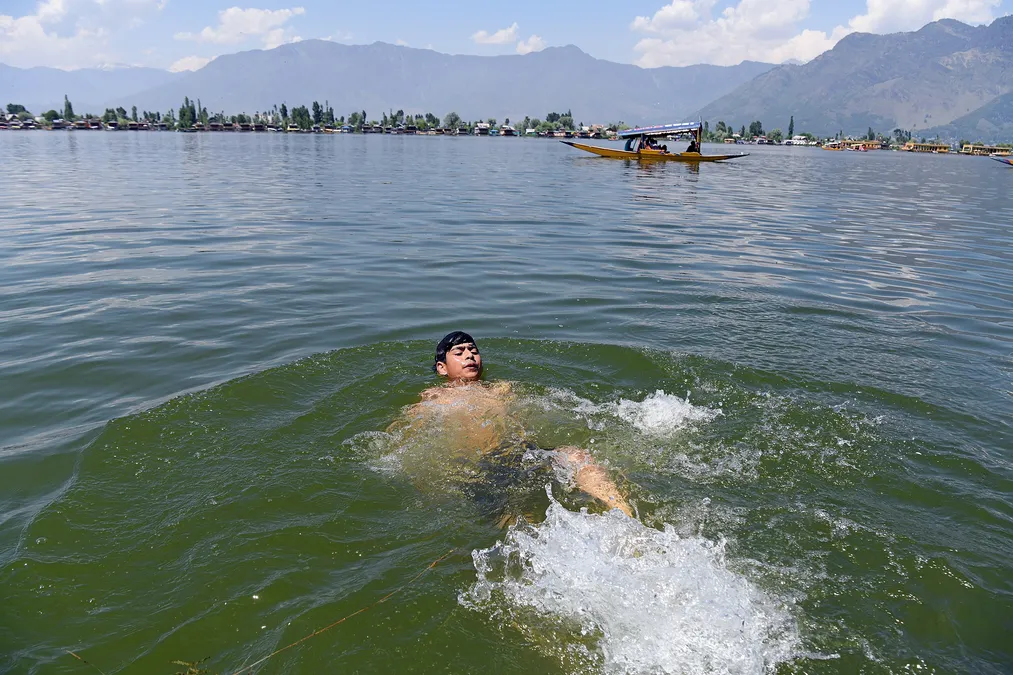
J&K Weather Forecast: Hot, Humid Conditions to Continue as Kashmir Faces Rising Heat and Sudden Rain
By: News Desk | 27 Aug 2026
Kashmir Is Not Getting a Break From the Heat — But Rain Could Bring a Different Kind of Risk
For a region normally associated with cool mountain air, August is ending on an unusually uncomfortable note.
The latest forecast from the Meteorological Centre Srinagar indicates that Jammu & Kashmir will remain generally hot and humid, with brief spells of rain and thundershowers at scattered locations.
But there is an important twist.
The forecast does not point towards uninterrupted dry heat.
Instead, Kashmir is entering a familiar but increasingly consequential Himalayan weather pattern: high daytime temperatures, moisture-laden air, intermittent thunderstorms and the possibility of very intense rainfall over small areas.
For Srinagar, the latest IMD city forecast puts maximum temperatures around 34°C on August 28–30, with temperatures easing to around 33°C on August 31 and approximately 30°C on September 1–2, when rain or thundershowers are expected.
Meanwhile, the Meteorological Centre has warned that intense localised showers around August 31 and September 1 could trigger flash floods, mudslides and landslides in vulnerable areas.
So this is not simply a story about “hot weather.”
It is a story about weather becoming increasingly difficult to predict from temperature alone.
What the Latest MeT Forecast Actually Says
The forecast issued by the Meteorological Centre Srinagar gives a relatively clear timeline.
August 28–30: Hot and Humid
Brief spells of rain or thundershowers are expected at scattered places, particularly during the early morning and afternoon.
The wider weather pattern is expected to remain generally hot and humid.
In Srinagar, the IMD forecast indicates maximum temperatures around 34°C on August 28, 29 and 30.
That is significant for Srinagar because temperatures in the low-to-mid 30s combined with humidity can feel considerably more uncomfortable than a dry 30°C day.
August 31–September 1: Rain Activity May Increase
The forecast becomes more interesting around the turn of the month.
The Meteorological Centre expects one or two spells of light-to-moderate rain or thundershowers at many places, with the possibility of brief intense showers at isolated locations.
The IMD’s Srinagar forecast similarly shows rain/thundershower activity around September 1, with the maximum temperature falling towards 30°C.
September 2–7: Mostly Dry, But Not Completely Dry
From September 2 onward, the broader forecast points towards generally dry conditions.
However, isolated brief rain or thundershower activity cannot be ruled out, particularly during morning and afternoon hours.
This means the phrase “hot and humid through early September” is directionally correct, but the weather is likely to fluctuate rather than remain uniformly hot every day.
Srinagar Has Already Crossed 32°C — But There Is an Important Detail
On August 27, Srinagar recorded a maximum temperature of 32.7°C, which was 3.4°C above the corresponding normal, according to the IMD’s city weather report.
The minimum was 18.2°C, while relative humidity was recorded at 81% at 8:30 am.
That combination matters.
Temperature tells only part of the story.
Humidity determines how efficiently the human body can cool itself through evaporation.
When humidity rises, sweat evaporates more slowly.
The result can be a sticky, oppressive sensation even when the thermometer does not show an extreme temperature.
This is particularly relevant in Srinagar’s increasingly built-up urban environment.
Jammu Has a Different Problem
Jammu’s weather is naturally warmer than Srinagar’s, and the latest observations demonstrate the contrast.
On August 27, Jammu recorded a maximum temperature of approximately 33°C, while the latest IMD Vaishno Devi weather information showed Jammu around 35°C with humidity near 71%.
The Jammu region therefore faces a different combination of risks:
- higher baseline temperatures;
- significant humidity;
- intense rainfall episodes;
- heat stress;
- urban heat accumulation;
- sudden runoff and flooding.
In other words, Jammu’s problem is not merely that it is hotter. It is that heat and intense rainfall can coexist within the same weather pattern.
Why Does It Feel So Much Worse Than the Temperature Suggests?
There is an important meteorological distinction between air temperature and human heat stress.
A temperature of 34°C under very dry conditions is not equivalent to 34°C under high humidity.
The body cools primarily by sweating and evaporation.
Higher atmospheric moisture reduces the efficiency of that process.
This can increase discomfort and heat stress, particularly for:
- outdoor workers;
- traffic personnel;
- construction workers;
- farmers;
- elderly people;
- children;
- people working in poorly ventilated buildings.
That makes the current weather relevant not only to tourism but also to public health and labour productivity.
But Here Is the More Serious Warning: Rain May Become More Dangerous
One of the most important details in the latest forecast is easy to overlook.
The MeT has warned that brief intense showers around August 31 and September 1 could trigger flash floods, mudslides and landslides.
This is a classic Himalayan risk.
A weather system does not need to produce widespread rainfall across the entire Valley to create a disaster.
A concentrated cloudburst or intense thunderstorm over a mountain catchment can rapidly send water downstream.
The resulting chain can be:
intense rainfall → rapid runoff → streams swell → debris moves downhill → roads are blocked → low-lying areas flood.
This is why a forecast saying “scattered rain” should not automatically be interpreted as “harmless rain.”
Kashmir’s Changing Weather Is Creating a Dangerous Contradiction
There is a broader climate story behind the immediate forecast.
Kashmir’s traditional weather rhythm is becoming increasingly difficult to rely upon.
The region can experience:
dry spells + unusually high temperatures + sudden heavy rainfall + prolonged humidity
within a relatively short period.
That creates problems because agriculture, tourism, water management and urban infrastructure are generally planned around historical seasonal patterns.
But the weather does not always behave according to those historical averages anymore.
That does not mean every unusual weather event can be directly attributed to climate change.
That distinction is essential.
Climate change is about long-term changes in the frequency, intensity and distribution of weather patterns, not about claiming that one particular hot day or rainstorm was “caused by climate change.”
What can reasonably be said is that a warming climate increases the likelihood of certain extremes and changes the background conditions in which weather events occur.
The Agriculture Problem: Heat Followed by Sudden Rain
For farmers, the current pattern is particularly complicated.
The MeT has advised farmers to continue harvesting and other agricultural activities while keeping local weather conditions in view.
That advice reflects a practical problem.
A farmer needs enough dry weather to:
- harvest;
- dry crops;
- transport produce;
- store agricultural products.
But sudden rain can interrupt these operations.
At the same time, prolonged heat can increase crop water requirements.
The result is an uncomfortable combination:
more irrigation demand during dry spells, followed by sudden rainfall that may arrive too intensely or at the wrong time.
For horticulture — one of Kashmir’s economic pillars — timing matters enormously.
Tourism: Gulmarg and Pahalgam May Gain, But the Story Is More Complicated
The obvious tourism response to hot weather is to head towards higher elevations.
Gulmarg and Pahalgam generally offer cooler conditions than the plains of Jammu and the lower elevations around Srinagar.
On August 27, for example, the reported maximum temperatures were around 20.3°C in Gulmarg and 24.7°C in Pahalgam, compared with 29.3°C in Srinagar in the same observation period reported by local media.
That creates an opportunity.
But weather volatility can also become a tourism risk.
Visitors travelling into mountain areas need to consider:
- sudden thunderstorms;
- landslides;
- road disruptions;
- flash flooding;
- poor visibility;
- slippery trekking routes.
The message for tourists should therefore not be “avoid Kashmir.”
It should be:
Enjoy the cooler mountains, but respect the weather.
The Power Demand Question Is More Complicated Than It Looks
Hot weather generally increases electricity demand because people use:
- fans;
- coolers;
- air conditioners;
- refrigeration;
- water pumps.
But the impact in J&K is not uniform.
Srinagar’s climate is considerably cooler than many Indian cities, meaning air-conditioning demand is not comparable to Delhi, Rajasthan or parts of central India.
The bigger concern during humid weather may be increased use of fans, cooling equipment and refrigeration, particularly during prolonged warm spells.
And because electricity tariffs have become a politically sensitive issue in J&K, any sustained increase in summer consumption adds another layer to the public debate over household energy costs.
The relationship is therefore real, but it should not be overstated as a direct “heatwave = electricity crisis” equation.
Srinagar’s Urban Landscape Can Make Heat Feel Worse
This is where the weather story connects directly to the city’s wider urban crisis.
Srinagar is becoming increasingly built-up.
Concrete, asphalt, dense construction, traffic and limited shaded space can create localised urban heat-island effects.
Urban surfaces absorb solar energy during the day and release it slowly after sunset.
Trees and vegetation, by contrast, provide shade and cool the environment through evapotranspiration.
This makes urban planning a climate adaptation tool.
A city with:
- mature trees;
- parks;
- wetlands;
- open spaces;
- shaded pedestrian routes;
- reflective surfaces;
- permeable ground;
will generally cope better with heat than a city dominated by concrete and asphalt.
This is why Srinagar’s environmental decline and its weather resilience are increasingly connected.
The Lakes Are Also Part of Kashmir’s Climate Defence System
Kashmir’s lakes and wetlands are not merely scenic attractions.
They are part of the Valley’s natural water-management system.
Healthy wetlands can:
- store water;
- slow runoff;
- support groundwater processes;
- regulate local hydrology;
- provide ecological habitat.
But when wetlands are filled, encroached upon or polluted, their ability to perform these functions is weakened.
This creates a dangerous feedback:
climate variability increases weather extremes → degraded wetlands have less capacity to absorb shocks → urban areas become more vulnerable.
The result is that environmental conservation becomes part of disaster management.
The Real Threat Is Not Heat Alone — It Is Weather Volatility
This may be the most important takeaway from the latest forecast.
Kashmir is not facing an uninterrupted heatwave.
The current pattern is more nuanced:
Warm temperatures + high humidity + scattered rainfall + occasional intense localised showers.
And that combination can be more difficult to manage than a straightforward spell of dry heat.
A hot, dry week can be planned for.
A sudden thunderstorm after several hot days can create an entirely different set of risks.
What Residents Should Watch Between August 31 and September 2
The MeT forecast suggests particular attention should be paid to the August 31–September 1 window, when rainfall and thunderstorm activity may increase and intense localised showers are possible.
Residents in vulnerable locations should monitor official warnings, especially if living near:
- steep slopes;
- streams and nallahs;
- flood-prone lowlands;
- unstable road cuts;
- river channels;
- areas with a history of landslides.
Outdoor activities in mountainous terrain should be reconsidered if thunderstorms develop.
Farmers should plan harvesting around local forecasts rather than relying solely on the broader Valley-wide prediction.
And travellers should check road and weather conditions before heading into higher elevations.
What This Weather Pattern Tells Us About Kashmir’s Future
There is a temptation to treat every weather bulletin as a short-lived inconvenience.
Temperatures rise.
People complain.
Rain arrives.
The weather cools.
Life continues.
But the cumulative pattern deserves more attention.
Kashmir’s climate is changing against the backdrop of:
- rapid urbanisation;
- shrinking wetlands;
- pressure on water resources;
- changing snowfall patterns;
- extreme rainfall episodes;
- rising temperatures;
- expanding built-up areas.
That means weather forecasting increasingly has to be integrated with urban planning, agriculture, tourism and disaster preparedness.
A forecast is useful.
But a climate-resilient city is better.
The Bottom Line
The latest MeT forecast does not support the idea that Jammu & Kashmir will experience uninterrupted extreme heat through early September.
The more accurate picture is more complex — and arguably more important.
Srinagar is expected to remain warm, with temperatures around 34°C through August 30, while rain and thunderstorm activity may increase around August 31 and September 1. Temperatures are then expected to ease, although scattered showers cannot be ruled out.
For Jammu, the heat and humidity remain more pronounced.
For Kashmir’s farmers, the challenge is balancing harvesting and crop stress.
For tourists, higher elevations remain attractive but require weather awareness.
For cities, the bigger lesson is about drainage, wetlands and heat resilience.
And for policymakers, the warning is perhaps the simplest:
Kashmir cannot control the weather. But it can control how vulnerable its people, farms, roads, lakes and cities are when the weather turns extreme.
The coming days may bring only a few degrees of temperature change and scattered thunderstorms.
The larger question is whether Kashmir learns to treat such changing weather not as an occasional surprise, but as the new reality that its infrastructure must be designed to withstand.