Tanvir Sadiq Says Time Has Come to Remind Delhi of Its Statehood Promise
By: Javid Amin | 05 May 2026
As Omar, Farooq and Tanvir Speak in Unison, National Conference Sharpens Pressure for Statehood Restoration
NC’s Message Is Becoming More Direct
The National Conference’s political messaging on statehood restoration appears to be entering a more assertive phase.
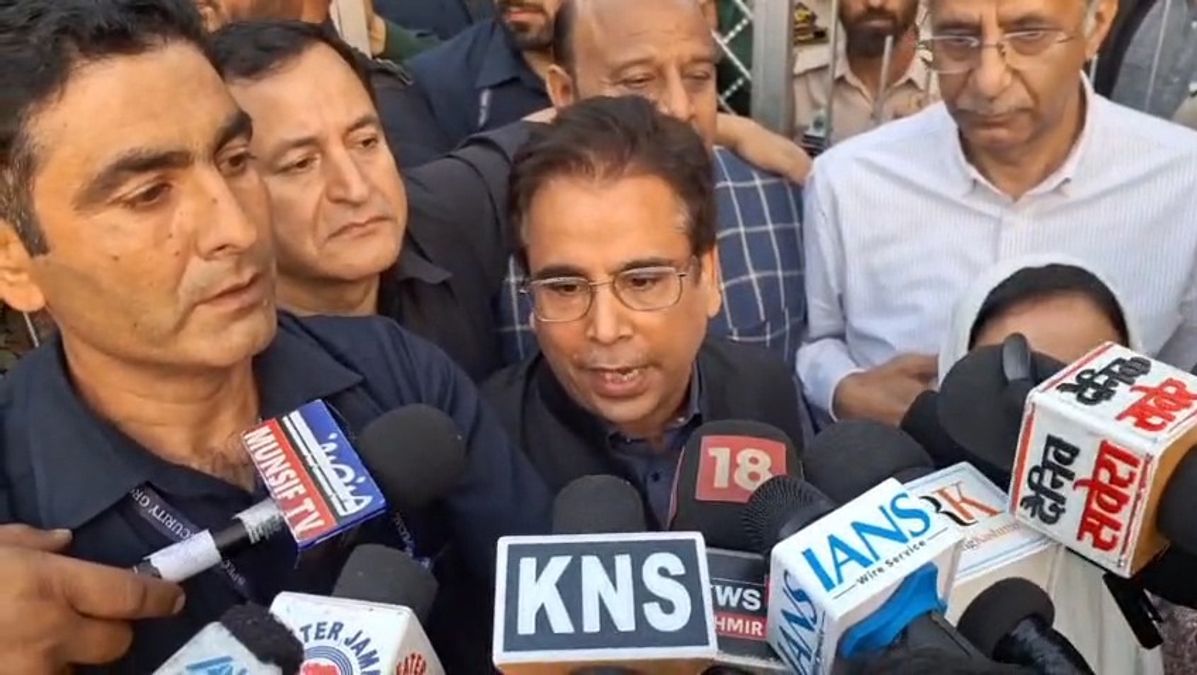
After weeks of discussions surrounding governance reviews, cabinet expansion, opposition criticism and internal party dynamics, senior National Conference leader Tanvir Sadiq has delivered what may be the clearest indication yet of the party’s emerging strategy.
“The time has come to remind Delhi of its promise.”
The statement is significant because it moves beyond merely reiterating the demand for statehood. Instead, it frames the issue as one of accountability.
For years, the restoration of Jammu and Kashmir’s statehood has featured prominently in political discussions. Assurances have been made at various levels, and statehood restoration has been publicly supported by the Union Government in principle.
What remains absent, however, is a definitive timeline.
It is that gap between commitment and implementation that Tanvir Sadiq is seeking to highlight.
From Demand to Accountability
Political language matters.
There is a noticeable difference between demanding something and reminding someone of a promise already made.
By choosing the latter framing, Sadiq is attempting to shift the debate.
The National Conference is increasingly arguing that the question is no longer whether statehood should be restored.
Instead, the question is:
When will the promise be fulfilled?
This subtle shift allows the party to position itself not as a petitioner seeking concessions, but as a political stakeholder demanding implementation of an assurance already acknowledged.
It is a strategy designed to increase political pressure while appealing to public frustration over delays.
The Emerging NC Narrative
Viewed in isolation, Sadiq’s statement is a routine political remark.
Viewed alongside recent interventions by senior party leaders, a broader pattern emerges.
Dr. Farooq Abdullah’s Position
Recently, Farooq Abdullah declared that Article 370 is inseparable from Kashmir’s existence and vowed to continue the struggle for constitutional rights.
Omar Abdullah’s Position
Chief Minister Omar Abdullah described the abrogation of Article 370 as the government’s “biggest policy mistake,” arguing that it weakened trust and altered the constitutional relationship between Jammu and Kashmir and the Union.
Tanvir Sadiq’s Position
Now, Tanvir Sadiq has moved the conversation toward implementation, emphasizing timelines and accountability.
Together, these statements create a layered political message:
- Farooq Abdullah focuses on identity.
- Omar Abdullah focuses on constitutional consequences.
- Tanvir Sadiq focuses on political accountability.
The result is perhaps the most coordinated messaging effort seen from the National Conference in recent months.
Why the Timing Matters
The statement comes at a politically sensitive moment.
The Dachigam retreat was intended to review governance and strengthen party coordination. Instead, it generated intense discussion over:
- Internal expectations within the party.
- Cabinet expansion demands.
- Aga Ruhullah Mehdi’s absence.
- Opposition accusations of political optics.
- Questions about the government’s future direction.
In the days following the retreat, the National Conference appears to have concluded that it needs to regain control of the political narrative.
Statehood offers precisely that opportunity.
Unlike governance debates, which often involve performance metrics and administrative scrutiny, statehood remains a broader constitutional issue capable of uniting large sections of the party’s support base.
Why Statehood Remains Politically Powerful
Nearly seven years after the constitutional changes of 2019, statehood continues to occupy a unique position in Jammu and Kashmir’s political discourse.
For many citizens, it represents:
Democratic Representation
The restoration of a full-fledged elected state’s powers.
Administrative Authority
Greater control over governance and decision-making.
Political Dignity
A symbolic acknowledgment of Jammu and Kashmir’s place within India’s federal structure.
Constitutional Assurance
The fulfillment of commitments repeatedly referenced in public discourse.
As a result, statehood remains one of the few issues capable of transcending routine political divisions.
Public Patience Is Wearing Thin
One reason Sadiq’s statement may resonate is the growing public frustration over delays.
Statehood is not the only issue caught in prolonged uncertainty.
Across Jammu and Kashmir, debates continue over:
- Recruitment processes.
- Reservation policies.
- Drug rehabilitation infrastructure.
- Tourism development projects.
- Education reforms.
- Administrative restructuring.
This broader atmosphere of delay has contributed to a growing trust deficit.
By emphasizing accountability rather than merely aspiration, the National Conference is attempting to align itself with public sentiment.
The message is straightforward:
Promises should eventually produce outcomes.
Opposition Will Demand More Than Rhetoric
Despite the sharper tone, opposition parties are unlikely to allow the National Conference to dominate the debate uncontested.
BJP’s Position
The BJP continues to argue that governance, development and investment should remain the primary focus.
Party leaders are also likely to question what practical results the NC’s strategy can achieve.
PDP’s Position
The PDP has recently advocated broader political unity on constitutional issues and may argue that collective action, rather than party-centric initiatives, offers a stronger path forward.
Peoples Conference’s Position
The Peoples Conference is expected to continue focusing on governance performance and delivery rather than constitutional symbolism alone.
This means the NC must eventually move beyond messaging and demonstrate political effectiveness.
Is This the Beginning of a Delhi Offensive?
The larger significance of Sadiq’s statement lies in what it may foreshadow.
Political observers increasingly believe the National Conference is preparing a sustained engagement strategy focused on New Delhi.
Such a strategy could include:
- Political outreach.
- Parliamentary engagement.
- Public campaigns.
- Institutional advocacy.
- Direct engagement with national stakeholders.
Whether such efforts yield tangible movement on statehood remains uncertain.
What is clear is that the party is seeking to elevate the issue from a regional demand to a national political question.
Conclusion
Tanvir Sadiq’s declaration that “the time has come to remind Delhi of its promise” represents more than a routine political statement.
It reflects a broader recalibration within the National Conference following the Dachigam retreat and amid intensifying debates over statehood, Article 370 and political accountability.
Together with recent interventions by Farooq Abdullah and Omar Abdullah, the statement suggests that the party is attempting to build a more coherent and assertive narrative around constitutional rights and democratic restoration.
The challenge now is translating rhetoric into results.
For a public increasingly weary of promises without timelines, the coming months may determine whether this renewed campaign becomes a meaningful political movement or simply another chapter in Jammu and Kashmir’s long history of deferred expectations.