Syama Prasad Mookerjee Death Controversy Reignited: Why Tarun Chugh’s Remarks on Sheikh Abdullah Have Reopened a 73-Year-Old Political Debate
By: Javid Amin | 23 June 2026
Syama Prasad Mookerjee Death Controversy Reignited: A Historical Mystery That Still Shapes Indian Politics
More than seven decades after the death of Syama Prasad Mookerjee in a Srinagar hospital, the circumstances surrounding his final days continue to stir political debate across India. The controversy resurfaced this week after BJP national general secretary Tarun Chugh questioned the role of Sheikh Abdullah and his administration in the events leading to Mookerjee’s death in custody in 1953.
For the Bharatiya Janata Party (BJP), Mookerjee is remembered as a nationalist icon who sacrificed his life while opposing Jammu and Kashmir’s special constitutional status. For many historians and political observers, however, the absence of a definitive judicial inquiry has left unanswered questions that continue to fuel competing narratives.
As Kashmir remains central to India’s political discourse, particularly after the abrogation of Article 370 in 2019, Mookerjee’s legacy and the mystery surrounding his death have once again become subjects of national discussion.
Who Was Syama Prasad Mookerjee?
Syama Prasad Mookerjee was one of the most influential political figures of post-Independence India.
Born on July 6, 1901, in Calcutta (now Kolkata), Mookerjee came from a distinguished academic family. His father, Ashutosh Mukherjee, was among Bengal’s most respected scholars and administrators.
Academic Excellence Before Politics
Mookerjee established himself as a brilliant academic long before entering national politics.
At just 33 years of age, he became the youngest Vice-Chancellor of University of Calcutta. During his tenure, he introduced several educational reforms and promoted Indian languages in higher education.
After completing legal studies and qualifying as a barrister from London’s Lincoln’s Inn, he gradually entered public life, where his influence would extend far beyond academia.
From Congress Ally to Jana Sangh Founder
Mookerjee’s political journey reflected the ideological debates that shaped newly independent India.
Early Political Career
He initially worked alongside leaders in the national movement but later aligned himself with the Hindu Mahasabha during the turbulent years preceding Partition.
He also served as Finance Minister in Bengal under A. K. Fazlul Haq between 1941 and 1942.
Following Independence, Prime Minister Jawaharlal Nehru invited Mookerjee to join the Union Cabinet as Minister for Industry and Supply.
However, ideological disagreements eventually emerged between the two leaders.
Resignation from Nehru Cabinet
In 1950, Mookerjee resigned from the cabinet over differences concerning the Nehru-Liaquat Pact, arguing that stronger measures were needed to protect minorities affected by Partition.
His resignation marked the beginning of an alternative nationalist political movement.
Birth of the Bharatiya Jana Sangh
In 1951, Mookerjee founded the Bharatiya Jana Sangh, the ideological predecessor of today’s Bharatiya Janata Party.
The party would later evolve into one of India’s most powerful political forces, making Mookerjee a foundational figure in the BJP’s ideological history.
The Kashmir Question and Opposition to Article 370
No aspect of Mookerjee’s political life is more closely associated with his legacy than his opposition to Article 370.
At the time, Jammu and Kashmir enjoyed a special constitutional arrangement that included:
- A separate constitution.
- A separate flag.
- Special residency provisions.
- Permit requirements for Indian citizens entering the state.
Mookerjee viewed these provisions as incompatible with complete national integration.
His famous slogan—
“Ek desh mein do vidhan, do pradhan, do nishan nahi chalenge”
(One nation cannot have two constitutions, two prime ministers and two flags)
—became a rallying cry for those advocating full constitutional integration of Jammu and Kashmir with the rest of India.
The 1953 Kashmir Protest That Changed History
Entering Jammu and Kashmir Without a Permit
In May 1953, Mookerjee launched a direct challenge to the permit system governing entry into Jammu and Kashmir.
Determined to demonstrate his opposition, he entered the state without obtaining the required permit.
The move was intended as a political protest against what he considered constitutional exceptionalism.
Arrest by Sheikh Abdullah’s Government
The government headed by Sheikh Abdullah ordered his arrest.
Mookerjee was detained and kept under custody near Srinagar.
What happened over the following weeks would become one of the most debated episodes in modern Indian political history.
Death in Custody: The Official Version
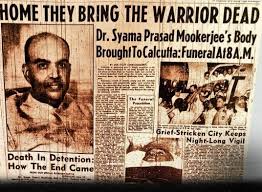
On June 23, 1953, Syama Prasad Mookerjee died at a hospital in Srinagar at the age of 51.
Official Cause of Death
Authorities stated that Mookerjee died of a heart attack following health complications during detention.
Government records and official communications maintained that his death resulted from natural medical causes.
No formal finding of foul play was ever established.
Yet the official explanation failed to satisfy many political supporters and family members, giving rise to allegations that continue to resonate decades later.
Why the Controversy Never Disappeared
The controversy surrounding Mookerjee’s death rests largely on the absence of a conclusive investigation capable of settling competing claims.
Allegations of Medical Negligence
Critics of the then Jammu and Kashmir administration have long argued that:
- Mookerjee did not receive timely medical attention.
- His deteriorating health was not properly monitored.
- Treatment decisions were delayed or mishandled.
- Authorities failed to provide adequate transparency regarding his condition.
While none of these allegations have been conclusively proven, they became central to the political narrative surrounding his death.
Calls for an Independent Inquiry
Over the years, family members, political allies and Jana Sangh leaders repeatedly demanded an independent judicial probe.
Such an inquiry never materialized in a form that produced universally accepted conclusions.
As a result, uncertainty continued to overshadow the official account.
Tarun Chugh Revives Questions About Sheikh Abdullah
The latest controversy emerged after BJP leader Tarun Chugh publicly questioned the role of Sheikh Abdullah’s administration.
What Chugh Alleged
According to Chugh, serious questions remain about whether Mookerjee’s death resulted from administrative negligence or a deeper political failure.
His remarks suggest that the Abdullah government cannot escape scrutiny because Mookerjee died while under state custody.
While Chugh stopped short of presenting new evidence, his statements have revived long-standing suspicions among sections of the BJP and its supporters.
Political Reactions and Counterarguments
The renewed debate has drawn predictable political responses.
BJP’s Position
For the BJP, Mookerjee is regarded as a martyr who sacrificed his life in pursuit of complete national integration.
Party leaders frequently argue that:
- His opposition to Article 370 was vindicated.
- His concerns regarding Kashmir’s constitutional status proved justified.
- The abrogation of Article 370 in 2019 fulfilled his unfinished mission.
Within this narrative, questions surrounding his death remain linked to broader demands for historical accountability.
Opposition View
Political opponents and several historians contend that revisiting allegations without fresh evidence risks politicizing history.
Critics argue:
- No conclusive proof has established conspiracy.
- The official medical explanation remains the only documented conclusion.
- Historical disputes should not be used solely for contemporary political mobilization.
This divide reflects wider disagreements over how India interprets its post-Independence history.
How Article 370’s Abrogation Changed Mookerjee’s Legacy
The repeal of Abrogation of Article 370 transformed Mookerjee’s place in political discourse.
For decades, his opposition to Article 370 remained an ideological position associated with the Jana Sangh and BJP.
After 2019, supporters argued that his vision had finally been realized.
As a result, every discussion about Kashmir’s constitutional evolution increasingly references Mookerjee’s role and sacrifice.
This has ensured that the circumstances of his death remain politically relevant even seventy-three years later.
Historical Debate: What Do Historians Say?
Many historians agree on one key point: the lack of a definitive, independent investigation has allowed competing interpretations to survive.
What Is Known
- Mookerjee entered Jammu and Kashmir without a permit.
- He was arrested by the state government.
- He remained under detention.
- He developed health complications.
- He died in a Srinagar hospital on June 23, 1953.
What Remains Disputed
- Whether medical care was adequate.
- Whether authorities acted negligently.
- Whether administrative decisions worsened his condition.
- Whether political motives influenced events.
Because these questions were never conclusively resolved, the debate continues to resurface whenever Kashmir’s political history is discussed.
Why the Issue Still Matters Today
The controversy surrounding Syama Prasad Mookerjee’s death is about more than a historical event.
It touches on three enduring themes in Indian politics:
1. National Integration
For supporters, Mookerjee symbolizes the struggle for a unified constitutional framework across India.
2. Historical Accountability
Questions about custodial responsibility remain relevant regardless of political ideology.
3. Competing Narratives of Kashmir
The debate reflects broader disagreements over Kashmir’s past, present and future.
As political parties continue to interpret history through contemporary lenses, Mookerjee’s death remains one of the most powerful and contested symbols in India’s democratic discourse.
Conclusion
Seventy-three years after Syama Prasad Mookerjee died in detention in Srinagar, the controversy remains unresolved. Tarun Chugh’s recent remarks have once again brought attention to a chapter of history that continues to shape political narratives around Kashmir, Article 370 and national integration.
For the BJP, Mookerjee represents sacrifice, conviction and the fulfillment of a long-held vision through the abrogation of Article 370. For critics and historians, the absence of definitive evidence and a conclusive inquiry means the debate remains open.
What is beyond dispute, however, is Mookerjee’s enduring influence on Indian politics. Whether viewed as a nationalist martyr, a constitutional crusader or a polarizing political figure, his life and death continue to resonate across generations, ensuring that the questions surrounding June 23, 1953, remain part of India’s historical and political conversation.