Shashi Tharoor’s Kashmir Visit Sparks Congress vs Congress Battle: What Lies Behind the Growing Rift?
By: Javid Amin | 21 June 2026
Kashmir Outreach Meant to Build Dialogue Ends Up Exposing Deeper Fault Lines Within Congress
What was intended to be a political outreach visit to Kashmir has unexpectedly evolved into a fresh episode of internal discord within the Congress party. Senior Congress leader and Member of Parliament Shashi Tharoor’s recent visit to Srinagar has triggered criticism from sections of the party’s Jammu and Kashmir unit, exposing long-simmering tensions over leadership, messaging and political strategy.
While the controversy initially appeared to revolve around protocol and coordination, political observers believe the backlash reflects a much deeper struggle within Congress—one involving competing visions of opposition politics, leadership autonomy and the party’s future direction.
At a time when the opposition is attempting to present a united front against the BJP ahead of key political battles, the public disagreement has handed rivals an opportunity to question Congress’s internal coherence and strategic clarity.
What Happened During Tharoor’s Kashmir Visit?
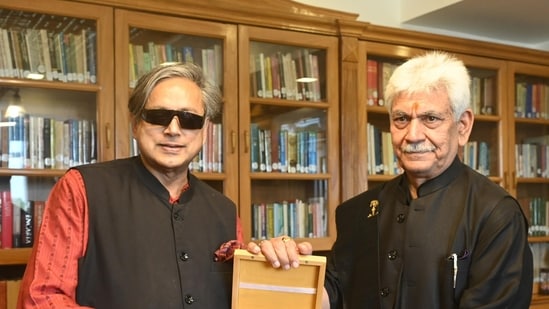
During his visit to Srinagar, Shashi Tharoor met members of civil society, academics, business representatives, intellectuals and local stakeholders to understand the evolving socio-political landscape of Jammu and Kashmir.
The outreach was projected as an effort to engage directly with voices from the region and assess ground realities beyond conventional political interactions.
However, the visit quickly became controversial after some leaders from the Jammu and Kashmir Pradesh Congress Committee (JKPCC) reportedly expressed dissatisfaction over what they viewed as inadequate consultation with the local party leadership.
Several Congress functionaries felt that the meetings were conducted independently of the state unit, creating a perception that local leaders had been sidelined during a politically significant engagement.
While no formal confrontation occurred during the visit, criticism soon surfaced in political circles and media discussions, transforming what was meant to be a routine outreach exercise into a national political debate.
The Surface Issue: Coordination or Courtesy?
Officially, the criticism revolves around coordination.
Local Congress leaders argue that any senior national leader visiting a politically sensitive region should engage extensively with the state unit, particularly when discussing issues that directly affect the people of Jammu and Kashmir.
For many within the local organisation, the concern is less about Tharoor’s presence and more about the process.
They contend that state leaders who have remained politically active on issues such as restoration of statehood, democratic rights, unemployment and governance deserve a central role in shaping the party’s regional narrative.
The perception that important conversations were held without sufficient involvement of local leadership has become one of the immediate triggers behind the controversy.
Yet most political analysts agree that this explanation only scratches the surface.
The Real Story: Congress’s Internal Identity Crisis
The Kashmir episode is being widely interpreted as another manifestation of Congress’s broader internal debate about its political identity.
Over the last few years, the party has struggled to strike a balance between aggressive opposition politics and constructive engagement on national issues.
This tension has repeatedly surfaced whenever senior leaders take positions that differ from the party’s dominant narrative.
Shashi Tharoor has often found himself at the centre of these debates.
Unlike many Congress leaders, he has maintained a reputation for expressing independent views on foreign policy, governance, national security and international affairs.
His willingness to acknowledge government achievements in certain areas, while simultaneously criticising policy failures, has frequently generated mixed reactions within his own party.
The Kashmir visit appears to have revived these underlying tensions.
Why Kashmir Remains a Sensitive Political Subject
No issue reflects Congress’s internal dilemmas more clearly than Kashmir.
Since the abrogation of Article 370 in August 2019, the party has attempted to navigate a politically complex position.
Congress has consistently questioned the manner in which Jammu and Kashmir’s special constitutional status was revoked and has repeatedly demanded restoration of statehood and democratic processes.
At the same time, some leaders have acknowledged improvements in infrastructure, tourism and security indicators in the region.
This creates a delicate balancing act.
When a senior Congress leader highlights positive developments in Kashmir, critics within the party sometimes fear that such remarks could be interpreted as validating the BJP’s broader political narrative.
Supporters of Tharoor, however, argue that acknowledging visible changes on the ground does not necessarily mean endorsing every aspect of government policy.
The disagreement reflects a larger debate over how Congress should communicate its position on Kashmir in the years ahead.
Shashi Tharoor: A Leader With an Independent Political Brand
One reason why controversies involving Tharoor attract disproportionate attention is his unique position within Congress.
Unlike many party leaders whose influence is largely organisational, Tharoor possesses a national and international profile that extends beyond traditional party structures.
His strengths include:
Strong Public Recognition
Tharoor remains one of Congress’s most recognisable faces across India and abroad.
Intellectual Credibility
His reputation as an author, diplomat and policy commentator gives him influence beyond conventional electoral politics.
Media Visibility
His statements often generate national headlines, ensuring that even routine observations receive widespread attention.
Cross-Party Appeal
Many political observers note that Tharoor commands respect among sections of voters who do not necessarily support Congress.
While these qualities enhance the party’s visibility, they also create occasional friction within a political organisation that traditionally functions through collective decision-making and centralised messaging.
The State Unit’s Perspective: Seeking Recognition and Relevance
The reaction from sections of the Jammu and Kashmir Congress cannot be understood without considering the state’s unique political environment.
The Congress faces intense competition from regional parties such as the National Conference and the People’s Democratic Party, while simultaneously confronting the electoral dominance of the BJP in several regions.
In such circumstances, local leaders often invest significant political capital in maintaining grassroots networks and organisational structures.
Many state-level functionaries believe that national leaders should strengthen these efforts rather than inadvertently overshadow them.
For some local leaders, the issue is therefore not merely about Tharoor but about ensuring that the state unit remains the primary political voice of Congress in Jammu and Kashmir.
National Leadership vs Regional Leadership: A Familiar Congress Challenge
The current controversy also reflects a longstanding challenge faced by the Congress party across multiple states.
Historically, Congress has often struggled to balance the influence of nationally prominent leaders with the aspirations of regional leadership.
This tension has surfaced periodically in states ranging from Punjab and Rajasthan to Kerala and Maharashtra.
The Kashmir episode fits into this broader pattern.
The central question remains:
How much autonomy should nationally recognised leaders have when engaging with politically sensitive issues without direct coordination with local party structures?
Congress has yet to establish a clear answer.
BJP and Rivals Find Political Opportunity
The public nature of the disagreement has inevitably provided ammunition to Congress’s political opponents.
The BJP has repeatedly accused the opposition party of lacking clarity on major national issues, including Kashmir.
Any visible disagreement within Congress reinforces that narrative.
Regional parties, meanwhile, may also benefit by portraying themselves as more consistent and rooted in local realities than a national party grappling with internal contradictions.
For opposition politics as a whole, such public disputes risk diluting efforts to project unity against the ruling establishment.
What This Means for Congress Going Forward
The Kashmir controversy is unlikely to have a major electoral impact on its own.
However, it highlights broader organisational challenges that Congress will need to address.
The party faces three critical questions:
Can It Accommodate Independent Voices?
Leaders such as Tharoor bring visibility, credibility and broader appeal. Managing such figures while maintaining organisational discipline remains a challenge.
Can It Present a Unified Narrative on Kashmir?
Congress continues to search for a coherent position that resonates nationally while addressing regional sensitivities.
Can It Strengthen Centre-State Coordination?
The episode underscores the need for better communication between national leaders and state units to avoid future misunderstandings.
Beyond Kashmir: A Symptom of a Larger Struggle
Ultimately, the controversy is less about a visit to Srinagar and more about Congress’s evolving political identity.
The criticism directed at Shashi Tharoor reflects competing visions within the party regarding leadership, messaging and opposition strategy.
Kashmir merely provided the stage upon which these tensions became visible.
Unless Congress successfully reconciles the relationship between independent national figures and regional leadership structures, similar disputes are likely to emerge in the future on issues ranging from foreign policy and governance to national security and electoral strategy.
For now, Tharoor’s Kashmir visit stands as a reminder that some of Congress’s toughest political battles are not only against its rivals—but also within its own ranks.