Kashmir Apple Orchards Under Attack: How Tree Cutting Is Threatening the Valley’s Horticulture Economy
By: Javid Amin | 14 June 2026
Kashmir’s Apple Economy Faces a New Threat: Orchards Cut Down, Farmers Left Counting Losses
For generations, apple orchards have been more than just farmland in Kashmir. They represent family savings, rural employment, and a stable source of income for thousands of households. But a disturbing pattern of orchard destruction has created fresh anxiety among growers across the Valley.
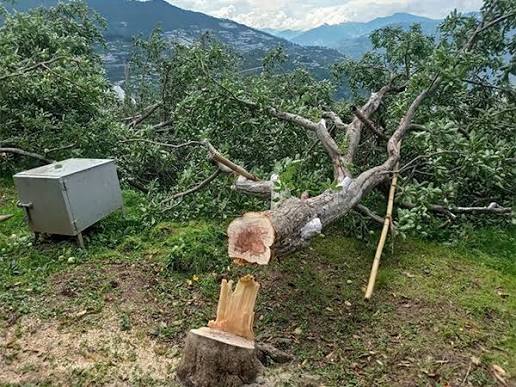
In recent months, incidents of unidentified people cutting down apple trees have been reported from parts of Kashmir, with some cases involving hundreds and even thousands of trees. The damage is not limited to the physical loss of plants — it represents years of investment, patience, and future income wiped out in a single night.
Recent reports indicate that more than 400 apple trees were allegedly chopped in Kaharwat village of Kulgam in April 2026, while thousands of high-density apple plants were reportedly destroyed in Rangeen Kultreh area of Chadoora, Budgam, in May 2026. Police cases and investigations have been initiated in some incidents, but the identity and motive of the attackers remain under investigation.
Recent Orchard Destruction Incidents in Kashmir
Kulgam: Over 400 Apple Trees Cut Overnight
In April 2026, residents of Kaharwat village in south Kashmir’s Kulgam district reported that more than 400 apple trees in a private orchard were damaged overnight.
According to local reports, the trees were found chopped, leaving growers shocked by the scale of destruction. Farmers described the incident as a major economic setback because apple trees require years of care before becoming productive.
Reports stated that unknown persons allegedly entered the orchard during the night, while authorities began efforts to identify those responsible.
The incident also highlighted a larger concern: for orchard owners, a tree is not simply wood and leaves — it is a long-term financial asset.
Budgam: Modern High-Density Orchard Destroyed
A second major incident was reported from Rangeen Kultreh area of Chadoora in Budgam district, where thousands of Italian high-density apple plants were allegedly cut down.
Unlike traditional orchards, high-density plantations require significant investment in imported varieties, irrigation systems, support structures, and scientific management. Such orchards are often promoted as the future of Kashmir’s horticulture sector because they can improve productivity and farmer income.
Reports said police registered a case after unidentified persons allegedly damaged a large number of apple plants, causing distress among orchard owners.
Why Cutting an Apple Tree Is an Economic Attack
An apple orchard represents years of financial planning.
A newly planted apple tree does not immediately provide returns. Farmers spend money on:
- Saplings
- Fertilizers
- Pesticides
- Irrigation
- Labour
- Land preparation
- Maintenance
Depending on the variety and farming method, an orchard may require several years before reaching full production.
When hundreds of trees are destroyed, the farmer loses:
- Future annual income
- Years of labour
- Investment already made
- Family economic security
The Bigger Picture: Kashmir’s Apple Economy
Kashmir’s horticulture sector is one of the strongest pillars of the regional economy. The Valley contributes a major share of India’s apple production, with estimates commonly placing its contribution around three-fourths of the national output. The sector supports millions of people directly and indirectly through farming, packaging, transport, storage, and trade.
The impact of orchard destruction therefore extends beyond individual farmers. It affects:
- Rural employment
- Fruit traders
- Transport workers
- Cold storage businesses
- Local markets
A Pattern of Fear: Why Farmers Feel Vulnerable
Many orchard attacks reportedly happen at night, making identification of suspects difficult.
Farmers say the biggest challenge is not only the immediate damage but also the uncertainty that follows.
Key concerns include:
1. Lack of Deterrence
When culprits remain unidentified, affected growers fear similar incidents could happen again.
2. Long-Term Financial Damage
A damaged crop can sometimes recover. A destroyed orchard may take years to rebuild.
3. Emotional Impact
For many families, orchards are inherited assets passed down through generations. Watching them disappear creates a deep sense of loss.
Political Claims, Allegations and the Need for Verified Investigation
Some political and local allegations have linked certain incidents to broader disputes, including land conflicts and political tensions. However, motives behind individual orchard destruction cases remain subject to police investigation and evidence.
A responsible approach requires identifying those involved through proper investigation rather than relying on unverified claims.
The central issue remains the same: farmers need protection, accountability, and confidence that their livelihoods will not be destroyed without consequences.
From Traditional Orchards to Modern Farming: A New Generation at Risk
The Budgam incident highlighted another important shift in Kashmir’s agriculture.
Many educated young people have entered horticulture by adopting modern farming techniques, including high-density apple plantations.
These farmers are not simply continuing traditional agriculture — they are investing in technology-driven farming models designed to compete in national and international markets.
When such orchards are destroyed, it damages not only one family’s income but also discourages future investment in agriculture.
Outsiders, Labour and the Changing Rural Economy
Kashmir’s horticulture sector depends heavily on seasonal labour. Workers from different parts of India participate in orchard activities such as pruning, harvesting, packing, and transportation.
At the same time, many local youth are increasingly moving towards government jobs, private employment, or opportunities outside the Valley.
This creates a complex rural economy where:
- Farmers own orchards but depend on external labour
- Seasonal workers earn from Kashmir’s agricultural economy
- Local families remain dependent on orchard income
The issue is not simply about who works in orchards — it is about protecting the economic foundation that supports rural Kashmir.
Beyond Vandalism: A Challenge for Kashmir’s Future
Experts and farmers argue that orchard destruction should be viewed as more than a criminal act. It represents a threat to one of the Valley’s most important economic sectors.
Kashmir’s apple industry already faces multiple pressures:
- Climate change
- Market competition
- Transportation challenges
- Rising farming costs
- Changing agricultural patterns
Adding insecurity around orchards creates another burden for growers.
What Farmers Demand
Growers and local communities have repeatedly called for:
- Faster investigations
- Strict punishment for offenders
- Better orchard security
- Compensation mechanisms
- Stronger protection for horticulture assets
Timeline of Orchard Attacks in Kashmir Valley
| Date | Location | Incident | Impact |
|---|---|---|---|
| Jan 2026 | Pulwama & Shopian | Farmers protested railway project threatening 6–7 lakh apple trees | Structural threat, “Chipko 2.0” movement |
| Apr 2026 | Kulgam (Kaharwat) | 400 apple trees chopped overnight by unknown persons | Farmers devastated, no arrests |
| May 2026 | Budgam (Chadoora) | 3,500 high‑density Italian apple plants destroyed | Educated youth’s modern orchard wiped out |
| Jun 2026 | South Kashmir (reported) | 500 apple trees cut down | Latest vandalism, culprits unidentified |
Conclusion: Protecting Kashmir’s Green Economy
The destruction of apple orchards is not only about fallen trees — it is about lost futures.
Every orchard represents years of patience, family investment, and economic hope. Whether caused by personal disputes, criminal motives, or other factors, such incidents expose the vulnerability of Kashmir’s horticulture sector.
Protecting orchards means protecting farmers, rural employment, and one of the Valley’s most valuable economic lifelines.
For Kashmir’s apple economy to survive and grow, accountability and farmer security will remain essential.