BJP Demands Apology from Tariq Karra as Dumper Controversy Deepens Public Anger
By: Javid Amin | 16 November 2026
Jammu: The killing of two Special Police Officers (SPOs) in the remote Dachhan area of Kishtwar has developed into a wider controversy, with questions now being raised not only about how the personnel died but also about how their mortal remains were brought home.
The two officers, Babi Chand, 57, and Rashpal Kumar, 45, went missing while travelling towards a security post in the Marwah sector. Their bullet-riddled bodies were recovered on November 12. Their service weapons were reportedly missing, prompting security agencies to investigate a possible militant connection.
But before the investigation could establish the circumstances of their deaths, the incident became the subject of competing political claims. Jammu and Kashmir Congress president Tariq Hameed Karra raised the possibility that the officers had been shot by Army personnel who mistook them for militants. The BJP rejected the suggestion, accused Congress of spreading misleading information and demanded an unconditional apology.
Then came another controversy.
When the bodies reached their native village of Kiyar on November 13, residents alleged that they had been transported in a dumper without coffins, proper covering or adequate arrangements. The reports triggered an emotional confrontation involving BJP MLA Shagun Parihar and Leader of Opposition Sunil Sharma, adding questions about official responsibility and the treatment of personnel who die in service.
The episode now presents two distinct but connected challenges for the administration: establishing the truth about the killings and explaining the alleged failures in handling the bodies.
How the two SPOs went missing
The sequence began on November 11, when Babi Chand and Rashpal Kumar, both posted with the Special Operations Group (SOG) in the Kiyar sector of Dachhan, were detailed for rotation duty at an Army camp in the Dharna-Marwah sector.
The two reportedly left for the assigned post but failed to reach their destination. Their disappearance triggered a search operation involving the Jammu and Kashmir Police, Army and Central Reserve Police Force.
Their bodies were recovered the following morning in a forested area of Dachhan, near the Nand Nullah region between Dachhan and Marwah. Both had suffered multiple bullet injuries. Their service weapons, reportedly an INSAS rifle and a .303 rifle, were missing.
The recovery of the weapons remains an important part of the investigation. Officials and sources quoted in early reports suspected that militants could have attacked the personnel and taken their rifles. Security forces launched search operations to locate the suspected attackers.
However, an important qualification is necessary: as of November 16, publicly available reporting does not establish that police or the Lieutenant Governor’s administration had formally declared the killings a confirmed terrorist attack. The missing weapons and the circumstances of the deaths have strengthened the suspected militant angle, but the investigation has not publicly settled responsibility.
That distinction has become central to the political dispute.
Karra’s mistaken-identity theory triggers BJP backlash
The political confrontation intensified on November 15, when Tariq Hameed Karra spoke about the killings and called for an investigation into all possible explanations.
According to his account, information received from the Congress’s Kishtwar district unit suggested that the two SPOs had gone hunting with their weapons. He alleged that they had crossed security pickets without difficulty while travelling towards the forest, but may have been mistaken for militants by Army personnel when returning in civilian clothes.
Karra described this as one possible account and argued that the investigation should not be restricted to the militant-attack theory.
He also criticised what he described as attempts to give the incident a communal colour. His position was that the killings were condemnable regardless of who was responsible and that the facts should be established through an impartial investigation.
The remarks immediately provoked a strong reaction from the BJP.
Leader of Opposition Sunil Sharma accused Congress of spreading misleading information and insulting the memory of the two deceased personnel. BJP leaders argued that raising allegations against the Army before the investigation was complete could create confusion and provide material for Pakistan’s propaganda.
BJP MLA Ranbir Singh Pathania also demanded that Karra withdraw his remarks and apologise unconditionally to the bereaved families and the security forces.
The BJP’s objection is that a serious allegation involving the Army should not be made on the basis of unverified information from a political party’s district unit.
There is a legitimate concern here. Public representatives should exercise caution when discussing an ongoing security investigation, particularly when their claims could affect public confidence in institutions operating in a sensitive area.
But the same standard must apply to every political party. A suspected militant attack should not be declared conclusively established merely because weapons are missing or because one explanation appears more plausible to political leaders.
The investigation, not political messaging, must determine what happened.
A second controversy: Why were the bodies allegedly brought in a dumper?
Even as the political debate over the killings gathered momentum, anger was building in Kiyar over the transportation of the two bodies.
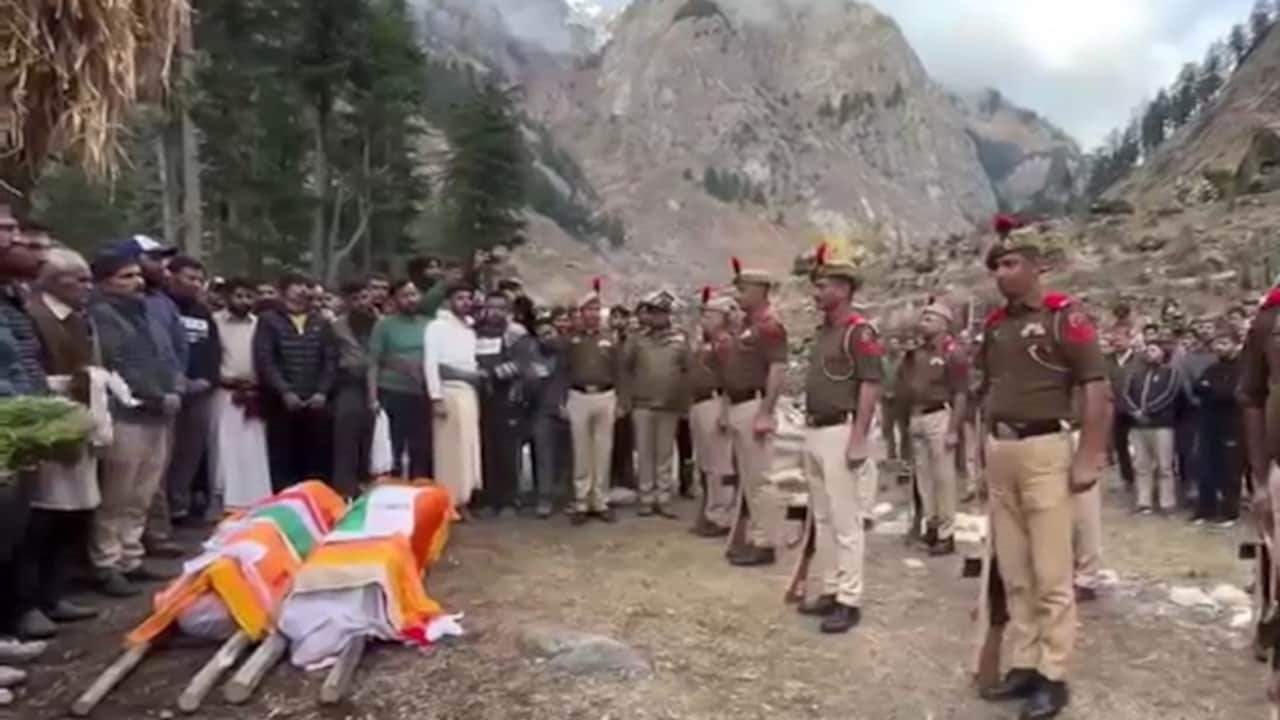
On November 13, the mortal remains of Babi Chand and Rashpal Kumar were brought to their native village in a dumper truck, according to reports by NDTV, India Today and other media organisations.
Residents alleged that the bodies were not placed in coffins and that the vehicle was not an appropriate arrangement for transporting the remains of two police personnel killed while on duty.
Villagers further claimed that no senior police officer accompanied the bodies. Some residents alleged that even basic arrangements, including a stretcher and suitable covering, were missing. They said they had to seek a stretcher from the Army and arrange white cloth themselves.
These allegations triggered anger among the families and local residents, who questioned why personnel who had served in a sensitive security area were not accorded basic dignity after death.
The distinction between what has been reported and what remains officially explained is important. The dumper’s use and the absence of coffins have been reported by several outlets, while details about the availability of transport, the sequence of recovery and the decisions taken by local authorities have not been fully explained in a public official account.
The administration needs to clarify whether this was caused by difficult terrain, a shortage of suitable vehicles, a breakdown in coordination or an avoidable failure of procedure.
Remote geography may complicate recovery operations. It cannot, by itself, answer why families were left with the impression that their loved ones had not been treated with dignity.
Shagun Parihar breaks down, Sunil Sharma takes up the matter
The controversy became more visible after Kishtwar MLA Shagun Parihar confronted police officials over the handling of the mortal remains.
Parihar, who attended the last rites along with Sunil Sharma, became emotional while questioning the arrangements. She said the two SPOs had been dishonoured by the manner in which their bodies were transported.
Her reaction, captured in videos circulating on social media, reflected the anger expressed by residents and relatives.
Sunil Sharma also condemned the alleged negligence and took up the matter with Lieutenant Governor Manoj Sinha, according to media reports. He conveyed the concerns of the families and local residents and sought accountability from the administration.
The bodies were subsequently laid to rest with full honours, including a wreath-laying ceremony attended by political representatives and officials.
The later ceremony was an important gesture, but it does not automatically resolve the questions surrounding the earlier transportation arrangements.
The administration must explain what went wrong and whether responsibility has been fixed.
The families are questioning more than the circumstances of the killings
The anger in Kiyar is also rooted in the area’s difficult security history.
The Dachhan region has experienced militant violence in the past. On August 1, 2000, eight members of a village defence group were killed in a militant attack. Reports have also documented the abduction and killing of two residents in 2004.
The families of the two deceased SPOs have questioned why they were assigned to travel outside their immediate area when security posts existed closer to their village.
According to reporting by The Thursday Times, relatives have demanded a Central Bureau of Investigation (CBI) inquiry into the killings and raised concerns about the security arrangements in the area. One relative questioned why the two personnel had been assigned duty away from their home sector when nearby posts were available.
The concern is not simply about whether the two officers were attacked by militants or mistakenly shot by security personnel. It is also about the operational decisions that placed them on the route in the first place.
Why were these two particular personnel assigned the duty? What instructions were they given? Were they aware of any specific security threat? Were there communication arrangements along the route? Were nearby security posts adequately staffed?
These questions deserve examination independently of the dispute over who fired the fatal shots.
Sunil Sharma questions the security arrangements too
An important contradiction has emerged in the political response.
While Sharma has demanded an apology from Karra for suggesting possible Army involvement, he has also publicly questioned the police’s operational decisions and security arrangements.
During a visit to Kiyar, Sharma reportedly questioned why the two SPOs had been sent across a difficult stretch of terrain to assist an Army post when personnel from nearby police pickets could have been assigned.
He also criticised the reduced security presence in the area and questioned the functioning of the police leadership.
This matters because the issue is not simply about defending one institution against political criticism.
If the personnel were sent on an inadequately planned assignment, the administration must investigate that decision. If the route was compromised, the source of the information leak must be identified. If militants were responsible, the security agencies must establish how the attack occurred and recover the missing weapons.
An honest inquiry must be willing to examine institutional failures regardless of which department or security organisation is involved.
An even more serious concern: Unverified allegations and communal overtones
The political debate has become more sensitive because some public statements have gone beyond the available evidence.
Telegraph reported that BJP MLA Shagun Parihar had earlier alleged that the killing was ordered from a mosque and that the officers’ route had been leaked to militants. The same report said Sunil Sharma had raised allegations involving police personnel and suggested a conspiracy against a particular community.
These are serious allegations. They should not be treated as established facts without supporting evidence from investigators.
The problem with such claims is that they can transform an investigation into a communal confrontation before the facts are known.
Kishtwar has a complex security history and a diverse social fabric. Any attempt to assign collective blame to a religious community, or to suggest that a place of worship was involved without evidence, risks deepening mistrust.
The same caution applies to Karra’s mistaken-identity theory. An allegation that Army personnel killed two police officers is extremely serious. It cannot be established through second-hand political information.
The correct response to both sets of claims is the same: preserve evidence, conduct a credible investigation and publish findings that can withstand scrutiny.
What does the investigation need to establish?
The circumstances of the killings require a clear reconstruction of the officers’ movements and the events leading to their deaths.
Several lines of inquiry are particularly important.
The route and timeline: Investigators need to establish when the two SPOs left Kiyar, which route they followed, which security pickets they crossed and when contact with them was lost.
The missing weapons: The recovery or continued absence of their service rifles could provide important evidence. Investigators should establish whether the weapons were taken by attackers, lost during an encounter or removed under some other circumstances.
Ballistic and forensic evidence: The bullets recovered from the bodies, if available, should be examined alongside any cartridge cases or other evidence found at the scene. Such material may help establish the type of weapon used and whether more than one firing position was involved.
Army and police movement records: Duty rosters, post registers, communication logs and operational records could help verify whether any security personnel fired in the area during the relevant period.
Witness and communication evidence: Statements from personnel at nearby posts, residents, and anyone who may have seen or heard the incident could help establish the sequence of events.
The alleged militant connection: If investigators suspect a militant attack, they must establish the identity of the suspected attackers and the evidence linking them to the killings.
None of these questions can be answered through political statements alone.
What happened to the missing weapons?
The disappearance of the two service weapons is one of the most significant elements in the case.
Early reports said the officers were carrying an INSAS rifle and a .303 rifle. Both were reportedly missing when the bodies were recovered.
Security officials cited by news organisations said this could indicate that militants had attacked the SPOs and taken the weapons. The possibility is serious because weapons taken from police personnel could potentially be used in subsequent attacks or transferred to militant networks.
However, the missing weapons do not independently prove who killed the officers.
Investigators must establish whether the rifles were taken from the scene, whether any other evidence supports a militant attack and whether the alleged recovery of weapons or other material has been documented.
Until then, the missing rifles are a significant investigative lead, not a final conclusion.
The administration must answer for the treatment of the dead
The controversy over the dumper raises a different set of questions from the investigation into the killings.
Even in remote areas, there should be a defined procedure for transporting the bodies of police personnel who die during duty. That procedure should identify the responsible department, available vehicles, coordination arrangements and the role of senior officers in communicating with bereaved families.
If a suitable ambulance or vehicle could not reach Kiyar because of terrain or road conditions, the administration should explain what alternatives were considered.
If the transport arrangements were inadequate because of negligence, the officials responsible should face an appropriate review.
The Deputy Commissioner and police administration should also clarify the status of compensation and other assistance for the families. The Thursday Times reported that Deputy Commissioner Pankaj Kumar Sharma had assured the families that cases concerning compensation and compassionate appointments for eligible dependants would be processed.
That assurance should be followed by a clear timeline.
The families should not have to repeatedly approach political leaders to secure basic entitlements after losing their loved ones.
Kiyar’s wider security problem cannot be ignored
The deaths have also reopened a broader question about security arrangements in remote parts of Kishtwar.
The region’s mountainous terrain, scattered settlements and difficult road connectivity make it challenging to maintain a consistent security presence. But these conditions also make local police personnel and SPOs particularly important.
They often possess local knowledge, understand the terrain and help security forces maintain contact with communities in difficult areas.
That makes their safety a matter of operational planning, not merely individual risk.
The families’ concerns about reduced security posts and the assignment of personnel to distant locations deserve a formal response. The administration should review whether the present deployment pattern is adequate, whether communication facilities are sufficient and whether vulnerable routes require additional security arrangements.
The killings should prompt a serious examination of those questions, irrespective of the final conclusion about who carried out the attack.
Two controversies, one demand: Accountability
The Kishtwar incident has exposed how quickly a tragedy can become entangled in competing political narratives.
The BJP says Karra’s remarks undermine the morale of security forces and insult the deceased. Congress says all possible angles must be investigated and that the government should not allow one version to dominate before the evidence is examined.
Meanwhile, the families are asking for answers about the deaths, the missing weapons, the duty assignment and the security arrangements. Villagers are demanding an explanation for the way the bodies were transported.
These concerns should not be treated as mutually exclusive.
The BJP can demand responsible political language while also demanding accountability from the police administration. Congress can call for an impartial investigation without presenting an unverified theory as fact. The administration can defend the security forces while remaining open to scrutiny of operational decisions.
And the families should not have to choose between seeking justice for the killings and demanding dignity for their deceased relatives.
The most important question now is not which party wins the political argument. It is whether the administration can establish who killed Babi Chand and Rashpal Kumar, explain why their service weapons disappeared, examine the decisions that sent them on that route, and account for the arrangements made when their bodies were returned home.
Until those questions are answered, demands for apologies and political accusations will remain secondary to the larger issue: justice and accountability for two men who lost their lives while serving in one of Jammu and Kashmir’s most difficult security environments.