Democracy, Voters and Institutions: Why the BJP vs INDIA Bloc Battle Matters
By: Javid Amin | 08 November 2026
From SIR and electoral roll revisions to the Election Commission’s credibility, India’s political confrontation is moving beyond conventional party politics. The deeper question is whether citizens can retain confidence in the institutions that determine who gets to vote and how governments are elected.
New Delhi, November 8, 2026: India’s political debate is increasingly moving beyond the familiar arguments of unemployment, inflation, economic growth and welfare delivery. These issues remain important, but another subject is occupying a growing share of the national political conversation: the credibility of democratic institutions and the integrity of the electoral process.
The confrontation between the BJP-led ruling establishment and the INDIA bloc has brought this question into sharper focus. At the centre of the latest political battle are the Election Commission of India, the Special Intensive Revision (SIR) of electoral rolls, allegations of voter exclusion and the accountability of constitutional institutions.
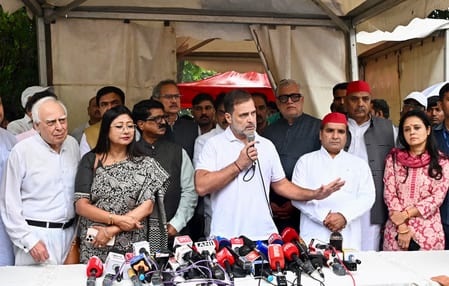
The INDIA bloc’s November 1 ‘Vote Bachao, Desh Bachao’ mobilisation at Delhi’s Ramlila Maidan was an important expression of this changing political landscape. Leaders from the Congress, Trinamool Congress, Samajwadi Party, RJD, Left parties, Jharkhand Mukti Morcha and National Conference assembled to challenge the Election Commission over the revision exercise and demand the resignation of Chief Election Commissioner Gyanesh Kumar.
The BJP responded with its own political campaign, accusing the Opposition of spreading distrust in constitutional institutions and attempting to create an atmosphere of political instability.
The disagreement is no longer confined to the technical details of voter registration.
It concerns something much larger: who defines the credibility of India’s electoral system, how that credibility is established, and what happens when the government and Opposition fundamentally disagree over the functioning of an institution responsible for conducting elections.
There is, however, an important distinction. Criticism of an electoral institution does not automatically establish that the institution has acted improperly. Equally, the constitutional status of an institution does not make its decisions immune from scrutiny.
That distinction is central to understanding the political confrontation unfolding in India.
India’s political battlefield is changing, but economic issues have not disappeared
For much of the past decade, the BJP and its political opponents have contested elections through competing narratives around development, national security, welfare programmes, employment, inflation, social justice and economic opportunity.
The BJP has built much of its political messaging around leadership, national development, infrastructure, welfare delivery and a strong central government.
The Opposition, particularly the Congress and regional parties, has challenged the government over unemployment, price pressures, economic inequality, agrarian difficulties, federal relations and the distribution of public resources.
These issues have not disappeared. Nor has the Opposition abandoned them.
What has changed is the growing importance of electoral integrity and institutional accountability as additional areas of political confrontation.
The SIR controversy has provided a common platform for parties that otherwise have very different ideological positions and regional interests.
The reason is relatively straightforward.
Economic policies can be debated through competing figures, government programmes and political promises. But the right to vote is a constitutional entitlement that determines how citizens participate in the political system itself.
For Opposition parties, therefore, questions surrounding electoral registration offer a way to connect constitutional principles with the everyday experience of voters.
For the BJP, repeated allegations against the Election Commission risk creating the impression that democratic institutions cannot be trusted even when elections produce results favourable to the ruling party.
Both sides understand the political importance of this debate.
The emerging confrontation is therefore not a replacement of economic politics by institutional politics. It is an expansion of the political battlefield into the rules and institutions through which electoral power is exercised.
The SIR controversy: What is actually at stake?
The exercise is intended to update voter lists by identifying deceased voters, duplicate registrations, people who have permanently shifted residence and other ineligible entries.
In principle, maintaining accurate electoral rolls is an essential responsibility of election authorities.
An outdated voter list can create administrative problems, allow duplicate registrations to remain and make election management more difficult.
The controversy arises from the scale of deletions, the documentation requirements, the verification process and the possibility that eligible citizens may be excluded.
The 13-crore deletions and the question of voter exclusion
According to data examined by The Indian Express, approximately 13 crore names were removed from draft electoral rolls across 30 states and Union Territories during the nationwide revision exercise.
The figure attracted national attention because it represented a substantial reduction in the number of registered electors.
A Reuters investigation published on October 9 provided a further breakdown of the Election Commission’s data cited by the BJP:
| Category | Approximate number |
|---|---|
| Deceased voters | 2.8 crore |
| Voters who relocated | 6.3 crore |
| Duplicate registrations | 1 crore |
| Voters who could not be traced | 3 crore |
| Total | 13.1 crore |
These figures require careful interpretation.
A person who has died cannot remain an eligible voter. Similarly, duplicate registrations and permanent relocation can justify corrections to electoral rolls, subject to applicable procedures.
But the category of people who could not be traced raises a different question.
Failure to locate someone during a verification exercise does not, by itself, establish that the person is ineligible to vote.
People migrate for employment, change rented accommodation, travel for family reasons or remain temporarily away from their registered residence. In a country with substantial internal migration, identifying genuine voters requires a process that can distinguish permanent relocation from temporary absence.
The Opposition argues that the exercise could disproportionately affect vulnerable communities and people who struggle to produce the required documentation.
The Election Commission maintains that the revision is intended to improve accuracy and includes opportunities for affected citizens to seek inclusion.
The essential issue is not whether electoral rolls should be updated. It is whether every deletion is properly verified and whether eligible voters have an accessible route to restoration.
The Election Commission faces questions from within its own institutional structure
One of the most important developments in the SIR controversy came not from a political rally but from reporting about disagreements within the Election Commission itself.
An investigation by The Indian Express reported that Election Commissioners Sukhbir Singh Sandhu and Vivek Joshi had raised objections on record on 14 occasions over a period of 10 months concerning decisions taken in the Commission’s name.
The reported disagreements included changes to Form 6, used by new voters seeking registration, and the centralised control of ECINet, the software platform used for electoral roll management.
The investigation also reported concerns about the authority of officials to control access to the electoral database and the ability of statutory election officers to perform their responsibilities.
This development gives the debate a dimension beyond the usual government-versus-Opposition confrontation.
If questions about administrative authority, software access and procedural safeguards are being raised within the institution, they deserve transparent examination.
At the same time, reported disagreements among commissioners should not automatically be interpreted as proof that electoral manipulation has taken place.
They raise questions that require answers, documentary scrutiny and appropriate institutional review.
The Election Commission’s response: A special drive for voters left out
Another important development occurred on September 29, when the Election Commission directed states and Union Territories where SIR had been completed to conduct special enrolment drives for eligible voters who might have been left out.
The instruction was reported by The Indian Express on October 5.
The Commission asked Chief Electoral Officers, District Election Officers and Electoral Registration Officers to facilitate the enrolment of left-out voters and young or first-time eligible electors through the continuous updating process.
Importantly, the special drive was to use Form 6 without the additional SIR-related declaration that had created difficulties for some applicants.
The Commission also asked officials to compare pre-SIR and post-SIR rolls and identify people who might have been wrongly excluded.
This development deserves attention because it demonstrates that the issue is not limited to political speeches.
The administrative process itself has undergone adjustments following scrutiny.
For the Opposition, the special drive reinforces the argument that concerns about voter exclusion cannot simply be dismissed.
For the Election Commission, it provides an opportunity to demonstrate that mistakes can be identified and corrected through established procedures.
The real measure will be how many eligible voters are successfully restored and whether the process is accessible across states.
The Supreme Court’s position: Legal authority does not end the debate over implementation
The legal dimension of the SIR controversy is particularly important because the Election Commission’s authority to revise electoral rolls has also been examined by the Supreme Court.
On May 27, 2026, the Supreme Court delivered its judgment in Association for Democratic Reforms and Others versus Election Commission of India and Others, concerning the Bihar SIR exercise.
The Court upheld the Election Commission’s authority to conduct the revision under Article 324 of the Constitution read with Section 21(3) of the Representation of the People Act, 1950.
It also held that the Bihar exercise had a legitimate purpose and that the procedure examined in that case complied with the applicable statutory framework and safeguards.
The judgment addressed several important issues, including the Commission’s authority to conduct intensive revision, the proportionality of the exercise, documentation requirements and the limited inquiry into citizenship for electoral registration purposes.
However, the judgment should not be interpreted as a blanket approval of every administrative action taken during every subsequent phase of SIR.
There is a difference between the legal authority to conduct a revision and the legality of every individual deletion made during its implementation.
The Supreme Court’s proceedings in the Bihar case also highlighted the importance of publishing reasons for exclusion, allowing political parties to assist affected voters through Booth Level Agents and recognising Aadhaar as an additional identity document for the specified purpose, while clarifying that Aadhaar is not proof of citizenship.
This distinction is crucial.
The legal validity of SIR does not remove the responsibility of election officials to follow due process. Nor does it prevent citizens from challenging wrongful exclusions through available legal and administrative remedies.
The larger constitutional question is how to balance the Election Commission’s responsibility to maintain accurate electoral rolls with the fundamental democratic importance of ensuring that eligible citizens are not excluded.
The INDIA bloc’s new strategy: Making electoral integrity a national political issue
For the Congress, the campaign offers an opportunity to place electoral transparency at the centre of its national political messaging.
For regional parties, it provides a common platform without requiring them to surrender their independent political identities.
The participation of Mamata Banerjee, Akhilesh Yadav, Tejashwi Yadav, Hemant Soren, Farooq Abdullah and Left leaders was particularly significant in this context.
The Indian Express, in its November 2 analysis, observed that the INDIA bloc displayed a degree of public coordination and bonhomie at Ramlila Maidan that had been missing during its previous joint gathering at the same venue in March 2024.
The common SIR-related message helped keep the speeches of most participating leaders focused on a shared subject, despite their different political backgrounds.
This was an important change in presentation.
The alliance has previously struggled to maintain a common narrative because its members frequently prioritise their individual state-level political battles.
The SIR issue offers a different kind of political ground.
It concerns the electoral process itself, which all parties depend on regardless of their ideological differences.
However, the alliance still faces an important challenge: maintaining unity when the immediate protest gives way to questions of electoral strategy, seat-sharing and leadership.
A common political demand can bring parties together. It does not automatically resolve their competing ambitions.
Why Congress is placing electoral integrity at the centre of its campaign
The Congress has increasingly used the expression ‘vote chori’ to describe its allegations concerning electoral processes.
Rahul Gandhi has repeatedly argued that electoral manipulation and voter-list irregularities threaten democratic representation.
The party has attempted to connect these allegations with specific examples, including discrepancies in electoral rolls, questions about the handling of data and the reported concerns of election commissioners.
The November 1 rally extended that campaign beyond Congress supporters.
The presence of regional leaders allowed the party to frame electoral integrity as a national concern rather than a dispute confined to one political organisation.
But the Congress faces an evidentiary challenge.
Serious allegations concerning elections require specific documentation, verifiable cases and institutional scrutiny. Political speeches can generate attention, but they cannot substitute for evidence.
The party will need to demonstrate how alleged irregularities affected eligible voters, what remedies were sought and whether the available procedures were adequate.
Without that supporting material, the campaign risks becoming a contest of political accusations.
BJP’s counter-strategy: Defending the electoral system and challenging the Opposition’s narrative
The BJP has approached the controversy from a fundamentally different perspective.
For the ruling party, the Opposition’s repeated allegations against the Election Commission risk undermining public confidence in an institution responsible for administering elections across the country.
BJP leaders argue that electoral rolls must be updated and that identifying deceased, duplicate and permanently shifted voters is a legitimate administrative responsibility.
They have also accused the Opposition of selectively questioning democratic institutions when political developments do not suit its interests.
This argument became particularly visible during the November 1 rally.
The BJP launched a counter-campaign under the banner ‘Loktantra Bachao, Arajakta Hatao’, or ‘Save Democracy, Remove Anarchy’.
Party president Nitin Nabin announced a mobilisation in Rohtak, Haryana, on the same day as the INDIA bloc’s Delhi programme. BJP leaders also held press conferences and other counter-mobilisation activities.
On November 2, the BJP described the Opposition rally as an orchestrated attempt to create instability.
The party also questioned the turnout, with Sambit Patra claiming that around 40 per cent of Ramlila Maidan was vacant during part of the gathering.
The BJP’s political argument was that the Opposition was exaggerating the scale of its mobilisation while attempting to discredit constitutional institutions.
There is also an important distinction between defending the Election Commission and answering questions about its functioning.
The BJP’s position is that the institution should not be politically delegitimised through unsubstantiated allegations.
The Opposition’s position is that constitutional institutions must remain open to scrutiny and accountability.
Both arguments can be examined without assuming that either side has established every claim it makes.
An election authority must be protected from political interference. But institutional independence also requires transparency, procedural consistency and the ability to address legitimate complaints.
The BJP-Congress confrontation over Delhi’s traders adds another dimension
The November 1 rally also generated a separate political dispute over its possible impact on Delhi’s commercial activity.
Before the demonstration, the BJP had criticised the decision to hold a major political gathering during the festive shopping period, arguing that traffic restrictions and road closures could hurt traders.
The Congress responded by encouraging visitors to Delhi to shop in local markets and support small businesses.
On November 2, Congress general secretary Jairam Ramesh claimed that markets, including Old Delhi’s wholesale trading areas, remained active and that shops continued to operate.
He described the BJP’s warnings about business disruption as politically motivated.
This exchange is worth examining because it illustrates how political parties attempt to expand or redirect a public controversy.
The BJP sought to frame the rally as a potential disruption to livelihoods. The Congress attempted to present the gathering as compatible with commercial activity and local business interests.
However, claims about markets remaining open do not, by themselves, establish whether individual traders experienced losses or additional costs.
That would require independent market-level data, comparisons with normal festive-season trading patterns and feedback from traders across affected areas.
The broader point is that political demonstrations in major commercial centres have economic consequences that should be assessed through evidence rather than party statements.
Why this battle is different: Elections are becoming the subject of the election debate
India has experienced several major political movements in its democratic history.
The anti-Emergency movement of the 1970s centred on civil liberties, executive power and democratic restoration.
The anti-corruption movement of 2011 brought questions of public accountability and institutional credibility into national politics.
Movements around caste representation, federalism, religious identity, economic reforms and social justice have also reshaped political debate.
The present confrontation has a different emphasis.
It focuses on the institutions and administrative processes through which electoral representation is determined.
This is significant because the electoral system is the mechanism through which political competition is organised.
If citizens believe that eligible voters are being unfairly excluded, confidence in electoral representation can suffer.
If citizens are repeatedly told that election results are illegitimate without convincing evidence, confidence can also suffer.
The two concerns are not identical, but both can damage public trust if left unresolved.
A functioning democracy requires more than the regular conduct of elections. It requires confidence that citizens can register, cast their votes and have those votes counted through an established and transparent process.
That confidence cannot be demanded from citizens. It must be earned through institutional performance.
The institutional question: How much scrutiny should the Election Commission face?
The Election Commission occupies a particularly important position in India’s constitutional structure.
Article 324 vests the superintendence, direction and control of elections in the Election Commission, subject to the constitutional and statutory framework.
Its responsibilities extend beyond announcing election dates.
They include electoral roll preparation, supervision of the election process, enforcement of relevant electoral rules and ensuring that the administration of elections remains fair.
This authority carries an equally important responsibility: public confidence.
The Commission must be able to explain its decisions, publish relevant information, address complaints and demonstrate that its procedures are applied consistently.
There are four areas where transparency is particularly important.
1. Electoral roll data
Citizens and political parties need accessible information about additions, deletions and corrections. Aggregate figures should be supported by clear category-wise explanations.
2. Individual deletion procedures
Voters must receive appropriate notice and an opportunity to respond wherever the applicable law requires it. Administrative convenience cannot replace due process.
3. Technology and data management
Digital systems such as ECINet must operate under clearly defined legal authority, with appropriate access controls, accountability and audit mechanisms.
4. Grievance redressal
A voter who believes their name has been wrongly removed must have an accessible and time-bound process for correction or restoration.
The Election Commission’s September special-drive instruction is relevant in this regard. It recognises the need to identify and restore eligible people who may have been left out of completed revisions.
The effectiveness of that exercise will be an important measure of institutional responsiveness.
The danger of turning every institutional disagreement into a political battle
There is another side to this debate that deserves equal attention.
Political parties have every right to question constitutional institutions. In fact, accountability is an essential part of democratic government.
But there is a difference between legitimate scrutiny and the wholesale rejection of institutional credibility.
When Opposition parties allege irregularities, they should provide evidence and pursue available remedies. When the government defends an institution, it should address specific allegations rather than rely exclusively on political counterattacks.
The Election Commission, meanwhile, must remain accountable through transparent procedures and lawful oversight.
The danger arises when political disagreement becomes so intense that citizens begin to distrust the entire electoral framework.
Consider two possible situations.
In the first, an eligible voter discovers that their name has disappeared from the electoral roll. They approach the authorities, receive an explanation and obtain a timely correction where an error is established. The institution may face criticism, but its corrective mechanism strengthens public confidence.
In the second, the voter receives no satisfactory explanation, encounters repeated administrative obstacles and begins to believe that the system is inaccessible or unfair.
That experience can have consequences extending beyond one individual.
Similarly, if political leaders repeatedly describe election outcomes as manipulated without presenting verifiable evidence, public confidence can deteriorate even when the allegations have not been established.
The responsibility, therefore, extends to all political actors.
Democracy requires institutions that can withstand scrutiny and political parties that understand the consequences of undermining public confidence without sufficient evidence.
What the coming months could mean for Indian politics
The confrontation over SIR is unlikely to remain limited to Delhi’s November 1 rally.
Its significance will increasingly depend on how political parties respond to electoral developments in different states and whether the debate produces practical changes in the administration of voter registration.
Several developments deserve particular attention.
1. The Election Commission’s handling of left-out voters
The special enrolment drive ordered in September provides an important opportunity to address concerns about voter exclusion.
The number of people successfully restored, the time taken to process applications and the availability of grievance mechanisms will be relevant indicators.
The Commission’s ability to demonstrate that eligible voters have not been unfairly excluded will be central to maintaining confidence.
2. The Opposition’s ability to sustain a common campaign
The November 1 gathering demonstrated that INDIA bloc parties can coordinate around an institutional issue.
But sustaining that coordination will require regular consultations, documented complaints and a common programme.
The alliance will also have to manage its internal differences over state elections, political leadership and seat-sharing.
The challenge is not simply to bring leaders together for a rally. It is to maintain cooperation when their political interests diverge.
3. The BJP’s response to allegations
The BJP and the Union government will continue to defend the Election Commission’s constitutional role and the legality of the revision exercise.
However, the credibility of that defence will also depend on how effectively the authorities address specific concerns about deletions, verification and technological administration.
A transparent response can be more effective in resolving public uncertainty than a political exchange of accusations.
4. The role of courts and independent scrutiny
The judiciary will remain an important avenue for resolving legal disputes involving electoral registration and the powers of election authorities.
Independent scrutiny, including examination of electoral data and administrative procedures, can help separate genuine irregularities from politically exaggerated allegations.
The objective should be to establish facts and correct errors rather than allow every disagreement to become another confrontation between political parties.
5. Whether voters make institutional accountability an electoral issue
Ultimately, political parties will respond to the issues that citizens consider important.
If electoral registration, transparency and institutional independence become sustained public concerns, political parties will have to address them more seriously.
But voters will continue to judge governments on employment, prices, education, healthcare, infrastructure, security and public welfare.
The institutional debate will therefore exist alongside, not necessarily instead of, the traditional concerns that influence Indian elections.
What this confrontation means for Jammu and Kashmir
Although the present political confrontation is being driven largely by the national SIR exercise, the debate over electoral institutions has particular relevance for Jammu and Kashmir.
The Union Territory has its own history of political representation, constitutional changes, electoral participation and public debate over democratic institutions.
The Election Commission’s May 14, 2026 announcement specifically excluded Jammu and Kashmir and Ladakh from the then-announced third phase of SIR, stating that their schedules would be considered separately after the relevant Census work and with due regard to weather conditions in snow-bound areas.
For Jammu and Kashmir, electoral credibility is not an abstract constitutional discussion.
Questions concerning representation, the relationship between elected governments and the Union government, regional political aspirations and public confidence in democratic processes remain important features of its political environment.
The National Conference’s participation in the Delhi mobilisation also reflects its engagement with the broader Opposition debate.
However, Jammu and Kashmir’s political concerns cannot be reduced to the national SIR controversy alone.
The region has its own questions concerning statehood, legislative powers, federal relations, local governance and the restoration of political confidence.
For parties representing Jammu and Kashmir, the challenge is to connect national debates about institutional accountability with the specific democratic expectations of the people they represent.
The larger question: Who owns Indian democracy?
Perhaps the most important aspect of the current political confrontation is that it raises a question extending beyond the BJP and INDIA bloc.
Does democracy belong to the government that wins an election? Does it belong to the Opposition that challenges the government? Or does it belong to the citizens whose participation gives the political system its legitimacy?
The constitutional answer is clear.
Democratic authority ultimately derives from the people and operates through the Constitution and the institutions established under it.
A government receives the authority to govern through the electoral process. The Opposition receives its democratic role through the same process. The Election Commission administers elections within its constitutional mandate, while courts provide avenues for legal scrutiny and the protection of rights.
No political party owns this framework.
That is why institutional accountability should not be confused with institutional hostility.
The Election Commission should be able to perform its responsibilities without political interference. At the same time, it must remain open to scrutiny when questions arise about the administration of elections.
The government should defend constitutional institutions without treating every criticism as an attack on democracy.
The Opposition should challenge government decisions and institutional actions without making allegations that exceed the available evidence.
And citizens should have access to reliable information rather than being forced to choose between competing political narratives.
These principles are essential irrespective of which party holds power.
Conclusion: Governments change, but democratic institutions must retain public confidence
India’s current political confrontation is about more than the Election Commission, SIR or the demand for the resignation of one constitutional office-holder.
It reflects a wider debate about how democracy functions, how institutions are held accountable and how citizens can remain confident that their political rights are protected.
The INDIA bloc wants electoral transparency and institutional accountability to become central national issues. The BJP argues that repeated allegations against the Election Commission risk weakening trust in the democratic process.
The disagreement will continue, but its outcome should not be measured only by political gains or losses for either side.
The real measure should be whether the electoral system becomes more transparent, whether eligible voters are protected from wrongful exclusion, whether complaints receive timely attention and whether constitutional institutions can perform their duties independently.
India does not need an Election Commission protected from every question. It needs an Election Commission capable of answering legitimate questions with evidence and transparency.
It does not need an Opposition that questions every electoral outcome without proof. It needs an Opposition that can hold institutions accountable through facts, constitutional methods and democratic debate.
And it does not need a government that treats institutional criticism as political hostility. It needs a government confident enough in the democratic system to allow scrutiny.
Political parties will continue to compete. Governments will change. Electoral victories and defeats will reshape the country’s political landscape.
But the democratic framework must remain larger than the ambitions of those who temporarily exercise power.
Because the credibility of Indian democracy cannot belong to the BJP, the INDIA bloc or any individual institution. It belongs to the citizens of the Republic.