Inside the Pampore Saffron Harvest: Growers, History and How to Buy Genuine Saffron
By: News Desk | 02 November 2026
Families across Kashmir’s saffron belt are hand-picking crocus flowers after one of the hardest seasons in memory. This is what is happening in the fields, how saffron is made and graded, where it comes from, how to buy it safely, and the other Kashmiri crafts that share its heritage.
At a glance
- Where: Pampore and nearby villages, Pulwama district
- Status: Harvest underway since the start of November 2026
- What growers say: Better than last year in many fields, but uneven
- How it’s made: Picked, separated and dried by hand
- Scale: Up to 150,000 flowers for one kilogram
- When new-crop saffron reaches shops: Usually late November to December
The harvest is on
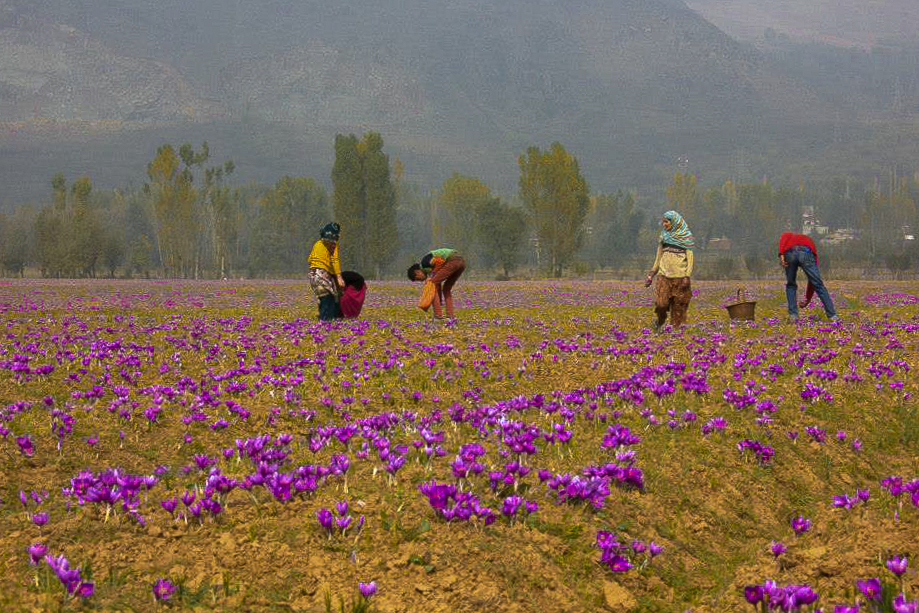
The Kashmir saffron harvest is in full swing. By 1 November, purple flowers were carpeting the fields of Pampore and adjoining areas, and farming families were collecting them in the early morning, when the flowers are fresh and their fragrance is strongest. Farmers are hoping for a better crop this year after significant losses last season.
Pampore, in Pulwama district, is known as the saffron town of Kashmir. The harvest here is a family affair, with parents, children and relatives working together through a short flowering window. For thousands of households it is the most important few weeks of the farming year, and an inherited livelihood rather than just a crop.
A mixed picture, not a bumper crop
The mood in the fields is cautious optimism. Some growers report improvement, but flowering was still developing in several areas, and others reported below-normal flowering. Water is the dividing line. Fields with better irrigation have shown more encouraging results.
Two growers show the range of experience:
- Irshad Ahmad, Patlibagh. He told Awaz The Voice that the crop is comparatively better this year, after an almost 80 per cent decline in production last season. He said lack of moisture was behind the poor flowering.
- Ghulam Mohi-ud-Din Bhat, Munpora. He reported harvesting more than 100 kilograms of saffron flowers after investing in his own borewell, and credits timely irrigation.
Recent rainfall has given cultivators some relief, though they remain cautious about final production while flowering continues. Officials are hopeful. The Agriculture Extension Officer for Pampore said flowering is being reported in several villages, and that replanting under the J&K Competitiveness Improvement Project is starting to show encouraging results.
How bad was last year? Figures differ. Growers quoted this week put last season’s drop at about 80 per cent. Earlier reports quoted farmers saying output fell by nearly 95 per cent. No official figure has been found, but every account describes a severe season, which is why this harvest matters so much.
How a harvest day works
No two farms run identically, but the sequence is the same.
1. Picking at first light. Flowers are collected by hand, generally in the early morning. Pickers move through the rows with baskets, taking each open flower individually. Flowers are collected early because they fade once the day warms up. There is no mechanised way to harvest saffron.
2. Carrying the crop home. The baskets go back to the house, where the harvest is sorted. Each flower holds three red stigmas, which are the saffron, surrounded by purple petals and other parts that are set aside.
3. Separating the stigmas. Families separate the three deep-red stigmas from each flower. This is slow, close work, often done by the whole family together, and it is where the effort behind each gram becomes clear.
4. Drying and processing. The stigmas are carefully dried and processed into the strands sold in the market, and quality, colour, aroma and flavour depend on careful handling at every stage. The raw stigmas must be dried to reduce moisture before they can be sold. This is why new-crop saffron usually appears in shops from late November into December.
5. Grading and packing. Dried saffron is sorted into grades and packed for sale. The grade is a major factor in price.
Why the price is so high
The arithmetic explains it. It takes up to 150,000 blooms to produce one kilogram of saffron. Every one of those blooms is picked and processed by hand, in a window of only a few weeks. The harvest also depends on rainfall and temperature, so a poor season can cut supply sharply, as growers have just experienced.
Saffron grades: Mongra, Lacha and Zarda
Kashmiri saffron is sold in grades, and knowing them helps you read a label.
- Mongra: Only the dark red tips of the stigma, with no yellow or white parts. The premium grade.
- Lacha: The red stigma with the yellow style still attached. Genuine, but gives less colour per gram.
- Zarda: The cheapest grade, made of lighter-coloured tips.
A bit of yellow at one end of a thread does not make saffron fake. It may simply be Lacha. The warning sign is paying Mongra prices for a lower grade.
The saffron belt: where it grows
Pampore and its adjoining villages, including Lethpora, Chandhara, Konibal, Munpora, Dusoo and Ladhoo, form the traditional heartland of saffron cultivation. Government estimates put close to 90% of Kashmir’s saffron cultivation in and around Pampore. The fields sit on karewa plateaus, the raised terraces that make up this part of the Valley.
In Kashmiri, saffron is called kong posh. slurrp
A history wrapped in legend
Nobody can say exactly when saffron reached the Valley, and the oldest accounts are tradition rather than documented history.
- The Buddhist account. One legend says a Buddhist missionary named Madhyantika sowed the first saffron crop on arriving in Kashmir in the 5th century BC. Wikipedia
- The Persian route. Another account says Persian rulers spread saffron across their empire to stock new gardens, and it reached Kashmir this way.
- The Sufi gift. According to Kashmiri tradition, two Sufi ascetics, Khwaja Masood Wali and Hazrat Sheikh Shariffudin, gave a local chieftain a saffron bulb in the 11th or 12th century after he helped them through an illness. A golden-domed shrine to the two saints stands in Pampore, and prayers are offered to them during the harvest.
What is certain is that saffron has long shaped farming, trade and food in the Valley.
Recognition and protection
Kashmiri saffron has formal protection. It received a Geographical Indication (GI) tag in 2020, which legally ties the name to the region. The FAO also lists the Saffron Heritage of Kashmir among India’s Globally Important Agricultural Heritage Systems. Growers argue that protecting this reputation needs better quality control, authentic labelling, improved processing and measures against adulterated or mislabelled products. The Saffron Park at Pampore has created opportunities for scientific processing, grading, packaging and marketing.
What still threatens the crop
Even in a better year, growers list stubborn problems:
- Irrigation. Inadequate irrigation and declining soil moisture are major concerns, and farmers want defunct irrigation facilities restored.
- Planting material. There is a shortage of quality saffron corms.
- Land loss. Farmland is being converted for construction. Official data show Pampore’s saffron area falling from 5,707 hectares in 1996 to 3,500 hectares in 2021, a drop of nearly 40%.
- Pests. Porcupines damage underground corms.
- Weather. Changing weather patterns, inadequate rainfall and declining snowfall affect production.
- Policy follow-through. The National Mission on Saffron, launched in 2011, aimed to improve productivity through irrigation, quality planting material and scientific practices, and farmers are seeking renewed attention to it.
A chance for agri-tourism
There is also an opportunity. Visitors arriving in Kashmir in autumn are drawn to the purple fields, which offers a chance to connect farming communities with tourism and local markets. Used well, that can bring growers more direct income and give buyers a link to the people behind the product.
FROM KASHMIRSTORE.IN: BRING THE HARVEST HOME
Want Kashmiri saffron for your kitchen, or a gift that carries the story of Pampore? Explore saffron at KashmirStore.in. Look for whole threads, a stated grade and clear origin details.
→ Shop Kashmiri saffron at KashmirStore.in
How to buy genuine Kashmiri saffron
Saffron is a prime target for fakes, so a few minutes of checking is worth it.
Check the thread. Real threads flare into a trumpet at one end and are irregular in shape, while fakes tend to be uniform straight strips.
Smell and taste. Genuine saffron smells sweet and faintly medicinal, like hay with honey behind it, and tastes bitter, never sweet.
Run the water test. Real saffron releases a golden-yellow colour slowly over 10 to 15 minutes while the threads stay crimson. Fake saffron bleeds colour almost instantly and the threads turn pale. Instant colour is not an automatic failure, because broken genuine threads can release colour fast, so use several checks together.
Do the rub test. A moist genuine thread leaves a golden-yellow stain on the skin. A red stain suggests dye.
Buy whole threads. Powdered saffron is more vulnerable to adulteration with turmeric, paprika, salt or synthetic dyes. FSSAI has also warned that saffron can be adulterated with dried maize cob.
Ask for paperwork. A GI claim should come with real documentation, and a lab report under ISO 3632 is the reliable measure of quality. Reputable sellers provide origin documentation and transparent harvesting dates.
Be sceptical of low prices. With 150,000 flowers per kilogram, a price far below market is a reason to ask questions.
Home tests are only a screen. They can expose obvious fakes but cannot prove grade or origin. We cover the full checklist in our guide to identifying real Kashmiri saffron.
Using and storing saffron
- Use sparingly. A few threads go a long way, and too much turns bitter.
- Steep first. Soak the threads in a little warm water or milk before adding them to a dish. This brings out colour and aroma.
- In Kashmiri kitchens, saffron is commonly used in kahwa, rice dishes and festive sweets.
- Store it in an airtight container in a cool, dry place.
Beyond saffron: Kashmir’s hand-made heritage
Saffron is one of several Kashmiri traditions that depend on skilled hands and generations of experience. The Valley is known for papier-mâché, walnut wood carving, copper engraving and embroidery, and visitors and buyers who care about saffron’s story often find these crafts just as rewarding.
Papier-mâché: paper turned into art
Kashmiri papier-mâché begins as paper pulp and ends as hand-painted boxes, bowls, vases, trays and decor. Artists create vases, bowls, cups, boxes, trays and lamp bases, often decorated with chinar leaves, water birds, kingfishers and paisley patterns.
How it’s made. The work has two stages: sakhtsazi, in which the base is made from recycled paper soaked and mashed to pulp, and naqashi, which completes the piece with painting and ornamentation. Different artisans often handle each stage. The craft involves two main groups: sakhtasaz, who create the base structure, and naqqash, who draw and polish the designs.
History. Locally known as Kar-e-Qalamdani, the craft is traced to the 14th century, when the Persian mystic Mir Syed Ali Hamdani introduced Central Asian arts such as paper crafting and naqashi. Another story credits Sultan Zain-ul-Abidin, who is said to have brought the technique back after being imprisoned in Samarkand. The walls and ceilings of the Shah Hamdan Mosque in Srinagar are decorated with papier-mâché art.
Look and colour. Typical colours are deep jewel tones of lapis blue, emerald, crimson, gold and black, with gold outlining in a technique called tilla. The craft has received GI recognition.
Buying tip. Machines cannot make true papier-mâché, but low-quality machine-made imitations exist. Look for hand-painted detail, fine line work and clear information about where the piece was made.
FROM KASHMIRBAZAR.IN: HAND-PAINTED PAPIER-MÂCHÉ
From jewellery boxes to decor bowls, Kashmiri papier-mâché is made stage by stage by skilled artisans. Find hand-painted pieces for your home, or as a gift that tells a story, at KashmirBazar.in.
→ Explore Kashmiri papier-mâché at KashmirBazar.in
Crewel: embroidery with a hook
Crewel, also called aari or chain-stitch work, is one of Kashmir’s best-known embroideries. Kashmiri crewel embroidery dates to the 15th century and flourished under Zain-ul-Abidin’s patronage.
How it’s made. Craftsmen use wool, cotton or silk threads and sew with the aari, a hooked needle with a wooden handle. The hook forms small loops that build up a chain stitch on the fabric. The design is first printed on the fabric using ink and then sent to the craftsmen to embroider. Aari designs are generally larger and more vibrant than sozni work, and cover bigger areas.
What it decorates. Craftsmen spend hours on intricate motifs that embellish shawls, rugs and more. Museum records describe examples worked on plain cotton for household furnishings. That is why crewel is popular today on cushion covers, curtains, throws and bedding, usually in floral and vine designs.
The people behind it. More than 10,000 craftsmen are associated with the twin crafts of crewel and chain-stitch across Kashmir. Buying hand-embroidered pieces supports that community directly.
FROM KASHMIRSTORE.IN: HAND-EMBROIDERED CREWEL
Give your home a Kashmiri touch with crewel cushion covers, curtains, throws and bedding, each stitched loop by loop. Browse crewel embroidery at KashmirStore.in.
→ Browse Kashmiri crewel at KashmirStore.in
Gifting season is coming
Christmas and New Year are close, and many buyers start planning gifts for family, clients and guests well ahead. Kashmiri products suit this well, because they come with a story and are made by hand.
- For families and friends: saffron, kahwa and dry fruits, or a papier-mâché box or crewel cushion cover.
- For corporate clients: premium saffron sets and handicraft pieces that stand out from standard hampers.
- For hotels and tour operators: decor and welcome gifts in volume, such as papier-mâché pieces and crewel soft furnishings.
- For retailers and bulk buyers: early enquiry helps with planning larger quantities.
FROM KASHMIRBAZAR.IN: PLAN YOUR CHRISTMAS AND NEW YEAR GIFTING
Whether you’re gifting family, clients, hotel guests or tour groups, you can browse saffron, specialty foods and Kashmiri handicrafts at KashmirBazar.in. Enquire early for corporate and bulk orders.
→ Pre-book your Kashmiri gifts at KashmirBazar.in
Visiting Pampore during the harvest
- Timing. Late October to mid-November is typical, but check local reports, since the bloom varies.
- Time of day. Go early, when the picking happens.
- Respect the fields. These are family farms. Ask before entering, keep to the paths, and never pick flowers.
- Buy responsibly. If you purchase from growers, ask about grade and harvest year.
- Plan the trip. Our Kashmir Travels guide to Pampore and the saffron season – covers routes from Srinagar, timing and nearby stops.
Frequently asked questions
Has the Kashmir saffron harvest started?
Yes. Reports from 1 to 2 November 2026 confirm picking is under way in Pampore and adjoining villages.
Is this year’s crop better than last year’s?
Many growers say it is better, particularly where irrigation is reliable, but flowering is uneven, and some areas report below-normal results. The final yield is not yet clear.
How bad was last year’s harvest?
Growers quoted this week say production fell by almost 80 per cent. Earlier reports quoted farmers at nearly 95 per cent. There’s no official figure.
How long does the bloom last?
The visible bloom usually lasts about two to three weeks, depending on weather.
Why is Kashmiri saffron so expensive?
It is picked and processed by hand, the season is short, and up to 150,000 flowers make a kilogram.
Where is saffron grown in Kashmir?
Mostly in Pampore and nearby villages such as Lethpora, Chandhara, Konibal, Munpora, Dusoo and Ladhoo.
What do Mongra and Lacha mean?
Mongra is the premium grade, made only of the red tips. Lacha keeps the yellow style, so it gives less colour per gram.
What is the GI tag?
A legal certification, granted in 2020, linking the name “Kashmiri saffron” to the region.
When can I buy new-crop saffron?
Typically from late November into December, after drying.
How can I tell if saffron is real?
Buy whole threads, run the water and rub tests, check the smell and taste, and ask for a GI claim with a lab report.
How do I store saffron?
In an airtight container, in a cool, dry place.
What is papier-mâché in Kashmir?
A hand-made craft where paper pulp is shaped into objects (sakhtsazi) and then hand-painted (naqashi).
What is crewel embroidery?
Kashmir’s hook-stitched chain-stitch embroidery, worked with a hooked needle called an aari on cushion covers, curtains, throws and bedding.
Where can I buy Kashmiri saffron and handicrafts online?
You can explore saffron and handicrafts at KashmirStore.in and KashmirBazar.in.
The bottom line
The purple fields of Pampore are a reminder that saffron is not only a spice but the work of thousands of families, and that work depends on water, weather and the protection of farmland. This harvest has brought some hope. Whether it turns into a real recovery will depend on the next few weeks, and on whether irrigation, planting material and land protection improve.