Suspected mechanical failure brings a Navratri pilgrimage to a deadly halt; 29 injured as authorities investigate how a heavy vehicle entered a restricted temple approach road.
By: News Desk | 18 October 2025
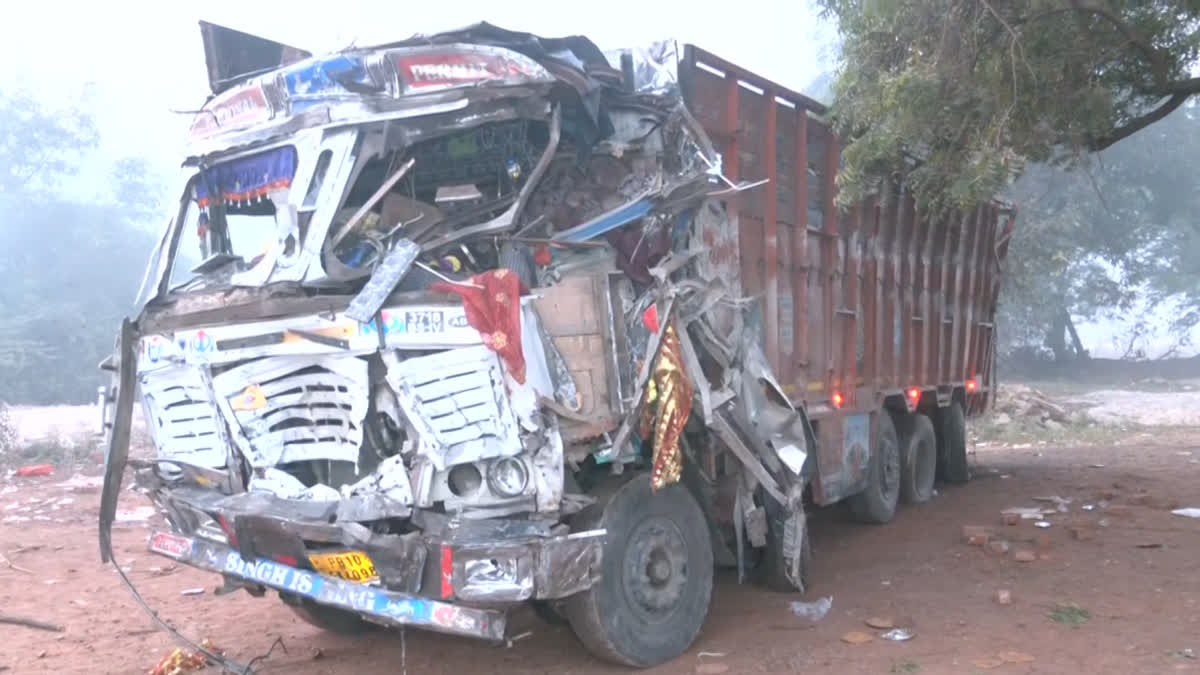
Gwalior: A night of religious devotion turned into a scene of devastation near Sheetla Mata Temple in Madhya Pradesh’s Gwalior district after a paddy-laden truck ran over devotees and crashed into the temple’s entrance gate early Sunday, killing 12 people and injuring 29 others, according to the latest available police figures.
The accident occurred at approximately 1:30 am, when large numbers of devotees were making their way to the temple during Navratri. The truck, reportedly travelling from the Chhinor side, lost control on a steep approach road, broke through police barricades and ploughed into pilgrims and roadside stalls before striking the temple’s outer wall and entrance gate.
The collision caused part of the gateway structure to collapse, trapping people beneath the debris and adding to the urgency of the rescue operation.
Gwalior police have identified a possible mechanical failure as an initial line of investigation. However, the precise cause of the crash has not yet been established. Authorities are also examining how the truck reached the crowded stretch despite restrictions on heavy vehicles and the presence of a police checkpoint.
The tragedy has brought renewed attention to road safety, vehicle fitness, crowd management and emergency planning at religious sites that attract thousands of visitors during major festivals.
What Happened Near Sheetla Mata Temple?
According to Gwalior police officials, the truck was approaching the temple from the Chhinor direction when it lost control on a steep stretch of road.
Superintendent of Police Dharamveer Yadav said heavy vehicles were restricted on the route because of the large Navratri gathering. A police barricade was reportedly in place when the truck approached the area.
The vehicle then moved uncontrollably down the slope, striking devotees and roadside stalls before crashing into the temple’s entrance gate and outer wall.
The force of the impact brought down part of the gateway structure. Several people were trapped beneath the debris, prompting an immediate rescue response from police personnel, emergency teams and local residents.
Police said five to six prasad stalls were damaged and approximately 41 people were struck during the incident. The number of people affected at the scene and the number ultimately admitted to hospitals are different measures; the latest reported hospital figures put the death toll at 12 and the number of injured at 29.
Mechanical Failure Suspected, Technical Inspection Ordered
Investigators are examining whether a mechanical fault caused the driver to lose control of the truck.
A technical inspection by the Regional Transport Office (RTO) has been ordered to establish the vehicle’s condition and identify any possible failure involving its braking system, steering or other critical components.
At this stage, mechanical failure remains a preliminary explanation rather than a confirmed finding. Investigators will need to establish whether the vehicle suffered a sudden defect, whether its condition contributed to the crash, and whether other factors played a role.
The truck’s load, maintenance history, fitness certification and compliance with applicable transport rules may also be relevant to the investigation.
The steep gradient is another important factor. A heavily loaded vehicle descending a slope can become difficult to control if its braking system fails or the driver is unable to manage its speed. The precise sequence of events, however, must be determined through technical evidence rather than assumption.
12 Dead, 29 Injured; Two Policemen Among the Victims
Officials said 39 people were taken to hospitals following the accident. Of these, 12 died, while 29 sustained injuries.
Five to six of the injured were reported to have serious injuries, including fractures. The remaining patients were receiving treatment for injuries of varying severity.
Two police personnel deployed for crowd management were also injured.
District Collector Ruchika Chauhan said ambulances and other emergency vehicles were dispatched after the administration received information about the crash. Medical teams were assessing patients and conducting diagnostic tests, including CT scans and X-rays, to guide treatment.
The district administration also said medical assistance was being provided to the injured, including through Red Cross funds.
The condition of seriously injured patients remains an important factor in assessing the full impact of the accident. The reported toll should therefore be treated as the latest confirmed figure available in the initial reports, not a guarantee that the numbers cannot change.
How Did the Truck Reach a Restricted Road?
One of the most pressing questions concerns the apparent failure of the vehicle restrictions to prevent the truck from reaching the crowded temple approach.
Officials have said a barricade and police checkpoint were in place during Navratri. Heavy vehicles were restricted on the steep stretch because of the large number of pilgrims travelling towards the temple.
Yet the truck reportedly crossed the barricades before entering the crowd.
The district administration has said it is investigating how this happened.
Several issues will need to be examined: whether the checkpoint was positioned appropriately, whether the vehicle was stopped before reaching the slope, whether the barricades were sufficient to prevent a heavy truck from entering, and whether the arrangements were adequate for the scale of the gathering.
These are questions for the official inquiry, not conclusions about individual responsibility.
Nevertheless, the incident highlights a fundamental principle of festival safety: a traffic restriction is effective only when it can be enforced under real-world conditions.
Where large crowds and heavy vehicles could converge, authorities need more than signs or temporary barriers. They need a traffic-control plan that physically separates vehicles from pedestrians and provides a safe response if a vehicle fails to stop.
Navratri Crowds and the Challenge of Religious-Site Safety
Religious festivals create distinctive crowd-management challenges. Devotees may arrive late at night or before dawn, move along narrow approach roads, gather near roadside stalls and walk through areas that also serve local traffic.
At popular temples, the concentration of people can increase sharply during particular days of Navratri.
The risks become more serious when a route includes a steep descent, a narrow carriageway or limited space for pedestrians to move away from danger.
In such circumstances, a single vehicle failure can have consequences far beyond an ordinary road accident.
The Gwalior tragedy illustrates why safety arrangements at crowded religious sites must account for foreseeable emergencies, including loss of vehicle control, sudden surges in pedestrian movement and the need for rapid ambulance access.
Practical measures can include clearly defined vehicle-exclusion zones, secure barriers, designated pedestrian routes, advance parking areas, emergency access corridors and trained personnel at critical points.
Where heavy vehicles are prohibited, enforcement must be supported by physical access controls and clear diversion routes. A vehicle should not be able to enter a dense pedestrian area simply because a temporary checkpoint is breached.
What the Investigation Needs to Establish
The investigation will need to address both the immediate cause of the crash and the circumstances that allowed it to become a mass-casualty incident.
The mechanical inspection should establish whether any vehicle defect contributed to the loss of control. Investigators will also need to examine the vehicle’s load and condition, the road gradient, the truck’s approach speed and the sequence in which it struck the crowd and temple structure.
Separately, the administration’s review of traffic management should establish how the truck entered the restricted zone, whether the barricades were functioning as intended and whether existing crowd-control arrangements adequately separated pilgrims from vehicles.
These are related but distinct questions.
A mechanical fault, if confirmed, could explain why the driver lost control. It would not, by itself, explain why a heavy truck was able to reach a crowded pedestrian area.
Likewise, the presence of barricades does not automatically establish that the traffic-control system was adequate. Their placement, strength, staffing and ability to prevent access all matter.
A credible inquiry should therefore examine vehicle safety and crowd-protection arrangements together.
A Wider Road-Safety Warning
India’s road-safety challenges are not confined to highways or urban intersections. Religious gatherings, fairs, pilgrimage routes and seasonal events can create temporary high-risk environments where normal traffic arrangements are insufficient.
The Gwalior crash underlines the need to plan for the consequences of a vehicle entering a crowd, not merely to assume that restrictions will prevent it from happening.
For festival organisers and local administrations, that means identifying dangerous gradients, preventing unauthorised vehicle access, providing physically protected pedestrian corridors and ensuring that emergency services can reach victims quickly.
For transport authorities, it reinforces the importance of vehicle fitness, maintenance and enforcement of restrictions on heavy vehicles.
For investigators, it means establishing the facts before assigning responsibility.
The immediate priority remains the treatment of the injured and support for bereaved families. The longer-term responsibility is to ensure that the findings lead to practical changes in safety arrangements.
Questions That Remain
As the inquiry proceeds, several issues remain unresolved:
- What mechanical fault, if any, caused the truck to lose control?
- Was the truck carrying a lawful load, and was its vehicle fitness up to date?
- How did it pass the checkpoint and barricades despite heavy-vehicle restrictions?
- Were the pedestrian route and roadside stalls adequately separated from traffic?
- Could additional barriers or earlier vehicle diversion have prevented the truck from reaching the crowd?
- What changes will be introduced before future large gatherings at the temple?
The answers will help determine whether the accident resulted primarily from a vehicle defect, a breakdown in traffic control or a combination of contributing factors.
Conclusion: A Tragedy That Demands Answers
The deaths near Sheetla Mata Temple have turned a major Navratri gathering into a tragedy for families across Gwalior and neighbouring areas.
The immediate task is to ensure that the injured receive appropriate treatment and that the bereaved receive the necessary support. But the broader responsibility cannot end with rescue operations and a mechanical inspection.
The investigation must establish how a paddy-laden truck entered a restricted road, why it could not be brought under control and whether the arrangements protecting thousands of devotees were adequate.
Until those questions are answered, mechanical failure should remain a suspected cause rather than a final explanation.
For authorities responsible for religious gatherings across the country, the lesson is clear: devotion should not expose pilgrims to preventable road hazards. Safe access, enforceable vehicle restrictions and effective emergency planning must be treated as essential parts of festival management—not as arrangements to be improvised after disaster strikes.