Jammu’s Punjabi Language Protest: Education, Official Status and the Bigger J&K Language Debate
By: News Desk | 05 October 2026
Jammu: A language question that has remained largely outside the centre of Jammu and Kashmir’s political debate has returned to the streets of Jammu.
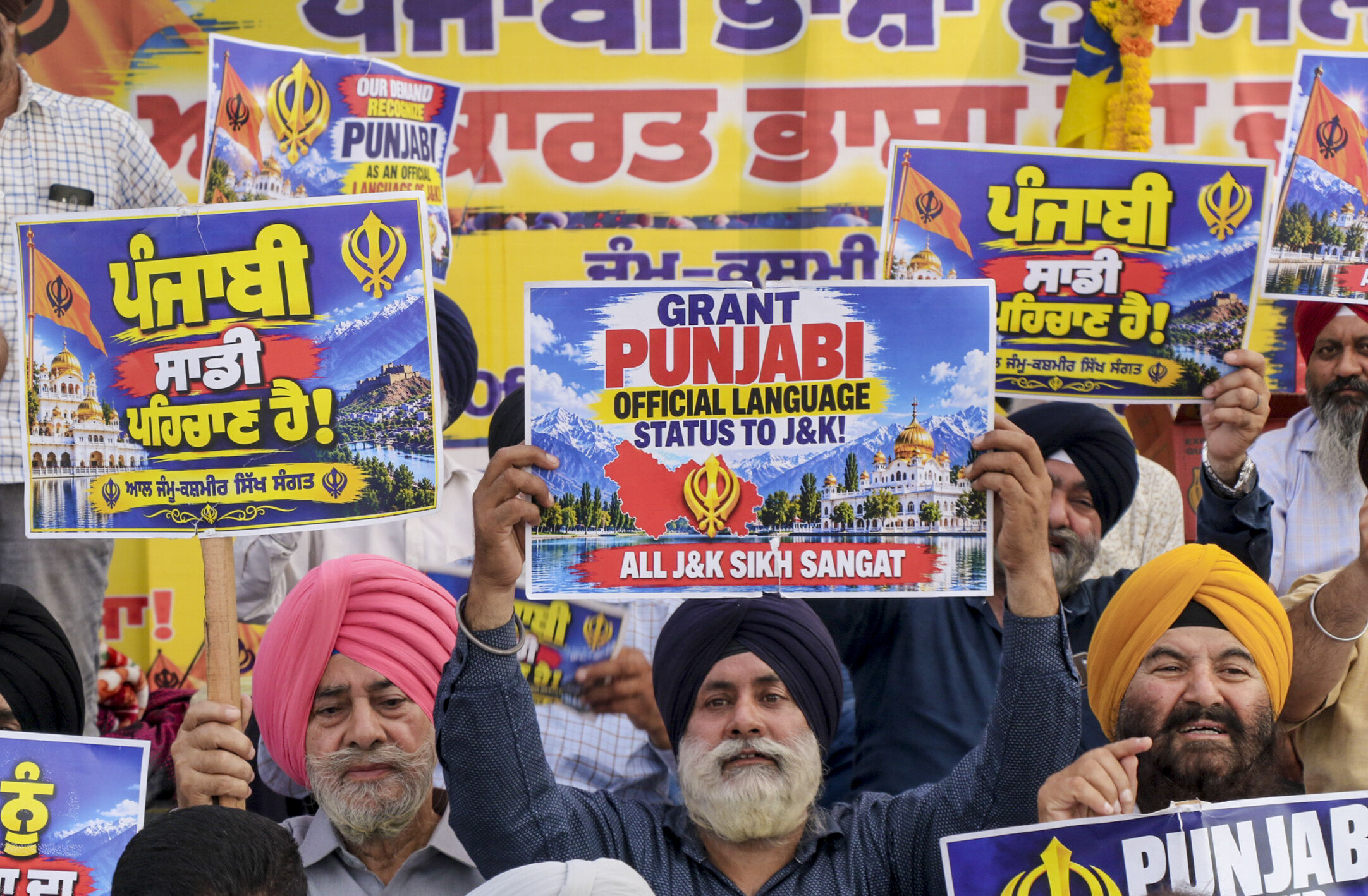
Members of the Sikh community, under the banner of the Jammu Punjabi Morcha, have launched a peaceful agitation demanding the restoration and promotion of Punjabi in the school education system and seeking its recognition as an official language of the Union Territory.
The protest has brought together a larger question than the teaching of one additional language in schools. It has reopened the debate over how Jammu and Kashmir protects its linguistic diversity, how community languages survive across generations and whether the present official-language framework adequately reflects the region’s multilingual character.
The demand has also acquired renewed relevance because the legal position is more complicated than the political slogans surrounding it.
Punjabi is not currently an official language of J&K. The Jammu and Kashmir Official Languages Act, 2020 lists Kashmiri, Dogri, Urdu, Hindi and English as the Union Territory’s official languages. At the same time, the same law specifically directs the institutional mechanisms of J&K to make special efforts for the promotion and development of Punjabi, along with Gojri and Pahari.
That distinction is central to understanding the present agitation.
The Jammu Protest: A Demand That Has Returned to the Public Space
The latest protest was organised under the Jammu Punjabi Morcha, with members of the Sikh community asking the Lieutenant Governor’s administration and the government to introduce Punjabi in the school curriculum and promote it as a community language.
Surjan Singh, general secretary of the District Gurdwara Prabandhak Committee, described the demand as a long-standing one. He argued that Punjabi had historically been taught in schools and said the community had repeatedly sought its restoration.
Protesters have also warned that they will continue with peaceful demonstrations and sit-ins if the administration does not respond to their concerns.
The agitation has subsequently attracted political attention as well. Reports from Jammu indicate that the indefinite dharna seeking official-language status for Punjabi has entered its fifth day, with the Peoples Democratic Party extending support to the campaign.
For the community, therefore, this is not merely a textbook issue. It is being presented as a question of linguistic identity, cultural continuity and recognition.
But Was Punjabi Really an Official Language Before 2019?
This is where the historical record needs to be handled carefully.
The claim that Punjabi was an official language of the erstwhile State of Jammu and Kashmir before 2019 is not accurate if “official language” is being used in the formal legal sense.
Under the Constitution of Jammu and Kashmir, Urdu was the official language of the State, while English continued to be used for official purposes subject to the constitutional framework. Punjabi, however, did have a recognised place among the State’s regional languages.
The Sixth Schedule of the former J&K Constitution specifically listed Punjabi among the regional languages, alongside Kashmiri, Dogri, Balti, Dardi, Pahari, Ladakhi and, later, Gojri.
That distinction matters.
Punjabi therefore had constitutional recognition as a regional language, but that was different from being the State’s official administrative language.
This historical nuance does not weaken the community’s current demand. If anything, it explains why many Sikh organisations view the present position as a loss of institutional space for a language that had a recognised place in the region’s linguistic framework.
What Changed After 2019?
The major change came with the reorganisation of the former State and the subsequent enactment of the Jammu and Kashmir Official Languages Act, 2020.
The Act established five official languages for the Union Territory:
- Kashmiri
- Dogri
- Urdu
- Hindi
- English
Punjabi was not included in that list.
But there is an important second part to the legislation.
Section 4 of the Act provides for the promotion and development of regional languages and specifically says that institutional mechanisms should make special efforts for the promotion and development of Gojri, Pahari and Punjabi.
In other words, the law did not treat Punjabi as an irrelevant or foreign language.
It placed Punjabi in a different legal category: a regional language whose development is to receive special institutional attention, rather than an official language for government purposes.
This distinction is now at the heart of the community’s demand.
The protesters are effectively asking why a language that the law itself identifies for special promotion should not have a stronger place in education and, ultimately, official recognition.
Punjabi Has a Real Demographic Footprint in J&K
The argument for Punjabi education also has a demographic foundation.
According to the 2011 Census mother-tongue data, 219,193 people in the erstwhile Jammu and Kashmir State reported Punjabi as their mother tongue.
That figure represented around 0.66 per cent of the population recorded in the 2011 Census.
The number should not be interpreted as the total number of people who can speak Punjabi. Mother-tongue data measures what respondents identify as their mother tongue and does not capture everyone who may understand, speak or use Punjabi as a second or additional language.
The Census data nevertheless establishes that Punjabi is not an insignificant linguistic presence in J&K.
It is part of the Union Territory’s documented multilingual landscape.
And the geographical character of Jammu makes the issue particularly significant. Punjabi has historical, cultural and social links with parts of the Jammu region and with communities that have maintained the language across generations.
The School Question: What Exactly Are Protesters Asking For?
The demand for Punjabi in education can mean several different things, and these should not be treated as identical.
One possibility is introducing Punjabi as an optional language subject for students who want to study it.
Another is providing Punjabi as a community-language option in schools with a significant number of Punjabi-speaking students.
A broader demand would be to establish Punjabi-medium educational institutions or expand Punjabi teaching across government schools.
The latest agitation appears primarily focused on bringing Punjabi back into the school curriculum and ensuring that students from the Sikh community have an institutional opportunity to learn their mother tongue.
This is particularly relevant in an education system where language choices increasingly influence cultural continuity.
A child may hear Punjabi at home, encounter English in school, Hindi through popular culture and social media, and use another regional language in everyday interaction.
Without structured education, reading and writing proficiency in the mother tongue can gradually weaken even when the spoken language survives inside families.
That is the central educational argument behind the demand.
Punjabi Is Not Being Asked to Replace Other Languages
The debate should not be reduced to Punjabi versus Dogri, Punjabi versus Hindi or Punjabi versus English.
Jammu and Kashmir is inherently multilingual.
Dogri has a strong linguistic presence in Jammu. Kashmiri is central to the Valley’s linguistic identity. Urdu has a deep literary and administrative history. Hindi and English have major educational and communication roles. Gojri, Pahari and other languages also form important parts of the region’s social fabric.
The question, therefore, is not whether one language should displace another.
It is whether the education system can accommodate linguistic diversity without forcing communities to choose between cultural identity and educational opportunity.
That is also consistent with the broader philosophy of multilingual education under the National Education Policy, which encourages education in children’s home or regional languages, particularly in the foundational and school years.
The practical challenge is implementation.
Adding another language to a curriculum requires teachers, textbooks, examinations, training, timetable space and a clearly defined administrative framework.
A declaration without those supporting systems would provide recognition on paper but limited educational benefit.
JKBOSE Already Has Punjabi in Its Academic Framework
There is another important point that can easily get lost in the present debate.
Punjabi is not entirely absent from the Jammu and Kashmir Board of School Education’s academic framework.
JKBOSE revised the syllabus for several subjects for Classes 11 and 12 for the 2026 academic cycle, including Punjabi at Class 11 level.
That means the present issue is not simply whether Punjabi exists anywhere in the J&K education system.
The more important question is where, for whom and at what scale Punjabi is available as a school subject.
The current controversy concerns wider access, institutional support and community-language education, particularly at school level.
This is a very different question from claiming that Punjabi has completely disappeared from J&K’s education system.
The Real Gap: Recognition Versus Availability
This is perhaps the most important part of the present debate.
There are at least three separate levels of language rights:
First, official status.
This determines whether a language is legally recognised for specified government and administrative purposes.
Second, educational availability.
This determines whether students can learn the language in schools and whether adequate teachers and textbooks are available.
Third, cultural promotion.
This concerns literature, publishing, academies, cultural institutions, public events and preservation of linguistic heritage.
Punjabi currently occupies different positions at these three levels.
It is not among J&K’s five official languages.
Yet the 2020 law specifically calls for its promotion and development.
And Punjabi also exists within the JKBOSE academic structure.
The community’s argument is that these arrangements do not go far enough.
Why the Official-Language Demand Is Legally Bigger
Restoring or granting official-language status is fundamentally different from introducing Punjabi as a school subject.
The 2020 Act itself specifies the official languages of the Union Territory. Therefore, making Punjabi an additional official language would require a change to the statutory framework rather than simply an administrative circular introducing a school subject.
That makes the demand politically and constitutionally larger.
The community is therefore asking for two related but distinct outcomes:
Punjabi in education, which involves curriculum and school-policy decisions;
and Punjabi as an official language, which involves the legal framework governing official languages in J&K.
Treating both demands as one administrative decision risks oversimplifying the issue.
Why the Sikh Community Says Education Matters
For minority linguistic communities, language preservation rarely depends only on whether people speak a language at home.
A language survives more securely when children can also read it, write it, study its literature and use it in formal settings.
For the Sikh community, Punjabi has an additional cultural and religious dimension.
Gurmukhi literacy provides access to a large body of Punjabi literature and Sikh religious literature in its original linguistic and script traditions.
When younger generations lose the ability to read their heritage language, the connection can become dependent on translations or oral transmission.
That does not automatically mean a community disappears culturally.
But it can weaken one of the most important mechanisms through which cultural memory is transmitted.
The protesters’ demand therefore goes beyond a single school subject.
They are asking for institutional support for a linguistic inheritance.
The Government’s Own Law Creates an Interesting Question
The strongest argument emerging from the present agitation comes from the language of the 2020 law itself.
The legislation did not simply omit Punjabi and stop there.
It specifically instructed the relevant institutional mechanisms to make special efforts for Punjabi’s promotion and development.
That creates a reasonable public-policy question:
If Punjabi is important enough to receive special statutory attention, what measurable steps have been taken to fulfil that obligation?
How many government schools currently offer Punjabi?
How many trained Punjabi teachers are available?
How many students study it?
Which districts have the highest demand?
Are textbooks available at every relevant level?
Is Punjabi being offered as an optional subject or as a community-language option?
And how much funding has been allocated for its promotion?
These are more useful questions than simply asking whether Punjabi has been “ignored.”
A transparent government database answering them would make the debate evidence-based.
A Larger Language Debate Is Emerging in J&K
The Punjabi agitation also arrives at a time when language and education are becoming increasingly important public issues in Jammu and Kashmir.
The region is home to multiple linguistic communities, many of which have historically worried about the survival of their languages.
The challenge for policymakers is therefore to create a framework where recognition does not become a zero-sum contest.
Promoting Punjabi does not require reducing Dogri.
Supporting Kashmiri does not require weakening Urdu.
Encouraging Gojri or Pahari does not require abandoning English.
The real policy test is whether J&K can build a multilingual education model in which children have access to their mother tongue while also gaining proficiency in the languages required for higher education, employment and wider communication.
What a Practical Punjabi Policy Could Look Like
If the administration wants to respond constructively without immediately resolving the larger official-language question, several intermediate measures are possible.
Punjabi could be offered as an optional language subject in government schools where there is sufficient student demand.
The government could conduct a district-wise demand survey to identify the number of Punjabi-speaking students.
A teacher database could identify trained Punjabi educators and vacancies.
JKBOSE could publish a clear pathway for Punjabi from primary to senior-secondary levels.
Digital textbooks and supplementary reading material could be developed where physical textbook availability is limited.
The government could also publish annual data showing how many schools offer Punjabi, how many students study it and how many teachers are deployed.
Such measures would turn language preservation from a slogan into an education policy.
The Question Before J&K Is Bigger Than Punjabi
The Jammu protest should not be viewed merely as a community demand or a confrontation between the administration and Sikh organisations.
It raises a broader question about what linguistic pluralism should mean in a Union Territory as diverse as Jammu and Kashmir.
The present legal framework recognises five official languages but simultaneously directs special promotion of Punjabi, Gojri and Pahari.
That creates room for a policy debate about whether recognition through promotion is sufficient or whether some languages should receive a stronger institutional status.
For the Sikh community, Punjabi is a question of identity and continuity.
For policymakers, it is a question of law, education, resources and equal cultural opportunity.
For the wider public, it is a reminder that language rights are rarely only about words.
They are about what children learn, what literature survives, what communities pass to the next generation and whether cultural diversity remains visible inside public institutions.
The Jammu Punjabi Morcha has now put that question back on the public agenda.
What happens next will depend not only on whether the administration responds to the protest, but on whether Jammu and Kashmir can develop a transparent language policy that protects its multilingual character without turning one community’s linguistic aspirations into another’s loss.