Dal Lake becomes Kashmir’s most unusual cinema hall
By: News Desk | 09 September 2026
Srinagar: There was no conventional theatre, no enclosed auditorium and no ceiling above the audience.
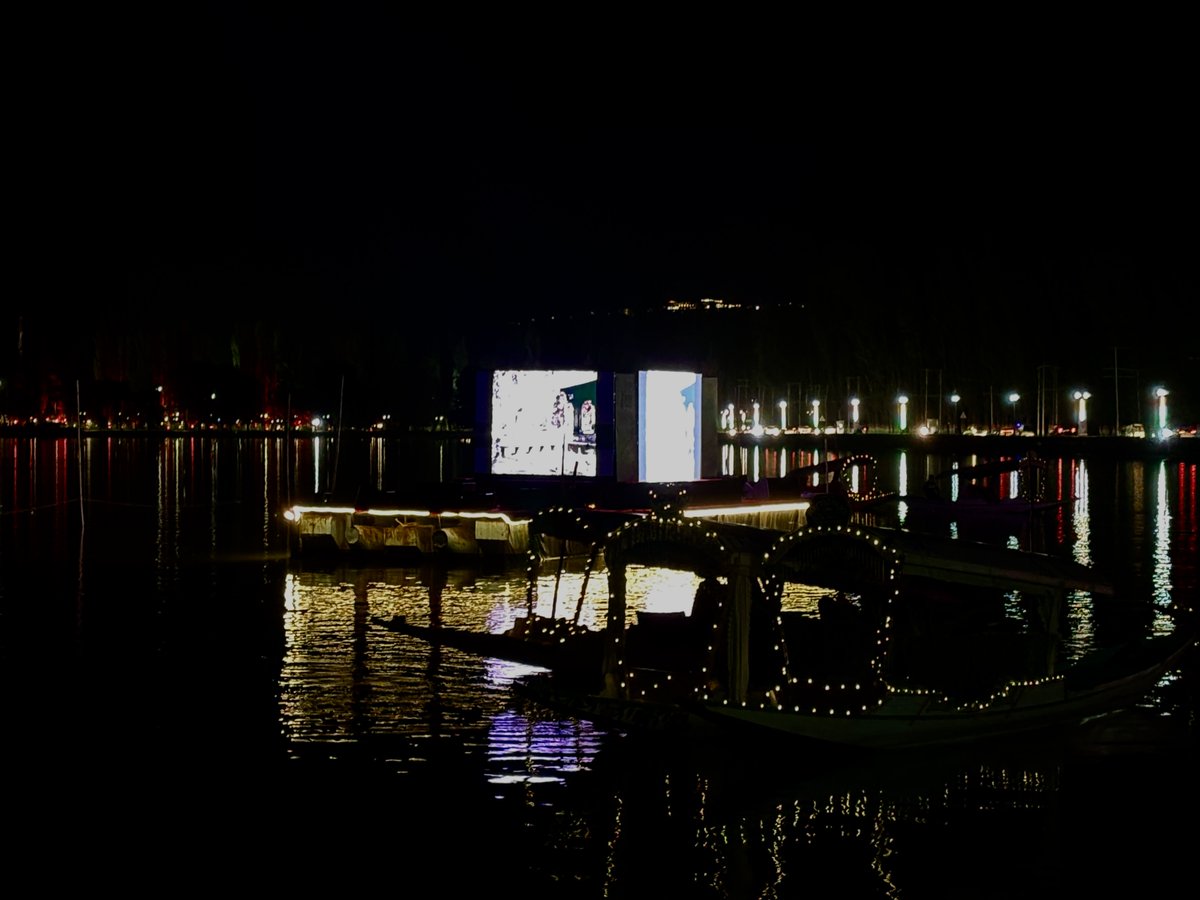
Instead, there was the dark water of Dal Lake, the silhouettes of the mountains, the lights of Srinagar and a giant screen floating on the lake.
As the opening frames appeared, one of Kashmir’s most recognisable landmarks became something it had never quite been before: a cinema hall.
The Floating Cinema at Dal Lake, one of the most distinctive attractions of the maiden International Film Festival of Jammu & Kashmir (IFFJK), has turned the festival’s promise of combining cinema with Kashmir’s landscape into a physical experience.
The initiative opened on September 7 with the screening of the 1961 classic Junglee, drawing spectators to the lakefront as the film played across the water. Subsequent screenings have included Arzoo (1965) and Kashmir Ki Kali (1964), with Yash Chopra’s Kabhi Kabhie (1976) scheduled for the festival’s concluding day.
What makes the spectacle striking is not simply the floating screen.
It is the choice of location.
Kashmir is watching films about the Kashmir it once was, in the middle of the landscape that helped make those films famous.
When Dal Lake became the auditorium
The concept is deceptively simple.
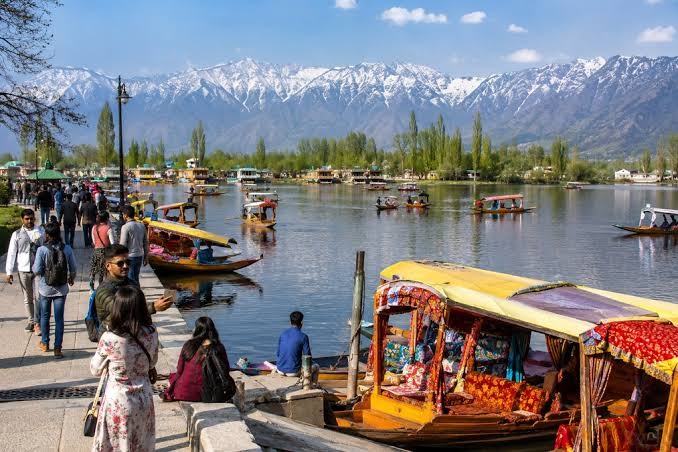
A large screen has been positioned over the waters near the festival’s SKICC venue, while viewers gather along the banks and surrounding public spaces. Reports also describe audiences experiencing the screenings from the lakefront, with the water, houseboats, mountains and Srinagar’s evening lights forming a natural backdrop.
The result is closer to an open-air cultural gathering than a conventional multiplex screening.
Families, visitors, film enthusiasts and curious onlookers have gathered around the lake to watch the classics.
That public character may be one of the initiative’s most important features.
A film festival can easily become an industry event attended primarily by filmmakers, critics, delegates and invited guests.
The Floating Cinema takes the opposite route.
It puts cinema outside the walls and into a public space.
People do not necessarily have to be industry insiders to become part of the experience.
Why Junglee was the perfect opening film
The choice of Junglee for the first Floating Cinema screening was hardly accidental.
The 1961 Shammi Kapoor classic belongs to the period when Kashmir was becoming one of Hindi cinema’s favourite filming destinations.
Its screening on Dal Lake therefore created a cinematic conversation between past and present.
The audience was not simply watching an old film.
It was watching a piece of the era that helped establish Kashmir’s enduring relationship with Bollywood, while sitting in the landscape that contributed to that relationship.
That nostalgia continues through the festival’s Floating Cinema programme.
Arzoo, Kashmir Ki Kali and Kabhi Kabhie similarly belong to a cinematic tradition in which Kashmir was frequently presented through romance, music and landscape.
The programming therefore carries a message.
Kashmir is not trying to manufacture a cinematic identity from scratch.
It is revisiting one it already possessed.
From Kashmir Ki Kali to Kabhi Kabhie: cinema comes full circle
Few places in India have been as closely associated with Hindi film imagery as Kashmir.
Dal Lake, Gulmarg, Pahalgam and the Valley’s mountains became shorthand for romance in generations of Indian films.
That connection weakened over time, with security concerns, changing production patterns and the emergence of alternative shooting destinations taking productions elsewhere.
IFFJK is attempting to revive that relationship.
The Floating Cinema gives that effort a particularly powerful visual form.
When Kashmir Ki Kali plays on a screen above Dal Lake, the boundary between film and location almost disappears.
The landscape is no longer merely behind the movie.
It becomes part of the movie-going experience.
That is precisely the kind of association destination marketers dream about.
A spectacle built for Kashmir’s visual identity
There is a reason the Floating Cinema has emerged as one of IFFJK’s most talked-about attractions.
A festival hall can be replicated.
A floating screen on Dal Lake cannot.
The mountains, water, houseboats and city lights provide an atmosphere that is almost impossible to reproduce elsewhere.
UNI described the setting as one where the lake, mountains and city lights come together, while the lakefront functions as an open-air auditorium.
The J&K Information and Public Relations Department has also highlighted the Floating Cinema as a major festival attraction, describing the combination of the lake, mountains and city lights as a distinctive cinematic setting.
This is where IFFJK’s larger branding idea becomes visible.
The festival has repeatedly presented Kashmir not merely as a filming location but as a creative sanctuary.
The Floating Cinema is almost a physical illustration of that argument.
The audience becomes part of the picture
There is another difference between watching a film inside a theatre and watching it beside Dal Lake.
Inside a theatre, the outside world disappears.
At Dal Lake, the opposite happens.
The environment remains visible.
The audience sees the lake while watching the screen. The surrounding mountains remain part of the experience. Shikaras and houseboats provide a distinctly Kashmiri setting.
The effect is immersive in a way that conventional cinema cannot easily reproduce.
That is why the Floating Cinema is more than a technical novelty.
It is a form of place-based cinema, where the geographical identity of the venue becomes inseparable from the film being screened.
For a festival attempting to build a distinct identity in its inaugural year, that is a smart programming choice.
Planning a Kashmir trip around cinema?
For festival visitors who want to combine IFFJK screenings with Kashmir’s landscapes, culture and local experiences, contact JKL Travels / Kashmir Travels:
+91 88033 24 365 | +91 97960 24 365
The tourism opportunity goes beyond the festival
The economic possibilities are equally interesting.
Kashmir has traditionally sold itself through scenery, hospitality and adventure.
Cinema offers another tourism product.
Imagine a visitor coming to Srinagar not merely for a Shikara ride, but to experience a film screening on Dal Lake after spending the afternoon exploring the city’s historic neighbourhoods.
The festival creates exactly that kind of possibility.
A visitor attending an evening screening can extend the trip into a broader itinerary involving Gulmarg, Pahalgam, Sonamarg, houseboats, handicrafts, food and local cultural experiences.
The Floating Cinema effectively packages cinema and destination tourism into one experience.
That could become valuable if the idea survives beyond IFFJK 2026.
Film tourism could become the bigger story
The real economic prize is not necessarily the number of people who attend one evening screening.
It is whether the festival helps persuade filmmakers to return.
J&K officials have repeatedly spoken about reviving the region’s old connection with Bollywood and attracting more filmmakers to shoot in the Union Territory.
Joint Director Information Syed Shahnawaz Bukhari said the administration wants to restore confidence among filmmakers and encourage them to return to Kashmir. He also said the festival had attracted more than 360 delegates from outside J&K for screenings, expert sessions and other programmes.
That is where the Floating Cinema fits into a much larger strategy.
The festival offers filmmakers an experience of Kashmir.
The government wants that experience to translate into production.
And production can create a much broader economic chain than tourism alone.
From one evening of cinema to a local creative economy
A major film production needs far more than actors and cameras.
It needs local transportation.
Hotels.
Catering.
Location managers.
Technicians.
Electricians.
Security.
Costume suppliers.
Set designers.
Make-up professionals.
Production assistants.
Local performers.
Guides and logistics providers.
If J&K can attract sustained production activity, those requirements can create opportunities for a wider network of local businesses and skilled workers.
That is why the larger IFFJK programme includes masterclasses and workshops alongside screenings. The official festival plan specifically targets students, aspiring filmmakers and cinema enthusiasts for interaction with established industry professionals.
The Floating Cinema attracts the crowd.
The workshops and industry sessions are intended to build the ecosystem.
Both are necessary.
Kashmir’s old Bollywood relationship gets a new stage
There is also an emotional dimension to the programming.
The classic films being screened on Dal Lake belong to an era when Kashmir was central to the visual language of Hindi cinema.
For older audiences, these films evoke memories.
For younger audiences, they offer a glimpse into how Kashmir was represented on screen decades ago.
For filmmakers attending IFFJK from outside the region, the screenings provide a reminder that Kashmir’s cinematic history is much deeper than contemporary location shoots.
This is particularly relevant because the inaugural festival is trying to connect that history with a new generation of filmmaking.
The message is essentially:
The old relationship can be revived, but it needs a new foundation.
Not just Bollywood nostalgia
There is a danger in treating the Floating Cinema purely as a Bollywood nostalgia project.
IFFJK itself is much broader.
The festival is hosting 135 films from 41 countries, covering feature films, documentaries, shorts and regional cinema. Its programme also includes international competition, masterclasses, workshops and industry discussions.
The Floating Cinema is therefore one component of a much larger international festival.
Its role is different.
The international competition gives the festival global credibility.
The masterclasses build professional exchange.
J&K Select gives regional filmmakers a platform.
The Floating Cinema gives the festival a visual identity that could belong nowhere else.
Together, those elements make the event more than a series of screenings.
Could Dal Lake become a permanent film venue?
That is perhaps the most interesting question emerging from the experiment.
There is no obvious reason why the concept has to disappear when IFFJK ends.
Seasonal floating screenings could potentially become part of Kashmir’s cultural calendar, subject to environmental, safety, weather and crowd-management considerations.
Imagine summer film nights on Dal Lake.
Documentary screenings.
Local short-film festivals.
Student film showcases.
Cultural evenings combining cinema with Kashmiri music.
Such programming could create a new cultural attraction for Srinagar.
But any permanent expansion would have to be carefully managed.
Dal Lake is not simply a scenic venue. It is an environmentally sensitive water body and a major part of Srinagar’s urban and tourism ecosystem.
The commercialisation of the lake therefore needs to remain compatible with conservation, waste management, crowd control and water-quality concerns.
The success of the Floating Cinema should not be measured only by how spectacular it looks.
It should also be measured by how responsibly it is operated.
A stronger tourism proposition for Srinagar
For destination businesses, the idea is already attractive.
The Floating Cinema creates an experience that is difficult to replicate in another city.
A visitor can say they watched a classic film on Dal Lake in Kashmir.
That is a story in itself.
And tourism increasingly depends on such experiences.
Hotels can build festival packages.
Tour operators can combine screenings with Shikara rides and heritage walks.
Restaurants can offer themed evening experiences.
Local artisans can connect exhibitions or markets with the festival.
Photographers and content creators can document the event and extend its reach far beyond the people physically present.
This is where culture can become an economic asset without reducing culture to a commodity.
Planning an IFFJK-Kashmir holiday?
For visitors travelling to Srinagar for the festival, the Floating Cinema can be combined with a wider Kashmir itinerary covering Dal Lake, Gulmarg, Pahalgam, Sonamarg and local cultural experiences.
JKL Travels can assist with customised Kashmir holiday packages, accommodation, transportation and sightseeing.
Call / WhatsApp: +91 88033 24 365 | +91 97960 24 365
The bigger meaning: Kashmir becomes part of the cinema, not just its backdrop
The most powerful thing about the Floating Cinema is perhaps its simplicity.
For decades, Kashmir was photographed by filmmakers.
Now Kashmir is providing the theatre.
That difference matters.
The lake that appeared behind actors in countless Hindi films has become the place where audiences themselves sit and watch cinema.
The mountains that once served as scenery have become part of the viewing experience.
And the city that once featured primarily through someone else’s camera is now hosting an international festival of its own.
That is a subtle but important shift in cultural positioning.
A cinematic experience that may outlive the festival
IFFJK’s Floating Cinema has already demonstrated the power of combining a film with the place in which it is being shown.
The opening with Junglee, followed by classics such as Arzoo and Kashmir Ki Kali, deliberately connects Kashmir’s present cinematic ambitions with its past relationship with Hindi cinema.
And with Kabhi Kabhie scheduled for the closing day, the festival is effectively ending its floating programme with another film deeply associated with Kashmir’s cinematic memory.
The experiment has worked because it offers something a normal theatre cannot.
It gives audiences a story and a place at the same time.
For Kashmir, that may be the real breakthrough.
The Valley has always had the scenery.
Now it has found a way to make the scenery part of the audience experience itself.
And under the night sky, with a film flickering across the waters of Dal Lake, cinema has finally come full circle in Kashmir.
Turn the IFFJK experience into a Kashmir holiday
A visit for the Floating Cinema can become much more than an evening at Dal Lake. Explore Srinagar’s heritage, houseboats and Shikaras, then extend the trip to Gulmarg, Pahalgam or Sonamarg.
Kashmir Travels can assist with customised Kashmir itineraries, stays, transfers and sightseeing.
Call / WhatsApp: +91 88033 24 365 | +91 97960 24 365