Srinagar Smart City Mission: 98% Projects Complete, But Has the City Become More Livable?
By: News Desk | 09 September 2026
Srinagar: On paper, Srinagar has come remarkably close to completing its transformation under the Smart Cities Mission. Out of 161 sanctioned projects, 157 had been completed by March 31, 2026, representing roughly 98 per cent of the portfolio. Completed works are valued at about ₹3,532 crore, against a sanctioned project cost of ₹3,634 crore.
The numbers tell a story of substantial implementation.
The streets tell another.
Across Srinagar, residents can point to new public spaces, redesigned roads, pedestrian areas, improved lighting, digital surveillance and technology-driven civic management. The city centre looks different from what it did a decade ago.
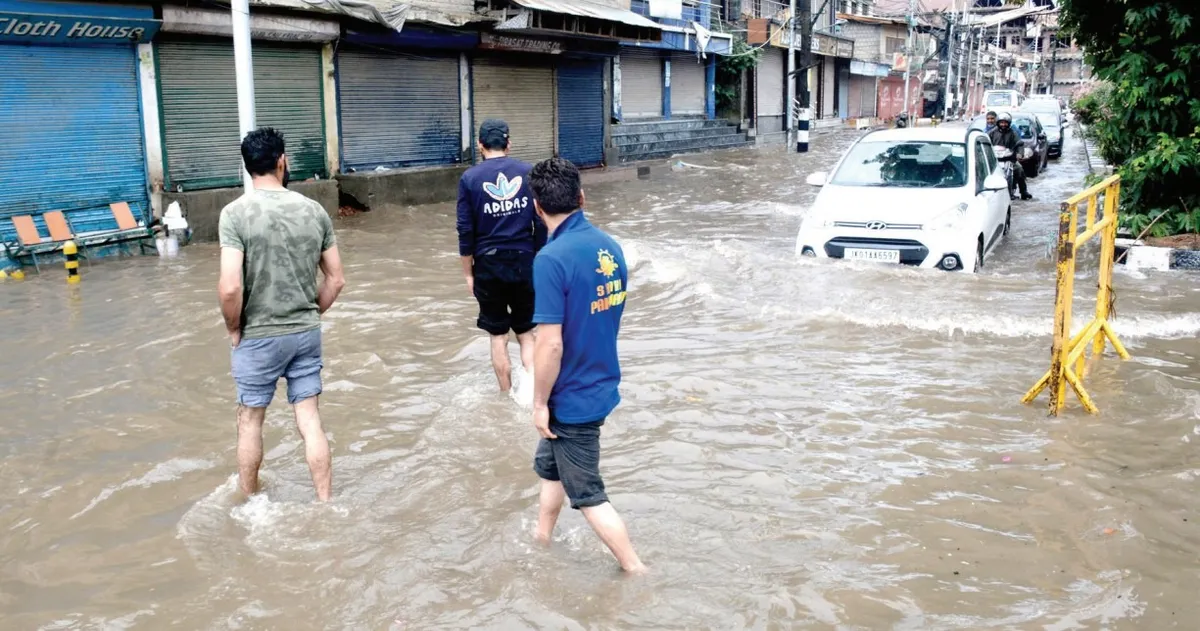
Yet when heavy rain arrives, familiar roads can still turn into pools of stagnant water. Traffic continues to choke important corridors. Parking remains a persistent headache. Waste management and the ecological health of Dal Lake remain unfinished urban battles.
That gap between project completion and lived experience is now at the heart of the debate over Srinagar’s Smart City journey.
The question is no longer simply how many projects have been completed.
It is whether those projects have made Srinagar easier, safer, cleaner and more resilient for the people who live and work here.
The Numbers Behind Srinagar’s Smart City Transformation
Srinagar was selected under the Smart Cities Mission in 2017, with the city’s proposal divided broadly between area-based development and pan-city solutions. Srinagar Smart City Limited, a special purpose vehicle, was incorporated in September 2017 to implement the programme.
The latest figures placed before Parliament show:
- 161 projects sanctioned for Srinagar
- 157 projects completed
- 4 projects still under implementation
- ₹3,634 crore total sanctioned project cost
- ₹3,532 crore worth of completed projects
- 98 per cent completion by project count as of March 31, 2026
The official parliamentary data also shows that Srinagar had claimed ₹452 crore in central financial assistance and utilised the entire amount claimed.
At the national level, the Smart Cities Mission had completed 7,790 of 8,064 projects by March 31, 2026, according to the Union government.
But there is an important timeline distinction.
The Centre says the Smart Cities Mission formally concluded on March 31, 2025. The subsequent figures are essentially a progress update on projects taken up under the mission rather than evidence that the national mission itself was still operating as a new programme in 2026.
That distinction matters when assessing what Srinagar has actually inherited from the programme and who is now responsible for maintaining those assets.
What Has Actually Changed on Srinagar’s Streets?
Walk through parts of downtown Srinagar and the physical change is difficult to miss.
Pedestrian-friendly areas, upgraded public spaces, renovated streetscapes and riverfront development have changed the appearance of several parts of the city.
The intention behind the programme was never merely to install technology.
The official Srinagar Smart City framework speaks of core infrastructure, quality of life, clean and sustainable surroundings and the use of smart solutions. It also identifies walkable neighbourhoods, better mobility and improved public services as important components of the smart-city concept.
That distinction is important because a smart city is not necessarily a city covered in cameras and digital screens.
A genuinely smart city should make ordinary life less difficult.
That means reaching work without losing an hour in traffic, walking without negotiating unsafe roads, finding parking without circling endlessly, moving through the city after heavy rain without wading through water and disposing of household waste without creating another environmental problem.
Srinagar has made progress on some of those fronts.
It has struggled on others.
The Visible Success: Public Spaces, Lighting and Urban Aesthetics
Perhaps the most obvious success of the Srinagar Smart City programme has been the transformation of public spaces.
Riverfront development and pedestrian-oriented projects have given parts of the city a more modern appearance while also creating areas that can be used by pedestrians and visitors.
The improvements have had a tourism dimension as well.
Srinagar is not only an administrative centre. It is the Valley’s principal tourism gateway and a historic city whose commercial and cultural areas attract visitors throughout the year.
Better streetscapes and public spaces therefore have economic value beyond appearance.
For shopkeepers, hotels, restaurants, artisans and small businesses, a cleaner and more attractive city can mean greater footfall.
But beautification has its limits.
A polished pavement does not compensate for a blocked drain.
A beautifully designed riverfront does not solve a city’s traffic problem.
And attractive street furniture cannot substitute for reliable waste collection.
That is where the Smart City debate becomes more complicated.
The ICCC: Making Srinagar More Connected
Technology is another important component.
Srinagar has an Integrated Command and Control Centre, intended to bring different streams of urban information into a common monitoring system.
Such systems can support traffic management, surveillance, emergency response and civic administration.
The larger Smart Cities Mission model was designed around this idea: instead of different agencies working in isolation, data and technology could help city administrators understand what is happening across the urban system and respond more quickly.
That is potentially significant for a city as geographically constrained as Srinagar.
But technology cannot manufacture road space.
A traffic camera can identify congestion.
It cannot, by itself, create another lane.
A control room can detect flooding.
It cannot automatically increase the capacity of an ageing drainage network.
A digital complaint portal can register a grievance.
It cannot guarantee that the underlying civic service has the staff, equipment and funding required to solve it.
The difference between monitoring a problem and eliminating it is central to understanding Srinagar’s experience.
Waterlogging: The Test Srinagar Has Not Yet Passed
Nothing has exposed the limitations of the city’s urban infrastructure more dramatically than rain.
In July 2026, heavy rainfall caused widespread waterlogging across Srinagar, affecting roads, markets and residential areas. Reports from several localities described disrupted traffic and prolonged accumulation of water.
The Srinagar Municipal Corporation activated dewatering stations and deployed mobile pumps and machinery to vulnerable areas, including locations around Lal Chowk, Jehangir Chowk and SMHS Hospital. Officials said sudden heavy rainfall can exceed the carrying capacity of drains and that de-clogging operations were also being undertaken.
But emergency pumping is not the same thing as flood resilience.
That is precisely why the issue has become politically sensitive.
Chief Minister Omar Abdullah announced a review after widespread waterlogging, saying the flooding had raised serious questions about the planning and implementation of the Srinagar Smart City Project.
A separate report said the J&K government had ordered an independent audit of the project amid concerns about waterlogging, traffic bottlenecks and parking problems.
The controversy is not simply about whether drains were constructed.
It is about whether the city’s drainage network has been planned as an integrated system.
Srinagar’s geography makes that especially important. Its wetlands, water channels, lakes and low-lying areas form part of a natural drainage and flood-management system. When urban expansion, construction, encroachment, solid waste and inadequate maintenance interfere with those systems, new infrastructure can struggle to cope with extreme rainfall.
The lesson is straightforward: drainage cannot be treated as a collection of individual projects. It has to work as a citywide network.
Traffic: Smart Signals Cannot Defeat Physical Bottlenecks
Traffic presents a similar contradiction.
Srinagar has introduced technology-assisted traffic management and improved several pedestrian and road spaces.
Yet congestion remains a routine feature of urban life.
That is partly because traffic is not merely a signalling problem.
It is a land-use problem, a parking problem, a public-transport problem and a road-capacity problem.
In April 2026, the divisional administration convened a multidisciplinary committee specifically to examine congestion and traffic management. The discussions included parking facilities, critical junctions and other infrastructure interventions.
The very fact that traffic management remains an active administrative priority after years of Smart City investment illustrates the limitation of a technology-heavy approach.
A smart signal can optimise the movement of vehicles through an intersection.
It cannot solve congestion created by thousands of vehicles entering a narrow corridor.
Similarly, a pedestrian zone may improve walkability in one location while traffic pressure increases on surrounding roads if the wider network has not been redesigned.
For Srinagar, the real challenge is therefore to move from smart traffic control to smart urban mobility.
That means better public transport, organised parking, pedestrian connectivity, last-mile mobility and rational traffic circulation.
Waste Management Remains a Different Kind of Urban Crisis
Waste is less visually glamorous than a new riverfront.
But it may be a more important measure of whether a city actually works.
The Srinagar Municipal Corporation lists sanitation and solid waste management among its core municipal functions.
Yet the wider J&K waste-management system continues to face significant capacity challenges.
A status report submitted before the National Green Tribunal showed that Srinagar and Jammu had only partial waste-processing capacity in the relevant reporting period. The report also projected March 2027 as a target for Srinagar to achieve the required processing capacity and identified substantial legacy waste-management challenges.
That is an important warning.
A city cannot become genuinely smart if it merely moves waste from one location to another.
The objective has to be segregation, collection, processing, recycling, scientific disposal and reduction of waste generation.
The new Solid Waste Management Rules, 2026, which came into force on April 1, 2026, have also placed stronger emphasis on segregation at source and tracking the waste-management chain.
For Srinagar, this creates another test for the post-Smart City phase.
Technology can help track collection vehicles and monitor services.
But households still have to segregate waste.
Municipal systems still have to collect it.
Processing facilities still have to function.
And the final disposal system still has to protect the environment.
Dal Lake: The Environmental Measure of a Smart Srinagar
No discussion of Srinagar’s urban future can avoid Dal Lake.
The lake is an ecological asset, a tourism symbol and an essential part of Srinagar’s identity.
It is also under pressure.
Research and field reporting in 2026 have highlighted concerns over sewage-laced inflows and the continuing stress placed on the lake’s ecological system.
This raises a fundamental question about the Smart City model.
Can Srinagar call itself smart if its most recognisable natural asset remains under environmental pressure?
The answer depends on what “smart” means.
If smart means new public spaces, digital monitoring and modern streetscapes, Srinagar has clearly moved forward.
If smart means long-term ecological resilience, the assessment is less comfortable.
The city’s future depends on treating the lake, wetlands, drainage channels and floodplains as interconnected infrastructure rather than as separate environmental projects.
The Four Projects Still Pending
The 98 per cent figure can also be misleading if read as 100 per cent completion.
Four Srinagar projects remained under implementation as of March 31, 2026.
Parliamentary reporting identifies these as including water transport services on the Jhelum and Dal Lake, a SCADA-based water-management system, balance works in Goni Khan and Maharaj Bazaar, and the SSCL office with an ICCC sub-hub.
Some of these unfinished components are directly connected to the question of how the city manages its infrastructure.
That makes the final four projects more important than their small number suggests.
Completion should therefore not be judged only by whether construction has ended.
The more important question is whether the assets are operational, integrated with existing departments, adequately maintained and producing measurable improvements.
What Residents See Versus What Government Counts
This is perhaps the central contradiction in Srinagar’s Smart City story.
The government measures projects.
Residents experience services.
Both measurements are legitimate, but they are not the same.
A government can reasonably point to 157 completed projects.
A resident can reasonably respond that the road outside their house still floods.
A city official can demonstrate that an ICCC is operational.
A commuter can still spend hours trapped in traffic.
An administrator can show newly constructed public spaces.
A shopkeeper can point to parking shortages and access problems.
None of these observations automatically cancels the other.
They measure different dimensions of urban performance.
That is why the next stage of Srinagar’s urban planning should move beyond counting completed works.
It should measure outcomes.
The Missing Metric: Livability
If Srinagar wants to know whether the Smart City Mission succeeded, it needs a different scorecard.
How quickly does water drain after a major rainfall event?
How much has average commuting time changed?
How many households receive reliable waste collection?
What percentage of municipal waste is actually processed?
How much has pedestrian safety improved?
Are public spaces maintained five years after construction?
Has sewage entering water bodies declined?
Are residents able to access public services without repeatedly visiting government offices?
These are the questions that determine whether infrastructure has translated into a better quality of life.
The Smart City Mission’s own Srinagar planning documents emphasised walkability, mobility, environmental improvement and smart waste management.
The real test, therefore, is whether those objectives are sustained after the construction phase ends.
The Maintenance Question Could Be Bigger Than the Construction Question
There is another issue that rarely receives enough attention.
Building an urban asset is only the beginning.
Roads have to be maintained.
Drainage channels have to be cleaned.
Traffic systems require software, hardware and trained personnel.
Public spaces require regular upkeep.
Streetlights require replacement.
Waste-processing systems require continuous operation.
Digital infrastructure needs cybersecurity and upgrades.
This is why the post-2025 phase of the Smart Cities Mission matters.
The Centre has directed states and Union Territories to ensure completion of remaining projects and prepare operation and maintenance plans for assets created under the mission.
For Srinagar, this may ultimately prove more consequential than the headline completion percentage.
A smart city is not created when the contractor leaves.
It is created when the system continues to work years later.
Has Srinagar Become a Smart City?
The honest answer is: partly, but the transformation is incomplete.
Srinagar has unquestionably changed.
Its public spaces are different. Its streetscape has improved in important areas. Digital governance and command-and-control infrastructure have expanded. Large sums have been invested in urban infrastructure.
The 157 completed projects are not meaningless numbers.
They represent real physical work and real public expenditure.
But completion is not the same as performance.
Recurring waterlogging, continuing traffic congestion, waste-processing challenges and environmental pressure on Dal Lake demonstrate that Srinagar’s hardest urban problems are systemic.
They cannot be solved through beautification alone.
They cannot be solved through cameras alone.
And they cannot be solved by building isolated pieces of infrastructure without maintaining the wider urban ecosystem.
The Next Phase Must Be About the City, Not the Project
The Smart City era has left Srinagar with a substantial physical and technological foundation.
The next challenge is to connect those pieces.
Drainage must connect with floodplain protection.
Traffic signals must connect with public transport and parking.
Waste collection must connect with processing.
Digital governance must connect with responsive municipal departments.
Riverfront development must connect with ecological protection.
And new public spaces must remain usable long after their inauguration ceremonies are over.
That is the difference between a city that looks smart and a city that actually works.
For Srinagar, the headline achievement of 157 projects completed out of 161 deserves recognition.
But the harder question begins after the ribbon-cutting.
When the next heavy rain falls, will the roads remain open?
When the morning rush begins, will commuters move faster?
When households put waste outside their doors, will the entire chain work?
When visitors arrive at Dal Lake, will they see not only a beautiful landscape but a healthier ecosystem?
Those answers will determine the real legacy of Srinagar’s Smart City Mission.
The city has become visibly more modern.
Now it has to become consistently more livable.
That is the unfinished project.