Mamata Banerjee Refuses to Resign After Defeat | What Constitution Says on CM’s Powers
By: Javid Amin | 05 May 2026
In the aftermath of a sweeping electoral defeat, West Bengal Chief Minister Mamata Banerjee has publicly refused to resign, even as her party — the All India Trinamool Congress (TMC) — falls far short of a majority in the Assembly.
With the Bharatiya Janata Party (BJP) reportedly securing a commanding two-thirds majority, the constitutional path forward is clearer than the political messaging suggests.
Mamata’s Stand: “No Question of Resigning”
Mamata Banerjee has framed the defeat not as a loss of public mandate but as the result of alleged irregularities.
She has claimed:
- Bias by the Election Commission
- Possible EVM manipulation
- Targeted violence against TMC workers
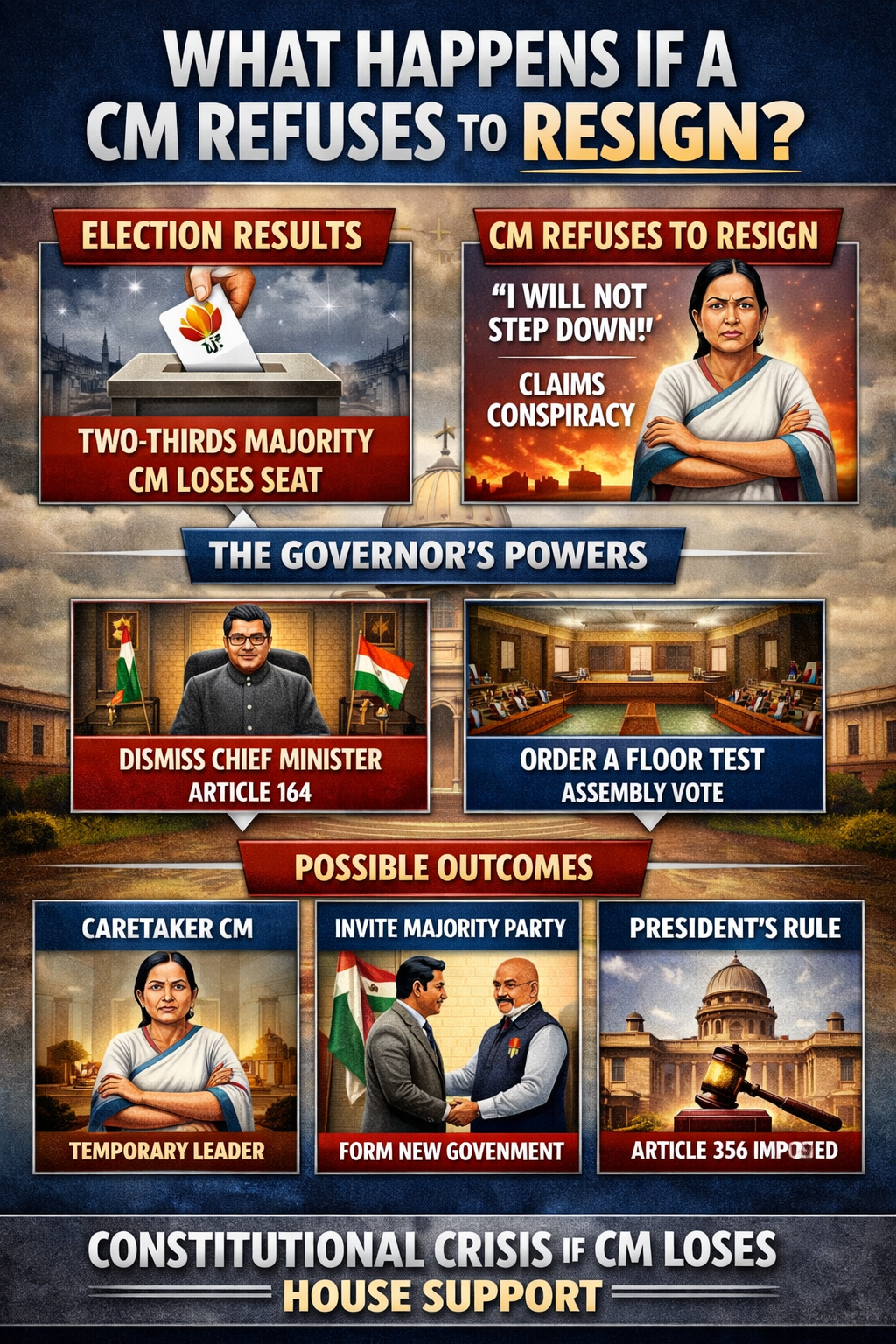
Calling the outcome a “conspiracy,” she insists that TMC has “morally won” and plans consultations with INDIA bloc allies, alongside a possible legal challenge.
Politically, this stance signals resistance and attempts to retain narrative control — but constitutionally, the situation is far less flexible.
The Constitutional Position: Majority Is Non-Negotiable
The Indian Constitution leaves little ambiguity here.
Under Article 164, the Chief Minister holds office only as long as they enjoy the confidence of the Legislative Assembly.
In practical terms:
- Losing majority = losing the legal basis to continue as CM
- Personal refusal does not override legislative arithmetic
The principle of collective responsibility ensures that the executive derives legitimacy strictly from the elected House — not from political claims or moral arguments.
Governor’s Role: निर्णायक Moment
The responsibility now shifts to the Governor of West Bengal.
Key Constitutional Options:
- Call for a Floor Test
If any ambiguity exists, the Governor may direct the CM to prove majority on the Assembly floor. - Dismiss the Government
If the loss of majority is evident (as in a clear election verdict), the Governor can withdraw recognition. - Invite Majority Party to Form Government
The BJP, with a decisive mandate, will be invited to stake claim.
This process has precedent across Indian states and is designed to ensure continuity without constitutional vacuum.
Caretaker Convention: What Should Happen Ideally
By established parliamentary convention:
- Mamata Banerjee should tender her resignation
- She may continue as a caretaker Chief Minister until the new government is sworn in
This caretaker phase is limited strictly to routine governance — no major policy decisions are expected.
Refusal to follow this norm does not create a constitutional crisis immediately, but it accelerates gubernatorial intervention.
What Happens Next: Likely Timeline
Step-by-Step Scenario:
1. Election Results Declared
BJP secures majority; TMC reduced significantly.
2. CM Refuses to Resign
Political messaging intensifies; allegations raised.
3. Governor Acts
- May seek resignation or call for floor test
- If non-compliance continues, may dismiss government
4. BJP Invited to Form Government
New Chief Minister elected by BJP legislative party.
5. Swearing-in Ceremony
Reports suggest a possible ceremony around May 9, symbolically aligned with Rabindranath Tagore’s birth anniversary.
Is President’s Rule (Article 356) Likely?
President’s Rule under Article 356 is typically a last resort.
It may come into play only if:
- No party can form a stable government
- Constitutional machinery is deemed to have failed
Given BJP’s clear majority, this scenario is highly unlikely unless unforeseen legal complications arise.
Political vs Constitutional Reality
🔹 For TMC:
Mamata’s refusal is largely symbolic and strategic:
- Signals resistance to BJP’s rise
- Helps consolidate core support base
- Buys time for legal and political recalibration
🔹 For BJP:
The path is procedurally clear:
- Majority ensures automatic claim to government formation
- Transition likely to proceed irrespective of TMC’s stance
🔹 For Governance:
India’s constitutional framework is designed for orderly transitions.
Even in high-voltage political situations, institutional mechanisms ensure continuity.
Key Takeaway
Mamata Banerjee’s refusal to resign is politically expressive but constitutionally untenable.
The Constitution does not accommodate subjective claims of a “moral victory” — only demonstrable legislative majority counts. The Governor is expected to act in line with this principle, paving the way for the BJP to form the next government in West Bengal.