Why Kashmiri Weddings Cost So Much
By: Javid Amin | 08 September 2026
A gold set here, an extra hundred guests there, a wazwan spread built to be talked about for years — in the Kashmir Valley, weddings have quietly become a currency of their own. The question worth asking isn’t how much families are spending. It’s what, exactly, they think they’re buying.
Every wedding season in Kashmir produces the same whispered arithmetic. Someone’s cousin heard that a family in Batamaloo spent close to a crore. Someone’s neighbour compares gold sets over tea. Somewhere in Baramulla or Anantnag, a father quietly takes out a loan he’ll spend the next several years repaying — not because he can’t say no to tradition, but because he’s afraid of what people will say if he does.
Ask any of these families why, and the answer arrives instantly: yim chu riwaaj — this is our custom. It’s a phrase that shuts down further questions almost by design. But sit with it for a moment, and a second, quieter sentence often sits just underneath it: if we do less, people will talk. That isn’t tradition speaking. That’s reputation, wearing tradition’s clothes.
What the Numbers Actually Say
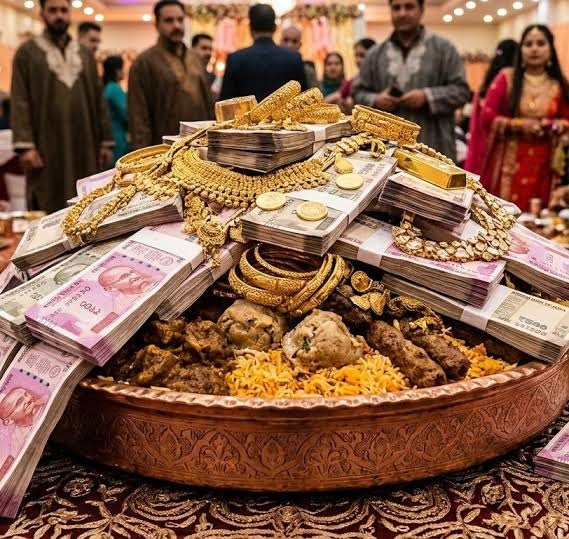
Kashmir’s wedding economy is not a rumour — it’s documented, and it has been rising for years. A detailed cost breakdown published by the Kashmir-focused outlet Gyawun in late 2025 found that what used to be a modest, tradition-rooted celebration has, for many middle-class families, become “a display of status and spending power,” with costs for an ordinary household now routinely touching a crore once gold, venue, multi-day feasting, and guest hospitality are added up. That’s not the ultra-wealthy end of the spectrum — that’s the middle-class Kashmiri family the essay’s imagined ₹2.25 crore case would sit well above.
The scale problem got serious enough, in fact, that the Jammu and Kashmir government stepped in over it. In 2017, facing mounting public complaints about extravagance and food waste at weddings, the administration placed formal legal limits on Kashmiri wedding size — capping guest lists at 500 from the bride’s side and 400 from the groom’s, and restricting the meal itself to no more than seven main dishes. A government does not legislate the size of a dinner party unless the problem has stopped being a private matter and started being a public one.
And there is already a documented counter-movement. Small communities across North Kashmir have begun promoting fixed-cost weddings, some capping total spending at as little as ₹2 lakh, explicitly inspired by Islamic teachings that favour simple nikah ceremonies over lavish display. That these initiatives exist — and are newsworthy enough to be reported on — tells you the extravagance isn’t universally accepted as sacred. Plenty of Kashmiris already suspect something has gone sideways; they’ve just been waiting for permission to say so out loud.
Riwaaj Is the Alibi. Izzat Is the Ledger.
Here’s the distinction worth sitting with: culture and social signalling can look identical from the outside while running on completely different fuel. Wazwan is genuinely Kashmiri culture — a centuries-old cuisine, cooked by wazas in enormous degs, built around hospitality as an almost sacred duty. The instinct to make this wazwan more elaborate than the one two streets over is something else entirely. Gold has a legitimate, long-standing place in a Kashmiri bride’s trousseau. Gold worn specifically to signal a family’s financial standing to the room is no longer ornament — it’s a balance sheet, worn on the body. Inviting extended family and neighbours is collective Kashmiri life, exactly as it should be. Padding the guest list because leaving someone off might generate gossip is not hospitality. It’s insurance against being talked about.
Sociologists have a term for spending built primarily to be seen rather than to be enjoyed: conspicuous consumption, a concept identified more than a century ago by the economist Thorstein Veblen, who observed that in tightly networked communities, visible spending becomes a way of communicating status precisely because everyone is watching everyone else. Kashmir’s social fabric is about as tightly networked as it gets — families know families, neighbourhoods track neighbourhoods, professional and social circles overlap constantly. A wedding here was never going to stay a private affair. It’s a public announcement, whether the hosting family intended it that way or not.
How Yesterday’s Extravagance Becomes Today’s “Normal”
This is where the trouble compounds. One family raises the bar — a bigger wazwan, heavier gold, a longer guest list. A second family, watching, feels the pressure to at least match it, not exceed it, just avoid falling short. A third family, worried about being remembered as the stingy ones, goes slightly further still. Multiply that across a wedding season, repeat it for a few years, and what used to be considered lavish quietly becomes the baseline — what everyone expects, and eventually, what people misremember as tradition itself. Call it cultural inflation: a ratchet that only turns one direction, because nobody wants to be the family that turns it back.
The uncomfortable part is that almost nobody in this cycle is acting irrationally. Each individual family is responding sensibly to a real, local social cost — actual gossip, actual judgment, a genuine risk to the family’s standing in a community where everyone really is watching. The irrationality lives at the level of the system, not the individual decision. That’s precisely what makes it so hard to opt out of alone.
What Islam Actually Says About Weddings Like This
This is where the “riwaaj” defence runs into its biggest problem: the faith Kashmiris say they’re honouring through these customs takes a strikingly different position on the subject. Islamic teaching doesn’t merely tolerate a modest wedding — it actively favours one. A well-known narration from Aisha (RA), preserved in al-Bayhaqi’s Shu’ab al-Iman, has the Prophet Muhammad (peace be upon him) stating that the most blessed marriage is the one that carries the least financial burden. Multiple hadith collections repeat the same theme in different words: ease and affordability in marriage are treated as a source of baraka — blessing — not a compromise to be tolerated only by families who can’t afford better.
The Prophet’s own conduct is often cited as the clearest illustration of this principle. Accounts of his walima — the celebratory feast held after a marriage — describe remarkably plain meals: dates, dried yogurt and butter on a leather sheet for one union; simple fare with neither elaborate meat dishes nor extensive courses for another. This was not a man without means or standing in his community; it was a deliberate choice about what a wedding celebration is actually for.
The Quran goes further, addressing extravagance as a moral failing in its own right, not just a wedding-specific concern. Verses warn against israf — wasteful excess — with one widely cited passage instructing believers to “eat and drink, but waste not by excess; verily He loves not the wasters” (Quran 6:141). Islamic scholarship treats israf, along with the related concept of tabzir (squandering wealth), as a serious matter — the term appears dozens of times across the Quran, hardly incidental phrasing. Scholars responding to questions about wedding spending consistently draw the same line: feeding guests generously is encouraged and rewarded; feeding them lavishly in order to be seen doing so shifts the same act from hospitality into the territory of a “grave sin,” because the intention behind the spending is what Islamic ethics actually evaluates — not the price tag alone.
Set against that backdrop, a great deal of what gets defended in Kashmir as riwaaj looks less like religious observance and more like the very excess the tradition was built to guard against. The dowry-adjacent gift-giving, the guest-list padding, the gold worn as a statement rather than an adornment — none of it draws support from the faith being invoked to justify it. If anything, the North Kashmir communities now capping wedding costs at a few lakh rupees are arguably closer to the Prophetic model than the crore-plus celebrations they’re quietly pushing back against.
What a Crore Actually Buys, When It Isn’t Spent on a Wedding
The core question isn’t really whether a lavish wedding is a large expense — obviously it is. It’s what that spending displaces. A family with genuine wealth, no debt, and its responsibilities already met can choose extravagance without doing itself financial harm; that’s simply a spending preference, not a crisis. The picture changes entirely the moment the motive shifts from celebration to comparison — the moment “we spent one crore, so we’ll spend two” becomes the actual logic in the room. At that point, families are frequently borrowing, liquidating savings, or dipping into funds earmarked for a child’s education or a parent’s medical needs, in service of a single day’s spectacle.
That money, redirected, does concrete things: it buys a home, funds a degree, seeds a small business, cushions ageing parents, builds the kind of financial independence that actually determines whether a new household thrives. None of this argues for a joyless, minimal wedding — celebration has real emotional and cultural value, and nobody sensible is proposing Kashmiris strip that away. The argument is narrower: there’s a meaningful difference between celebrating prosperity you already have, and spending down decades of it in three days to appear as though you do.
A Different Question Worth Asking
Kashmiri culture has weathered real hardship over the decades precisely because it holds onto its traditions with unusual seriousness. That’s a strength — but it’s also exactly why the culture can, occasionally, examine its own customs without being accused of abandoning them. A society doesn’t dishonour its traditions by asking whether some of what it now calls tradition was actually invented within living memory, under social pressure nobody consciously chose.
Here’s a version of the thought experiment worth sitting with honestly: if no photograph left the room, no video circulated on WhatsApp, no neighbour could ever compare notes on the cost — would the spending look the same? For the parts of a Kashmiri wedding that are genuinely cultural — the nikah, the family gathering, the wazwan shared among relatives — the answer is almost certainly yes; those things exist even in the absence of an audience. For the parts driven by izzat, the honest answer is very often no. That gap between the two answers is, in effect, a rough estimate of how much of the modern Kashmiri wedding bill belongs to culture, and how much belongs to being seen.
Maybe the better long-term measure of a Kashmiri wedding was never its cost at all. Maybe it’s a much duller, much harder question: how is the marriage doing twenty years later — the household it built, the debts it did or didn’t carry into its first decade, the children it educated instead of impressed. Somewhere along the way, in Kashmir as in much of India, the opening ceremony of a marriage began quietly competing with the marriage itself for attention and resources. The fixed-cost wedding movements already spreading through North Kashmir suggest at least some families have noticed — and are choosing, deliberately, to stop keeping score.