NC Clarifies Mirwaiz Invitation, Says Delhi Protest Is Solely About J&K Statehood
By: Javid Amin | 10 July 2026
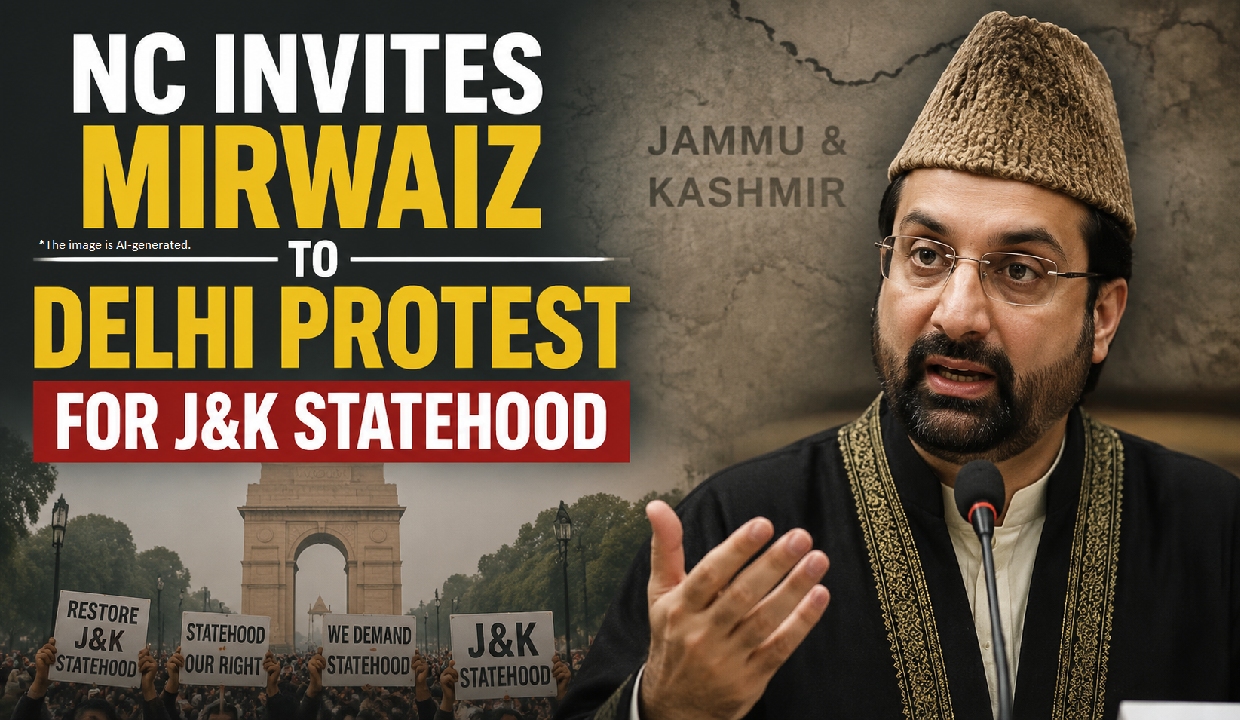
The National Conference (NC) has sought to clarify its decision to invite Mirwaiz Umar Farooq to its upcoming protest in New Delhi, saying the invitation should not be interpreted as a political endorsement but as part of a broader outreach to civil society and influential public voices.
The clarification comes after the invitation triggered political reactions across Jammu and Kashmir, with rival parties questioning the party’s decision and accusing it of sending mixed political signals.
Responding to the criticism, NC leaders maintained that the proposed demonstration has only one objective—the restoration of Jammu and Kashmir’s statehood—and is unrelated to any other political agenda.
Why the Invitation Triggered Political Debate
The invitation to Mirwaiz Umar Farooq quickly became the focus of political discussion because of the symbolic significance attached to his participation in Kashmir’s public life.
Opposition leaders questioned whether inviting a prominent religious and socio-political figure could blur the distinction between the National Conference’s constitutional campaign for statehood and other political narratives in the region.
The controversy shifted attention away from the planned protest itself and towards the broader political messaging surrounding the event.
NC: Invitation Was Part of Wider Civil Society Outreach
Seeking to contain the controversy, the National Conference explained that invitations had been extended to a broad spectrum of political leaders, social organisations, religious personalities and members of civil society.
According to the party, the objective is to demonstrate that the demand for restoring Jammu and Kashmir’s statehood enjoys support beyond party politics.
NC leaders stressed that the invitation was intended to broaden participation in a democratic campaign rather than signal any change in the party’s political position.
The party reiterated that its constitutional and democratic approach remains unchanged and that the protest is centred exclusively on seeking the restoration of statehood.
Statehood Remains the Core Demand
The National Conference has consistently maintained that the proposed protest in New Delhi is intended to press the Union Government to fulfil its commitment to restore Jammu and Kashmir’s statehood.
Party leaders argue that the issue transcends political rivalries and concerns governance, democratic representation and the constitutional status of the Union Territory.
According to the NC, bringing together political parties, civil society representatives and other public figures is aimed at demonstrating the breadth of support for this demand.
Civil Society Participation: A Strategy to Broaden the Campaign
Political movements in Jammu and Kashmir have often sought support from civil society groups, trade bodies, religious leaders, academics and social organisations to strengthen public outreach.
The National Conference argues that wider participation can:
Increase Public Engagement
Including respected community voices may encourage broader public discussion on governance issues.
Demonstrate Wider Support
The party believes participation beyond political circles reflects that the statehood demand resonates across different sections of society.
Build Democratic Legitimacy
According to the NC, involving diverse stakeholders reinforces that the campaign is rooted in constitutional and democratic processes.
Critics, however, argue that such outreach can invite political controversy depending on the individuals involved.
Political Reactions Continue
The clarification has not fully ended the political debate.
Opposition parties continue to question the optics of the invitation, arguing that political messaging is as important as the stated objective of the protest.
The issue has become another point of contention in the increasingly competitive political landscape of Jammu and Kashmir, where parties are seeking to shape public opinion ahead of future political developments.
Supporters of the NC, meanwhile, argue that engaging with a broad cross-section of society should not be viewed as inconsistent with the party’s constitutional demand for statehood.
The Larger Political Context
The controversy comes at a time when Jammu and Kashmir’s political discourse is increasingly centred on constitutional and governance issues.
Alongside debates over employment, recruitment policies and development, the restoration of statehood remains one of the most prominent demands raised by several mainstream political parties.
The proposed Delhi protest is expected to serve as a platform for highlighting these concerns before the national leadership.
Whether the controversy surrounding the invitation affects participation or shifts the focus of the campaign remains to be seen.
What Lies Ahead?
As preparations for the Delhi protest continue, the National Conference faces the challenge of keeping public attention focused on its primary objective—the restoration of Jammu and Kashmir’s statehood.
The party’s clarification indicates an effort to balance inclusive public outreach with the political sensitivities surrounding Kashmir’s complex landscape.
For supporters, the protest represents an opportunity to press for constitutional and political rights.
For critics, the invitation has raised questions about political messaging and strategic choices.
Regardless of differing political interpretations, the episode highlights the continuing significance of symbolism, alliances and public perception in Jammu and Kashmir’s evolving political discourse.