‘Bulldozers Won’t Cure Addiction’: Sakina Itoo Challenges J&K’s Demolition Policy
By: Javid Amin | 08 May 2026
A sharp debate is emerging in Jammu and Kashmir over the government’s controversial demolition drives targeting properties linked to alleged drug peddlers.
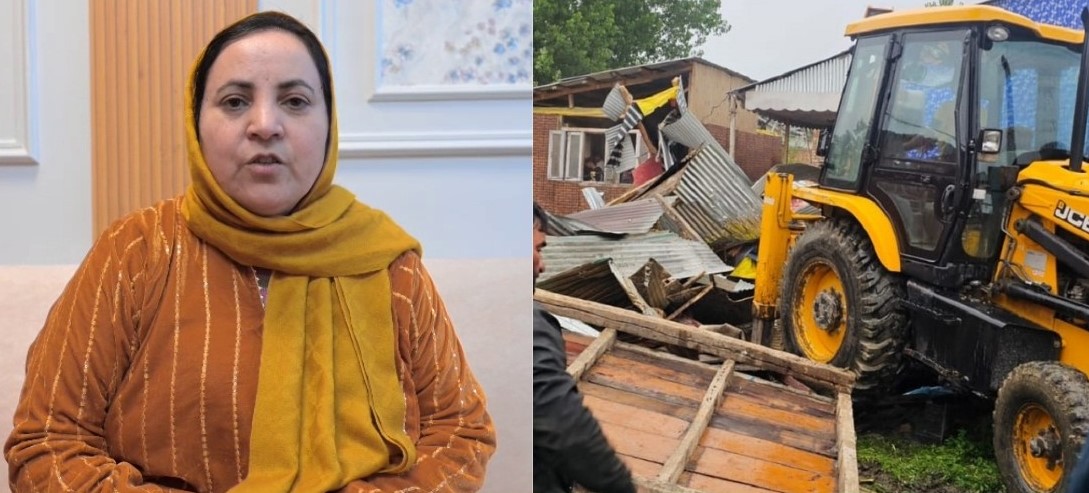
Senior leader Sakina Itoo has openly criticized the policy, arguing that bulldozing family homes is “wrong and counterproductive” and warning that such actions punish entire households rather than addressing the root causes of addiction and drug trafficking.
Her remarks have added momentum to a growing conversation in Kashmir about whether the region’s escalating drug crisis should be treated primarily as a law-and-order issue or as a public health and social challenge.
Sakina Itoo’s Core Argument: ‘Punishment Cannot Replace Rehabilitation’
Sakina Itoo’s criticism centers on one fundamental point:
Demolition drives may create fear, but they do not solve addiction.
According to her:
- Destroying homes affects innocent family members, including women, children, and the elderly
- Entire households face displacement, stigma, and financial collapse
- Punitive action weakens social structures instead of strengthening them
She argues that the government should prioritize:
- counseling programs,
- rehabilitation centers,
- awareness campaigns, and
- community-based intervention.
Her framing shifts the conversation away from punishment and toward human recovery and reintegration.
Kashmir’s Growing Drug Crisis: A Public Health Emergency?
The debate comes against the backdrop of an alarming rise in drug addiction across Jammu and Kashmir.
Key Concerns Often Highlighted
- Large numbers of young people affected, especially in the 16–35 age group
- Increasing use of narcotics among students and unemployed youth
- Families struggling silently with addiction-related trauma
The crisis has evolved from isolated incidents into a broader social concern involving:
- unemployment,
- psychological stress,
- peer pressure, and
- economic uncertainty.
This is why many health experts and social workers increasingly argue that addiction should be approached as:
a medical and psychological issue, not only a criminal one.
Bulldozer Policy Under Scrutiny
Recent demolition drives targeting homes allegedly linked to drug peddlers have triggered intense public and political reactions.
Critics say the policy:
- creates collective punishment,
- bypasses due process concerns in public perception, and
- fuels fear rather than rehabilitation.
Supporters of the crackdown, however, argue that strong measures are necessary to dismantle drug networks and send a deterrent message.
The controversy has now expanded beyond law enforcement into questions of:
- governance,
- fairness, and
- regional treatment.
Jammu vs Kashmir: Allegations of Unequal Enforcement
One of the most sensitive aspects of the debate is the perception of unequal implementation across regions.
In Kashmir
Critics allege:
- More frequent demolition of residential homes
- Families displaced without rehabilitation support
- Actions perceived as harsher and more visible
In Jammu
Opposition voices claim:
- Enforcement appears more administrative than punitive
- Greater use of notices, fines, and procedural penalties
- Fewer demolitions of family residences
This perceived imbalance has fueled allegations of:
selective enforcement and regional bias.
While authorities have defended their actions as legally justified, the contrast in public perception remains politically significant.
Governance Debate: Optics vs Long-Term Solutions
The demolition controversy has opened a larger debate about governance priorities in Jammu and Kashmir.
Critics Ask:
- Are bulldozer actions solving the drug problem—or merely creating headlines?
- Why are rehabilitation centers underfunded if addiction is truly the concern?
- Can fear-based enforcement produce sustainable recovery?
Opposition leaders, including Sakina Itoo and Mehbooba Mufti, increasingly frame demolition drives as:
- symbolic politics,
- diversionary tactics, or
- governance optics.
Alternative Model: Counseling & Reintegration
Experts advocating a health-first approach often recommend:
1. Counseling & Mental Health Support
Addiction recovery requires:
- psychological care,
- family counseling, and
- long-term therapy.
2. Rehabilitation Centers
Accessible, properly funded rehab infrastructure remains limited in many parts of J&K.
3. Skill Development & Employment
Vocational training and economic reintegration are considered crucial in preventing relapse.
4. Community Awareness
Grassroots campaigns involving:
- schools,
- mosques,
- families, and
- civil society groups
can help reduce stigma and early exposure.
Policy Clash: Punishment vs Rehabilitation
| Approach | Bulldozer Policy | Rehabilitation Model |
|---|---|---|
| Objective | Fear & deterrence | Recovery & reintegration |
| Impact on Families | Displacement & stigma | Support & stabilization |
| Public Perception | Punitive | Human-centric |
| Long-Term Outcome | Uncertain | Potentially sustainable |
Political Implications
For the Government
- Faces criticism over selective enforcement and due process concerns
- Must justify demolitions as effective anti-drug strategy
For Opposition Parties
- Opportunity to project themselves as defenders of civil rights and social justice
- Strong emotional resonance among affected communities
For Society
- Deepens debate over how Kashmir should address addiction:
- through punishment,
- rehabilitation, or
- a balanced mix of both.
Conclusion: Can Bulldozers Solve a Social Crisis?
Sakina Itoo’s remarks have tapped into a growing unease across Jammu and Kashmir:
whether the region’s drug crisis is being addressed with policy depth—or political spectacle.
Her argument is simple but powerful:
Addiction destroys lives, but collective punishment may destroy families too.
As the debate intensifies, the real challenge before policymakers is not just controlling narcotics networks—it is building a strategy that combines:
- law enforcement,
- rehabilitation,
- mental health support, and
- social healing.
Because in the long run, experts say, fear may suppress symptoms—but only rehabilitation can rebuild lives.