Vande Mataram Row in Kashmir: Religious Body Objects to Waqf Event Rendition, Clerics Express Regret
By: Javid Amin | November 25, 2026
Mutahida Majlis-e-Ulama questions the playing of the national song at a Srinagar Waqf Day ceremony; controversy brings religious freedom, national identity and the role of public institutions into focus.
Srinagar: A controversy over the playing of Vande Mataram at a Jammu and Kashmir Waqf Board function in Srinagar has opened a fresh debate over religious sensitivities, national symbols and the responsibilities of public institutions in a religiously diverse country.
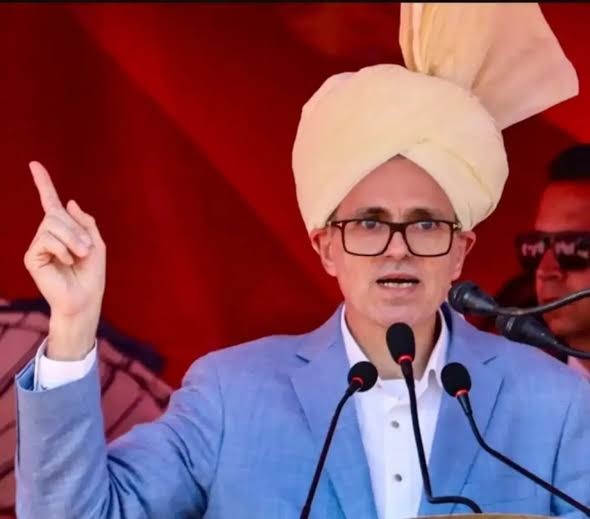
The objection has come from the Mutahida Majlis-e-Ulama (MMU), a conglomerate of religious organisations and institutions representing different schools of Islamic thought in Jammu and Kashmir, headed by Kashmir’s chief cleric Mirwaiz Umar Farooq.
The organisation has described the rendition of Vande Mataram at the Waqf Day ceremony as “unacceptable”, arguing that its religious interpretation conflicts with the Islamic principle of Tawheed, which emphasises the absolute Oneness of Allah.
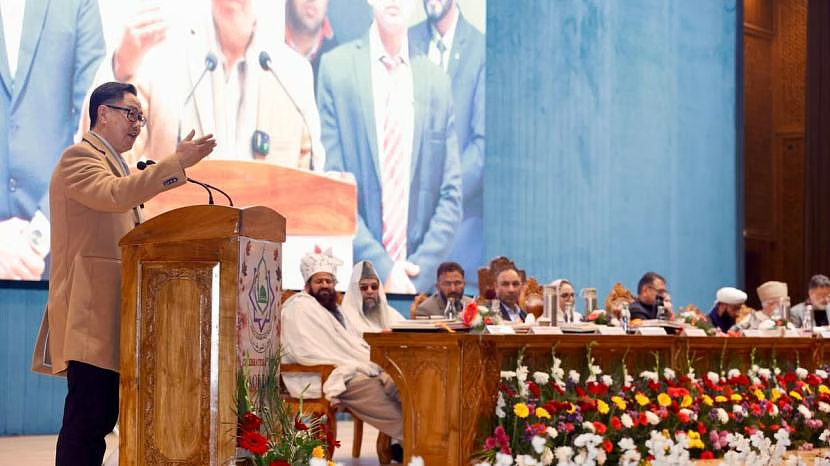
The controversy concerns an event organised by the Jammu and Kashmir Waqf Board on November 23 at the Convention Centre of Sher-e-Kashmir University of Agricultural Sciences and Technology of Kashmir (SKUAST-K), where the national song was played in the presence of Union Minority Affairs Minister Kiren Rijiju, Waqf Board Chairperson Darakhshan Andrabi, Lok Sabha MP Mian Altaf Ahmad and other dignitaries.
The issue has since widened beyond the original objection. Several clerics who attended the ceremony have expressed regret over their participation, while the MMU has indicated that it is considering legal opinion and intends to submit a formal representation to the authorities.
At the centre of the dispute is a question with wider implications for Jammu and Kashmir: how should public institutions accommodate national expressions while respecting the religious convictions of the communities they serve?
What happened at the Srinagar Waqf Day ceremony?
The controversy originated at the first Waqf Day celebrations organised by the Jammu and Kashmir Waqf Board on Monday, November 23, at SKUAST-K’s Convention Centre in Srinagar.
The ceremony brought together government representatives, political leaders and religious personalities. Union Minority Affairs Minister Kiren Rijiju attended as the chief guest, while Darakhshan Andrabi, chairperson of the J&K Waqf Board, hosted the programme.
National Conference Lok Sabha MP Mian Altaf Ahmad, Shia religious leader Imran Ansari and other clerics were also among those present.
During the proceedings, Vande Mataram was played, with reports confirming that all six stanzas of the composition were rendered.
The presence of religious personalities during the rendition subsequently became a separate source of controversy.
Videos of the ceremony circulated on social media, attracting criticism from sections of the religious community. The discussion was no longer limited to the decision to play the national song; it also turned towards the conduct of clerics who stood during its rendition.
On Wednesday, November 25, a group of clerics who had attended the programme issued a video statement expressing regret over their participation. They said their presence at the gathering should not be interpreted as an endorsement of the song and sought forgiveness if their participation had hurt religious sentiments.
The episode added another layer to an already sensitive debate, bringing questions about religious representation, public conduct and the responsibilities of religious leaders into the discussion.
Why has the Mutahida Majlis-e-Ulama objected?
The MMU’s objection is based primarily on the Islamic concept of Tawheed.
In Islamic theology, Tawheed represents the absolute Oneness of Allah. It rejects the attribution of divine qualities or worship to any person, object, creation or entity other than God.
The organisation argues that the religious imagery associated with certain portions of Vande Mataram creates a conflict with this fundamental belief.
Its statement makes an important distinction: Muslims can love their homeland, respect its people and contribute to its development without accepting religious expressions that they interpret as attributing divinity to the motherland.
The MMU has therefore argued that patriotism and religious worship should not be treated as interchangeable concepts.
Its objection has a specific institutional dimension as well.
The organisation has questioned why a song that it considers religiously objectionable was included in a programme organised by the Waqf Board itself.
Waqf institutions are responsible for administering Muslim religious endowments and associated properties. In Jammu and Kashmir, the Board oversees a significant network of religious and charitable assets.
The MMU believes that an institution entrusted with safeguarding these endowments should exercise particular sensitivity towards the religious beliefs of the community it serves.
In its November 25 statement, the organisation described the rendition as deeply regrettable and said it was considering legal opinion on the matter.
It also announced plans to submit a formal representation to the authorities, seeking an end to what it calls the forced inclusion of Vande Mataram at government functions, educational institutions and other public events in Jammu and Kashmir.
The organisation has further referred to the position of the All India Muslim Personal Law Board (AIMPLB), which has opposed compulsory rendition of the song on religious and constitutional grounds.
Vande Mataram: Why the full six-stanza version has become controversial
To understand the current dispute, it is important to look beyond the Srinagar event and examine the historical composition of Vande Mataram.
Written by Bankim Chandra Chattopadhyay, the song was first published in the literary journal Bangadarshan on November 7, 1875. It was subsequently incorporated into his Bengali novel Anandamath, published in 1882.
The composition became an important symbol of India’s freedom movement, particularly during the Swadeshi movement against the partition of Bengal in 1905.
Rabindranath Tagore famously sang it at the 1896 session of the Indian National Congress in Calcutta.
Following independence, the Constituent Assembly recognised Vande Mataram as India’s National Song. On January 24, 1950, its President, Dr Rajendra Prasad, stated that the song would be honoured equally with Jana Gana Mana, while the latter would serve as the National Anthem.
The religious imagery behind the objections
The debate over Vande Mataram is not new.
The composition personifies the motherland through powerful imagery. While its opening portions describe the country’s natural beauty, prosperity and abundance, later stanzas contain explicit references to Hindu goddesses, including Durga.
This distinction has historically influenced the debate over which portions should be rendered at public and official gatherings.
The first two stanzas have traditionally been used in many public settings. The remaining portions, particularly those containing religious imagery, have attracted objections from sections of Muslim organisations and other groups.
For critics, the issue is not necessarily the expression of affection for India. It is the religious language through which the motherland is represented.
For supporters, the song represents a historical expression of resistance to colonial rule and national identity, and its broader patriotic significance should not be reduced to a single religious interpretation.
This difference in interpretation explains why the same composition can carry different meanings for different communities.
Why the Centre’s 2026 Vande Mataram protocol matters
The Srinagar controversy has also emerged against a changing national policy environment surrounding the rendition of Vande Mataram.
In January 2026, the Union Ministry of Home Affairs issued a detailed protocol concerning the playing and singing of the National Song at specified government and public functions.
The guidelines identify the official version as comprising all six stanzas, with an approximate duration of three minutes and ten seconds.
The protocol specifies occasions including:
-
Civil investiture ceremonies.
-
The arrival and departure of the President at formal State functions and other government-organised events.
-
The arrival and departure of Governors and Lieutenant Governors at formal State functions.
-
The bringing of the National Flag onto a parade.
-
Certain other occasions as directed by the Government of India.
It also provides for mass singing on specified ceremonial occasions and advises schools to begin the day with community singing.
Where the National Song and National Anthem are both rendered at an event, the guidelines place Vande Mataram first, followed by Jana Gana Mana.
The protocol further specifies that audiences should stand to attention when the official version is played or sung, subject to the stated exceptions.
These provisions are important because they establish a formal national framework for the rendition of the song. However, the guidelines identify particular occasions and should not automatically be interpreted as making its rendition compulsory at every government or religious function.
The Waqf Day controversy raises precisely this question: what was the administrative basis for including the song in this particular ceremony, and under which provision was the decision taken?
The Ministry of Home Affairs’ July 2026 order and the government’s subsequent communications provide the relevant policy background. The specific applicability of the protocol to the Srinagar programme, however, requires clarification from the organisers or competent authorities.
The 2026 amendment: What does the law actually say?
Another important development is the Prevention of Insults to National Honour (Amendment) Act, 2026.
The amendment, enacted on August 6, 2026, extended statutory protection under Section 3 of the 1971 Act to the National Song, Vande Mataram, alongside the National Anthem.
Under the amended provision, intentionally preventing the singing of either the National Anthem or the National Song, or causing disturbance to an assembly engaged in such singing, is punishable with imprisonment of up to three years, a fine, or both.
The legislation gives Vande Mataram the same specific statutory protection against deliberate obstruction that previously applied to the National Anthem.
However, an important legal distinction must be maintained.
The amendment does not, by itself, make every individual legally bound to sing Vande Mataram or establish a universal requirement to participate in its rendition at every public event.
Its stated criminal provision concerns intentionally preventing the singing or disturbing an assembly engaged in it. The question of compulsory participation, religious conscience and the applicability of particular government protocols involves separate legal considerations.
The distinction is essential to understanding the current controversy. An objection to the inclusion of a song in a programme, a decision not to sing it and an act of deliberately disrupting its rendition are not automatically the same legal conduct.
Religious freedom and national identity: What does the Constitution provide?
The controversy also raises an important constitutional question concerning freedom of conscience and religious expression.
Article 25 of the Indian Constitution guarantees every person the freedom of conscience and the right to profess, practise and propagate religion, subject to public order, morality, health and other constitutional provisions.
Article 19(1)(a), meanwhile, protects freedom of speech and expression.
These provisions are relevant when examining whether participation in a particular national or religious expression can be compelled despite a genuine conscientious objection.
An important judicial precedent in this regard is the Supreme Court’s 1986 judgment in Bijoe Emmanuel v. State of Kerala.
The case involved three schoolchildren belonging to the Jehovah’s Witnesses faith who declined to sing the National Anthem because of their religious convictions. They nevertheless stood respectfully when it was played.
The Supreme Court ruled in their favour, holding that their expulsion from school violated their fundamental rights under Articles 19(1)(a) and 25(1).
The Court also distinguished between refusing to sing and deliberately disrupting the singing.
There is, however, an important qualification when applying this judgment to the present controversy.
The 1986 ruling concerned the National Anthem and a particular set of facts. It should not be presented as a direct judicial ruling on every question involving Vande Mataram, particularly after Parliament’s 2026 amendment.
Nevertheless, the judgment remains an important constitutional reference when discussing freedom of conscience and the distinction between respectful non-participation and deliberate disruption.
The broader constitutional challenge is to ensure that national symbols are respected without treating genuine differences of religious belief as hostility towards the country.
Waqf Board under scrutiny: Why the organisers’ explanation matters
One of the most significant unanswered questions concerns the decision-making process behind the inclusion of Vande Mataram in the Srinagar ceremony.
The programme was organised by the Jammu and Kashmir Waqf Board, an institution responsible for managing religious endowments and associated assets.
Its participation in a national-level public celebration is not, in itself, unusual. Waqf institutions operate within the country’s legal and administrative framework, and their activities can involve government representatives and public officials.
However, the religious character of the institution makes the choice of ceremonial elements particularly relevant.
The MMU’s criticism is directed not simply at the playing of a national song but at the decision to include it in a programme organised by an institution primarily associated with Muslim religious endowments.
This raises several legitimate questions:
-
Was the rendition included as part of a centrally communicated programme or protocol?
-
Was the full six-stanza version specifically selected by the organisers?
-
Were the religious representatives attending the ceremony informed about the programme beforehand?
-
Was any consideration given to the concerns of participating religious personalities?
-
Has the Waqf Board formally explained the decision following the controversy?
As of November 26, no detailed public clarification from the Waqf Board addressing these specific objections has been established in the reports reviewed.
A response from the Board would help distinguish between a decision based on official protocol, an independent programme choice or another administrative consideration.
That explanation is important because the controversy should not be allowed to rest entirely on competing interpretations of the event.
Kashmir’s political and social landscape adds another dimension
In Jammu and Kashmir, debates involving religious identity, constitutional rights and national symbols frequently acquire a wider political significance.
The region’s political history, religious composition and relationship with the Union government make such issues particularly sensitive.
The current controversy has emerged at a time when the Union government is promoting a more formalised ceremonial framework for Vande Mataram, while sections of the Valley’s religious leadership are raising objections to its full rendition.
The two positions are not necessarily debating the same question.
For supporters of the national song, its historical role in India’s freedom movement and its recognition as the National Song provide sufficient reasons for its inclusion in public ceremonies.
For the MMU, the concern is about religious interpretation, freedom of conscience and the limits of institutional authority when dealing with communities holding distinct religious convictions.
The presence of prominent political and religious personalities at the Srinagar event has further increased public interest.
However, it would be premature to assume that the MMU’s position represents every Muslim in Jammu and Kashmir or that all participants at the ceremony share the same interpretation.
The reactions themselves demonstrate differences within the wider religious community.
The clerics who expressed regret over attending the programme, those who stood during the rendition and the organisation’s subsequent statement represent distinct responses to the same event.
Recognising these differences is essential to understanding the controversy without reducing it to a simplistic religious-versus-national debate.
Beyond the Vande Mataram controversy: Kashmir’s everyday concerns remain
The debate has also revived a familiar question about the priorities of public discourse in Jammu and Kashmir.
While religious identity and national symbols are important subjects of public discussion, the region continues to face several pressing socio-economic challenges.
Unemployment, recruitment controversies, rising household expenditure, educational costs, healthcare access, environmental degradation and limited economic opportunities remain significant concerns for ordinary families.
The controversy surrounding the Waqf Day ceremony has generated considerable attention within a short period. However, the administration’s broader responsibilities extend well beyond managing disputes over ceremonial decisions.
The Waqf Board itself faces important questions concerning the management of religious properties, transparency, public accountability and the effective use of institutional resources.
These issues deserve sustained attention alongside discussions about religious sensitivities and national identity.
A constructive public debate should not require choosing between respect for national symbols and protection of religious freedom. Both are important elements of India’s constitutional and democratic framework.
What happens next?
The immediate next step is likely to be the formal representation that the MMU has indicated it intends to submit to the authorities.
The organisation is also considering legal opinion on the matter.
The response of the Jammu and Kashmir Waqf Board and the relevant government departments will be important in determining whether the controversy remains a public disagreement or develops into a formal administrative or legal dispute.
Three issues will require particular attention:
First, clarification of the event’s protocol: The authorities should explain the basis for including the full version of Vande Mataram in the Waqf Day programme.
Second, protection of religious freedom: Public institutions should clearly distinguish between respecting national symbols and compelling individuals to express religious or ideological agreement.
Third, institutional sensitivity: The Waqf Board and other public bodies should develop clear event protocols that account for their institutional responsibilities and the diverse beliefs of participants.
The controversy also presents an opportunity to clarify the difference between patriotism, religious conviction and constitutional obligation.
For Jammu and Kashmir, where questions of identity and belonging have long been part of public life, the handling of such issues carries significance beyond a single ceremony.
The real challenge is not whether national identity or religious belief should prevail over the other. It is whether public institutions can respect both without turning a ceremonial decision into another source of social division.