Kashmir’s Government Schools Go Door to Door, But Parents Want Better Classrooms
By: Javid Amin | 20 November 2026 | Srinagar – Kashmir
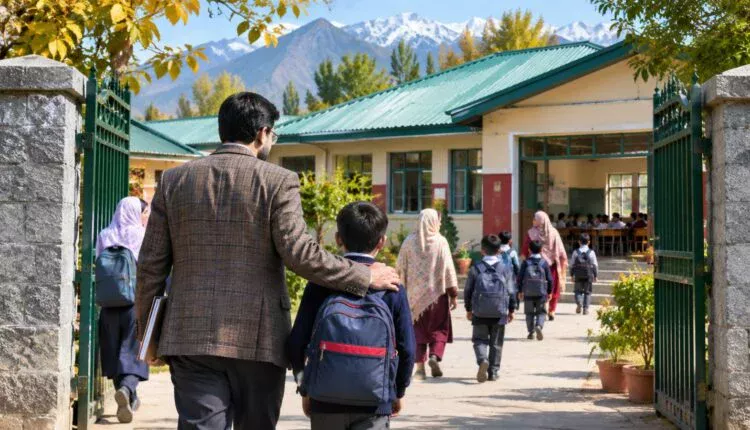
Government school teachers across Jammu and Kashmir are once again knocking on doors, organising rallies and meeting parents in an effort to persuade families to enrol their children in public institutions. The campaign is gathering momentum ahead of the next academic session, with education officials highlighting free textbooks, uniforms, scholarships, midday meals, digital learning facilities and qualified teaching staff.
In Pampore, the latest reported figures offer an encouraging start. Education Zone Pampore has recorded 138 fresh admissions, including 80 students who have shifted from private schools to government institutions. In Baramulla’s Singpora Kalan zone, officials have also reported large-scale admissions during a public enrolment event at Higher Secondary School Delina.
These developments suggest that government schools can still attract families. But a few encouraging local figures cannot, by themselves, reverse a much larger trend.
The School Education Department is facing a difficult question: Can it convince parents to return to government schools without first addressing the reasons many families moved away?
The answer will depend less on the number of rallies organised and more on what happens inside classrooms after the admissions are completed.
A campaign that goes beyond door-to-door admissions
The Directorate of School Education Kashmir launched a month-long enrolment campaign from November 2 to November 30, involving heads of institutions, teachers and field-level staff.
The exercise is not limited to persuading parents to shift their children from private schools. Officials have also been asked to identify children who have never enrolled, those who have dropped out and families whose children remain outside the formal education system.
According to the reported departmental instructions, education officials are conducting household surveys, updating Village Education Registers and submitting daily enrolment figures for monitoring.
Special attention is being directed towards children with special needs, children from migrant families and girls who remain outside the education system. School Management Committees, Village Education Committees, Panchayati Raj Institutions and community representatives have also been asked to participate.
This is an important distinction. Increasing admissions from private schools is one objective, but identifying children who have been excluded from education is an equally important responsibility.
A child who has never attended school cannot be reached through publicity alone. Such cases require household-level identification, financial and social support, accessible schools and continued follow-up to ensure that admission does not end in another dropout.
The department’s campaign, therefore, needs to be judged on two separate outcomes: how many children are brought into government schools and how many remain enrolled and continue their education.
The numbers behind the government’s urgency
The enrolment challenge becomes clearer when the figures placed before the Jammu and Kashmir Legislative Assembly are examined.
According to data reported by Kashmir Life from the School Education Department’s reply, government schools recorded 1,384,849 students in 2023-24. The figure declined to 1,356,836 in 2024-25.
Private schools, meanwhile, increased their enrolment from 1,208,834 to 1,260,979.
| School management | 2023-24 | 2024-25 | Change |
|---|---|---|---|
| Government schools | 13,84,849 | 13,56,836 | -28,013 |
| Private schools | 12,08,834 | 12,60,979 | +52,145 |
| Combined enrolment | 25,93,683 | 26,17,815 | +24,132 |
The figures reveal two developments taking place simultaneously. Government schools lost students, while private institutions gained more than the public sector lost. Overall enrolment across both sectors increased by 24,132.
The decline was particularly pronounced at the government primary level, where enrolment fell from 529,708 to 503,628, a reduction of 26,080 students.
This is significant because primary education forms the foundation of the entire school system. If families are choosing private institutions at the earliest stage of schooling, the government may find it increasingly difficult to bring those students back at middle or secondary levels.
However, the figures should be interpreted carefully. A change in enrolment between two academic years does not, by itself, establish that every additional private-school admission represents a direct transfer from a government school. New admissions, demographic changes, migration and reporting differences can also affect the totals.
Even with that qualification, the direction of the trend is difficult to ignore.
Government schools are not without achievements
It would be inaccurate to suggest that public education in Jammu and Kashmir has made no progress.
The government’s Economic Survey 2024-25 records a network of 24,241 schools during 2023-24, including 18,724 government schools and 5,517 institutions under other management.
It also highlights the expansion of pre-primary education, vocational learning and technology-based facilities. According to the survey, 22,819 pre-primary students shifted from private to government schools during 2023-24.
Vocational education had expanded to 1,067 schools by 2023-24, benefiting around 1.25 lakh students. The survey said the programme was further expanded to 1,315 schools during 2024-25, benefiting approximately 1.41 lakh students.
The government also reported the establishment of 3,000 ICT and computer-aided learning laboratories, alongside plans for additional ICT laboratories and smart classrooms.
These developments deserve recognition. They demonstrate that government schools are not standing still and that some families are willing to choose public institutions when they see educational opportunities and facilities that meet their expectations.
But there is a difference between creating facilities and ensuring that students benefit from them. A computer laboratory matters only when it is functional, accessible and used regularly. A vocational course matters only when it provides meaningful skills. A smart classroom is not a substitute for a teacher who can explain a difficult lesson effectively.
The next stage of reform must focus on the actual use and quality of these facilities.
The biggest test: Are children learning enough?
Parents do not choose a school only by looking at its building, playground or list of government benefits. They want to know whether their children are learning.
This is where the findings of the Ministry of Education’s PARAKH Rashtriya Sarvekshan 2024 become particularly relevant.
The assessment, conducted by NCERT’s PARAKH unit, examined student competencies in Grades 3, 6 and 9. The Jammu and Kashmir report covered 719 schools and 12,841 students in Grade 3, 666 schools and 13,329 students in Grade 6, and 686 schools and 17,880 students in Grade 9.
The Union Territory’s average performance was below the national average across the assessed subjects.
At Grade 3, students in Jammu and Kashmir scored 57 per cent in Language against the national average of 64 per cent, and 54 per cent in Mathematics against 60 per cent nationally.
At Grade 6, the average scores were:
- Language: 46 per cent, compared with 57 per cent nationally.
- Mathematics: 39 per cent, compared with 46 per cent.
- The World Around Us: 41 per cent, compared with 49 per cent.
At Grade 9, the scores were 50 per cent in Language, 32 per cent in Mathematics, 38 per cent in Science and 36 per cent in Social Science. The corresponding national averages were 54, 37, 40 and 40 per cent.
These figures are not a direct ranking of government schools against private schools. They represent the Union Territory’s overall performance across the participating school categories. However, the report also provides a breakdown by school management.
At Grade 3, students in Jammu and Kashmir’s state government schools scored 52 per cent in Language and 50 per cent in Mathematics. The corresponding national averages for state government schools were 64 per cent and 61 per cent.
The report also shows that the performance gap varies by grade, subject and school category. Private schools in Jammu and Kashmir were not uniformly outperforming the national average either.
The findings should not be used to stigmatise teachers or students. They should be treated as a diagnostic warning. If the government wants to attract more students, it must demonstrate that children are developing the reading, writing, numeracy and analytical skills expected at each stage.
The real measure of a successful enrolment campaign will not be how many admission forms are collected, but whether children are learning more effectively after joining.
Teacher vacancies raise questions about classroom capacity
The government frequently highlights the qualifications of its teaching staff. Many government teachers are recruited through competitive selection processes and have professional training.
But recruitment credentials alone cannot guarantee effective classroom teaching. Schools need the right number of teachers, deployed in the right subjects and locations.
A government reply reported in September 2026 disclosed substantial vacancies across the School Education Department. The figures included:
- 10,268 vacant Teacher posts.
- 5,278 vacant Master posts.
- 2,154 vacant Lecturer posts.
- 633 vacant Headmaster posts.
- 268 vacant Principal posts.
These figures cover different cadres and should not be added together and described as a single category of classroom-teacher vacancies. Nevertheless, they reveal the scale of the staffing challenge facing the department.
Separately, UDISE+ figures for 2025-26, placed before Parliament by the Union Ministry of Education, recorded 91,569 teachers in position in J&K government schools across the primary, upper-primary, secondary and higher-secondary stages.
The same parliamentary reply listed 1,544 single-teacher schools across all management categories in Jammu and Kashmir. This figure is not limited to government schools, but it highlights the need to examine staffing distribution and the realities of small and remote institutions.
The issue is not simply how many teachers are employed across the Union Territory. It is whether a school in a remote village has the subject teachers it needs, whether a higher-secondary institution has lecturers in essential subjects and whether students are receiving regular classroom instruction.
Parents will naturally question a system that asks them to choose government schools while thousands of sanctioned positions remain vacant.
The department needs to publish a school-wise staffing assessment, identify institutions facing serious shortages and explain the timetable for filling vacancies and rationalising teacher deployment.
Empty schools are a warning that cannot be ignored
Another set of official figures points to a deeper problem.
A written reply to a Rajya Sabha question in March 2026 disclosed that Jammu and Kashmir had 146 government schools with zero student enrolment in 2024-25, compared with 65 in 2023-24.
The 146 schools had 61 teachers posted in them, according to the parliamentary annexure.
The same data showed that the number of government schools in J&K declined from 23,173 in 2021-22 to 18,785 in 2022-23, remaining at that level through 2024-25.
The fall in the number of schools requires context. It may reflect administrative consolidation, closure or changes in how institutions are counted. It should not automatically be interpreted as the physical disappearance of thousands of functioning school buildings.
However, zero-enrolment institutions demand an explanation.
Are these schools located in areas where families have migrated? Have nearby schools become more accessible? Are the buildings unsuitable? Have parents shifted their children elsewhere? Are some institutions technically open but unable to attract students?
The government should publish the status of these schools and explain what has happened to their infrastructure, staff and resources.
A school with no students is not merely an enrolment statistic. It represents a public asset whose purpose is no longer being fulfilled.
Why are parents choosing private schools?
The answer is unlikely to be the same for every family.
Some parents may prefer private institutions because of their proximity to home, perceived discipline, English-language instruction, regular communication or a particular curriculum. Others may believe that private schools provide more consistent classroom monitoring, extracurricular activities or examination preparation.
These are parental perceptions, not proof that every private school delivers better education.
Government schools, on the other hand, offer major financial advantages. Free textbooks, uniforms, scholarships and PM POSHAN meals reduce the cost of schooling, particularly for families with limited incomes. Public institutions also provide access to education in areas where private schools may not be commercially viable.
Yet the existence of free facilities does not automatically settle the question of quality.
A family may save money by choosing a government school, but parents will still want assurance that teachers attend regularly, lessons are completed, examinations are taken seriously and students receive support when they struggle.
The government must understand these concerns through structured parent surveys rather than assuming that families are moving to private schools because they are unaware of public-sector benefits.
If parents are concerned about teaching quality, the response should be measurable academic improvement. If they are concerned about discipline, schools need effective monitoring and student-support systems. If they want better English-language skills, the department must strengthen language teaching without undermining children’s foundational learning in other subjects.
Public confidence is built through performance, not publicity.
The paradox: Private-school complaints are rising, but parents still choose them
There is another contradiction in Jammu and Kashmir’s education landscape.
Parents have repeatedly raised concerns about high private-school fees, annual charges, expensive textbooks, supplementary book lists, uniforms and transport costs. The regulatory framework governing private-school fees has also faced questions over delayed decisions and the prolonged vacancy in the chairperson’s position at the Fee Fixation and Regulation Committee.
Yet the latest enrolment figures show that private schools continued to gain students during 2024-25.
This should prompt the government to examine the reasons behind parental choices more seriously.
If private education is becoming financially burdensome, why are families still willing to pay? Are they dissatisfied with the quality of public education? Do they believe private institutions offer better academic monitoring? Are government schools failing to communicate their achievements? Or are there differences in access, timings, language instruction and the availability of particular classes?
The government should not interpret private-school enrolment growth as proof that every private institution is better. Equally, it should not assume that free facilities alone will persuade parents to return.
Families often make difficult financial decisions because they believe the perceived educational benefit justifies the expense. Restoring confidence in government schools requires addressing that perception with evidence.
Door-to-door outreach must become a two-way exercise
The enrolment campaign has the potential to do more than distribute information about government schemes.
Teachers visiting households can listen to parents and identify the specific reasons children have left public schools. The department should use these interactions to collect structured feedback on teacher availability, subject coverage, classroom conditions, transport, school timings, safety, learning outcomes and access to digital facilities.
Instead of treating every household visit as an opportunity to persuade parents, officials should treat it as an opportunity to understand why families made their choices.
The information collected should be analysed at the school and education-zone levels. If a particular school has lost a large number of students, the department should investigate the reasons rather than simply directing teachers to conduct another rally.
Similarly, where students shift from private to government institutions, officials should record the reasons behind the transfer. Was it affordability, dissatisfaction with the private school, better access to a government institution or a specific academic programme?
Such information would help the department identify what is working and where intervention is needed.
What a credible turnaround would look like
The government has several tools available to turn the enrolment campaign into a sustained improvement programme.
1. Publish school-wise enrolment figures: Make annual admissions, withdrawals, transfers and retention rates publicly available, with comparisons across education zones.
2. Conduct parent satisfaction surveys: Collect feedback on teaching quality, attendance, discipline, infrastructure, communication and academic support.
3. Fill critical teacher vacancies: Prioritise schools lacking subject teachers, particularly at middle, secondary and higher-secondary levels.
4. Strengthen foundational learning: Use PARAKH findings to prepare district-specific plans for improving reading, mathematics and problem-solving skills.
5. Monitor teacher attendance and classroom teaching: Go beyond attendance registers and assess whether scheduled lessons are actually being delivered.
6. Make facilities functional: Publish school-wise details of working laboratories, libraries, computers, internet connectivity, toilets, drinking water and heating arrangements.
7. Improve parent-school communication: Ensure that School Management Committees meet regularly and that parents have a meaningful channel to raise concerns.
8. Track students after admission: Follow up with children who shift from private schools or return after dropping out to ensure they remain enrolled.
9. Review zero-enrolment schools: Assess each institution individually before deciding on consolidation, reopening, repurposing or redeployment of staff.
10. Publish measurable results: Report changes in retention, learning outcomes, teacher deployment and parent satisfaction rather than relying solely on admission totals.
These steps would make the enrolment drive more than a seasonal exercise.
The real competition is for public confidence
Government schools in Jammu and Kashmir still have considerable strengths. They have an extensive network, experienced teachers, public funding, established institutions and schemes designed to reduce the financial burden on families.
The government is also right to remind parents that public education deserves serious consideration. But the campaign must not become a substitute for confronting institutional weaknesses.
Parents should not have to choose between affordable education and quality education. A public school should be able to offer both.
The reported 80 transfers from private to government schools in Pampore are encouraging. The admissions reported in Baramulla and other areas also suggest that community outreach can produce results. But these figures need to be followed by evidence of attendance, retention and academic progress.
The larger enrolment data, teacher vacancies, zero-enrolment schools and learning assessment findings show why the department cannot afford to rely on publicity alone.
A government school does not win back a student merely because a teacher knocks on the family’s door. It wins that student when parents believe the school can provide a dependable education, year after year.
The challenge before the School Education Department is therefore not just to increase admissions for the next academic session. It is to rebuild the confidence that makes parents willing to keep their children in government schools until they complete their education.
That will require fewer slogans, stronger classrooms, accountable administration and results that families can see for themselves.
Frequently Asked Questions
Why has the J&K government launched an enrolment drive in government schools?
The School Education Department is trying to increase admissions, identify children who have dropped out or never enrolled, and encourage parents to consider government institutions.
How many students shifted from private to government schools in Pampore?
According to the November 20 report, Education Zone Pampore recorded 138 fresh admissions, including 80 students who shifted from private schools.
How much did government-school enrolment decline in J&K?
Figures reported from the School Education Department’s reply in the Legislative Assembly show that government-school enrolment declined by 28,013 students between 2023-24 and 2024-25.
How many zero-enrolment government schools were reported in J&K?
A parliamentary reply dated March 18, 2026, recorded 146 government schools with zero student enrolment in 2024-25, compared with 65 in 2023-24.
What did PARAKH 2024 reveal about learning outcomes in J&K?
The NCERT assessment found that Jammu and Kashmir’s average scores in Grades 3, 6 and 9 were below national averages across the assessed subjects. The report also identified gaps in state government-school performance.
Are government schools providing free facilities?
Government schools provide benefits such as free textbooks, uniforms and PM POSHAN meals to eligible students under applicable schemes. Scholarships and other support are also available for eligible categories.