After 1,600-Kg Meat Seizure, J&K FDA Steps Up Inspections, Suspends Three Licences
Srinagar: Jammu and Kashmir’s food safety authorities have intensified their crackdown on meat processing units, poultry businesses and food establishments after a series of disturbing incidents raised fresh questions about the quality, handling and transportation of meat reaching consumers across the Union Territory.
In its latest enforcement action, the Food and Drugs Administration (FDA), J&K, has suspended the food safety licences of three establishments, conducted 108 inspections and destroyed expired food articles valued at approximately ₹77,500.
The establishments facing licence suspension are M/s Nadam Poultry and M/s Asalam Chicken in Anantnag district, and M/s The Frozen Hub at Kothanwal in Jammu.
The enforcement drive also resulted in five food samples being collected for laboratory examination, five cases being recommended for proceedings over unhygienic food processing conditions, and another case being initiated in connection with the sale of expired food products.
Three additional violations were compounded, generating ₹3,000 in compounding fees.
The action is significant not merely because three businesses have lost their licences, but because it comes at a time when public confidence in the region’s meat supply chain is under renewed pressure. The recent seizure and destruction of approximately 1,600 kg of buffalo meat in Budgam has brought the issue of cold-chain management, transportation standards and food inspection back into the spotlight.
Together, these developments raise a larger question: Are existing food safety inspections sufficiently equipped to protect consumers at every stage, from slaughterhouses and processing units to transportation, storage and retail counters?
The latest enforcement figures suggest that authorities are stepping up inspections. But sustained monitoring, transparent laboratory results and effective action against repeat offenders will ultimately determine whether this crackdown produces lasting improvements.
Three Establishments Face Licence Suspension
The three establishments named by the FDA are:
Anantnag, Kashmir
Food safety licence suspended.
Anantnag, Kashmir
Food safety licence suspended.
Kothanwal, Jammu
Food safety licence suspended.
The suspensions were reported on November 16, following inspections conducted across different districts. The FDA identified violations of the Food Safety and Standards Act, 2006, as the basis for the action.
The department has not, in the publicly available reporting reviewed for this article, provided a detailed establishment-wise account of the specific violations, inspection findings or evidence leading to each suspension.
That information matters. Consumers deserve to know whether the violations involved unhygienic processing, improper storage, expired products, deficient infrastructure or other breaches.
Equally, the businesses concerned must have the opportunity to respond through the prescribed legal process.
A licence suspension is a significant regulatory action, but it should not be confused with a criminal conviction.
108 Inspections, Five Food Samples and Multiple Legal Proceedings
The latest enforcement drive covered meat processing units, meat shops and other establishments dealing in meat and meat products.
According to the FDA statement reproduced by several news organisations, the operation produced the following results:
108 – Inspections (Across J&K)
3 – Licences suspended (Food establishments)
5 – Food samples (Sent for laboratory analysis)
₹77,500 Expired food destroyed
Approximate value
The five samples collected during the campaign are particularly important. Physical inspections can identify visible hygiene and storage problems, but laboratory examination is necessary to establish whether sampled food complies with relevant safety and quality standards.
The publicly available reports do not provide the identities of the sampled products or their laboratory results. Those findings, when available, will help establish whether the violations were limited to operational hygiene or also involved the quality and safety of food products.
What the law says about the violations
The FDA has recommended five cases for proceedings under Section 56 of the Food Safety and Standards Act.
Section 56 deals with unhygienic or unsanitary processing or manufacturing of food for human consumption. It provides for a monetary penalty of up to ₹1 lakh.
Another case was initiated under Section 58 in connection with the sale of expired food articles. This section provides for a penalty of up to ₹2 lakh for contraventions for which no specific penalty is provided elsewhere in the relevant chapter.
The distinction is important: these are maximum statutory penalties, not fines automatically imposed on every establishment. The final outcome depends on adjudication and the evidence presented.
Three additional violations were compounded under Section 69, with the FDA reportedly collecting ₹3,000 in total compounding fees.
Expired Food Worth ₹77,500 Destroyed
The destruction of expired food products worth approximately ₹77,500 is another important aspect of the operation.
Expired food products can become a public health concern when businesses continue storing, displaying or selling them after their permissible consumption period.
The risks depend on the food category, storage conditions and nature of deterioration. Meat and other perishable products require particularly careful temperature control.
Destroying expired products prevents them from being sold or consumed through the ordinary retail chain. But effective enforcement must go further by identifying how such products entered storage, why they remained there and whether similar practices exist elsewhere.
The FDA’s action is therefore significant, but the longer-term test will be whether inspections result in better compliance rather than merely the removal of products after violations have already occurred.
The 1,600-Kg Meat Seizure That Put Kashmir’s Food Safety System Under Pressure
The latest crackdown comes against the backdrop of a disturbing incident in Budgam.
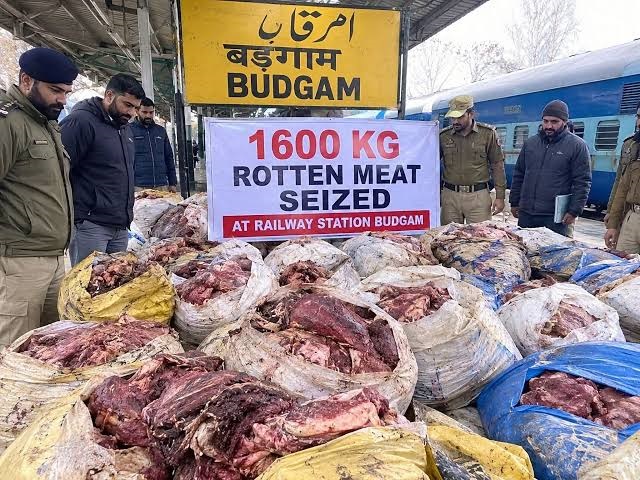
On November 14, authorities seized and destroyed approximately 1,600 kg of buffalo meat at Budgam Railway Station after detecting serious violations involving its declaration, transportation and maintenance of prescribed cold-chain conditions.
According to reporting by The Tribune, the consignment was found without adequate refrigeration or dry-ice arrangements to maintain the prescribed transportation temperature of minus 18°C or below. The operation involved the FDA, Railway Police, railway authorities and the district administration.
The incident raises a fundamental question about the movement of meat across long distances.
Meat safety does not begin when a product reaches a retail counter. It begins at the point of slaughter and depends on a chain of controls involving processing, refrigeration, transportation, storage and handling.
If one stage fails, the entire supply chain can be compromised.
Why the minus 18°C cold-chain requirement matters
Frozen meat must be maintained at appropriate temperatures throughout transportation and storage.
A temperature of minus 18°C or below is a widely recognised benchmark for frozen food storage and transportation.
When frozen meat is exposed to higher temperatures for prolonged periods, its quality can deteriorate and microbial risks can increase, particularly if it begins thawing and is subsequently mishandled.
Freezing does not sterilise meat. Some microorganisms can survive freezing and become active again after thawing.
This is why uninterrupted refrigeration, appropriate packaging and temperature monitoring are essential.
The Budgam incident highlights the need for authorities to examine not only the condition of meat at the point of seizure but also the documentation, origin, transportation arrangements and responsibility of the businesses involved.
It also raises questions about the effectiveness of routine checks at transport hubs and distribution points.
Another Enforcement Operation: 85 Meat Units Inspected and 16 Notices Issued
There is another important development that should not be overlooked.
On November 16, Health and Medical Education Minister Sakeena Itoo said the FDA had inspected 85 meat units across Jammu and Kashmir, issued 16 notices and recommended 11 cases for legal proceedings.
The minister’s statement followed the Budgam meat seizure.
She publicly stated:
“Food safety is non-negotiable, and violations will invite strict action.”
She also warned that enforcement would be intensified and those violating prescribed food safety standards would face legal action. The remarks were reported by The Tribune and Greater Kashmir.
This is a direct ministerial statement, unlike the general commitment attributed to her in some reports about the separate 108-inspection operation.
An important distinction in the figures: The 85-unit inspection and 108-inspection reports appear to describe separate enforcement updates. They should not be combined into a claim of 193 unique establishments inspected. The available reporting does not establish whether there is any overlap between the operations.
The distinction matters because accurate reporting of enforcement statistics is essential when assessing the scale of government action.
The Bigger Problem: Food Safety Cannot Stop at Meat Shops
While the latest action has focused attention on three establishments, food safety is a much broader issue.
The journey of meat from its source to a consumer’s plate involves several stages, each carrying potential risks.
1. Slaughter and initial handling
Animals must be slaughtered at appropriately regulated facilities under hygienic conditions.
Poor sanitation, contaminated equipment, improper handling and inadequate inspection can introduce harmful microorganisms into meat.
2. Processing and packaging
Processing units must maintain clean equipment, suitable working surfaces, pest control and appropriate separation between raw and processed products.
Packaging must protect meat against contamination and deterioration.
3. Transportation
This is one of the most vulnerable stages.
Meat transported without adequate refrigeration can deteriorate, especially during long journeys or delays.
Transport vehicles must be suitable for food products, properly maintained and capable of maintaining the required temperature.
4. Cold storage and wholesale distribution
Cold-storage facilities must maintain appropriate temperatures, hygiene and stock rotation.
Businesses should maintain records that allow products to be traced back to their source.
5. Retail shops and restaurants
Retailers must ensure that meat is stored at the appropriate temperature, protected from contamination and handled using clean equipment.
The same standards apply to restaurants, hotels and other food service establishments.
A shop displaying fresh-looking meat is not necessarily operating safely. Proper refrigeration, hygiene and traceability are essential.
What Consumers Should Check Before Buying Meat
Regulatory inspections are essential, but consumers also need to exercise basic caution.
A few precautions can reduce exposure to unsafe meat.
-
Purchase meat from licensed and identifiable establishments.
-
Check whether the shop maintains proper refrigeration.
-
Avoid meat exposed to dust, flies or other sources of contamination.
-
Be cautious about products with unusual odours, discolouration or abnormal texture.
-
Buy packaged meat only when its labelling, date and storage instructions are clear.
-
Avoid purchasing frozen meat that appears to have thawed and been refrozen.
-
Refrigerate or freeze meat promptly after purchase.
-
Keep raw meat separate from cooked food and vegetables.
-
Wash hands, knives and cutting surfaces after handling raw meat.
-
Cook meat thoroughly and follow safe food-handling practices.
One important caution: smell and appearance cannot reliably establish whether meat is free from harmful microorganisms. Contaminated food may sometimes look and smell normal.
Consumers should therefore never rely on visual inspection alone.
What the FDA Must Do Next: From Inspections to Accountability
The latest enforcement operation is a step towards strengthening food safety, but inspections and licence suspensions should be part of a wider regulatory strategy.
There are several areas where sustained intervention is necessary.
Regular inspections rather than occasional campaigns: Food safety checks should be conducted throughout the year, not only after major incidents.
Transparent laboratory reporting: Authorities should make relevant sampling outcomes available to the public, particularly when food products are found to be non-compliant.
Cold-chain monitoring: Meat transported by road, rail or other means should be subject to appropriate temperature checks and documentation.
Traceability: Authorities should be able to identify the origin of meat, the processing facility, the transporter and the final distributor.
Action against repeat offenders: Businesses repeatedly violating hygiene or storage standards should face stronger regulatory consequences under the law.
Consumer complaint mechanisms: People should have an accessible way to report suspected adulteration, unhygienic handling and the sale of expired products.
The FDA has urged food business operators to maintain hygiene during the handling, processing and storage of meat products and to ensure that expired, unsafe or non-compliant food is not offered for sale. It has also called on consumers to report suspected unsafe or adulterated food.
The Public Health Stakes: Why Food Safety Is Not a Minor Regulatory Issue
Foodborne illness is not limited to stomach infections.
Depending on the contaminant, unsafe food can cause diarrhoea, vomiting, dehydration and severe infections. Certain bacterial infections can be particularly dangerous for young children, older people, pregnant women and individuals with weakened immune systems.
The World Health Organization identifies unsafe food as a major global public health concern, with contaminated food capable of causing more than 200 different diseases.
Meat products require particular care because they can support the growth of disease-causing microorganisms when handled or stored incorrectly.
This is why food safety regulations must be treated as a public health responsibility rather than merely a licensing requirement.
For Jammu and Kashmir, where meat forms an important part of everyday diets and the hospitality industry, maintaining consumer confidence is also economically important.
A breakdown in food safety can affect households, restaurants, traders, tourism and the reputation of the region’s food businesses.
The Unanswered Questions
The latest FDA operation provides several important figures, but some questions remain unanswered.
-
What were the specific violations detected at each of the three establishments?
-
Were the five collected samples related to meat products, or did they include other food articles?
-
When will the laboratory results be made public?
-
How many of the 108 inspections resulted in notices or corrective directions?
-
Will the FDA publish a district-wise account of inspections and enforcement action?
-
What monitoring system is in place to verify cold-chain compliance during transportation?
-
Will repeat offenders face stronger action under the Food Safety and Standards Act?
These are not merely administrative questions. They concern the public’s right to safe food and the accountability of businesses entrusted with supplying it.
Final Word: A Crackdown Is Only the Beginning
The suspension of three food safety licences, 108 inspections and the destruction of expired products worth ₹77,500 demonstrate that Jammu and Kashmir’s food safety authorities are taking enforcement action.
The Budgam seizure of approximately 1,600 kg of buffalo meat has further exposed the importance of proper transportation, refrigeration and monitoring across the meat supply chain.
Health Minister Sakeena Itoo’s warning that food safety violations will not be tolerated has set a clear public position. The challenge now is to translate that commitment into consistent enforcement.
But the success of a food safety campaign cannot be measured simply by the number of inspections conducted or licences suspended.
It must be measured by whether unsafe products are prevented from reaching consumers, whether businesses improve their practices, whether violations are prosecuted fairly and whether the public can trust the food available in the market.
The real objective must be prevention, not merely seizure.
Consumers should not have to wait for a major meat seizure or a government inspection drive to feel confident about what they are buying.
Safe food is a basic public health requirement. Ensuring it demands continuous vigilance from regulators, responsibility from food businesses and awareness among consumers.