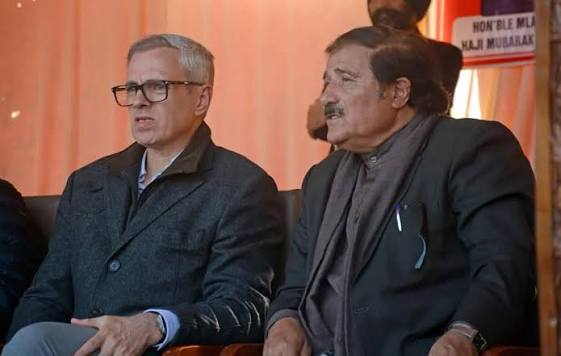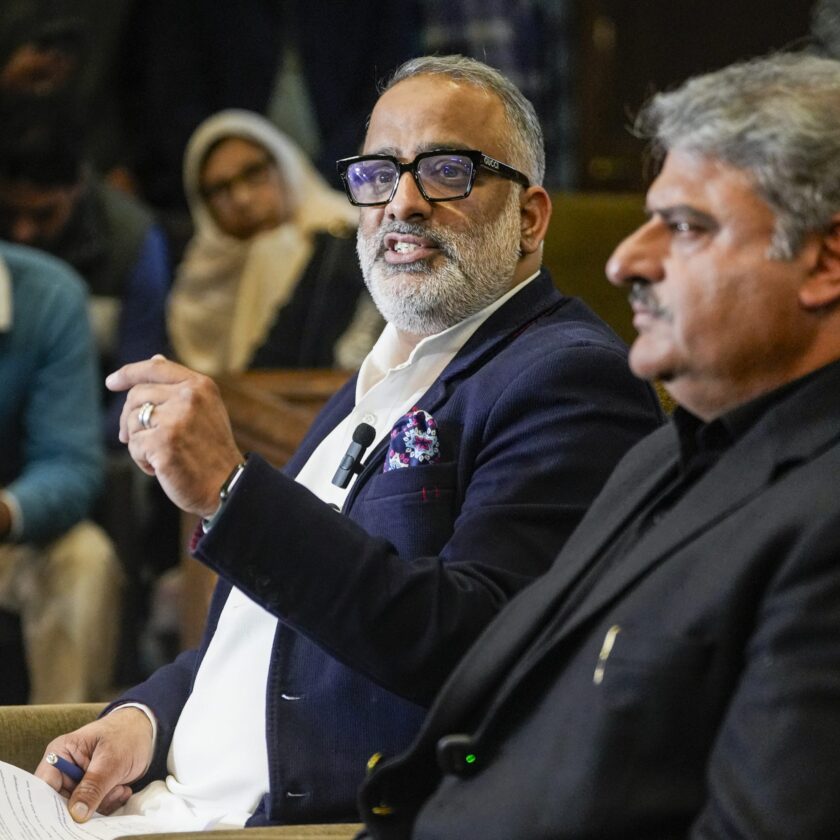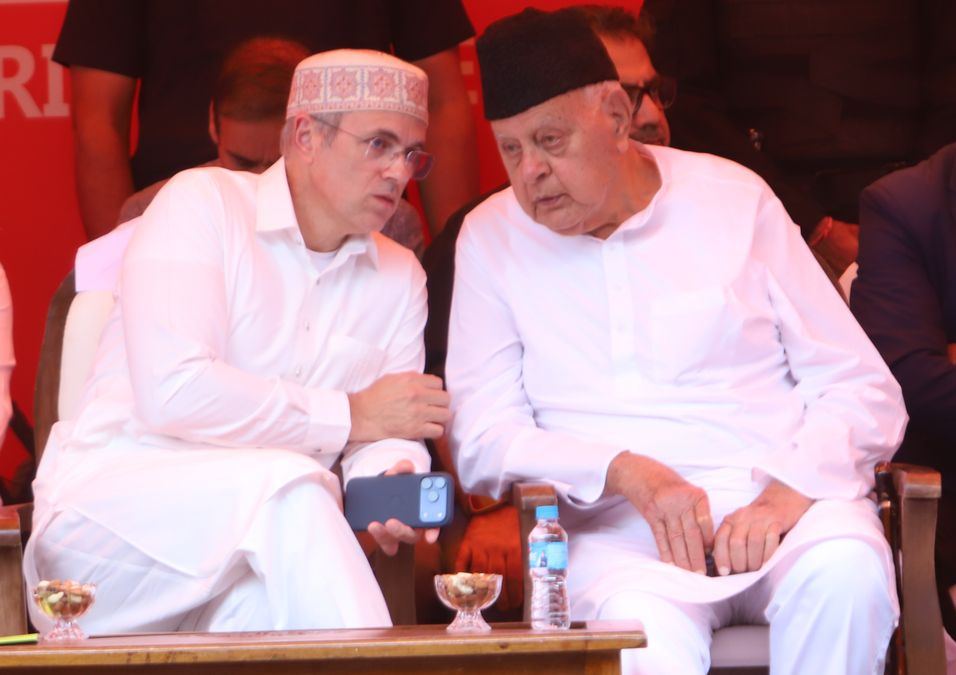
From the 1939 ideological split and the 1984 Shah rebellion to the present-day dissent, the NC has repeatedly faced challenges from within. Its survival has depended not simply on its political legacy, but on its ability to absorb internal pressure.
By: Javid Amin | 07 November 2026
Srinagar: Every few years, the National Conference finds itself facing a familiar prediction: this time, the party may finally break.
The prediction has followed leadership disputes, ideological disagreements, defections, political compromises and electoral setbacks. Yet the organisation has repeatedly returned to the centre of Jammu and Kashmir’s politics, surviving challenges that fundamentally altered its leadership, identity and relationship with New Delhi.
That resilience is not accidental. The National Conference is more than a conventional political party. Its history is closely connected with the political movement against the Dogra monarchy, the debate over Jammu and Kashmir’s constitutional relationship with India, the rise of regional political identity and the evolution of electoral politics in the former state.
But its history also contains a less comfortable lesson: the NC has not always emerged from internal rebellions stronger. Some challenges weakened its political authority, others produced lasting organisational divisions, and at least one resulted in the removal of an elected government.
The latest disagreement, following Omar Abdullah’s October 27 cabinet expansion, has brought those historical questions back into focus.
A group of dissatisfied legislators challenged the cabinet arrangements, questioned the concentration of decision-making and sought changes in the government’s functioning. Farooq Abdullah intervened, acknowledged that their grievances were genuine and promised action in phases. The legislators, meanwhile, said they would wait for the assurances to translate into concrete decisions.
The immediate confrontation has been contained. But the episode raises a larger question: Why has the National Conference survived so many rebellions, and what kind of internal challenge could eventually prove more difficult to contain?
To understand the present, it is worth revisiting the rebellions and political turning points that shaped the party.
The party is 94 years old, but its National Conference identity dates to 1939
The National Conference traces its origins to October 1932, when Sheikh Mohammad Abdullah, Mirwaiz Yusuf Shah and Chaudhry Ghulam Abbas helped establish the All Jammu and Kashmir Muslim Conference.
On June 11, 1939, the organisation was renamed the All Jammu and Kashmir National Conference. The change reflected Sheikh Abdullah’s attempt to broaden the movement beyond a specifically Muslim political identity and build a platform representing different communities of the princely state.
The transition was not universally accepted. Chaudhry Ghulam Abbas and other leaders disagreed with the direction taken by Sheikh Abdullah. The resulting ideological and organisational division led to the revival of the Muslim Conference, which retained a separate political identity.
This was arguably the first major internal rupture in the organisation’s history.
It was not simply a disagreement over leadership positions. It concerned the political character of the movement itself: whether it should remain organised around Muslim political representation or develop into a broader, secular nationalist platform.
The dispute established a pattern that would recur throughout the NC’s history. Its biggest internal disagreements often concerned the party’s political direction, not merely who occupied positions within it.
1953: The removal of Sheikh Abdullah changed the party’s political trajectory
The next major crisis came after Independence.
Sheikh Abdullah had emerged as the most influential political leader in Jammu and Kashmir. The National Conference dominated the Constituent Assembly elections of 1951, winning all 75 seats. But his relationship with the Union government became increasingly strained as disagreements developed over the state’s constitutional future and the terms of its relationship with India.
On August 9, 1953, Sheikh Abdullah was dismissed as Prime Minister and arrested. Bakshi Ghulam Mohammad took over the government.
This was not a conventional rebellion in which a group of legislators openly formed a rival party. It was a much more consequential political rupture involving the removal of the party’s founding leader and a fundamental change in the direction of government.
The consequences were enormous.
The NC under Bakshi Ghulam Mohammad continued in power, while Sheikh Abdullah’s political supporters increasingly gravitated towards the Plebiscite Front, which demanded a plebiscite to determine Jammu and Kashmir’s political future.
The party’s organisational identity and its political leadership were effectively separated. The government continued under a different leadership, while Sheikh Abdullah retained considerable political influence outside it.
For the NC, this was a lesson in the difference between holding power and retaining political legitimacy. A government could continue functioning even after its most prominent leader had been removed, but the political movement that had brought the organisation to prominence could not be separated from its founding leadership so easily.
1965–1975: The decade when the National Conference effectively disappeared
One of the least discussed but most important episodes in the party’s history came in 1965.
The National Conference merged with the Indian National Congress and became the Jammu and Kashmir unit of the Congress. The change came during a period when Sheikh Abdullah was in detention and the political structure established after 1953 remained firmly in place.
For nearly a decade, the NC did not function as an independent political party in the form associated with its earlier history.
Sheikh Abdullah’s political supporters continued to operate through the Plebiscite Front, keeping alive a separate political current.
The 1975 Indira-Sheikh Accord changed the situation. Sheikh Abdullah returned to power, and the National Conference was revived as an independent political organisation.
The party’s victory in the 1977 Assembly elections was particularly important. It demonstrated that the NC could regain electoral relevance after a prolonged period in which it had ceased to exist as an independent governing party.
This episode offers perhaps the clearest evidence of the organisation’s ability to recover from institutional disruption.
But it also shows that the NC’s survival was never guaranteed by its name alone. Its revival required a political settlement, the return of its most recognisable leader and the restoration of an independent organisational identity.
1984: The rebellion that actually brought down an NC government
If one episode deserves to be remembered as the National Conference’s most damaging internal rebellion, it is the July 1984 split led by Ghulam Mohammad Shah.
The circumstances were particularly sensitive.
Sheikh Abdullah had died in September 1982, and his son Farooq Abdullah had taken over as Chief Minister and party leader. The NC secured a strong mandate in the 1983 Assembly elections, but tensions developed between Farooq and sections of the political establishment.
Ghulam Mohammad Shah, Farooq’s brother-in-law, led a breakaway faction of NC legislators. The group withdrew support from Farooq’s government, reducing it to a minority.
Governor Jagmohan dismissed Farooq Abdullah in July 1984 and appointed Shah as Chief Minister.
The episode was widely viewed as an instance of political interference by New Delhi. Farooq and his supporters accused the Centre of engineering the rebellion, while Shah’s faction became the immediate beneficiary of the political change.
The new government did not last. Congress withdrew support in 1986, leading to the imposition of Governor’s Rule.
The damage, however, extended far beyond the fall of one Chief Minister.
The breakaway demonstrated that an internal faction could use legislative numbers to displace the party’s elected leader and take control of the government. It also deepened the perception that Jammu and Kashmir’s political institutions were vulnerable to manipulation from outside.
The Shah episode remains a powerful warning for the current NC leadership. A party can possess a popular mandate and still face a serious threat if internal disagreements become organised legislative opposition.
1987: The alliance that strengthened the party but damaged its credibility
The 1987 Assembly election presents a different kind of historical turning point.
After Farooq Abdullah returned to power through an agreement with Prime Minister Rajiv Gandhi, the NC contested the election in alliance with Congress.
The alliance won a commanding majority. But the election was accompanied by widespread allegations of rigging and electoral malpractice, particularly from the Muslim United Front (MUF), which had emerged as a significant challenger.
The controversy surrounding the election became one of the most consequential episodes in modern Kashmir history. It contributed to the erosion of public faith in electoral politics and is widely regarded as an important factor in the developments that preceded the outbreak of armed militancy in 1989.
This was not a conventional rebellion within the NC. But it exposed a different vulnerability: a party could retain legislative power while losing public confidence.
The distinction matters.
The 1984 rebellion threatened the party through an internal legislative split. The 1987 controversy damaged the credibility of the political system in which the NC operated.
A party may survive a leadership challenge. Rebuilding public trust after a major political legitimacy crisis is much harder.
1996: The NC returned, but its political dominance had changed
After the outbreak of militancy and the collapse of elected government in 1990, Jammu and Kashmir remained under central rule for several years.
The NC returned to electoral politics in 1996 and secured an overwhelming victory, winning 57 of the 87 Assembly seats.
It was a major comeback.
The result demonstrated that the party retained a substantial political base despite years of conflict, the absence of an elected government and the emergence of competing political narratives.
But the return to power did not restore the political landscape of the 1970s or 1980s.
The electorate had changed. New political actors were emerging, and the NC faced growing questions about its relationship with New Delhi, its handling of the conflict and its ability to represent a population that had experienced years of violence and political instability.
The 1996 victory proved the party could recover electorally. It did not prove that its old dominance was permanent.
1999: The NDA alliance and the ideological contradiction
Another major political test came when Farooq Abdullah took the National Conference into the National Democratic Alliance in 1999.
The decision to align with the BJP-led coalition was politically significant. The NC had historically built its identity around regional autonomy and a distinct constitutional position for Jammu and Kashmir. Its participation in an alliance led by the BJP created discomfort among sections of its traditional political constituency.
Omar Abdullah joined the Vajpayee government as a Minister of State. He resigned from the Union Council of Ministers in December 2002.
The alliance did not split the NC, but it exposed the tension between political pragmatism and ideological consistency.
This contradiction remains relevant today. The party has repeatedly had to balance its regional political commitments with the practical realities of governing and negotiating with the Centre.
That balancing act can produce political opportunities, but it can also create dissatisfaction among supporters who expect a more uncompromising position.
2002: The electoral setback that ended the era of unquestioned dominance
The 2002 Assembly election was another major test.
The NC fell from 57 seats in 1996 to 28. The People’s Democratic Party (PDP), founded by Mufti Mohammad Sayeed in 1999, emerged as a serious competitor and won 16 seats.
The result ended the NC’s immediate political dominance and demonstrated that its traditional support base was no longer beyond challenge.
The PDP’s emergence was particularly important because it offered voters a regional alternative with a different political language, promising a softer approach to the conflict, reconciliation and a more accessible style of governance.
The NC did not disappear. It remained a significant political force and returned to government in 2008 through an alliance with Congress.
But 2002 showed that the party could lose its grip on power without suffering a formal organisational split.
This is an important distinction in assessing the present crisis. A party does not have to break into factions to lose political influence. Electoral competition, declining public confidence and the emergence of credible alternatives can weaken it just as significantly.
2015–2018: The BJP-PDP experiment and the NC’s return to opposition
The PDP-BJP coalition government formed in 2015 created another difficult political environment for the NC.
The alliance brought together two parties with sharply different political histories and ideological positions. Its collapse in June 2018, after the BJP withdrew support, reshaped the political landscape.
The NC remained outside the government and positioned itself as a regional opposition force.
This period also reinforced the party’s traditional political argument: that regional parties must protect Jammu and Kashmir’s political interests while navigating an increasingly centralised political environment.
Yet the NC continued to face competition from the PDP, the People’s Conference, the Apni Party and other political actors.
The lesson was clear: survival in opposition is not the same as political dominance. The party could remain relevant, but it had to compete for public confidence rather than rely exclusively on historical legacy.
2019: The constitutional rupture that changed the party’s political challenge
The abrogation of Article 370 and the reorganisation of Jammu and Kashmir in August 2019 created the most significant constitutional and political challenge to the NC in decades.
The region was placed under President’s Rule, political leaders were detained and Jammu and Kashmir was reorganised into two Union Territories: Jammu and Kashmir, and Ladakh.
The NC opposed the changes and pursued a legal challenge. In December 2023, the Supreme Court upheld the constitutional changes, while directing that Assembly elections be held and statehood restored at the earliest.
The 2019 developments altered the nature of the party’s political challenge.
The NC could no longer rely on its earlier constitutional framework as the basis of its governing position. It had to pursue the restoration of statehood and its political demands within a changed institutional arrangement.
This also created an ideological test for the leadership. How far could the party go in pursuing constitutional restoration while governing a Union Territory under the new arrangement?
That question has become central to the present disagreement with Aga Syed Ruhullah Mehdi and to the concerns expressed by some NC legislators.
It is not, however, evidence that Ruhullah’s departure and the current dissident legislators’ campaign are part of a single organised rebellion. They remain distinct developments unless evidence establishes otherwise.
2024: The return to power raised expectations as well as pressure
The NC’s victory in the 2024 Assembly elections marked another major recovery.
The party won 42 seats, becoming the largest political force in the 90-member Assembly. Omar Abdullah returned as Chief Minister, this time heading a government operating under the Union Territory framework.
But returning to power created a new set of expectations.
The party had campaigned on restoring statehood, protecting regional interests, creating employment opportunities and addressing public grievances. Its supporters expected the government to deliver on these commitments despite the restrictions of the Union Territory arrangement.
The challenge was not simply to form a government. It was to demonstrate that electoral victory could translate into meaningful political and administrative change.
That is the background against which the October 2026 cabinet expansion triggered internal dissatisfaction.
2026: The present rebellion is different from 1984
The current dispute began gathering momentum after Omar Abdullah expanded his Cabinet on October 27, inducting four new ministers.
Several legislators expressed dissatisfaction, arguing that seniority, experience and regional considerations had not been adequately reflected in the reshuffle.
The concerns soon expanded beyond ministerial representation.
Reports of repeated meetings among unhappy legislators and a memorandum submitted to the leadership pointed to wider grievances: the distribution of portfolios, the role of Chief Minister’s adviser Nasir Aslam Wani, limited consultation with elected representatives, ministerial performance and the implementation of the party’s election manifesto.
The group also wanted a stronger political push for statehood and the restoration of Jammu and Kashmir’s constitutional position.
The November 6 meeting with Farooq and Omar Abdullah helped contain the immediate confrontation.
Farooq acknowledged that the grievances were genuine and promised that some would be addressed quickly while others would be taken up gradually. Nazir Gurezi and other legislators publicly rejected the suggestion that they intended to form a separate faction.
But subsequent reporting suggests that the issue has not disappeared.
The Tribune reported on November 8 that legislators who attended the meeting were adopting a wait-and-watch approach. They wanted the leadership to demonstrate a course correction rather than simply offer assurances. The same report said Omar Abdullah had offered to resign as Chief Minister during the meeting, but the legislators declined, indicating that they were seeking changes in the party and government’s functioning rather than his departure.
This is an important development.
It suggests that the disagreement is not necessarily about replacing Omar. It is about how power is exercised, how elected representatives are treated and whether the leadership is willing to change its internal decision-making arrangements.
That makes the current episode different from the 1984 rebellion.
In 1984, a faction withdrew support and helped remove the Chief Minister. In 2026, the legislators have publicly insisted that they want to remain within the party and seek corrective action through its leadership.
The comparison is useful as a warning, not as evidence that history is repeating itself.
What made some rebellions survive while others faded?
The history of the National Conference reveals several factors that have repeatedly determined whether an internal challenge becomes a lasting political threat.
1. The strength of the party’s historical identity
The NC’s political identity was built over decades of mobilisation and leadership. Its association with the movement against the Dogra monarchy and its role in the political history of Jammu and Kashmir gave it a base that could survive individual setbacks.
A challenger could criticise the leadership, but replacing the organisation required something much more substantial: a credible alternative identity and a network capable of reaching voters across constituencies.
2. The difference between personal popularity and organisation
A prominent leader can attract public attention and command a following. But building a durable political alternative requires local workers, constituency structures, credible candidates, resources and a programme that extends beyond one personality.
The history of regional political competition shows that electoral success cannot be assumed simply because a leader has left an established party.
3. The ability of the leadership to absorb dissent
The NC has survived because it has, at different points, accommodated disagreements, restored organisational structures and negotiated political compromises.
But accommodation has limits. If legislators and workers repeatedly feel excluded, the party risks turning manageable disagreements into a larger crisis of confidence.
4. Public legitimacy matters as much as legislative numbers
The 1987 experience demonstrated that political authority can be weakened even when a government retains a large Assembly majority.
A party’s strength ultimately depends on public trust, not only on the number of legislators sitting behind its Chief Minister.
5. External pressure cannot explain every internal problem
The NC has often accused New Delhi of interfering in Jammu and Kashmir’s political affairs. There are historical episodes, particularly the 1984 dismissal of Farooq Abdullah’s government, that have fuelled those accusations.
But external pressure should not become an explanation for every internal disagreement.
Questions about ministerial performance, consultation, representation and governance require answers from the party leadership itself.
Farooq Abdullah: The stabiliser, but also the institutional question
The latest episode once again demonstrated Farooq Abdullah’s importance in the party.
His intervention helped bring the legislators and Omar together. His public acknowledgment of their grievances gave both sides a way to step back from confrontation without appearing to surrender.
That is a considerable political asset.
But it also raises an institutional question.
Can the NC develop a decision-making system that handles disagreements before they require the personal intervention of its president?
The party has a large legislative group, an elected government and an established organisational structure. It should be possible to create regular mechanisms for consultation, ministerial performance reviews and the resolution of constituency-level grievances.
If every major disagreement must ultimately be taken to Farooq Abdullah, the party risks becoming too dependent on individual authority.
His experience may help resolve the current crisis. But a modern political organisation must also be able to function through institutions rather than personalities alone.
What could actually break the NC?
The present dissident group is not, by itself, an existential threat to the party. Its members have publicly maintained that they want to remain within the NC, and there is no confirmed collective resignation or announcement of a breakaway organisation.
The more serious danger lies in the accumulation of unresolved problems.
Three developments could gradually weaken the party.
First, a widening gap between the leadership and its legislators. If elected representatives feel unable to influence government decisions or secure responses to constituency problems, dissatisfaction could spread beyond the present group.
Second, a loss of ideological credibility. The NC’s commitments on statehood and the constitutional status of Jammu and Kashmir remain central to its political identity. If voters begin to believe that the party has abandoned those commitments, it could face pressure from alternative political voices.
Third, a failure to renew its organisation. A party that depends too heavily on established leadership and a narrow decision-making circle may struggle to bring forward new leaders, retain younger workers and respond to changing public expectations.
These risks are more serious than a temporary disagreement over cabinet positions because they can affect the party’s long-term ability to reproduce political support.
The next 30 to 60 days will matter
The leadership has bought time. It now has to use that time.
The most important indicators will be:
-
Whether the promised review of portfolios or ministerial performance produces a concrete decision.
-
Whether the role and responsibilities of the Chief Minister’s adviser are reconsidered or clarified.
-
Whether a formal mechanism is established for regular consultation with NC legislators.
-
Whether the party provides a clearer roadmap for implementing its election manifesto.
-
Whether the dissident legislators return to routine party functioning or resume collective meetings and public criticism.
The outcome will determine whether the November episode becomes another contained disagreement or the beginning of a more persistent internal power struggle.
Final verdict: The NC has survived bigger rebellions, but history is not a guarantee
The National Conference has survived the ideological division of 1939, the removal of Sheikh Abdullah, a decade-long loss of independent party identity, the Shah rebellion of 1984, the political crisis surrounding the 1987 election and the electoral setback of 2002.
It has repeatedly recovered because its political roots were deeper than the ambitions of individual leaders.
But there is a difference between surviving a rebellion and learning from it.
The 1984 episode showed how quickly internal divisions can become a threat to a government. The 2002 election showed that a party can lose dominance without formally splitting. The present episode is still at a much earlier stage, but it has exposed questions about representation, access, accountability and ideological direction that cannot be resolved through public displays of unity alone.
Omar Abdullah has avoided an immediate confrontation. Farooq Abdullah has restored a degree of calm. The dissidents have secured recognition and are waiting for action.
The real challenge now is whether the leadership can turn those assurances into organisational reform.
The National Conference is unlikely to be broken by the present rebellion alone. But its history offers no guarantee that it can survive indefinitely by relying on the strength of its past.
A party built through a movement must continue to listen to the people and representatives who sustain it. When that connection weakens, even the oldest political institutions begin to lose their strength.
The NC has survived rebellions that once appeared capable of destroying it. Its next test may not be whether it can defeat another rebellion, but whether it can prevent the conditions that produce one.
Editorial Note: The NC was founded as the Muslim Conference in 1932 and renamed the National Conference in 1939. It is therefore 94 years old in 2026, while its identity under the National Conference name dates back 87 years. The article distinguishes the 1939 organisational split, the 1953 leadership crisis, the 1965 merger and 1984 breakaway rather than presenting every episode as the same kind of rebellion. The November 8 update also reflects the reported wait-and-watch position of the legislators and Omar Abdullah’s reported offer to resign, which they declined.