Apni Party chief questions revenue approvals over alleged hotel project at Saedpora; government disputes allegations, putting land records and permissions under scrutiny
By: News Desk | 03 October 2026
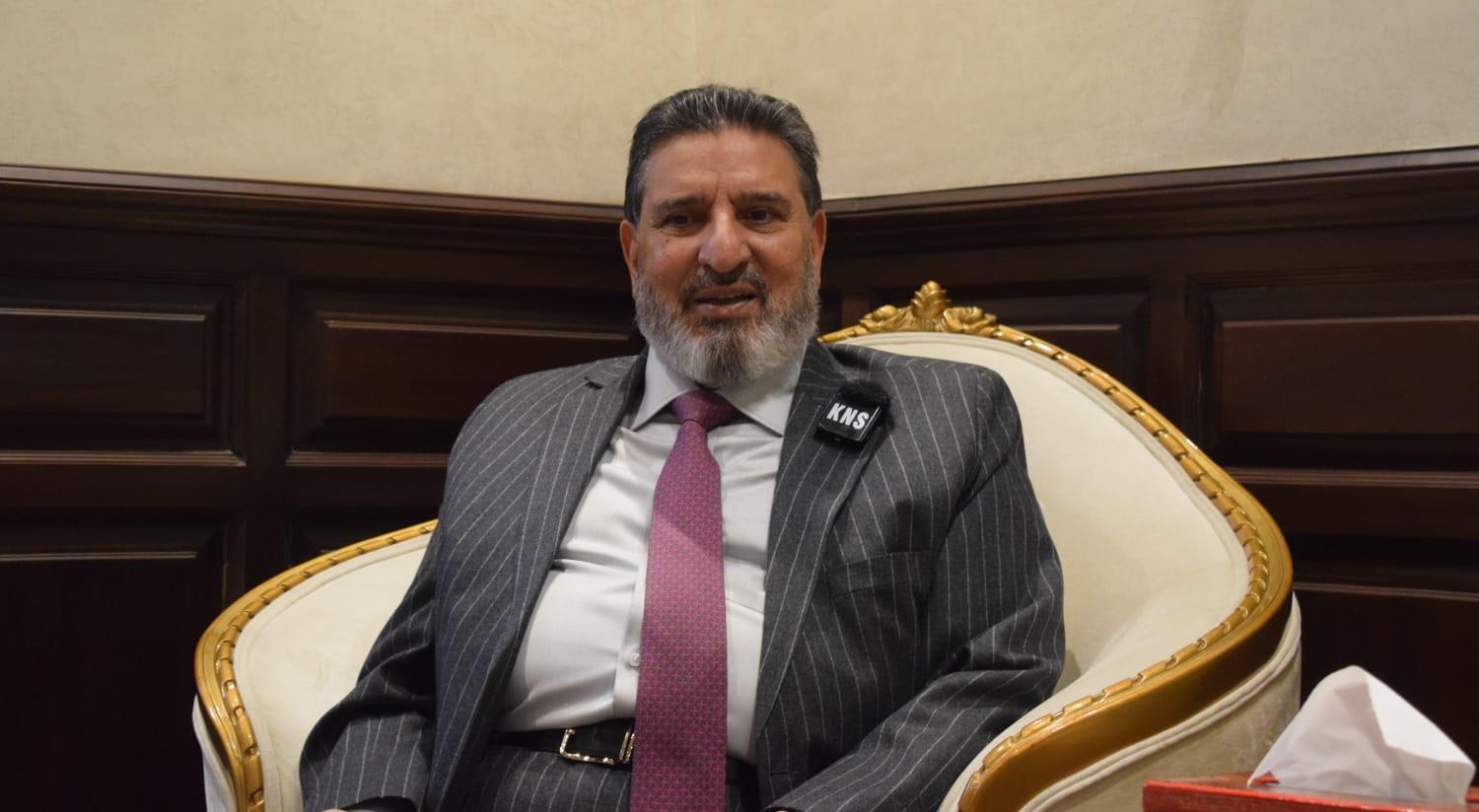
Srinagar: A fresh political controversy over land ownership in Jammu and Kashmir has erupted after Apni Party president Syed Mohammad Altaf Bukhari demanded a transparent inquiry into an alleged land purchase near Srinagar involving a non-domicile and a proposed hotel project.
Bukhari has questioned how the transaction was processed, who handled the revenue records and whether the necessary legal permissions were obtained. The government, however, has disputed key parts of the allegation, saying it neither allotted land to the person at the centre of the controversy nor granted permission for the proposed hotel.
The dispute has consequently moved beyond a simple allegation of an “outsider” purchasing land. It now raises a more specific set of questions: What was the classification of the land? Was the transaction registered legally? What permissions were required? Were those permissions obtained? And what, if anything, did government departments approve?
Those questions can ultimately be answered only through the underlying revenue and registration records.
Bukhari Demands Answers From Government
The controversy relates to an alleged land transaction at Saedpora, on the outskirts of Srinagar, which Bukhari has linked to a proposed hotel project.
On October 3, the Apni Party chief renewed his demand for an inquiry after Chief Minister Omar Abdullah’s Advisor Nasir Aslam Wani rejected his earlier allegations.
Bukhari questioned who had allowed the alleged purchase and who processed the associated revenue documentation.
He specifically sought answers on who facilitated the transaction, processed the revenue records and authorised the deal.
For Bukhari, the central issue is not simply the identity or domicile status of the alleged purchaser. It is whether the administrative chain followed the law and whether officials permitted a transaction that required additional approval.
He has therefore called for a transparent investigation and demanded that its findings be made public.
Government Disputes the Allegation
The Omar Abdullah government’s position, as reported in connection with the controversy, is markedly different.
Chief Minister’s Advisor Nasir Aslam Wani has disputed Bukhari’s allegations, saying the government neither allotted land to the individual identified in the controversy nor granted permission for the hotel project.
That distinction is significant.
A private land sale and government allotment are not necessarily the same thing. Likewise, ownership of a parcel of land and permission to construct and operate a hotel involve different legal and administrative processes.
Consequently, establishing whether the alleged purchaser acquired land lawfully would require examination of the sale deed, mutation and revenue records, classification of the land, applicable permissions and the status of any building or development approval.
At present, the publicly reported positions of the two sides do not provide that complete documentary picture.
The Crucial Question: Can a Non-Domicile Buy Land in J&K?
This is where the political debate needs to be separated from the legal position.
The rules governing land ownership in Jammu and Kashmir changed substantially after 2019.
In 2020, amendments removed the earlier permanent-resident restriction from important provisions governing the disposal and purchase of non-agricultural land. The changes effectively opened the purchase of certain non-agricultural land to people from outside J&K.
Therefore, the statement that a person without a J&K domicile is automatically prohibited from purchasing land in the Union Territory is too broad under the current legal framework.
But that does not mean every land transaction involving a non-domicile is automatically valid.
The classification of the land matters.
Agricultural Land Is a Different Legal Question
J&K’s current framework retains restrictions around agricultural land.
The J&K government’s Department of Registration states that under Section 133-H of the J&K Land Revenue Act, agricultural land can be transferred from an agriculturist to a non-agriculturist subject to permission from the concerned Deputy Commissioner and specified conditions.
Among the conditions listed by the government are that:
- the land must be used for the purpose for which permission was granted;
- it must be put to that use within the prescribed period;
- the applicant must comply with applicable rules; and
- the transaction should not render the transferor landless.
The government also outlines a formal approval process involving the Deputy Commissioner, Tehsildar and other revenue authorities before a decision is taken.
This makes the classification of the Saedpora land particularly important.
If the land was non-agricultural and otherwise transferable, the mere fact that the purchaser was not a J&K domicile would not, by itself, prove an offence.
If, on the other hand, the parcel was agricultural land and was transferred to a non-agriculturist, the relevant permission and conditions under Section 133-H would become central to determining whether the transaction complied with the law.
The Hotel Proposal Adds Another Layer
There is also a distinction between buying land and developing a hotel on it.
Even where ownership has been legally transferred, a hotel project may require compliance with separate land-use, building, planning, environmental, fire-safety and other regulatory requirements depending on the location and nature of the project.
This is why the government’s reported statement that no permission was granted for the hotel does not necessarily answer the separate question of whether a private land transaction occurred.
Conversely, an allegation that land was purchased for a hotel does not establish that the government authorised the hotel.
The documentary trail needs to be examined independently.
Bukhari Puts the Revenue Department Under the Spotlight
Bukhari has argued that the Revenue Department comes under the direct administrative control of the Chief Minister and that the government therefore cannot simply distance itself from questions surrounding revenue records.
His demand is essentially for an administrative audit of the transaction: who entered the records, who verified them, what documents were submitted, what classification was recorded and whether any statutory permission was required.
That is a more concrete question than the broader political debate over “outsiders” and demographic change.
If the transaction was lawful, the records should establish that.
If required permissions were missing, those records should also reveal where the process broke down.
The Dispute Has Also Become a Political Fight
The controversy is unfolding against a wider political confrontation between Bukhari’s Apni Party and the ruling National Conference.
Bukhari had already raised allegations about land purchases by people or entities from outside J&K during a September 27 public meeting in Srinagar.
He questioned the alleged purchase of land for a hotel at Syedpora by a Mumbai-based businessman and separately referred to an alleged acquisition of 150 kanals at Chatterhama-Hazratbal by a Delhi-based company.
Those earlier allegations were presented by Bukhari in the broader context of demographic change and government accountability.
The latest dispute over the alleged hotel project has therefore become part of a larger political argument about how the post-2019 land regime is operating in Kashmir.
But Allegation Is Not Proof of Illegal Land Purchase
That distinction is essential.
There are currently competing claims:
Bukhari’s position: the government must explain how the alleged transaction was permitted and investigate whether existing land and domicile-related laws were violated.
Government’s reported position: the administration did not allot the land to the person in question and did not grant permission for the alleged hotel project.
Neither position, on its own, establishes the complete legal status of the underlying land transaction.
The available public reporting also does not establish, independently, that the purchaser committed an offence or that officials unlawfully altered revenue records.
That is precisely why a documentary inquiry could be consequential.
What an Inquiry Would Need to Establish
A meaningful investigation would need to move beyond political statements and examine the official paper trail.
Among the questions requiring answers are:
1. What was the exact classification of the land?
Was it agricultural, non-agricultural, residential, commercial or subject to another category of land-use restriction?
2. Who was the recorded owner before the transaction?
The revenue record and registered sale documents would establish the ownership chain.
3. Who purchased the land and in what capacity?
The purchaser’s domicile status is relevant only within the legal framework applicable to the particular category of land.
4. Was any permission from the Deputy Commissioner required?
If Section 133-H applied, the relevant permission and supporting revenue reports would become critical.
5. Was the transaction registered and mutated?
The registration and mutation records would help establish whether the transaction entered the official land records.
6. Was any hotel or construction permission granted?
This would be separate from the question of ownership.
7. Was the land use changed?
If the original classification differed from the proposed commercial use, the applicable conversion or development permissions would need examination.
These are questions that can be answered through documents rather than political rhetoric.
Why the Controversy Matters Beyond One Plot of Land
The political sensitivity surrounding land in Jammu and Kashmir is rooted in the dramatic transformation of the region’s legal and constitutional framework since 2019.
Before the changes, J&K had a substantially different land-ownership regime tied to the erstwhile state’s permanent-resident framework.
The 2020 legal changes altered that architecture, including provisions governing non-agricultural land, and became the subject of intense political debate.
The result is that land transactions involving people from outside J&K can become politically charged even where the legal question is much narrower.
The real test in each individual case is therefore not simply “Is the buyer a non-domicile?”
It is:
“What kind of land was transferred, under what provision, through which authority, with what permissions and for what purpose?”
That is the legal and administrative question that matters.
Transparency Could Defuse the Political Controversy
The simplest way to settle the dispute would be to place the relevant facts on record.
If the land purchase complied with the law, the government can demonstrate that through the revenue and registration documents.
If permissions were required and obtained, those can be identified.
If the proposed hotel has no government approval, the relevant authorities can clarify its status.
And if any irregularity is discovered, responsibility can be fixed through the appropriate administrative or legal process.
Such transparency would also prevent an individual land dispute from becoming a much broader debate about demographic change and the future of land ownership in Kashmir.
What Remains Unanswered
For now, several important questions remain unresolved in the public domain.
The exact nature and classification of the land involved has not been established through publicly available official records.
The precise registration and mutation details have not been independently disclosed.
The full documentary basis of Bukhari’s allegation has not yet been made public, although he has indicated that he intends to produce evidence in the continuing political dispute.
At the same time, the government’s denial that it allotted the land or granted hotel permission does not, by itself, settle whether a private transaction took place or whether every required approval was obtained.
Those are matters for records and, if necessary, an inquiry.
The Bigger J&K Land Question
The Saedpora controversy illustrates a larger challenge facing Jammu and Kashmir after the restructuring of its land laws.
The legal regime is no longer the same as it was before 2019. At the same time, restrictions and regulatory requirements continue to apply to particular categories of land and transactions.
That creates a space in which political claims can easily outpace the underlying legal facts.
For the public, the most important requirement is therefore clarity.
A transparent examination of the alleged transaction would establish whether the dispute concerns a lawful investment, a regulatory violation, an unauthorised construction project, an irregularity in revenue administration—or simply competing political claims.
Until the relevant records are examined, declaring the transaction either legal or illegal would be premature.
For Bukhari, however, the political question is already clear: he wants the government to explain how the alleged transaction happened and who, if anyone, authorised it.
The government’s response is equally significant because the controversy now concerns not just one alleged land purchase, but the credibility of the administration’s land-record and regulatory systems.
Ultimately, the documents—not the political accusations—will determine what actually happened.