Srinagar Drug Network: When a Public Image Becomes a Tool of Influence
By: News Desk | 02 October 2026
Srinagar: A major inter-state narcotics investigation in Srinagar has exposed far more than a large cache of pharmaceutical drugs.
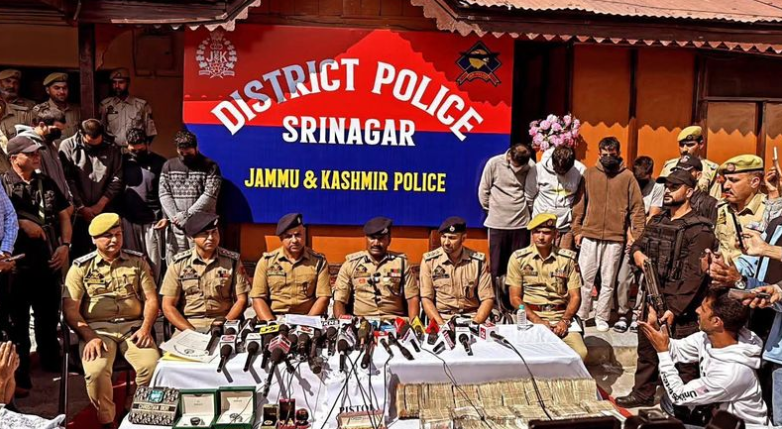
Police say the investigation into an alleged organised drug network operating from downtown Srinagar has so far resulted in the arrest of eight people, recovery of more than 2.19 lakh pharmaceutical tablets and capsules, codeine-containing liquid, a heroin-like substance, cash, gold, luxury items and a firearm. The investigation has also taken police teams outside Jammu and Kashmir, including to Chandigarh, Panchkula and Ambala, as investigators trace the alleged procurement and distribution chain.
But alongside the scale of the alleged narcotics operation, another issue has attracted attention: reports that at least one accused projected himself publicly through a purported journalistic identity and photographs with prominent people.
That aspect requires caution.
A photograph with a politician, police officer, bureaucrat or other public figure is not evidence by itself of a relationship, endorsement, protection or participation in wrongdoing. Nor does possession of a press card or association with a media organisation, by itself, establish that a person was using journalism for criminal purposes.
The question worth examining is narrower and more important:
Can a carefully constructed public image create an appearance of influence that makes it easier for an individual to move through society without suspicion?
That question extends beyond this particular case.
The Drug Network Police Say They Have Uncovered
The case arises from FIR No. 135/2026 registered at Police Station Safakadal.
According to Srinagar Police, investigators uncovered an organised network allegedly involved in the procurement, transportation, storage, distribution and financing of banned pharmaceutical drugs, with connections extending outside Jammu and Kashmir. Eight people have been arrested so far. One of them, Haris Hameed Malla, was traced through technical surveillance and apprehended in Bengaluru, according to police.
The arrested persons have been identified by police as Mohammad Waseem Zargar, Inam Ahmad Zargar, Sahib Ahmad Ganie, Ansar Hussain Bhat, Peer Shakoor, Haroon Tariq Pandit, Aquib Saleem and Haris Hameed Malla. Their individual roles and alleged connections remain part of the investigation.
Police say the investigation has moved in both directions: forward toward alleged distributors and beneficiaries, and backward toward the sources from which pharmaceutical drugs were allegedly procured.
Teams examined pharmaceutical establishments and transport agencies in Chandigarh, Panchkula and Ambala, while invoices, bills, goods receipts and other records were collected for scrutiny. Police have said discrepancies involving licences, purchaser details, invoices and payments are being examined with regulatory authorities.
That is significant because it suggests investigators are treating the case not simply as possession of drugs but as a possible supply-chain investigation.
The Numbers Behind the Case
The seizure reported by police is substantial.
The investigation has so far resulted in the recovery of:
- 2,19,425 pharmaceutical tablets and capsules
- Around 3.83 kg of codeine-containing liquid
- Approximately 40 grams of a heroin-like substance
- Around ₹85.75 lakh in cash
- Gold coins, biscuits and other gold articles
- Two Rolex watches
- A Dior handbag
- A DSLR camera and lens
- An iPhone 16 Pro Max
- A .32-bore pistol with two empty magazines
- A dagger
Police have also said that approximately ₹1.07 crore held in multiple bank accounts has been frozen. A residential property and two vehicles have also been attached under law.
In a separate search of two bank lockers linked to one accused, police reported recovering around ₹65 lakh in cash and gold articles, with the locker recovery valued at approximately ₹2.20 crore.
The quantities are still allegations and seizure figures at this stage. Their ultimate legal significance will depend on investigation, forensic examination, the chain of evidence and court proceedings.
Pharmaceutical Drugs: The Less Visible Side of the Drug Crisis
One of the most important aspects of the case is the nature of the alleged contraband.
The bulk of the seizure reportedly involved pharmaceutical substances rather than a conventional image of street-level narcotics. Police said the haul included approximately 2.18 lakh tapentadol tablets, 1,200 pregabalin capsules and 414 tramadol tablets/capsules, alongside codeine-containing liquid.
That matters because pharmaceutical drug diversion can operate through legitimate-looking commercial channels.
A pharmaceutical product can begin its journey inside a legal supply system. The point at which it is diverted, misrepresented, illegally supplied or distributed becomes the critical investigative question.
That is why the police investigation into invoices, licences, purchaser details, payment records and transport documents could become as important as the arrests themselves.
The case potentially raises questions not only about people allegedly selling drugs, but also about how pharmaceutical supply chains are monitored and where regulatory controls may fail.
Then Comes the Question of the “Journalist” Identity
This is where the story needs careful handling.
Reports circulating after the arrests have alleged that one of the accused projected himself as a journalist or used a journalistic identity while maintaining photographs with politicians, police officers and other public figures.
However, the principal police-based reports and the widely circulated accounts of the October 1 briefing that I could verify focus on the narcotics investigation, arrests, recoveries, financial trail and interstate supply chain. They do not independently establish that the accused was a legitimate journalist, a fake journalist, or that any political or police contact shown in photographs was connected to the alleged drug activity.
That distinction is essential.
A photograph is a photograph.
It does not establish:
- a private relationship;
- political protection;
- police patronage;
- knowledge of alleged criminal activity;
- financial involvement;
- endorsement of the individual;
- or participation in the alleged network.
Those conclusions would require independent evidence.
Why the Public-Image Question Still Matters
Even after making that distinction, the broader issue deserves attention.
People routinely use social credentials to establish trust.
A media identity can carry a certain degree of social access. So can association with political figures, government officials, police officers, lawyers, businessmen or community leaders.
For someone attempting to project influence, photographs can therefore become part of a wider reputation-building exercise.
But that is different from proving criminal intent.
The important institutional question is whether organisations and individuals have mechanisms for distinguishing actual professional credentials from merely claimed status.
That question is particularly relevant in an age when social-media profiles can create a carefully edited version of a person’s public identity within minutes.
Journalism Is Not a Photograph
There is another distinction that should not be lost.
Journalism is not defined simply by possessing a press card, uploading news stories or appearing in photographs with public officials.
The Press Council of India has long recognised the need for proper accreditation standards. Its accreditation material emphasises verification of a journalist’s employment and newsgathering role, including examination of work such as news clippings and other journalistic output.
A 2024 Press Council subcommittee report also specifically identified the need to ensure that genuine journalists are not denied accreditation while people who are not genuine journalists do not receive the facility.
That does not mean every person without formal accreditation is not a journalist. Many journalists work without government accreditation, particularly in digital and smaller media organisations.
The real issue is verifiable professional work.
A newsroom should be able to answer basic questions:
Who employs the person?
What does the person report?
Where is the published work?
Who edits or supervises that work?
What organisation does the person represent?
Is the identity current?
Those checks protect both the public and genuine journalists.
Social Media Has Changed the Meaning of “Influence”
There was a time when influence was largely built through institutions.
Today it can also be manufactured through visibility.
A social-media account containing photographs with officials, political leaders, celebrities or senior professionals can create an impression of proximity that may be much greater than the underlying relationship.
That does not make the photographs false.
It makes their interpretation potentially misleading.
This is an increasingly important issue for society because people often judge credibility through visual shortcuts.
A photograph can communicate:
“I know important people.”
But it cannot independently establish:
“Important people trust me.”
And it certainly cannot establish:
“Important people know what I am doing.”
That difference becomes critical when criminal allegations enter the picture.
The Money Trail May Tell the Bigger Story
For investigators, photographs may ultimately be far less important than financial and communication evidence.
The police have already said that approximately ₹1.07 crore in bank accounts was frozen and that assets, including property and vehicles, were attached. They have also examined bank lockers and recovered cash and gold.
Digital devices recovered during the investigation are also reportedly being analysed.
That could potentially help investigators establish:
- who communicated with whom;
- how orders were placed;
- how payments moved;
- where drugs were sourced;
- who transported them;
- where they were stored;
- who received them;
- and whether additional people were involved.
Those forms of evidence carry considerably greater investigative value than social-media photographs.
The Investigation Has Not Ended With Eight Arrests
Police have indicated that the probe remains active.
Two individuals identified during the investigation in connection with the pharmaceutical supply chain have reportedly been described as absconding, while investigators continue tracing distributors and beneficiaries.
The interstate dimension is equally important.
If the allegations are ultimately established, the network would demonstrate how a local distribution operation can depend on a chain extending across multiple jurisdictions.
That means enforcement cannot stop with arrests in Srinagar.
The source, transport mechanism, financial channels and downstream distribution network all matter.
Kashmir’s Larger Drug Problem Cannot Be Reduced to One Raid
The Srinagar case arrives amid a broader anti-drug campaign in Jammu and Kashmir.
The Director General of Police has said that more than 4,000 people have been arrested in J&K in drug-related cases since the launch of the Nasha Mukt Abhiyan in April, according to reports published on October 1.
The number alone does not measure the prevalence of drug use or trafficking. Arrest statistics depend on enforcement intensity, registration practices and investigative priorities.
But they do indicate the scale of the policing challenge.
The larger issue is not merely how many people are arrested.
It is whether the supply chains can be dismantled, financial proceeds identified, pharmaceutical diversion controlled and vulnerable users prevented from entering cycles of addiction.
The Media Must Be Careful Too
There is an uncomfortable lesson here for journalism itself.
When an accused person is described as a journalist, news organisations have a responsibility to establish exactly what that means.
Was the person employed by a recognised publication?
Was the organisation genuine?
Did the individual regularly produce journalism?
Was the identity current?
Was the press card issued by a legitimate organisation or authority?
These are basic verification questions.
At the same time, journalists must avoid turning allegations into established facts.
Calling someone a “fake journalist” is itself a factual claim that requires evidence.
The responsible formulation, where evidence is incomplete, is:
“Police have arrested the accused in a narcotics case, while separate reports have alleged that he projected himself through a journalistic identity.”
That preserves the distinction between what investigators have established and what remains to be independently verified.
Photographs With Officials Should Not Become a Shortcut to Guilt
This point deserves particular emphasis.
If photographs emerge showing an accused alongside politicians or police officers, the photographs should not automatically become evidence against those individuals.
Public officials routinely meet journalists, citizens, business representatives, social workers and members of the public.
The relevant question is not:
“Was there a photograph?”
It is:
“Is there independent evidence of a substantive relationship connected to the alleged offence?”
If there is such evidence, it should be reported with attribution and documentation.
If there is not, the photograph should remain exactly what it is: evidence that two people were photographed together.
Anything beyond that risks converting association into accusation.
What This Case Ultimately Tests
The Srinagar investigation now has several layers.
At the first level is the alleged narcotics offence.
At the second is the alleged interstate supply chain.
At the third is the financial investigation involving cash, gold, bank accounts, property and vehicles.
At the fourth is the pharmaceutical regulatory trail.
And at the fifth is the question of whether social identity, professional labels or perceived connections were used to create credibility.
The last question may prove difficult to establish, but it is worth examining independently from the criminal case.
The Larger Lesson
The most important lesson is not that photographs with powerful people are suspicious.
It is that credentials should never replace verification.
A journalist should be judged by journalistic work.
A professional should be verified through professional credentials.
A public representative should be accountable through institutional records.
And a criminal allegation should be tested through evidence and due process.
The Srinagar drug investigation is still developing. Police may uncover additional accused, financial transactions, suppliers or distributors. The courts will ultimately determine criminal liability.
For now, the documented facts are already serious enough: police say they have uncovered an alleged organised inter-state narcotics network, arrested eight people and recovered a large quantity of pharmaceutical drugs along with cash, gold, assets and a firearm.
The question of public image is separate.
And perhaps that is precisely why it deserves to be examined carefully rather than sensationally.
In an age where influence can be displayed with a photograph, credibility still has to be established with evidence.