J&K’s Mountain Roads: When an Ordinary Journey Turns Into a Fight for Life
By: News Desk | 28 September 2026
Five killed in Kupwara, two in Kathua as separate crashes bring the region’s road-safety challenge back into focus
Srinagar: For the families involved, there was nothing unusual about the journeys that ended in tragedy.
People were travelling from one place to another.
Vehicles were moving along roads that thousands of residents use every day.
Then, within hours, ordinary journeys turned into fatal crashes.
In Kupwara’s Karnah area, five people were killed and several others injured after a passenger vehicle plunged into the Kishanganga River from the Seemari road in the Teetwal area on Monday. In Kathua, two men died after their car skidded off the Bani-Basohli road near Satasar and plunged into a deep gorge.
The two accidents happened in different parts of Jammu and Kashmir and under different circumstances.
But together they raise the same uncomfortable question:
How safe are the roads on which people in the mountainous parts of J&K depend every day?
The question is not about one accident, one driver or one stretch of road.
It is about the entire road-safety chain: the road itself, vehicle condition, driver behaviour, protective infrastructure, enforcement, emergency response and access to medical care.
Two Tragedies, One Difficult Geography
The Kupwara accident occurred on the Seemari road in the Teetwal area of Karnah-Tangdhar.
Officials said the passenger vehicle plunged into the Kishanganga River, triggering an immediate rescue operation. Six injured passengers were reported by PTI and The Tribune, while another report based on UNI put the number at seven.
The five people who died included a nine-month-old infant, according to UNI’s report, which also identified the other deceased passengers. Several injured passengers were taken to health facilities, with some reportedly requiring referral for advanced treatment.
Hours later, the picture from Kathua was equally grim.
Two residents of Bani, Gablesh Kumar and Raj Kumar, were killed when their car went off the Bani-Basohli road near Satasar and fell into a deep gorge.
Rescue personnel worked for several hours before recovering the bodies from the wreckage.
Police have registered a case at Police Station Bani and begun investigating the circumstances of the accident.
There is no evidence at this stage to suggest that the two crashes were connected.
Their significance lies elsewhere.
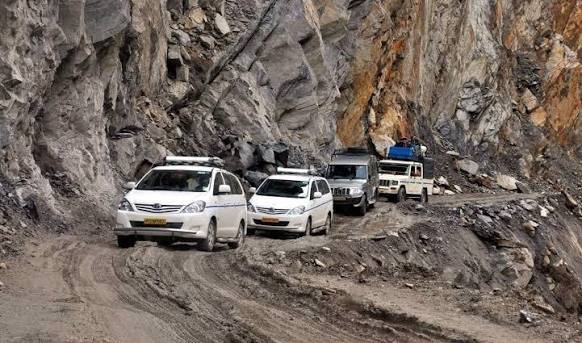
Both occurred in mountainous terrain where a vehicle leaving the road can have consequences far more severe than a conventional collision.
The Gorge Is Sometimes Only a Few Metres Away
This is one of the defining characteristics of mountain-road safety.
On a relatively flat road, a vehicle that loses control may collide with another vehicle, a barrier or roadside object.
On a mountain road, the same loss of control can mean a fall down a steep slope, into a gorge or into a river.
That changes the consequences of even a momentary error.
A skid.
A sudden obstruction.
A mechanical failure.
Excessive speed.
Poor visibility.
Driver fatigue.
A sharp bend taken incorrectly.
Any of these can become catastrophic when there is little room for recovery.
But it is important not to assume that any particular factor caused the Kupwara or Kathua crashes.
Investigations into both incidents remain necessary before responsibility can be assigned.
J&K Has a Road-Safety Problem Even as Accident Numbers Fall
There is an important contradiction in the numbers.
The overall number of reported road accidents in J&K has been declining.
Government figures show accidents falling from 6,120 in 2023 to 5,726 in 2024 and 5,287 in 2025, a decline of roughly 14 per cent over the three-year period. Authorities have linked the improvement to enforcement, awareness programmes, technology and other road-safety measures.
But fewer crashes do not mean the danger has disappeared.
The human cost remains high.
Data presented by the J&K Transport Department in January 2026 showed that since the Integrated Road Accident Database became operational in June 2022, 20,135 accidents involving 32,819 people had been recorded, resulting in 3,688 deaths and 29,131 grievous or minor injuries.
That means the road-safety conversation cannot stop at whether the number of accidents is rising or falling.
The more important questions are:
Where are crashes occurring?
Why are they occurring?
Why do some crashes become fatal?
And perhaps most importantly:
What can be changed before the next vehicle leaves the road?
Kathua Is Already Identified as a High-Risk Area
The government has previously identified the Jammu region as an important road-safety concern.
The J&K Road Safety Policy 2025 noted that 40 per cent of accidents in the data cited by the government occurred in Jammu, Udhampur, Samba and Kathua. The policy also set a target of reducing road accidents and fatalities by 50 per cent by 2030.
That makes the latest Kathua tragedy particularly significant.
It does not, by itself, establish that the Satasar stretch is a black spot or that road engineering caused Monday’s crash.
But it does reinforce why vulnerable locations need continuous examination.
A road-safety policy has value only when data from individual crashes eventually leads to action on individual roads.
The Problem Is Not Always the Road Alone
When a vehicle plunges into a gorge, public discussion often immediately turns towards the condition of the road.
That question is legitimate.
But road safety is rarely explained by one factor.
A safe mountain road requires several layers of protection.
The road must be properly engineered and maintained.
Dangerous curves need appropriate warning signs.
Vehicles need to be roadworthy.
Drivers need appropriate training and discipline.
Speed needs to be controlled.
Protective barriers need to be installed wherever the consequences of leaving the carriageway are severe.
And emergency services must be capable of reaching crash sites quickly.
If one part fails, the risk increases.
If several fail simultaneously, a survivable mistake can become a fatal accident.
The Barrier Question
Mountain roads bring a particularly important engineering question into the conversation:
What happens if a vehicle leaves the carriageway?
A crash barrier is not simply roadside decoration.
On a steep mountain road, it can be the final physical separation between a vehicle and a gorge.
But barriers also need to be appropriately designed, installed and maintained for the particular road geometry and hazard.
The answer cannot be to place barriers everywhere without engineering assessment.
Instead, vulnerable stretches need systematic identification and treatment.
The Road Safety Policy 2025 calls for District Road Safety Committees to identify accident-prone areas and black spots and undertake corrective measures.
The challenge is implementation.
Speed Remains a Major Factor
There is another uncomfortable part of the road-safety conversation: driver behaviour.
Data presented by the Transport Department in January showed that rash driving and speeding accounted for nearly half of the road mishaps reported during 2025, according to the analysis presented at a government road-safety review meeting.
National-level data also repeatedly identifies over-speeding as a major contributor to road crashes.
On mountain roads, speed has an additional consequence.
A driver travelling too fast has less time to react to a sudden bend, loose material, another vehicle, a pedestrian, an animal or an unexpected obstruction.
The difference between recovering from a mistake and losing control can sometimes be only a few seconds.
Enforcement Has Increased
J&K’s authorities have not ignored the problem.
The government says enforcement has become increasingly technology-driven.
In 2025, authorities issued more than 52,000 e-challans, seized 1,528 vehicles, suspended 1,641 driving licences, blacklisted more than 10,000 vehicles and cancelled 1,192 registration certificates, according to figures reported by officials.
Traffic enforcement has also been strengthened with interceptor vehicles, highway patrol vehicles, body-worn cameras, breath analysers and other equipment.
These are important measures.
But enforcement has a limitation.
A challan issued after a violation does not undo a crash.
The most effective road-safety intervention is the one that prevents the dangerous behaviour or road condition from becoming an accident in the first place.
What Happens After a Vehicle Falls Into a Gorge?
The first challenge is simply finding and reaching the vehicle.
The second is extracting people from the wreckage.
The third is getting injured passengers to medical care.
Mountain terrain makes every stage more difficult.
In the Kathua accident, rescue teams required several hours to recover the two bodies from the deep gorge.
In Kupwara, rescue teams and local volunteers responded after the vehicle entered the Kishanganga River, while injured passengers were moved to health facilities.
This is where local emergency-response capacity becomes part of road safety.
A region does not become safer merely because crashes are prevented.
It also becomes safer when survivors of unavoidable crashes can receive help quickly.
The Last Mile of Healthcare Matters
For a person with severe trauma, time can determine survival.
This is particularly important in remote mountainous districts.
A crash may happen far from a major hospital.
Ambulances may have to negotiate the same difficult roads.
Rescue personnel may first need to reach a vehicle at the bottom of a gorge.
Weather can complicate the operation.
And specialised trauma care may not be immediately available nearby.
This makes the relationship between road safety and healthcare infrastructure impossible to ignore.
Prevention remains the priority.
But when prevention fails, the emergency medical chain becomes the second line of defence.
The Data Has Another Message: Location Matters
The Transport Department’s iRAD analysis found that a large share of accidents and fatalities occurred on major highways, particularly in Jammu, Kathua, Udhampur and Rajouri. It also found that many accidents occurred between 3 pm and 9 pm, while speeding and rash driving were prominent contributors in 2025.
That information can be more useful than simply counting accidents across the entire Union Territory.
If authorities know where crashes are concentrated, they can focus resources.
If they know when crashes are concentrated, enforcement can be targeted.
If they know why crashes occur, engineering and behavioural interventions can be designed accordingly.
This is the basic principle of evidence-led road safety:
Do not wait for another death to identify a dangerous road.
A Decline in Accidents Must Not Become Complacency
The decline from 6,120 accidents in 2023 to 5,287 in 2025 is encouraging.
But road safety is not a competition to produce a smaller number each year.
Even one preventable death is significant to the family involved.
The government itself has acknowledged the scale of the challenge through the Road Safety Policy 2025, which seeks a 50 per cent reduction in both accidents and fatalities by 2030.
That target requires more than enforcement drives.
It requires road engineering, vehicle fitness, driver education, data analysis, emergency response and accountability to operate together.
The Question of Vehicle Fitness
Mountain roads also put greater demands on vehicles.
Brakes, tyres, steering systems and other mechanical components become particularly important when vehicles operate on steep gradients and winding roads.
Authorities have increased inspections and enforcement.
The government has also reported inspections of driving-training schools and checks relating to vehicle fitness and speed-limiting devices.
But the responsibility cannot rest entirely with inspectors.
Vehicle owners and operators also have a basic obligation to ensure that vehicles used to carry people are properly maintained.
A mechanically unsafe vehicle on a difficult mountain road can become a lethal combination.
The Human Cost Is Larger Than the Accident Report
Seven deaths in two separate crashes are not simply numbers in a daily news bulletin.
They represent families.
They represent children who may have lost parents.
Parents who may have lost sons.
Wives, husbands, brothers and sisters who may never see a loved one return home.
The language of road accidents can become strangely routine because such incidents are reported so frequently.
“Vehicle skidded.”
“Car plunged.”
“Bus overturned.”
“Two killed.”
“Five injured.”
But every such line represents an actual family receiving devastating news.
That is why road safety deserves to be treated as a public-health and governance issue rather than merely a traffic-policing issue.
The Road-Safety Conversation Needs to Move From Reaction to Prevention
After every major crash, rescue teams respond.
Officials issue condolences.
Investigations are ordered.
The injured are taken to hospitals.
The news cycle moves on.
The more difficult task begins afterwards.
Was the location already known to be dangerous?
Was the road properly protected?
Were warning signs adequate?
Was the vehicle fit?
Was the driver speeding?
Was there a visibility problem?
Could the crash have been prevented?
Could the consequences have been reduced?
Those questions need answers even when the headlines have disappeared.
What J&K Needs Is a Culture of Safer Travel
Road safety ultimately depends on a culture.
Drivers need to understand that mountain roads cannot be treated like urban highways.
Passengers need to understand that refusing unsafe driving is not an inconvenience.
Vehicle operators need to maintain their vehicles.
Road agencies need to treat protective infrastructure as essential.
Traffic authorities need to enforce rules consistently.
And government departments need to share data instead of working in isolation.
Technology can help.
GIS-based mapping can identify dangerous stretches.
Crash databases can reveal patterns.
Cameras can strengthen enforcement.
E-challans can improve accountability.
But technology cannot replace judgment.
Nor can it replace a properly engineered road.
Two Accidents Should Not Become Two Forgotten Stories
The deaths in Karnah and Kathua happened on different roads and involved different vehicles.
The investigations will determine the specific causes.
But the larger lesson is shared.
Jammu and Kashmir’s mountainous geography makes road travel essential and inherently challenging.
That reality cannot be changed.
What can be changed is how much risk society accepts.
The government has already acknowledged the problem, introduced a Road Safety Policy, strengthened enforcement and reported a decline in accident numbers.
The next step is to make sure that these measures reach the stretches where people are most vulnerable.
Because for a family travelling through Karnah, Kathua, Udhampur, Rajouri, Doda, Kishtwar or any other mountain district, road safety is not an abstract policy.
It is the difference between reaching home and receiving a phone call that changes a family forever.
The goal should not merely be fewer accidents on paper.
The goal should be fewer families mourning someone who never made it home.