Mehbooba Defies FIR, Tells PDP Workers to Stay the Course on Article 370; Omar Calls Iltija Row a ‘Fixed Match’
By: Javid Amin | 07 Aug 2026
Srinagar: The political confrontation between the People’s Democratic Party (PDP) and the administration over the August 5 Article 370 protests has taken another turn, with PDP president Mehbooba Mufti urging party workers to remain committed to the political path laid down by the party’s founder even if she and her daughter, PDP leader Iltija Mufti, are jailed.
The message came a day after police questioned Iltija Mufti in connection with an FIR registered following a confrontation between PDP protesters and police in Srinagar.
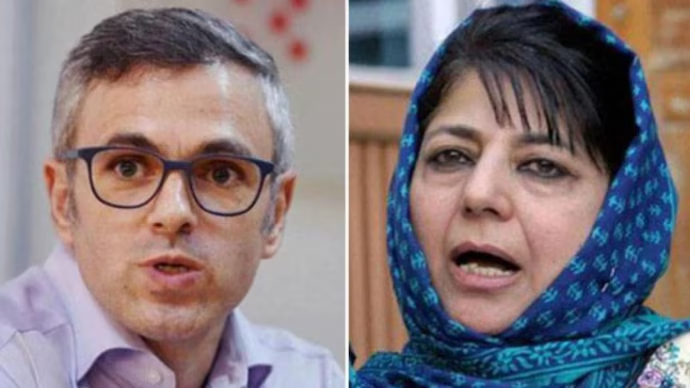
At the same time, Jammu and Kashmir Chief Minister Omar Abdullah sharply criticised the PDP’s handling of the controversy, describing the FIR episode as a “fixed match” and alleging that agencies were being used to help restore the party’s political credibility.
The exchange has widened an already significant political divide in Jammu and Kashmir. While the PDP and National Conference both oppose the political legacy of the August 5, 2019 changes, their competing approaches—and increasingly sharp attacks on each other—show that the opposition space in the Valley remains far from united.
Mehbooba’s Message to PDP Cadres: Do Not Lose Focus
Addressing party workers amid the continuing controversy over the FIR, Mehbooba Mufti delivered a message centred on political resilience.
She urged PDP cadres to remain committed to the party’s founding political vision and said the movement should not depend on whether its senior leadership remains outside prison.
The message was particularly significant because it came amid the legal proceedings involving Iltija Mufti.
The former chief minister indicated that even if she and her daughter were imprisoned, the PDP’s political campaign should continue.
The emphasis was clear: the party’s struggle, in Mehbooba’s framing, is larger than any individual leader.
Recent reporting from the region also confirms that the PDP leadership continues to place restoration of Article 370 and Jammu & Kashmir’s special status at the centre of its political programme.
Iltija Mufti: “Our Fight Is for Article 370, Not Statehood”
The same message was reinforced by Iltija Mufti after she appeared before police at Kothi Bagh Police Station in Srinagar on August 7.
Speaking to reporters after cooperating with the investigation, Iltija said the PDP would continue its “peaceful battle” for restoration of Article 370 and Jammu & Kashmir’s special status.
She specifically distinguished the PDP’s position from the statehood-focused approach of other political parties.
According to Iltija, the PDP does not intend to reduce its political demand to restoration of statehood.
She said the party would continue to seek restoration of:
- Article 370
- Jammu & Kashmir’s special status
- The former J&K Constitution
- The former J&K state flag
She also said she was prepared to face imprisonment if necessary, while insisting that the campaign would remain peaceful.
That statement gives the PDP’s current strategy a sharper ideological edge: statehood may be an issue for other parties, but Article 370 remains the PDP’s defining demand.
Why the FIR Became a Political Flashpoint
The controversy began with the PDP’s August 4 candlelight protest outside its Srinagar headquarters.
Police subsequently registered FIR No. 63/2026 at Kothibagh Police Station, naming Iltija Mufti and Mehbooba Mufti.
The FIR invokes Sections 132, 121 and 191(2) of the Bharatiya Nyaya Sanhita (BNS), relating broadly to assault or criminal force against a public servant, causing hurt to deter a public servant from duty, and rioting.
Police allege that Iltija assaulted an officer during the confrontation and grabbed and bit his forearm, causing injuries.
The PDP has rejected that account and accused police personnel of manhandling Iltija during the protest.
The party has said that Iltija was dragged by police personnel and subsequently required hospital treatment. It has also indicated that it intends to take the matter before a court.
The competing versions remain central to the controversy.
An FIR is a starting point for investigation, not a judicial finding of guilt.
Omar Abdullah Calls It a “Fixed Match”
The controversy took an unexpected political turn when Chief Minister Omar Abdullah was asked about the case.
Rather than treating the FIR simply as a police matter, Abdullah launched a broader political attack on the PDP.
He described the episode as a “fixed match”, alleging that agencies were attempting to revive the PDP’s credibility after the party came under criticism over an earlier controversial remark by Mehbooba Mufti.
Abdullah questioned the police allegation that Iltija had bitten an officer, asking rhetorically whether she was a young child who could be expected to behave in such a manner.
He went further, alleging that the PDP itself had been created by agencies and that whenever its political image weakened, those same agencies attempted to restore its credibility.
These are Omar Abdullah’s political allegations, not established facts.
No evidence has been publicly established proving that the FIR was orchestrated as part of an agency-backed plan.
What Is Behind Omar’s “Fixed Match” Remark?
Omar’s comments were not limited to the FIR itself.
According to his remarks reported on August 7, he linked the latest controversy to criticism surrounding Mehbooba Mufti’s earlier “banta hai” remark concerning pellet guns.
Mehbooba had subsequently apologised and clarified the wording of her statement.
Omar argued that the controversy surrounding Iltija’s FIR could shift public attention away from that episode and help the PDP recover politically.
His argument therefore has two layers:
First, he questioned the credibility of the police allegation against Iltija.
Second, he suggested that the controversy itself was serving a political purpose by bringing the PDP back into public attention.
That interpretation has been strongly rejected by the PDP.
PDP and NC: United on Article 370, Divided on Politics
The latest exchange exposes an important contradiction in Jammu and Kashmir’s opposition politics.
The NC and PDP broadly oppose the constitutional changes introduced on August 5, 2019, but they are not political allies operating with a single strategy.
The National Conference has increasingly prioritised restoration of statehood, while continuing to maintain its broader opposition to the 2019 changes.
The PDP insists that Article 370 and special status must remain the primary political demand.
Iltija Mufti made that distinction particularly clear after appearing before police.
She said the BJP talks about statehood and the NC also talks about statehood, while the PDP would continue its campaign until special status, the former flag and the former Constitution are restored.
That difference has become increasingly visible.
The Emerging Political Divide
| Issue | PDP | NC |
|---|---|---|
| Article 370 | Central political demand | Continues to oppose the 2019 changes |
| Statehood | Not sufficient by itself | Immediate political priority |
| Strategy | Peaceful mobilisation and political campaign | Institutional, constitutional and political avenues |
| August 5 | Day of mourning/protest | Opposition to 2019 changes, with statehood emphasis |
| Current Political Attack | Says PDP is being targeted | Omar questions PDP’s credibility |
The differences do not mean the parties agree with the 2019 changes.
Instead, they reflect different political calculations about what should be prioritised and how the opposition should position itself.
Mehbooba’s “Even If We Go to Jail” Message Has a Larger Political Meaning
The jail reference is politically significant because detention has deep historical resonance in Kashmir’s post-2019 politics.
After the abrogation of Article 370, several prominent regional leaders—including Mehbooba Mufti, Omar Abdullah and Farooq Abdullah—were detained.
That history gives Mehbooba’s latest statement additional political weight.
By telling party workers that the struggle should continue even if she and Iltija are jailed, she is attempting to present the current confrontation as part of a longer political struggle rather than an isolated police case.
It also serves an organisational purpose.
A political party facing legal pressure can suffer from uncertainty among its cadres. Mehbooba’s message seeks to eliminate that uncertainty by telling workers that the leadership’s legal troubles should not interrupt the party’s political campaign.
Iltija’s Police Appearance Adds to the Political Narrative
Iltija’s decision to appear before police rather than avoid the investigation has also become part of the PDP’s messaging.
After cooperating with investigators, she reiterated that she was prepared to continue the campaign peacefully.
Her statement that she was willing to go to jail reinforces the narrative being constructed by the PDP: that its leaders are prepared to accept legal consequences while continuing to challenge the constitutional changes of 2019.
At the same time, police maintain that the FIR concerns alleged conduct during a protest and is being investigated under the law.
The two narratives are therefore fundamentally different:
PDP: political repression and suppression of dissent.
Police: enforcement of law and accountability for alleged obstruction and assault.
The evidence gathered during the investigation will be crucial in determining what actually occurred during the confrontation.
Article 370 Remains the Common Political Fault Line
Despite their rivalry, both the NC and PDP continue to operate within the larger political debate created by August 5, 2019.
The Supreme Court’s December 2023 judgment upheld the Union government’s decision relating to Article 370 while directing that statehood be restored to Jammu and Kashmir.
The legal position and political position are therefore now operating on two different tracks.
The constitutional question has been adjudicated by the Supreme Court.
The political demand for restoration remains active among regional parties.
That distinction is critical to understanding the current debate.
The PDP’s campaign is not simply a legal challenge. It is a political movement seeking to keep Article 370 alive as a central issue in Kashmir’s democratic discourse.
Why the NC-PDP Rift Matters
The growing rivalry between the two parties could have consequences beyond their immediate political exchanges.
A united opposition would potentially have greater political visibility when raising issues such as:
- Article 370
- Statehood
- Civil liberties
- Political detainees
- Security restrictions
- Centre-J&K relations
But public disagreements make a coordinated campaign more difficult.
Omar Abdullah’s dismissal of the FIR controversy as a “fixed match” is therefore more than criticism of Mehbooba Mufti.
It reflects a deeper contest over who speaks for the opposition in Jammu and Kashmir.
The NC, as the ruling party in the Union Territory, has a fundamentally different political position from the PDP, which is attempting to rebuild itself as a strong opposition force.
PDP’s Political Survival Is Also Part of the Story
The latest confrontation has another dimension: the PDP’s struggle to remain politically relevant.
The party suffered a major setback in the 2024 Jammu and Kashmir Assembly elections, where it won only a small number of seats compared with its earlier political influence.
Since then, Mehbooba Mufti and Iltija Mufti have attempted to keep Article 370 and special status central to the PDP’s political identity.
The latest confrontation has unexpectedly pushed the party back into the national spotlight.
Whether that translates into sustained political support is a different question.
For the PDP, visibility is useful—but sustained relevance ultimately depends on whether it can convert symbolic opposition into broader public and electoral support.
What Happens Next?
Several developments will determine how this political confrontation evolves.
1. Police Investigation
The investigation into the allegations against Iltija and other PDP leaders will remain the immediate legal issue.
2. Possible Court Proceedings
If the investigation leads to further legal action, the competing accounts of the confrontation could eventually be tested before a court.
3. PDP Mobilisation
Mehbooba’s latest message suggests the party has no intention of abandoning its Article 370 campaign.
4. NC-PDP Political Competition
Omar’s remarks indicate that the rivalry between the two parties is likely to continue, even on issues where they broadly oppose the 2019 constitutional changes.
5. Article 370 Debate
The PDP’s renewed emphasis on Article 370 ensures that the issue will remain part of Jammu and Kashmir’s political conversation.
Outlook: A Legal Case Becomes a Larger Political Battle
The latest developments show how quickly a police case can become politically significant in Jammu and Kashmir.
For Mehbooba Mufti, the FIR involving her and Iltija has become an opportunity to reinforce a message of political resilience and tell PDP workers that the party’s campaign must continue regardless of pressure.
For Iltija, the police investigation has become another platform to reaffirm that Article 370—not merely statehood—remains the PDP’s core demand.
For Omar Abdullah, the controversy represents something very different: an alleged effort to revive a PDP whose political credibility, in his assessment, has weakened. His “fixed match” allegation has added another layer to an already bitter political contest.
The result is a striking paradox in Jammu and Kashmir politics.
The NC and PDP remain broadly opposed to the political legacy of August 5, 2019, yet they are increasingly competing with each other over who should lead that opposition.
That rivalry could prove just as important as the Article 370 issue itself in shaping the next phase of J&K politics.