Mehbooba Mufti’s Upside-Down Tricolour Sparks Fresh Row on August 5; Authorities Examine Legal Action
By: News Desk | 05 Aug 2025
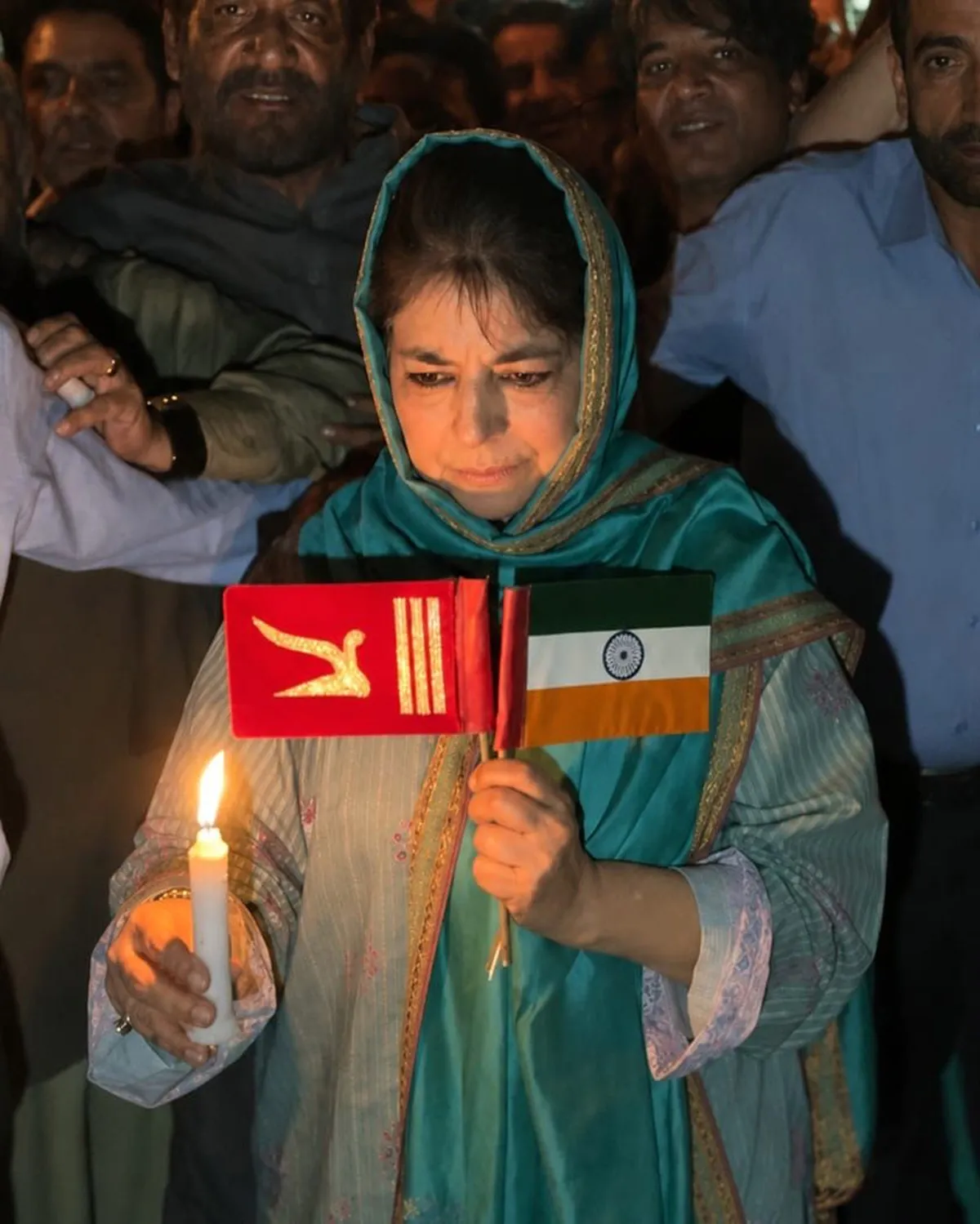
Srinagar: People’s Democratic Party (PDP) president and former Jammu & Kashmir Chief Minister Mehbooba Mufti has found herself at the centre of a fresh political controversy after she was photographed holding the Indian National Flag in an inverted position during a candlelight sit-in held on August 5, the anniversary of the abrogation of Article 370.
The incident, which quickly went viral across social media platforms, has intensified an already charged political atmosphere in Jammu and Kashmir. Officials have confirmed that they are examining the circumstances surrounding the display of the Tricolour and are assessing whether any legal provisions relating to the National Flag were violated. As of publication, no FIR or formal charges have been publicly announced.
The controversy unfolded during protests organised by the PDP to mark what the party describes as a “Black Day” following the constitutional changes introduced on August 5, 2019, when the Centre revoked the special status of the erstwhile state under Article 370 and reorganised Jammu & Kashmir into two Union Territories.
Candlelight Sit-In Turns Into Political Flashpoint
The protest was organised by the PDP in Srinagar despite restrictions imposed by the administration on public demonstrations.
Visuals from the sit-in show Mehbooba Mufti seated alongside party workers holding two separate flags:
- The Indian National Flag (Tricolour).
- The former Jammu & Kashmir State Flag, identifiable by its red background and plough emblem.
However, the Tricolour appeared to be held upside down, with the green band positioned above the saffron band, contrary to the prescribed display under the Flag Code of India.
Within minutes of the images surfacing online, political leaders, social media users and several commentators questioned whether the display amounted to disrespect towards the National Flag or whether it was an inadvertent mistake.
The photograph soon became one of the most discussed political images of the day.
Authorities Examine Whether Legal Action Is Warranted
Government officials have stated that the incident is under examination.
According to officials quoted by multiple media organisations, authorities are assessing whether the manner in which the National Flag was displayed attracts provisions under the Prevention of Insults to National Honour Act, 1971, or any applicable provisions of the Flag Code of India.
Importantly, there has been no official announcement of criminal charges or registration of an FIR at the time of writing.
Legal experts point out that any prosecution under the Prevention of Insults to National Honour Act generally requires examination of the facts and circumstances, including whether there was intentional disrespect or deliberate misuse of the National Flag.
Consequently, the outcome will depend on the findings of the authorities rather than public perception alone.
What Does the Flag Code Say?
India’s National Flag is governed by the Flag Code of India, 2002, together with the Prevention of Insults to National Honour Act, 1971.
The Flag Code prescribes the proper manner of displaying the Tricolour.
The flag should always be displayed with:
- Saffron at the top
- White in the middle with the Ashoka Chakra
- Green at the bottom
Displaying the National Flag upside down is generally regarded as improper unless the specific context is examined under applicable law.
However, the Flag Code itself is distinct from criminal law.
Whether an incident amounts to a punishable offence depends upon the circumstances and applicable legal provisions.
This distinction is important because social media debate often treats every irregular display as automatically constituting a criminal offence, which is not necessarily the legal position.
PDP’s Protest and the Political Context
The controversy unfolded during a politically significant day in Jammu and Kashmir.
August 5 marks the anniversary of the Centre’s decision in 2019 to revoke Article 370 and Article 35A, ending Jammu & Kashmir’s special constitutional status.
For the BJP and the Union government, the decision is presented as a landmark step towards national integration, uniform application of laws and accelerated development.
The PDP, however, continues to oppose the move and argues that it represented the removal of constitutional safeguards guaranteed to the people of Jammu & Kashmir.
During the August 5 observance, Mehbooba Mufti reiterated the party’s long-standing demand for the restoration of Article 370 and Article 35A, while describing the anniversary as a day of constitutional loss.
The candlelight sit-in formed part of the PDP’s broader political campaign centred on these demands.
Social Media Amplifies the Controversy
The photograph rapidly spread across X, Facebook, Instagram and WhatsApp groups, generating sharply divided reactions.
Critics accused Mehbooba Mufti of disrespecting the National Flag and questioned whether the act reflected the message the protest intended to convey.
Supporters, on the other hand, argued that the focus should remain on the political issues raised during the protest and suggested that the flag’s orientation may not have been deliberate.
At the time of publication, neither the PDP nor Mehbooba Mufti had issued a detailed public clarification specifically addressing the flag’s orientation.
The absence of an immediate explanation further fuelled online speculation.
Political Reactions Expected to Intensify
The incident is likely to become another point of confrontation between the BJP and opposition parties.
The BJP has consistently portrayed respect for the National Flag as a matter of national pride and constitutional responsibility.
Opposition parties, meanwhile, have focused their August 5 messaging on Article 370, statehood, civil liberties and democratic rights.
The latest controversy risks shifting the public conversation away from constitutional issues and towards symbolism surrounding the National Flag.
Political observers believe rival parties are likely to use the incident to reinforce their respective narratives in the days ahead.
Symbolism Takes Centre Stage
The controversy also highlights the power of political symbolism in Jammu & Kashmir.
For the PDP, August 5 represents what it considers the loss of constitutional guarantees and regional autonomy.
For the BJP, the same date symbolises national unity and the completion of constitutional integration.
The presence of both the former Jammu & Kashmir State Flag and the Indian National Flag in the same protest image has added another symbolic layer to an already polarised political debate.
The inverted display of the Tricolour has now become the dominant visual associated with the protest, overshadowing much of the political messaging the PDP intended to convey.
Could There Be Legal Consequences?
Whether the controversy results in legal proceedings will depend on the findings of the authorities.
Officials are expected to examine:
- Whether the flag was intentionally held upside down.
- Whether the act falls within the scope of the Prevention of Insults to National Honour Act.
- Whether there was any deliberate intention to insult or disrespect the National Flag.
- Whether the circumstances indicate an accidental or inadvertent display.
Until any formal action is initiated, it would be premature to conclude that any law has been violated.
The legal process, if pursued, will determine whether further action is warranted.
A Politically Sensitive Anniversary
The controversy comes against the backdrop of heightened security across Jammu & Kashmir for the August 5 anniversary.
Authorities had already restricted public demonstrations in several areas, citing concerns over law and order.
Regional political parties, including the PDP, National Conference, Apni Party and others, had announced programmes to mark the anniversary, each presenting its own interpretation of the constitutional changes introduced in 2019.
Against this backdrop, the flag controversy has added a fresh dimension to an already sensitive political day.
Outlook: Legal Scrutiny and Political Fallout
The controversy surrounding Mehbooba Mufti’s display of the National Flag is likely to remain in the spotlight over the coming days.
If authorities decide to initiate legal proceedings, the issue could acquire greater political significance and further sharpen the debate between the ruling BJP and opposition parties in Jammu & Kashmir.
Conversely, if officials conclude that the incident resulted from an inadvertent error rather than deliberate disrespect, the controversy may gradually subside, although its political impact is likely to persist.
For now, one thing is clear: a single photograph has transformed a protest over Article 370 into a wider national debate over political symbolism, the National Flag and the limits of protest politics.
As the legal examination continues, the incident serves as a reminder that in today’s digital age, powerful images often shape public discourse as much as political speeches themselves.
Editorial Note: This report is based on verified photographs, official statements indicating that the matter is under examination, and published media reports. At the time of publication, no court has determined that Mehbooba Mufti committed any offence, and no official announcement of criminal charges has been made. Any legal conclusions will depend on the findings of the competent authorities.